For many first-time visitors, traveling to South Korea has traditionally meant one place above all:
Seoul.
Gyeongbokgung Palace, Myeongdong, Hongdae, Gangnam and the Han River still deserve their place on a first Korea itinerary.
But something is changing.
More international travelers are beginning to look beyond Seoul.
Some are heading south to Busan, where a major coastal city offers beaches, seafood, nightlife and urban energy.
Others are beginning to discover a very different Korea along the country’s western and southwestern coast — a landscape of tidal flats, islands, fishing villages, spectacular sunsets and some of Korea’s most interesting seafood.
If Busan represents Korea’s energetic seaside city life, the west coast offers something quieter.
And perhaps more unexpected.
Busan Is No Longer Just a Side Trip from Seoul
The numbers coming from Busan are remarkable.
From January through July 2026, approximately 2.93 million international visitors traveled to Busan, according to the city.
That was a 46.1% increase compared with the same period a year earlier.
Busan also reported that roughly one in four international visitors to Korea visited the city during that period.
Even more interesting is what happened to travelers arriving through Gimhae International Airport.
During the first half of 2026, about 98% of foreign arrivals through the airport stayed in Busan or the surrounding southeastern region rather than immediately moving toward the Seoul metropolitan area.
That suggests an important shift.
For some travelers, Busan is becoming a destination in its own right rather than simply an extra stop after Seoul.
But There Is Another Side of Coastal Korea
Busan is relatively easy for international visitors to understand.
It has skyscrapers, famous beaches, huge seafood markets and excellent public transportation.
Korea’s west coast is different.
This is not necessarily where you go for a checklist of famous attractions.
You go there to slow down.
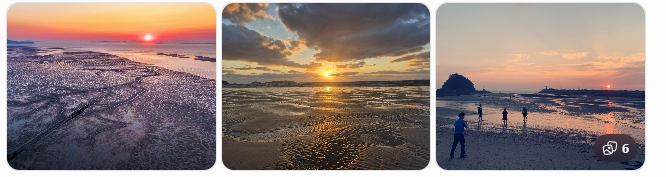
Much of Korea’s western coastline faces the Yellow Sea, where dramatic tides expose enormous tidal flats known in Korean as getbol (갯벌).
At low tide, the sea can appear to retreat far into the distance.
What remains is a vast landscape of mud, shallow water and tiny marine creatures.
Then the tide returns and the landscape changes again.
For someone who has only seen Seoul’s dense streets and high-rise buildings, it can feel like discovering another country.
Korea’s Tidal Flats Are a UNESCO World Heritage Site
These mudflats are not simply empty stretches of mud.
They are among Korea’s most valuable natural ecosystems.
UNESCO’s Getbol, Korean Tidal Flats World Heritage property includes tidal-flat ecosystems along Korea’s western, southwestern and southern coasts.
Originally inscribed in 2021, the World Heritage property was expanded in 2026.
UNESCO records thousands of plant and animal species in these coastal wetlands, which also provide vital habitats for migratory birds.
Places including Seocheon, Gochang and Shinan are part of this extraordinary coastal ecosystem.
But for travelers, there is another reason getbol is fascinating:
You don’t always have to admire it from a distance.
You can actually walk into it.
Don’t Just Look at the Mudflat — Step Into It
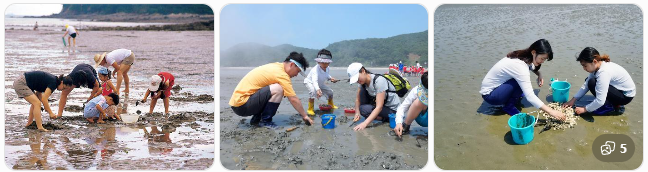
One of the most memorable west-coast experiences is a Korean tidal-flat activity.
Put on rubber boots, walk onto the mudflat at low tide and you may be able to dig for clams and discover small creatures living beneath the surface.
For Korean families, experiences like these have long been a familiar form of coastal recreation.
For an international traveler, however, it can feel completely different from conventional sightseeing.
You are not looking at Korea through a bus window.
You are standing ankle-deep in it.
And after seeing where shellfish actually live, the seafood you eat later that day suddenly has a story behind it.
Yes, Koreans Even Turn Mud Into a Festival
If the idea of getting covered in mud sounds fun rather than frightening, there is one west-coast destination you should know:
Boryeong.
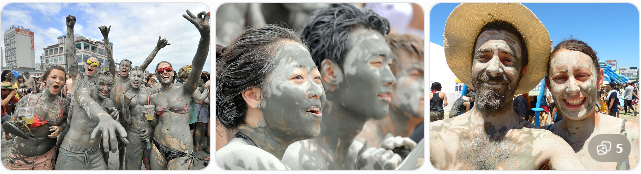
The Boryeong Mud Festival has become one of Korea’s best-known international summer festivals.
Visitors slide through mud, play in mud zones, paint themselves with mud and participate in mud beauty-care experiences.
It is one of those rare travel experiences where getting completely dirty is the entire point.
There is an important distinction, however.
The organized mud used for festival and beauty experiences should not be confused with simply scooping random mud from a natural tidal flat and applying it to your skin.
If you want the famous Korean “mud on your face” photo, an organized mud experience such as Boryeong is the better choice.
Then Comes the Best Part: Eating
For me, this is where Korea’s west coast becomes especially interesting.
The tidal flats are not separate from Korean food culture.
They helped create it.
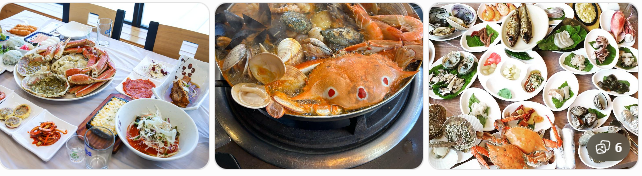
Depending on where you travel and the season, western coastal regions are famous for foods involving clams, oysters, shrimp, blue crab, octopus and other seafood.
In some coastal areas, the experience can become a complete journey:
Walk across the tidal flat. Experience the fishing village. See where seafood comes from. Watch the sunset. Then eat local seafood nearby.
That is very different from ordering seafood in the middle of Seoul.
The food becomes connected to the landscape.
The West Coast Sunset Is Different
There is another reason Koreans travel west.
Sunset.
Because the western coast faces the Yellow Sea, there are countless places where the sun appears to fall directly toward the ocean.
But it is not only the sunset itself.
The combination of shallow water, exposed tidal flats, small islands and fishing boats can create incredibly quiet and almost poetic landscapes.
At low tide, pools of water left across the mudflat can reflect the evening sky.
Fishing villages slowly turn into silhouettes.
The sky changes from gold to orange and finally deep red.
Busan can be exciting.
The west coast can be emotional.
[IMAGE: Dramatic red-orange sunset reflected across a Korean tidal flat]
And the Food Changes as You Travel
Another mistake visitors sometimes make is thinking of “Korean food” as one cuisine that tastes roughly the same everywhere.
Travel outside Seoul and that idea quickly disappears.
Coastal food changes according to geography, season and what local fishermen bring ashore.
Different areas of Korea’s western and southwestern coast have their own relationships with shellfish, crab, shrimp, octopus, oysters, fermented seafood and countless local dishes.
This is one of the reasons I believe food is one of the best ways to travel through Korea.
Don’t only ask:
“What Korean food should I eat?”
Ask:
“What do people eat here?”
That one question can completely change your trip.
Busan or the West Coast?
You don’t necessarily have to choose.
They offer two very different versions of coastal Korea.
Choose Busan if you want a major city, famous beaches, nightlife, markets and excellent seafood with the convenience of an urban destination.
Explore the west coast if you want tidal flats, fishing villages, islands, sunsets, seafood experiences and a slower journey through Korea.
And if you have enough time?
Experience both.
The Korea Beyond Seoul Is Much Bigger Than Most Visitors Realize
Seoul is extraordinary.
But Seoul is not Korea.
The country changes remarkably quickly once you leave the capital.
Travel south and you can find the energy of Busan.
Travel west and the cityscape gives way to tidal flats, fishing villages and sunsets.
Go farther along the southwestern coast and you encounter islands, wetlands and regional food cultures that many international visitors still know very little about.
Perhaps the next stage of Korean tourism will not be about discovering another neighborhood in Seoul.
It will be about discovering another Korea outside Seoul.
And sometimes, the best way to discover it is simple:
Take off your city shoes.
Put on a pair of rubber boots.
Walk onto the tidal flat.
Watch the sun go down.
And then find out what the fishermen caught that day.
For years, one store has dominated the shopping lists of beauty-loving tourists visiting South Korea:
Olive Young.
Walk through Myeongdong or Hongdae and you will see international visitors filling baskets with Korean sunscreens, masks, serums and cleansers.
But something interesting is happening in Korea in 2026.
Some tourists are adding a completely different stop to their K-beauty shopping route:
the Korean pharmacy.
Foreign spending at Korean pharmacies has surged, tourist-oriented pharmacies are appearing in major shopping districts, and travelers on Reddit are increasingly asking what skincare products they should buy from Korean pharmacies.
So why are tourists suddenly going to pharmacies for beauty products?
Korean Pharmacies Are Becoming Part of the K-Beauty Trip
This is no longer just a niche trend.
According to Korean tourism-industry data reported by The Korea Times, foreign visitors’ spending at Korean pharmacies in May 2026 increased 206.1% from a year earlier.
The trend is especially visible in Myeongdong, one of Seoul’s busiest tourist districts.
At some pharmacies catering heavily to international visitors, foreigners reportedly account for more than 90% of sales.
That is an extraordinary change.
A pharmacy used to be somewhere tourists visited because they were sick.
Now, for some travelers, it is becoming another stop on the Korean shopping itinerary.
Reddit Shows What Tourists Are Actually Asking
The interesting part is what travelers are talking about online.
In Korea travel and beauty communities on Reddit, visitors ask questions such as:
What skincare products are worth buying at a Korean pharmacy?
Are Myeongdong pharmacies overpriced?
What should I buy at a pharmacy that I cannot easily find at Olive Young?
Discussions frequently move toward products associated with skin barriers, pigmentation, acne care and ingredients such as PDRN.
That tells us something important.
These tourists are not simply looking for another place selling Korean cosmetics.
They are looking for products they perceive as being closer to Korean dermatology and pharmacy culture.
Olive Young and a Korean Pharmacy Are Not the Same Thing
This is probably the most important distinction for first-time visitors.
Olive Young is primarily a health and beauty retailer.
It is an excellent place to find:
Korean skincare brands
sunscreen
sheet masks
makeup
hair products
beauty devices
supplements
trending K-beauty products
A Korean pharmacy serves a different purpose.
It is first and foremost a pharmacy, where pharmacists dispense medicines and provide professional guidance.
Depending on the pharmacy, you may also find dermatological skincare products and other skin-related items that are less visible in mainstream beauty stores.
So it should not really be:
Olive Young vs. Korean pharmacy.
For many visitors, the better approach is:
Olive Young + Korean pharmacy.
They serve different needs.
Why Myeongdong Is at the Center of the Trend
If you visit Myeongdong today, the change is difficult to miss.
The neighborhood already attracts huge numbers of international shoppers because of its cosmetics stores, fashion shops, street food and department stores.
Pharmacies have increasingly adapted to those customers.
Some display information in multiple languages.
Some prominently show skincare-related products.
And some have become destinations that tourists intentionally search for rather than places they enter only when they need medicine.
This creates a fascinating new shopping route:
K-beauty store → pharmacy → skincare clinic → Korean food → more shopping.
Beauty and wellness are increasingly becoming part of the travel experience itself.
But Don’t Assume Everything at a Pharmacy Is a Cosmetic
This is where international visitors should be careful.
A product being popular on TikTok, Instagram or Reddit does not automatically mean it should be used like an ordinary cosmetic.
Korean pharmacies sell medicines as well as non-drug products.
Some products may have specific instructions, precautions or intended uses.
So rather than buying something simply because it has gone viral, ask the pharmacist:
What is this product for?
How should I use it?
How often should I use it?
And if you have allergies, sensitive skin, take other medications, or have a significant skin condition, mention that too.
The pharmacist is not just the person standing behind the counter.
Professional advice is one of the reasons to visit a pharmacy in the first place.
Are Tourist Pharmacies in Myeongdong More Expensive?
This question appears repeatedly among travelers.
And it is a reasonable one.
Pharmacy prices in Korea can vary depending on the product and store, particularly for non-prescription items.
A pharmacy in a major tourist district may not always offer the same price as a neighborhood pharmacy elsewhere in Seoul.
So if you plan to buy several skincare-related products, it can be worth checking prices rather than assuming every pharmacy charges exactly the same amount.
This is particularly important when social media turns one product into a must-buy item overnight.
Popularity can make tourists focus on the product before they even know what a reasonable price is.
Why This Trend Is Bigger Than Skincare
There is a larger story behind the pharmacy boom.
Korean tourism is changing.
Visitors are no longer coming only for palaces, shopping and Korean food.
Increasingly, they are interested in experiences connected to Korea’s beauty and wellness culture.
Korean skincare.
Dermatology.
Beauty treatments.
Health checkups.
And now pharmacies.
What began as global fascination with K-beauty is expanding into a broader curiosity about how Koreans actually manage beauty, skin and wellness in everyday life.
Should You Visit a Korean Pharmacy?
If you are traveling to Korea specifically because you love Korean skincare, the answer is:
It can definitely be worth visiting one.
But don’t go expecting a secret version of Olive Young.
Go because it is something different.
Visit Olive Young for the enormous world of mainstream Korean beauty.
Visit a Korean pharmacy if you want to explore another side of Korean skincare and speak with a pharmacist about products appropriate for your needs.
And don’t feel that you have to shop only in Myeongdong.
Sometimes an ordinary neighborhood pharmacy can be one of the most interesting places to experience everyday Korea.
That may be the most surprising part of this new travel trend.
One of Korea’s newest tourist shopping destinations was never designed to be a tourist attraction at all.
Maybe BLACKPINK, Stray Kids, SEVENTEEN, aespa, IVE or another artist you’ve followed from thousands of miles away.
The concert may last only a few hours.
But if you are flying all the way to South Korea, don’t make the concert your entire trip.
Make it the beginning.
K-pop fans are increasingly traveling to Korea not only to see their favorite artists, but to experience the country behind the music.
And for a first visit, there is one itinerary I recommend more than almost any other:
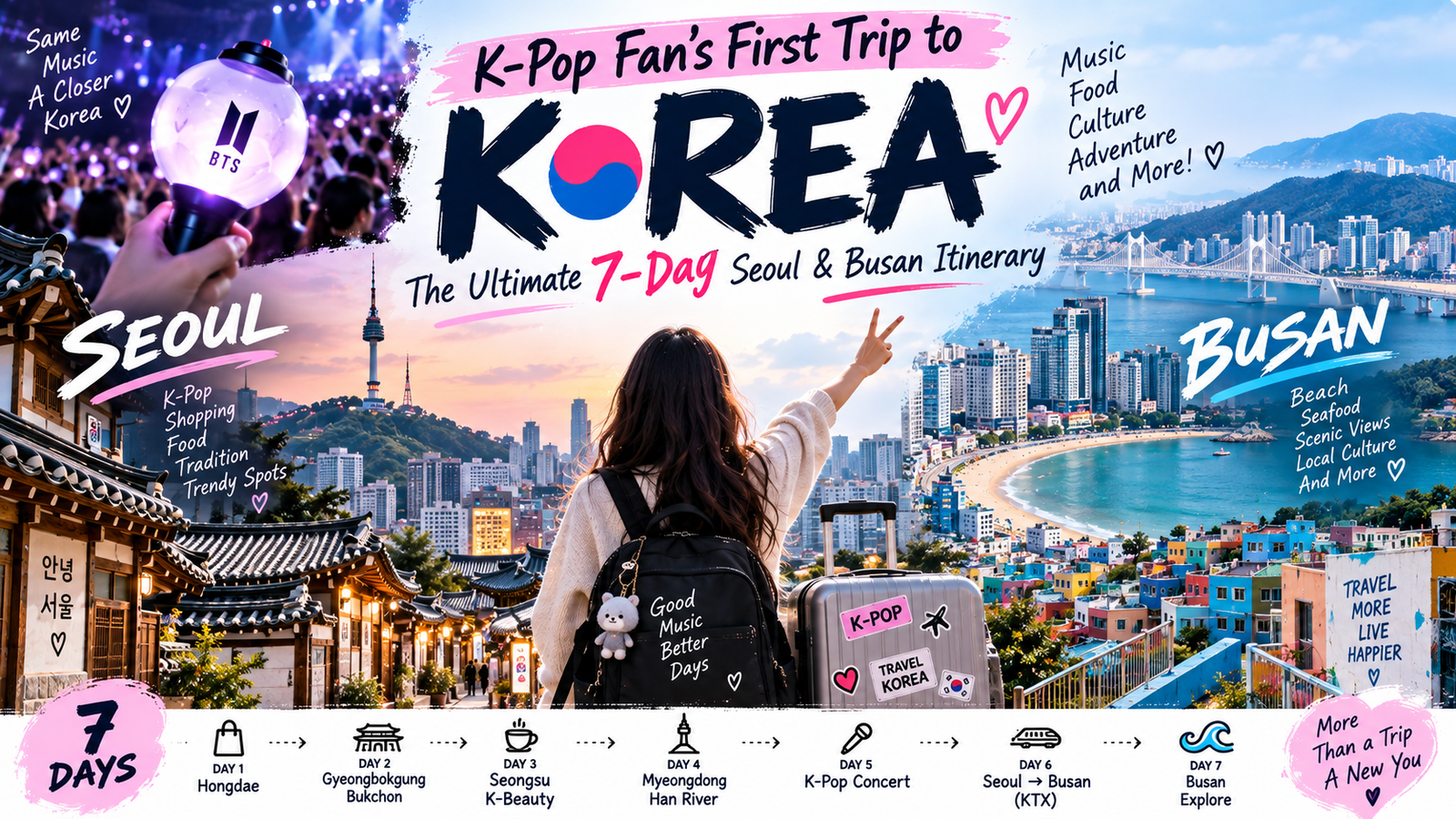
5 Days in Seoul + 2 Days in Busan
Seven days is long enough to experience modern Seoul, traditional Korea, K-pop culture, Korean food, K-beauty and the country’s most famous coastal city — without turning your vacation into an exhausting race between tourist attractions.
This itinerary is designed especially for a first-time international visitor to South Korea who loves K-pop.
You don’t need to spend seven days visiting idol-related locations.
Instead, we’ll use K-pop as the doorway and experience the Korea that exists beyond the concert.
Why 7 Days Is a Great First Korea Trip
You can technically visit Seoul in three or four days.
But if you are flying from North America, Europe or another long-distance destination, that can feel painfully short.
Seven days gives you time for:
K-pop
Korean food
K-beauty
traditional Korea
modern Seoul
shopping
the Han River
and
Busan
without changing hotels every night.
There is another advantage.
If your main reason for visiting Korea is a concert, arriving several days early gives you protection against flight delays.
Never schedule an international arrival only hours before a concert you spent months trying to attend.
For this itinerary, I would ideally place the concert around Day 4 or Day 5.
Before You Arrive: The Three Things You Need
Before discussing the itinerary, prepare three things.
1. A Transportation Card
Seoul’s subway and bus network makes traveling around the city relatively easy.
A rechargeable transportation card can be used across much of Korea’s public transit system.
You’ll use public transportation constantly, so this should be one of the first things you organize after arriving.
2. Korean Map Apps
One surprise for many international travelers is that Google Maps is not always the best navigation option in South Korea.
Install at least one Korean navigation app before your trip.
Naver Map and KakaoMap are widely used for navigating Korean cities.
Save your hotel and important destinations in advance.
This will make your first day considerably easier.
3. Comfortable Shoes
This sounds trivial.
It isn’t.
You are going to walk.
A lot.
Subway stations can be large, neighborhoods are best explored on foot, and several attractions involve hills or long walking routes.
Your fashionable concert shoes and your sightseeing shoes do not necessarily need to be the same pair.
Your feet will thank you by Day 5.
DAY 1 — Arrive in Seoul, Hongdae and Your First Korean Night
Don’t plan too much for your first day.
After immigration, baggage collection and transportation from the airport, you may already be tired.
Check into your hotel, take a short break and begin with one of Seoul’s easiest neighborhoods for younger international visitors.
Hongdae
Hongdae is an excellent introduction to modern Seoul.
The neighborhood is filled with:
cafés,
restaurants,
fashion shops,
street performers,
music,
beauty stores
and nightlife.
If K-pop was your introduction to Korea, Hongdae will probably feel surprisingly familiar and completely new at the same time.
Don’t spend your first evening checking boxes on a sightseeing list.
Walk.
Explore.
Eat.
Watch the city.
What Should You Eat on Your First Night?
For your first Korean meal, keep it fun.
Try:
samgyeopsal — Korean grilled pork belly
or
Korean fried chicken
If you are traveling with friends, Korean barbecue is particularly good because eating together around the grill is part of the experience.
And if you still have energy afterward?
Find a Korean convenience store.
Buy a drink and some snacks.
Congratulations.
Your Korea trip has officially started.
DAY 2 — Traditional Korea: Gyeongbokgung, Bukchon and Insadong
Yesterday was modern Korea.
Today, go backwards in time.
Start at:
Gyeongbokgung Palace
Built during the Joseon Dynasty, Gyeongbokgung is one of Seoul’s most important historical landmarks.
If this is your first visit to Korea, don’t skip it simply because it appears on every tourist itinerary.
There is a reason it does.
The contrast between the palace architecture and modern Seoul surrounding it is one of the city’s defining experiences.
Many visitors also rent hanbok, traditional Korean clothing, near the palace.
If that interests you, allow extra time.
Walk Toward Bukchon
After the palace, explore the traditional streets around Bukchon Hanok Village.
But remember something important:
Bukchon is not a theme park.
People actually live there.
Keep your voice down, respect restricted areas and avoid blocking residential entrances while taking photographs.
That small amount of consideration makes tourism better for everyone.
Lunch: Try a Traditional Korean Meal
This is a good day to move beyond the most internationally famous Korean foods.
Consider:
bibimbap
bulgogi
mandu
samgyetang
or a Korean set meal with multiple side dishes.
One of the best parts of traveling in Korea is discovering that Korean food is much larger than barbecue and kimchi.
Finish the Day in Insadong
Insadong is an easy continuation from the palace area.
You’ll find:
traditional crafts,
tea houses,
souvenirs,
galleries
and smaller streets worth exploring.
If Day 1 showed you the Korea of K-pop, Day 2 shows you part of the cultural foundation underneath modern Korea.
DAY 3 — Seongsu, K-Beauty and Contemporary Seoul
Today is about the Korea that is changing right now.
Head to:
Seongsu
Seongsu has become one of Seoul’s most interesting neighborhoods for fashion, beauty, cafés and pop-up culture.
This is particularly relevant for K-pop fans.
K-pop does not exist separately from Korean:
fashion,
beauty,
design,
brands
and youth culture.
They constantly influence one another.
And Seongsu is one of the easiest places to see those worlds overlap.
Don’t Overplan Seongsu
This is important because pop-ups change constantly.
A store that everyone was posting about three months ago may already be gone.
Instead of building your entire itinerary around one old viral TikTok, check what events and pop-ups are operating shortly before your trip.
Then spend time simply exploring the neighborhood.
Sometimes the most interesting place will be something that did not exist when you booked your flight.
K-Beauty Shopping
If you’ve wanted to try Korean skincare or makeup, today is a good day.
But don’t feel that you need to buy everything immediately.
Korean beauty stores are everywhere in Seoul.
Compare products.
Check what actually suits your skin.
And remember that a giant shopping bag becomes much less exciting after carrying it around for six hours.
DAY 4 — Myeongdong, Namsan and the Han River
Start with one of Korea’s most famous shopping districts.
Myeongdong
Myeongdong is touristy.
And that’s perfectly fine.
For a first-time visitor, it is convenient.
You can find:
K-beauty,
fashion,
restaurants,
cafés,
street food,
currency exchange
and easy transportation.
It is also a good place to buy gifts for people back home.
Try Korean Street Food
Depending on what is available, look for foods such as:
tteokbokki
hotteok
eomuk
dakgangjeong
and various grilled snacks.
Don’t worry about eating every famous Korean dish in one afternoon.
You have seven days.
N Seoul Tower and Namsan
From Myeongdong, you can continue toward Namsan.
Whether you actually go to the top of N Seoul Tower is up to you.
The more important experience is seeing Seoul from above and understanding just how enormous the city really is.
Evening: Do Something Very Korean — Nothing
After several busy days, slow down.
Go to the:
Han River
Buy food.
Get a drink.
Sit.
Talk.
Watch bicycles pass.
Look at Seoul’s skyline.
If you’ve watched Korean dramas, variety shows or idol content, you’ve probably seen people spending time beside the Han River.
It may not sound as exciting as a palace or concert.
But ordinary experiences are often what travelers remember most.
DAY 5 — K-Pop Day and Concert Night
This is the day you came for.
But don’t ruin it by exhausting yourself beforehand.
Keep the daytime schedule light.
Sleep a little longer.
Eat properly.
Charge your phone.
Check your ticket.
Check the venue’s official rules.
Check transportation.
Check prohibited items.
And most importantly:
Follow the organizer’s official instructions rather than random social-media posts.
Concert procedures can change.
What to Do Before a K-Pop Concert
If official merchandise is being sold, queues can be long.
There may also be:
fan events,
pop-up stores,
photo zones,
special cafés,
album events
or citywide promotions.
Plan those around your concert rather than trying to squeeze them into the final hour.
If the venue is outside central Seoul — for example, Goyang or Incheon — allow significantly more transportation time than the map initially seems to suggest.
Thousands of other people may be traveling to the same place.
The Most Important Concert Tip: Plan the Trip Home
Everyone plans how to reach the concert.
Fewer people think carefully about what happens when tens of thousands of fans leave simultaneously.
Before entering the venue, know:
your subway route,
the last train time,
alternative routes,
taxi possibilities,
and where you will meet friends if your phones stop working.
Your concert ends when you are safely back at your hotel.
Not when the encore ends.
DAY 6 — Take the KTX to Busan
Now we change cities.
And this is where your first Korea trip becomes much more interesting.
Take the KTX high-speed train from Seoul to Busan.
The journey is roughly 2.5 to 3 hours depending on the service.
For many international visitors, the train ride itself becomes part of the experience.
You leave the enormous capital behind and begin seeing a different side of Korea.
First Stop in Busan: The Sea
Seoul is one of the world’s great metropolitan cities.
Busan feels different almost immediately.
It is Korea’s largest port city, surrounded by mountains and the sea.
For a short first visit, I would focus on a few major areas rather than trying to see everything.
Haeundae Beach
Haeundae is one of Korea’s most famous beaches.
Walk along the coast, explore nearby restaurants and enjoy the slower atmosphere.
If your Seoul days have been packed with subway transfers and shopping streets, the contrast feels wonderful.
Gwangalli at Night
If you can choose only one Busan night view, Gwangalli is hard to beat.
The illuminated Gwangan Bridge stretches across the water in front of you.
Find somewhere to eat nearby or simply walk along the beach.
This is one of those moments when you’ll realize:
Korea is much more than Seoul.
What to Eat in Busan
Busan has its own strong food identity.
Depending on your preferences, consider trying:
dwaeji gukbap — pork soup with rice
milmyeon — wheat noodles
eomuk — Busan-style fish cake
and, if you enjoy seafood, visit one of the city’s seafood districts.
This is exactly why adding Busan to a K-pop trip is worthwhile.
The music may be the same.
But the Korea around you has changed.
DAY 7 — Gamcheon, Jagalchi and Goodbye to Korea
Your final day should combine one more memorable neighborhood with food and a little shopping.
Start with:
Gamcheon Culture Village
Gamcheon is famous for its colorful hillside houses and narrow streets.
It has become one of Busan’s most recognizable destinations.
Take your time.
The neighborhood is hilly.
Again: comfortable shoes.
Jagalchi Market
Then experience another side of Busan at Jagalchi Market, one of Korea’s best-known seafood markets.
Even if you don’t eat seafood, the area around the market offers an interesting look at Busan’s identity as a port city.
Nearby streets are also good for exploring traditional markets and local food.
One Last Korean Meal
Your final meal does not need to be expensive.
In fact, one of the joys of Korea is that memorable meals can come from very ordinary places.
A small gukbap restaurant.
A noodle shop.
A gimbap restaurant.
A market stall.
A neighborhood barbecue restaurant.
By Day 7, you’ll probably already have your own opinion about which Korean food deserves one final meal.
That’s when you know you’ve actually traveled.
The Complete 7-Day Korea Itinerary
Here is the entire route in one place:
Day
Destination
Main Experience
Day 1
Hongdae
Arrival, modern Seoul, Korean food
Day 2
Gyeongbokgung–Bukchon–Insadong
Traditional Korean culture
Day 3
Seongsu
K-pop culture, cafés, K-beauty, pop-ups
Day 4
Myeongdong–Namsan–Han River
Shopping, street food, Seoul lifestyle
Day 5
Concert Day
K-pop concert and fan experiences
Day 6
Seoul → Busan
KTX, Haeundae, Gwangalli
Day 7
Busan
Gamcheon, Jagalchi, local food
Where Should a First-Time Visitor Stay in Seoul?
For this particular itinerary, three areas stand out.
Hongdae
Best if you want:
youthful atmosphere,
nightlife,
cafés,
easy airport access
and lots of restaurants.
Excellent for younger travelers and K-pop fans.
Myeongdong
Best if you want:
central location,
shopping,
K-beauty,
tourist convenience
and relatively easy access to major attractions.
For a first visit to Korea, Myeongdong is difficult to beat for convenience.
Seoul Station Area
Best if you plan to take the KTX to Busan and value transportation convenience.
It is not necessarily the neighborhood I would choose purely for atmosphere, but it makes moving around Korea easier.
How Much Money Should You Budget?
There is no single answer because Korea can accommodate very different travel styles.
Your biggest expenses are likely to be:
international airfare,
hotel,
concert ticket,
and shopping.
Public transportation and everyday Korean food can be relatively affordable compared with many major global cities.
A budget traveler can use:
guesthouses,
subways,
local restaurants
and convenience stores.
A higher-budget traveler can easily spend much more on:
hotels,
fine dining,
beauty treatments,
taxis,
shopping
and premium concert experiences.
The important thing is to separate your concert budget from your daily travel budget.
K-pop merchandise has a mysterious ability to make carefully planned budgets disappear.
Should You Visit Only K-Pop Locations?
I wouldn’t.
And I’m saying that in a guide specifically written for K-pop fans.
If BTS, BLACKPINK, Stray Kids or another artist made you curious about Korea, that’s wonderful.
Visit the places connected to them.
Go to the concert.
Buy the album.
Take the photos.
But don’t leave Korea having experienced only your fandom.
Spend one day learning about Korean history.
Eat food you’ve never seen your favorite idol eat.
Visit a neighborhood you discovered by accident.
Talk to people.
Take the train to another city.
Sit beside the Han River without doing anything.
Let K-pop bring you to Korea.
Then let Korea surprise you.
Why This Trip Is Bigger Than K-Pop
Recent tourism data shows that K-pop concerts can have a remarkable effect on international travel to Korea.
Foreign accommodation bookings during selected major K-pop concert weeks rose dramatically compared with non-concert periods, while government research around BTS performances found international concertgoers staying longer and spending more than the average foreign visitor.
That’s the phenomenon I explored in our previous article:
The BTS Effect: Why K-Pop Concerts Are Transforming Tourism in South Korea
But statistics only tell half the story.
The other half begins when the fan walks out of the stadium.
What happens next?
They eat tteokbokki.
They discover Seongsu.
They walk beside the Han River.
They shop in Myeongdong.
They ride the KTX.
They see Busan.
And suddenly the concert they flew across the world to attend becomes only one chapter of a much bigger memory.
A Few Mistakes First-Time Korea Travelers Should Avoid
Don’t schedule your flight too close to the concert.
Don’t rely entirely on one navigation app without preparing alternatives.
Don’t carry your passport, wallet and every valuable item carelessly in one place.
Don’t try to visit ten Seoul neighborhoods in one day.
Don’t assume every viral restaurant is worth waiting two hours for.
Don’t forget that residential areas such as parts of Bukchon require respectful behavior.
And don’t spend your entire vacation looking through your phone camera.
You traveled a long way.
Look at Korea with your own eyes too.
What If You Have More Than 7 Days?
Excellent.
Then I would not add more Seoul.
I would add more Korea.
With 9–10 days, consider:
Seoul → Gyeongju → Busan
Gyeongju offers a completely different experience from both Seoul and Busan.
It was the capital of the ancient Silla kingdom and is filled with archaeological and historical sites.
With 10–12 days, you could consider adding Jeju Island.
That gives you four dramatically different versions of Korea:
Seoul — modern metropolis
Gyeongju — history
Busan — coastal city
Jeju — nature
That’s a far richer introduction to Korea than spending the entire trip in one city.
Final Thoughts: Come for the Concert, Stay for Korea
Maybe your journey starts with a notification.
“World Tour Announced.”
Then comes the ticket battle.
The flight search.
The hotel reservation.
The countdown.
Finally, you arrive in Korea.
And for one night, thousands of people inside a stadium sing the same songs together.
That may be the reason you came.
But years later, you might remember something else just as clearly.
The smell of Korean barbecue on your first night.
The rooflines of Gyeongbokgung.
A random café in Seongsu.
Convenience-store ramyeon beside the Han River.
The KTX pulling out of Seoul Station.
The lights of Gwangan Bridge reflecting on the sea.
That is the wonderful thing about traveling because of music.
K-pop may give you the ticket to Korea.
But Korea gives you the journey.
So if you’re traveling thousands of miles for a concert, don’t simply attend the show and fly home.
For rail schedules and KTX reservations, use KORAIL. Because schedules, fares, concert rules, pop-ups and opening hours can change, verify these details shortly before traveling.
K-Beauty Shopping
If you want to explore Korean skincare, cosmetics and beauty products before or after your trip, you can browse OLIVE YOUNG Global.
For millions of international travelers, a trip to South Korea once began with a familiar checklist:
Seoul.
Gyeongbokgung Palace.
Myeongdong.
Korean barbecue.
Maybe Jeju Island or Busan.
But a new kind of traveler is changing Korean tourism.
Their trip may begin with something completely different:
A concert ticket.
A BTS performance. A BLACKPINK concert. A Stray Kids show.
Fans fly thousands of miles to Korea for a few hours of music — but they rarely leave after the concert.
They stay in hotels.
They eat Korean food.
They shop.
They visit neighborhoods connected to their favorite artists.
They travel to other cities.
And increasingly, K-pop is becoming not simply something tourists enjoy while visiting Korea.
K-pop is becoming the reason they visit Korea in the first place.
New tourism data shows just how powerful this phenomenon has become.
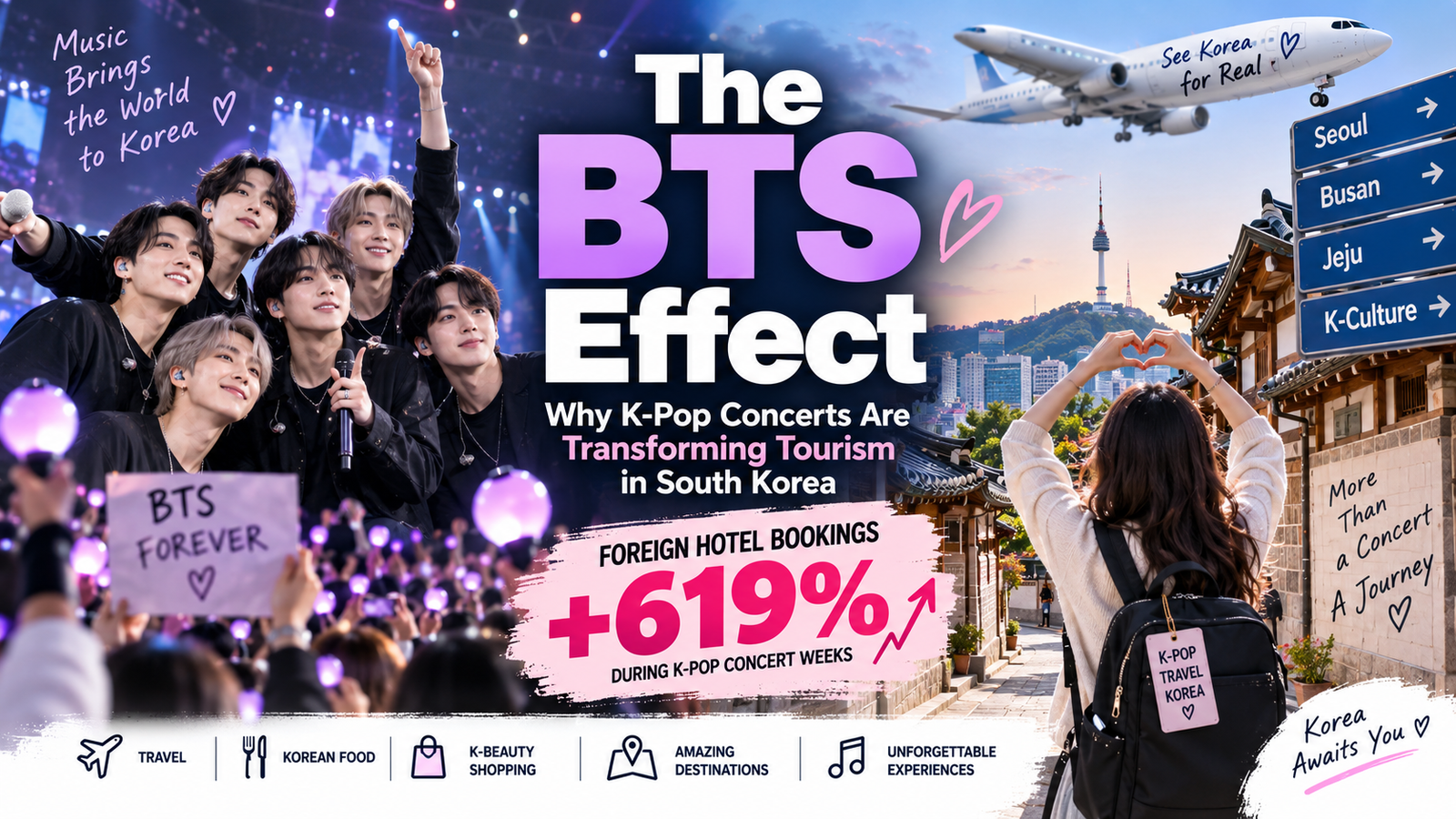
According to an analysis by the Korea Tourism Organization, accommodation bookings by foreign visitors surged 619.2% during weeks featuring concerts by three major K-pop acts compared with non-concert weeks in the dataset.
And BTS provides perhaps the clearest example yet of what happens when global fandom turns into actual travel.
Welcome to the new era of K-pop tourism in South Korea.
The BTS Effect Is Bigger Than a Concert
When BTS returned to the stage in South Korea in 2026, thousands of international ARMYs traveled to the country.
But Korea’s Ministry of Culture, Sports and Tourism wanted to know something beyond concert attendance:
What did those fans do after they arrived?
Together with the Korea Culture & Tourism Institute and Korea Tourism Organization, the ministry surveyed concertgoers and analyzed mobile-network and credit-card data surrounding BTS performances in Seoul and Goyang.
The results were remarkable.
Foreign visitors who attended BTS’s March 21 Gwanghwamun performance stayed in South Korea for an average of:
8.7 days
and spent approximately:
KRW 3.53 million per person.
By comparison, the average international visitor during the first quarter of 2026 stayed 6.1 days and spent approximately KRW 2.45 million.
In other words, BTS concert visitors stayed about 2.6 days longer and spent roughly KRW 1.08 million more per person than the average international tourist.
That changes the way we should think about a K-pop concert.
It is not simply a three-hour entertainment event.
For international fans, it can become the anchor around which an entire Korean vacation is built.
73.6% Came to Korea Primarily Because of BTS
There is an even more important number.
Among foreign visitors surveyed around BTS’s Gwanghwamun performance:
73.6% said the BTS event was their primary reason for visiting South Korea.
Another 17.4% were already visiting Korea for another purpose and added the event to their trip.
Think about what that means.
Without the concert, many of those international visitors might not have booked:
a flight to Korea,
a hotel room,
airport transportation,
restaurant meals,
shopping trips,
or visits to Korean attractions.
The concert created the trip.
This is why the phrase “BTS Effect” is more than fan language.
It increasingly describes a measurable tourism phenomenon.
BTS Fans Didn’t Just Attend the Concert and Go Home
The Goyang concerts provide an even clearer picture.
International fans attending BTS’s Goyang shows stayed in Korea for an average of 7.4 days and spent approximately KRW 2.91 million per person.
And they traveled well beyond the stadium.
Visitors connected their concert trips with places such as:
Yongsan
Myeongdong
Dongdaemun Design Plaza (DDP)
and the National Museum of Modern and Contemporary Art.
These destinations were linked to the broader “BTS THE CITY Seoul” experience surrounding the performances.
This is exactly why K-pop matters so much to tourism.
A concert may last several hours.
But the trip surrounding it can last more than a week.
One BTS Concert Area Saw Foreign Spending Jump 38-Fold
Perhaps the most dramatic evidence comes from the neighborhood surrounding the Goyang concert venue.
The Korea Tourism Organization compared mobile and card data around Daehwa-dong, where the concerts took place, with the same period a year earlier.
During the three BTS concert days, foreign visitors increased from 1,397 to 48,581.
That’s approximately:
35 times more foreign visitors.
Foreign card spending in the area increased from approximately KRW 8.9 million to KRW 337.8 million.
That’s roughly:
38 times more spending.
These numbers show why cities around the world compete aggressively to host major concerts.
The economic impact does not stop at the ticket booth.
It reaches:
hotels,
restaurants,
cafés,
convenience stores,
taxis,
subways,
shopping centers,
tourist attractions
and local businesses.
Then Came an Even Bigger Number: 619%
BTS is not an isolated case.
A newer Korea Tourism Organization analysis examined accommodation behavior surrounding major events.
The results suggest that the concert-tourism effect extends across K-pop.
During weeks featuring concerts by BTS, BLACKPINK and Stray Kids in the analyzed data, accommodation bookings increased dramatically.
Domestic bookings rose around 99.4%.
But bookings by foreign visitors increased by approximately:
619%
compared with non-concert periods in the analysis.
That number deserves attention.
Fans are not merely streaming Korean music from Los Angeles, Tokyo, Paris, Bangkok or London.
Increasingly, they are getting on airplanes.
K-Pop Has Changed the Meaning of a “Tourist Attraction”
Traditionally, tourism promotion centered around physical landmarks.
For Korea, that meant places such as:
Gyeongbokgung Palace,
Bukchon Hanok Village,
N Seoul Tower,
Jeju Island,
or Haeundae Beach.
Those places remain important.
But younger international travelers increasingly build trips around something less traditional.
They want to visit places connected to Korean culture they already love.
A café visited by an idol.
A music-video filming location.
A neighborhood featured in Korean entertainment.
A pop-up store.
A concert venue.
A K-pop agency district.
A restaurant associated with an artist.
A beauty store selling products used by Korean celebrities.
The tourist attraction is no longer always a monument.
Sometimes the attraction is a connection to a story, artist or fandom.
Why K-Pop Fans Often Stay Longer
Traditional sightseeing trips can be surprisingly short.
A visitor might spend three or four days checking off famous attractions and then leave.
Fandom tourism works differently.
Imagine flying to Seoul for a Saturday concert.
You may arrive several days early because international travel is expensive and you don’t want to risk missing the event.
Then you discover that your favorite group has:
a pop-up event,
a merchandise store,
a themed café,
a photo exhibition,
or related attractions elsewhere in the city.
After the concert, you might add another few days for Korean food, shopping and sightseeing.
Suddenly, a concert weekend becomes:
a seven- or eight-day Korea vacation.
The BTS data shows exactly this pattern.
Where Do K-Pop Fans Go in Korea Beyond the Concert?
This is where K-pop tourism becomes particularly interesting for first-time visitors.
You don’t have to spend your entire vacation searching for idol-related locations.
The best K-pop trip combines fandom with Korea itself.
Here are several places that fit naturally into that itinerary.
1. Hongdae
Hongdae is one of Seoul’s most energetic neighborhoods.
Street performances, cafés, fashion, nightlife and music culture make it especially popular with younger travelers.
For a K-pop fan visiting Korea for the first time, Hongdae is one of the easiest places to experience contemporary Seoul.
2. Myeongdong
Myeongdong remains one of the most convenient areas for international visitors.
You can combine:
K-beauty shopping,
Korean street food,
restaurants,
fashion
and easy transportation.
BTS concert visitors were also observed traveling to Myeongdong during their wider Korea itinerary.
3. Yongsan
Yongsan has become increasingly relevant to K-pop travelers.
The area combines major transportation connections, shopping and proximity to entertainment-related destinations.
It also appeared among locations visited by international BTS concertgoers.
4. Dongdaemun Design Plaza
DDP is one of Seoul’s most recognizable modern landmarks.
It frequently hosts exhibitions, pop-ups, fashion events and cultural programs.
Its late-night surroundings also make it easy to combine sightseeing with shopping and food.
5. Seongsu
If you want to understand modern Korean pop culture beyond music, visit Seongsu.
The neighborhood has become known for:
brand pop-ups,
fashion,
cafés,
beauty launches
and collaborations involving celebrities and entertainment brands.
It represents another important part of contemporary Korean youth culture.
6. The Han River
Not everything needs to be a paid attraction.
One of the simplest Seoul experiences is spending an evening along the Han River.
Buy convenience-store food, order Korean fried chicken, sit by the river and watch Seoul slow down after sunset.
For international visitors who first discovered Korea through highly produced music videos and dramas, ordinary experiences like this often become some of the most memorable moments of the trip.
And K-Pop Tourism Is Moving Beyond Seoul
This may ultimately be the most important change.
Historically, international tourism to Korea has been heavily concentrated in Seoul.
But recent tourism data shows foreign travelers are increasingly exploring other regions.
The share of international visitors staying outside the greater Seoul region rose from 39.5% to 43%, according to the recent tourism analysis.
Growth was particularly notable in destinations including:
Busan
Jeju
Andong
and Gyeongju.
K-pop can accelerate that trend.
If a major concert takes place outside central Seoul, thousands of international fans suddenly need:
accommodation,
transportation,
food,
shopping
and things to do nearby.
A concert can therefore become a gateway to regional Korea.
Busan May Be the Perfect Example
For many international visitors, Busan is already Korea’s obvious second destination after Seoul.
It offers something completely different:
beaches,
seafood,
traditional markets,
mountains,
coastal temples,
night views
and a more relaxed atmosphere.
K-pop events can give travelers the initial reason to visit.
But once they arrive, places such as:
Haeundae,
Gwangalli,
Jagalchi Market,
Gamcheon Culture Village
and Haedong Yonggungsa Temple
turn a concert trip into a broader Korean travel experience.
This is the real tourism value of K-pop.
Music gets people onto the plane.
Korea gives them reasons to stay.
K-Pop Is Also Selling Korean Food
There is another powerful effect that tourism statistics alone don’t fully capture.
Fans often arrive in Korea already familiar with Korean food.
They have seen idols eating:
tteokbokki,
ramyeon,
samgyeopsal,
fried chicken,
gimbap,
kimchi jjigae
and Korean convenience-store food.
So when they finally visit Korea, eating those foods can feel like participating in the culture they have followed from abroad.
This is one reason K-pop tourism connects naturally with food tourism.
A fan who travels to Korea for BTS may return home remembering the concert.
But they may also remember:
their first Korean barbecue dinner,
late-night fried chicken,
tteokbokki from a street stall,
or convenience-store ramyeon eaten beside the Han River.
That emotional connection is extremely powerful.
K-Pop Also Leads Travelers Into K-Beauty
The same phenomenon occurs with Korean beauty.
K-pop fans are constantly exposed to:
Korean skincare,
makeup,
fashion,
hairstyles
and beauty trends.
Once they arrive in Korea, stores in Myeongdong, Hongdae, Gangnam and Seongsu become part of the tourism experience.
This is why the economic value of Korean popular culture extends far beyond music sales.
One song can eventually influence spending on:
travel,
hotels,
restaurants,
beauty,
fashion,
transportation
and entertainment.
That is the larger K-Culture economy.
K-Pop Tourism Is Different From Ordinary Celebrity Tourism
Celebrity tourism is not new.
People have always traveled to see musicians.
But K-pop has several characteristics that make the effect unusually powerful.
First, K-pop fandoms are highly organized internationally.
Fans communicate through social media and online communities across national borders.
When a concert is announced, information about:
tickets,
flights,
hotels,
transportation,
restaurants
and fan events
can spread globally within hours.
Second, K-pop provides a constant stream of content between concerts.
Music videos, livestreams, variety shows, social media, documentaries and fan platforms create continuous engagement.
For many international fans, Korea does not feel like a completely unfamiliar country by the time they arrive.
They have already been experiencing parts of Korean culture digitally for years.
The physical trip becomes the final step of a relationship that began online.
From “Korean Wave” to “Travel to Korea”
For years, people talked about the Korean Wave — Hallyu — primarily in terms of exports.
Korean music was exported.
Korean dramas were exported.
Korean movies were exported.
Korean beauty products were exported.
But something more interesting is now happening.
Instead of Korean culture only traveling overseas, overseas consumers are traveling to Korea.
That represents a major change.
A Spotify stream generates one type of economic value.
A tourist who flies to Korea and stays for eight days generates something completely different.
They may buy:
airfare,
accommodation,
concert tickets,
food,
transportation,
cosmetics,
fashion,
souvenirs
and additional travel experiences.
The BTS tourism data makes this difference visible.
What This Means for Someone Planning a Korea Trip
If you are considering traveling to Korea for a K-pop concert, there is one piece of advice worth remembering:
Don’t make the concert your entire trip.
Make it the beginning.
If your concert is in Seoul or Goyang, consider spending several days exploring Seoul before or after the event.
Then add another destination.
For example:
Days 1–4: Seoul Day 5: K-pop concert Days 6–7: Seoul neighborhoods and shopping Days 8–9: Busan or Gyeongju
Even a shorter trip can combine K-pop with Korean food, history and everyday culture.
And that is often where the best memories happen.
The BTS Effect May Be Showing Us the Future of Korean Tourism
The most interesting thing about the BTS tourism data isn’t simply that BTS is popular.
We already knew that.
What matters is what fans do because of that popularity.
They cross borders.
They stay longer.
They spend more.
They explore neighborhoods.
They eat Korean food.
They shop for Korean products.
And increasingly, they travel beyond Seoul.
Government data showed foreign visitors around BTS’s Goyang concert increased about 35-fold, while their card spending increased about 38-fold compared with the same period a year earlier.
More recent tourism data found foreign accommodation bookings surging roughly 619% during selected major K-pop concert weeks.
Those aren’t streaming numbers.
They represent people physically moving around Korea.
Final Thoughts: They Come for BTS — But They Discover Korea
Perhaps the simplest way to understand K-pop tourism is this:
Fans may buy the plane ticket because of BTS.
But BTS isn’t necessarily what they remember most about every day of the trip.
They may remember eating grilled pork with friends in Seoul.
Getting lost on the subway.
Walking along the Han River at night.
Buying skincare in Myeongdong.
Discovering a tiny restaurant they had never seen on TikTok.
Taking the KTX to Busan.
Seeing the Korean coastline for the first time.
That is where K-pop’s tourism power becomes much larger than music.
K-pop gives millions of people a reason to become curious about Korea.
And once they arrive, Korea itself becomes the experience.
That may be the real BTS Effect — not simply selling more concert tickets, but turning global music fans into travelers who want to experience the country behind the music.
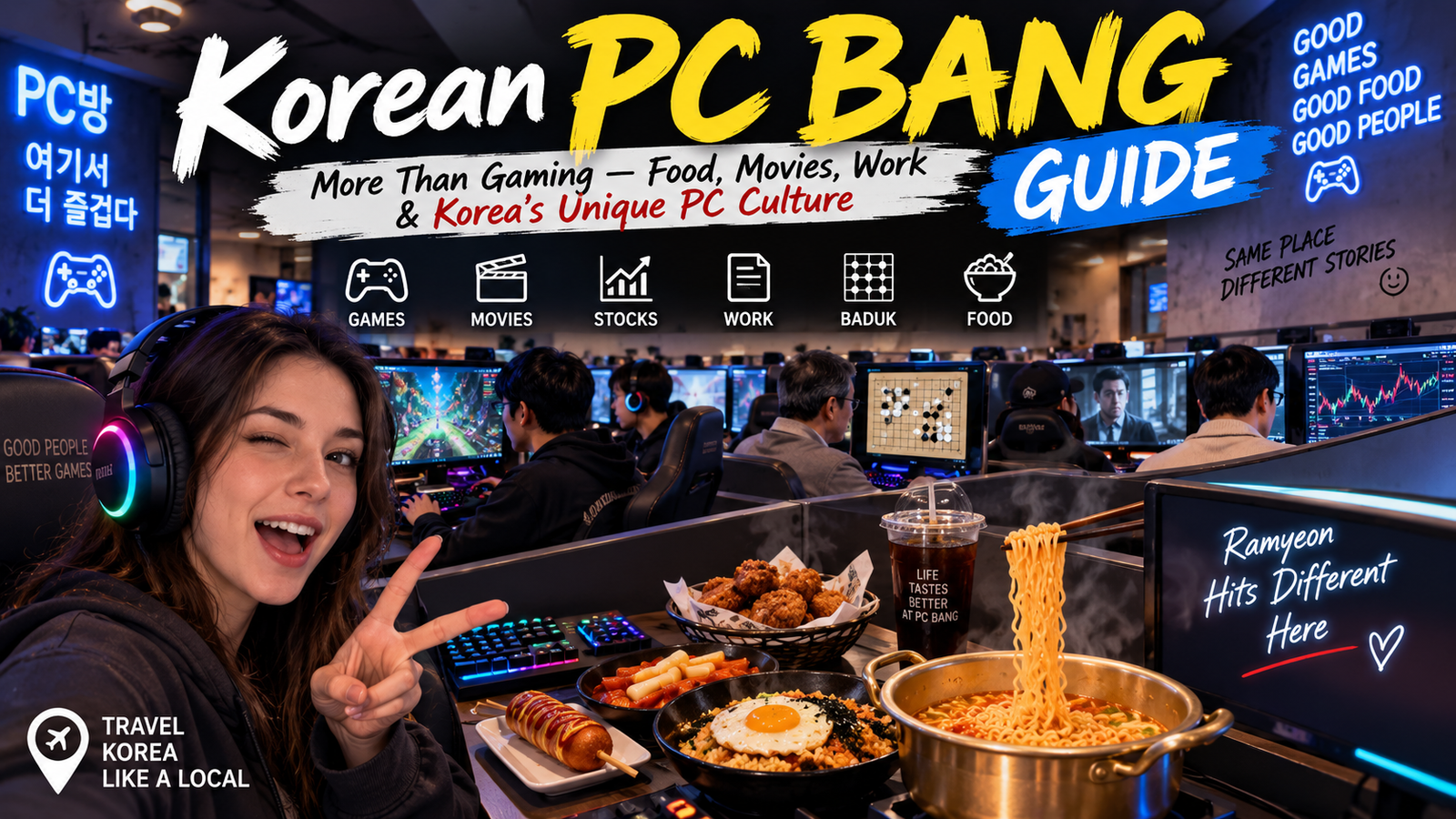
When most foreigners hear the words “Korean PC Bang,” they imagine one thing:
Gamers.
Rows of young people playing League of Legends, Valorant, PUBG or other online games on powerful computers.
That image isn’t wrong.
But it is incomplete.
Walk into a PC bang in Korea and you may find someone playing an intense online game at one desk.
At another, an older customer may be playing online baduk, the Korean game of Go.
Someone else may be watching a movie.
Another person may be checking stock prices.
Someone may be working on a document.
And somewhere nearby, someone who barely cares about games may be eating a bowl of ramyeon or kimchi fried rice.
That is what makes the Korean PC bang interesting.
You don’t have to be a gamer to experience one.
For travelers who want to see how Koreans actually spend their everyday lives—not just visit palaces and famous tourist attractions—a PC bang can be one of the most surprisingly authentic experiences in Korea.
What Is a Korean PC Bang?
The word “bang” (방) means “room” in Korean.
So PC bang literally means:
“PC room.”
But translating it as an “internet café” doesn’t really capture what it is.
In many countries, an internet café is simply a place where you pay to use a basic computer and internet connection.
A modern Korean PC bang can be very different.
You may find:
powerful gaming PCs,
high-refresh-rate monitors,
gaming keyboards and mice,
large monitors,
comfortable chairs,
fast internet,
hundreds of installed games,
food and drinks,
and ordering systems built directly into the computer.
Some premium locations even offer private or group rooms.
Korea Tourism Organization describes PC bangs as affordable spaces with high-quality equipment, comfortable seating and food, and notes that they provide travelers with a glimpse into everyday Korean gaming culture.
But gaming is only the beginning.
PC Bangs Are Part of Everyday Korean Life
Korea’s PC bang culture developed alongside the country’s rapid broadband expansion and the rise of competitive online gaming.
Games such as StarCraft helped turn PC bangs into social spaces where people could meet friends and compete together.
Eventually they became closely connected with Korea’s enormous esports culture.
Today, however, the PC bang has evolved into something broader.
Think of it as a place where you rent:
a powerful computer + a comfortable chair + fast internet + your own digital space
for a certain amount of time.
That makes it useful for many different people.
Who Actually Uses Korean PC Bangs?
1. Gamers
Obviously, gamers remain the biggest group.
League of Legends is particularly visible, but depending on the location you may see people playing everything from FPS games and MMORPGs to strategy and casual games.
Playing at a PC bang also has a social element.
Friends may sit beside each other and play as a team instead of playing alone at home.
That is part of why PC bangs remain relevant even though almost everyone in Korea has internet access.
2. People Playing Baduk and Board Games Online
Not every person staring seriously at a monitor is playing an action game.
You may find older customers playing baduk (바둑), known internationally as Go, or other online board and card games.
This is an interesting side of PC bang culture that foreign travelers may not expect.
The customers aren’t necessarily all teenagers or esports fans.
Different generations can use the same space in very different ways.
3. People Watching Movies, YouTube or Sports
A large monitor, headphones, fast internet and a comfortable chair also make a PC bang a convenient place to watch videos.
Some people use them to watch:
movies,
YouTube,
streaming content,
sports,
or esports broadcasts.
If you have time to kill before a train or appointment, renting a computer for an hour can be surprisingly convenient.
4. People Checking Stocks and Crypto
You may also occasionally see people staring at charts instead of games.
Korea has an enormous community of individual investors.
So PC bangs can also be used for checking stock markets, financial news or cryptocurrency prices when someone needs access to a computer away from home.
Of course, travelers should be careful when logging into sensitive financial accounts on any shared computer.
5. People Working
Need to edit a document?
Download a file?
Send an email?
Search for information?
Deal with something that is annoying to do on a phone?
A PC bang can solve the problem.
Seoul’s official tourism guide has long noted that PC bangs can also be used for email and other practical computer tasks.
For a traveler whose laptop is back at the hotel—or who didn’t bring one at all—that can be useful.
6. People Who Come for the Food
And then there is perhaps the most surprising customer.
The person who comes partly because they want to eat.
Yes.
PC bang food has become a culture of its own.
And this deserves an entire section.
PC Bang Food: The Surprise Most Foreigners Don’t Expect
Imagine walking into an internet café and seeing a menu containing:
ramyeon,
tteokbokki,
kimchi fried rice,
rice bowls,
fried chicken,
dumplings,
hot dogs,
French fries,
coffee,
smoothies,
and desserts.
That is possible in Korea.
Some PC bangs have evolved so far beyond packaged snacks that their food menu looks like a small casual restaurant.
Korea Tourism Organization even highlights PC bang food as part of the experience; examples at gaming venues include ramyeon and kimchi fried rice, while other PC cafés offer items such as tteokbokki, fried chicken-and-mayo rice and hot dogs.
Menus vary enormously by location, so don’t expect every PC bang to sell everything listed below.
But these are some foods worth looking for.
10 PC Bang Foods You Should Try in Korea
1. Ramyeon — 라면
If you try only one PC bang food, make it ramyeon.
Few things feel more Korean-PC-bang than playing a game while eating steaming Korean instant noodles.
Depending on the location, you may be able to add:
egg
cheese
tteok (rice cakes)
or other toppings.
And unlike simply buying a cup of noodles from a convenience store, many PC bangs prepare the noodles for you.
2. Kimchi Fried Rice — 김치볶음밥
This is one of the safest choices for someone who wants an actual meal.
Warm rice stir-fried with kimchi is filling, inexpensive and easy to eat at the computer.
Some places add an egg or other toppings.
Korea Tourism Organization specifically features kimchi fried rice among foods available at gaming venues.
3. Tteokbokki — 떡볶이
Spicy rice cakes are another classic Korean comfort food.
If you’ve already tried street-market tteokbokki, ordering it inside a PC bang gives you a completely different setting for the same iconic food.
And if you’ve read our Korean food guides, this is another chance to see how deeply tteokbokki is woven into everyday Korean life.
4. Jjapagetti / Jjajang-style Noodles
Black-bean-flavored instant noodles are perfect computer food.
They’re savory, filling and easy to eat while watching something or playing a game.
Some places add egg, cheese or meat.
5. Rice Bowls — 덮밥
PC bangs with larger kitchens may offer surprisingly substantial rice dishes.
Popular variations can include things like:
chicken mayo,
spicy pork,
bulgogi-style meat,
or other toppings over rice.
At T1 Base Camp, for example, Korea Tourism Organization has highlighted a chicken-and-mayonnaise rice dish among the player-inspired menu choices.
6. Dumplings — 만두
Fried or steamed dumplings are ideal if you want a snack rather than a full meal.
They’re also easy to share if you’re visiting with a friend.
7. Sotteok-Sotteok — 소떡소떡
This is a fun one for first-time visitors.
Sausage + rice cake + sausage + rice cake on a skewer, usually finished with sauce.
It’s strongly associated with Korean snack culture and is also found on some PC bang menus.
8. Hot Dogs & Fried Snacks
Depending on the PC bang, you may see:
hot dogs,
French fries,
fried chicken,
chicken skewers,
fried dumplings,
and other quick snacks.
This is where the distinction between “internet café” and “mini restaurant with computers” starts getting blurry.
9. Toast & Simple Snacks
If you’re not very hungry, look for toast, packaged snacks or simple baked items.
They’re easy to eat without interrupting whatever you’re doing.
10. Iced Americano — 아이스 아메리카노
And finally:
coffee.
In Korea, the iced Americano is practically an everyday companion.
PC bangs are no exception.
If you see Koreans gaming late at night with a giant plastic cup beside the keyboard, there’s a good chance coffee is involved.
The Best Part: Order Food Without Leaving Your Computer
This is the part foreign visitors should experience at least once.
You don’t necessarily walk up to a counter to order your food.
At many PC bangs, there is a food-ordering menu directly on the computer.
You click the food icon.
Browse the menu.
Choose your ramyeon or fried rice.
Place the order.
Then continue using the computer.
A little later:
your food arrives at your desk.
A recent guide for foreign residents describes exactly this process: customers can open the food-order menu from the PC, choose dishes such as ramyeon, sotteok-sotteok or kimchi fried rice, and staff deliver the order directly to the seat. Payment method varies by location.
For Koreans, this feels normal.
For many first-time foreign visitors, it can be one of the most memorable parts of the experience.
How to Use a Korean PC Bang: Step by Step
If you’ve never visited one, don’t worry.
It is usually easier than it looks.
Step 1 — Find a PC Bang
Search Korean map services for:
PC방
You’ll find them almost everywhere in major cities.
In Seoul, areas around universities, nightlife districts and busy subway stations tend to have plenty.
Step 2 — Enter and Look for the Kiosk
Many modern PC bangs use self-service kiosks.
You’ll usually see options for members and non-members.
If you’re visiting Korea temporarily, look for something similar to:
Non-member / Guest / 비회원
A recent 2026 foreigner guide notes that many kiosks allow non-members to purchase time using cash or card and receive temporary login information.
The exact system differs by business.
Step 3 — Buy Some Time
PC bangs normally charge according to time.
Prices vary by location, equipment and whether you’re a member.
For reference, Korea Tourism Organization currently lists T1 Base Camp in Seoul at ₩2,000 per hour for members and ₩3,000 for non-members, although this is a premium branded location and should not be treated as a nationwide standard.
For a tourist, buying just an hour or two is enough to experience the culture.
Always check the current price at the specific location.
Step 4 — Choose a Seat
Depending on the system, you may select a seat at the kiosk or take an available seat and log in.
Some premium locations have different sections.
You may see:
regular seats,
premium seats,
FPS gaming seats,
dual-monitor seats,
or private/group rooms.
For example, the Gen.G GGX gaming complex in Dongdaemun includes dedicated FPS seating, dual-monitor areas, premium rooms and team rooms.
Can Foreigners Use Korean PC Bangs?
Generally, yes.
Korea Tourism Organization notes that many internet cafés are foreigner-friendly and that English-language guidance may be available.
However, there is an important difference between:
using the PC
and
accessing every Korean online game.
Some Korean games or Korean servers may require a Korean game account or identity verification.
So don’t assume that every locally installed game can automatically be played by a tourist.
If you already use Steam or another international gaming service, bringing your own account may make things easier.
And remember:
Always log out before you leave.
This applies especially to:
email,
social media,
cloud storage,
Steam,
financial services,
and any other personal account.
Do not save passwords on a public computer.
What If You Don’t Play Games?
This is actually one of my favorite reasons to recommend a PC bang to travelers.
Don’t play games?
That’s fine.
Try this instead.
Buy one hour.
Sit down.
Order a bowl of ramyeon and an iced Americano.
Watch YouTube.
Look up tomorrow’s travel route.
Write your travel journal.
Check your photos.
Watch an esports match.
Or simply observe what the people around you are doing.
You are still experiencing Korean PC bang culture.
That’s because the PC bang isn’t interesting only because of the computer.
It’s interesting because of how Koreans use the space.
A Great Place When Korea’s Weather Turns Bad
There’s another practical reason tourists should remember PC bangs.
Imagine you’re in Seoul and suddenly:
it starts pouring,
it’s freezing outside,
the summer heat becomes unbearable,
or you have two hours before meeting someone.
Instead of sitting in another café, try a PC bang.
You get a chair, computer, internet, entertainment and food under one roof.
Some locations operate 24 hours, although hours vary and travelers should always check the individual business before visiting. Major gaming venues such as T1 Base Camp and Gen.G GGX are currently listed by Korea Tourism Organization as operating 24 hours.
Want a Premium PC Bang Experience? Try an Esports-Themed Venue
If you’re a serious esports fan, Seoul has some particularly interesting options.
T1 Base Camp
Fans of League of Legends will immediately recognize the name T1 and its legendary player Faker.
T1 Base Camp in Hongdae combines a PC bang with premium gaming rooms, merchandise and esports culture.
Korea Tourism Organization currently lists it as open 24 hours and highlights menu items inspired by T1 players, including T1 Ramyeon and chicken-mayo rice.
This is less like randomly entering a neighborhood PC bang and more like visiting an esports attraction.
Gen.G GGX
Another interesting option is Gen.G GGX, near Dongdaemun Design Plaza.
The complex combines high-end gaming equipment, esports merchandise and Korean food.
There are FPS seats, dual-monitor setups, premium rooms and team rooms.
Its food space even includes Korean dishes such as bibim ramyeon and kimchi fried rice.
For an international esports fan, this could easily become part of a Seoul itinerary.
PC Bang Etiquette for Foreign Visitors
You don’t need to know complicated rules.
But a few things help.
Keep your voice reasonable. Excited gamers can certainly be noisy, but that doesn’t mean you need to shout across the room.
Don’t touch someone else’s equipment.
Keep food around your own desk area.
Use headphones.
Check whether your seat type costs extra.
Don’t leave your personal accounts logged in.
And if you’re unsure about something, asking the staff politely is perfectly fine.
Useful Korean Words at a PC Bang
Korean
Meaning
PC방
PC bang
비회원
Non-member
회원
Member
자리
Seat
시간
Time
먹거리
Food/snacks
주문
Order
라면
Ramyeon
김치볶음밥
Kimchi fried rice
떡볶이
Tteokbokki
만두
Dumplings
아이스 아메리카노
Iced Americano
Even knowing 비회원 (non-member) can make your first visit easier.
The Perfect 1-Hour PC Bang Experience for a Tourist
If you’re visiting Korea and don’t know what to do, try this simple challenge.
Minute 0–10
Find a good-looking PC bang and purchase one hour as a non-member.
Minute 10–15
Choose your seat and explore the computer.
Minute 15
Open the food menu.
Order:
Ramyeon + Iced Americano
or
Kimchi Fried Rice + a drink.
Minute 20–50
Play a game, watch something, check your travel plans or simply browse the internet.
Eat your food at the computer like a local.
Minute 50–60
Take a final look around.
You’ll probably notice that the people surrounding you aren’t all doing the same thing.
And that’s the point.
PC Bang vs. Regular Café: What’s the Difference?
Korean PC Bang
Regular Café
High-performance PC
Usually no PC
Pay mainly for computer time
Buy drinks/food
Gaming
Usually not
Movies/videos
Possible on PC
Work
Possible
Food delivered to your seat
Counter/table service
Ramyeon & fried rice
Café-style menu
Gaming peripherals
No
Late-night options common
Depends on café
Esports culture
No
A café is still better if you want sunlight, conversation and coffee.
But if you need a computer—or simply want to experience a very Korean digital environment—the PC bang wins.
PC Bang, Jjimjilbang, Noraebang: Understanding Korea’s “Bang Culture”
There’s also a larger cultural idea here.
Korea has many spaces whose names end in bang (방):
PC bang — computer room
noraebang — singing room
jjimjilbang — Korean sauna/bathhouse complex
The experiences are completely different, but together they reveal something interesting about modern Korean leisure culture.
Instead of always meeting in large public spaces, Koreans have developed many specialized spaces where people can spend time around a particular activity.
For travelers, experiencing these spaces can sometimes teach you more about everyday Korea than checking another famous landmark off a list.
Why a PC Bang Belongs on Your Korea Itinerary
You can see beautiful palaces in Korea.
You can visit Buddhist temples.
You can walk along the Han River.
You can watch a KBO baseball game.
All of those are worthwhile.
But if you want to understand modern Korea, spend an hour in a PC bang too.
Because modern Korea isn’t only ancient palaces, K-pop and Korean barbecue.
It is also:
ultra-fast internet,
online games,
esports,
late-night digital culture,
individual investors watching charts,
people working at computers,
friends playing together,
and someone eating spicy ramyeon while staring intensely at a glowing monitor.
That is Korea too.
Final Thoughts: You Don’t Have to Be a Gamer
This is the most important thing to remember.
You don’t have to love games to enjoy a Korean PC bang.
Go because you’re curious.
Go because it’s raining.
Go because you need a computer.
Go because you want to see where Korea’s gaming culture lives.
Or go simply because you want to order ramyeon from a computer and have someone bring it to your desk.
For many tourists, the most memorable moments in Korea aren’t necessarily the famous attractions.
Sometimes they are the ordinary things Koreans barely think about anymore.
A neighborhood market.
Ramyeon beside the Han River.
A late-night convenience store.
A baseball crowd singing together.
Or a glowing PC bang at midnight.
If your goal is to experience Korea like a Korean rather than only see Korea like a tourist, a PC bang deserves at least one hour of your trip.
Subways run beneath crowded streets. Cafés stay busy late into the evening. Neon signs glow, delivery motorcycles move through narrow alleys, and people seem to be going somewhere at almost every hour of the day.
But travel a little outside the city — or sometimes simply toward the mountains surrounding it — and Korea can suddenly feel completely different.
You may hear wind moving through pine trees.
A wooden temple bell.
Birds in the mountains.
The quiet footsteps of a monk crossing an old courtyard.
And if you stay overnight, you may wake before sunrise and experience something very different from the Korea of K-pop, skyscrapers and shopping districts.
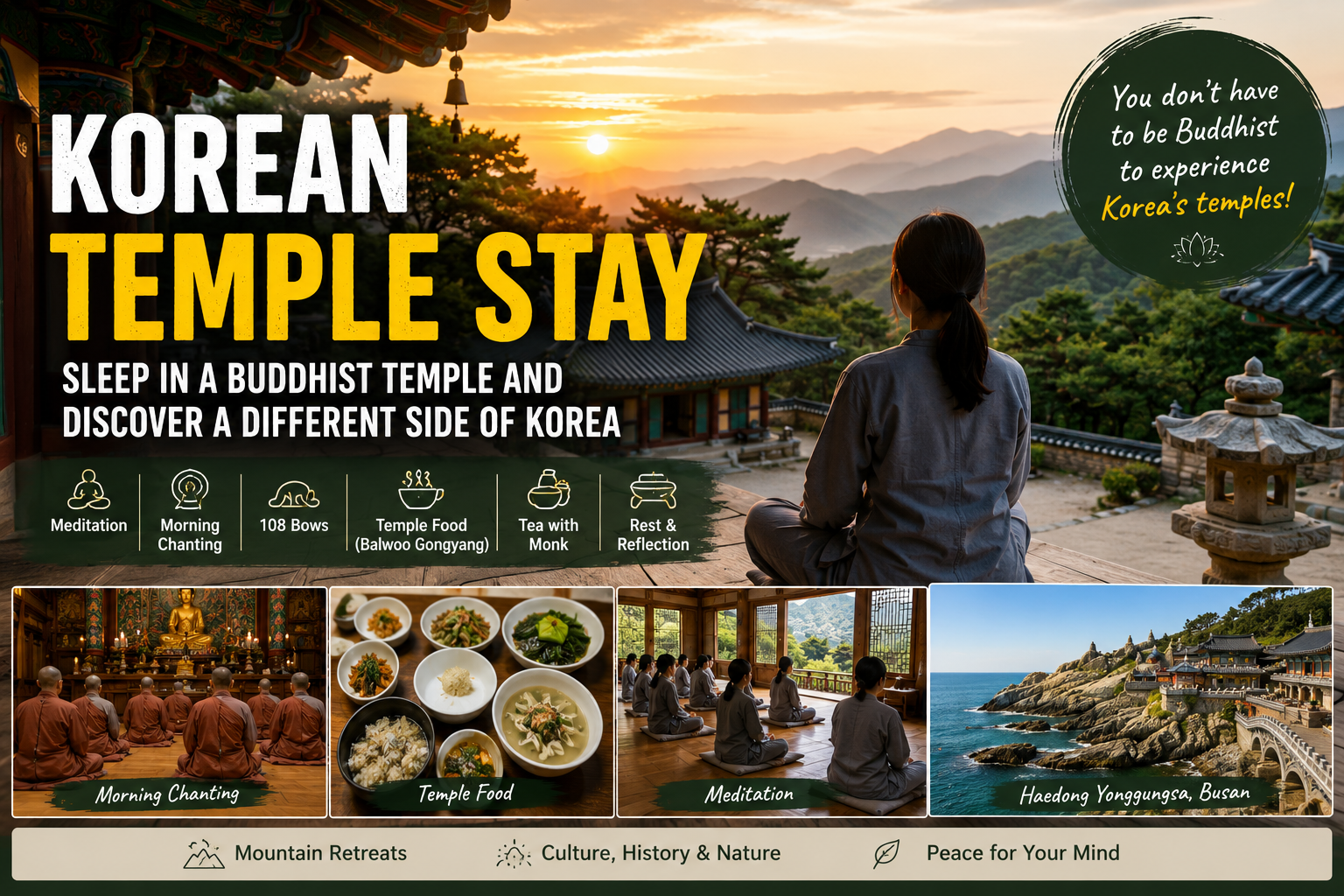
This is a Korean Templestay (템플스테이).
But before explaining how to book one, there is something important foreign travelers should understand.
To Koreans, a Buddhist temple is not necessarily a place visited only by Buddhists.
Sometimes it is also a mountain destination, a historic site, a place to rest — or simply somewhere to clear your mind.
And understanding that may completely change the way you experience a Korean temple.
You Don’t Have to Be Buddhist to Visit a Korean Temple
This may surprise some foreign visitors.
A Korean who visits a Buddhist temple is not necessarily Buddhist.
A Christian may visit.
A Catholic may visit.
Someone with no religion at all may visit.
Many Koreans go to temples while hiking, to see autumn leaves or spring flowers, to appreciate historic architecture, or simply because they want somewhere peaceful to walk.
For many people, visiting a temple does not mean changing their religion.
It means visiting an important part of Korean history and culture.
And sometimes it means something even simpler:
They just need somewhere quiet.
This is an important distinction.
A Buddhist temple remains a sacred religious space and should always be treated respectfully.
But culturally, many Korean temples are also deeply connected with mountains, landscapes, architecture, history and ordinary leisure.
That is why seeing hikers walking through a temple courtyard should not surprise you.
They may have come for Buddhism.
They may have come for the mountain.
Or perhaps for both.
Why Are So Many Korean Temples in the Mountains?
If you travel around Korea, you will notice something interesting.
Many of the country’s most memorable Buddhist temples are surrounded by mountains and forests.
This isn’t just a travel stereotype.
Korea’s tradition of mountain monasteries is historically significant enough that seven Sansa, Buddhist Mountain Monasteries in Korea were inscribed on the UNESCO World Heritage List in 2018.
The seven are Tongdosa, Buseoksa, Bongjeongsa, Beopjusa, Magoksa, Seonamsa and Daeheungsa. They were established between the 7th and 9th centuries and remain living centers of Buddhist faith and practice today.
But Korean Buddhism was not always exclusively a mountain religion.
Buddhism flourished in ancient Korean kingdoms, and important Buddhist sites also existed around political and urban centers. UNESCO’s Gyeongju documentation, for example, records extensive Buddhist remains from the Silla period, including temples, pagodas and sculptures.
Over Korea’s long history, however, mountain monasteries became an especially distinctive part of Korean Buddhist culture.
During the Joseon Dynasty, Buddhism experienced centuries of suppression, yet mountain monasteries survived and continued their religious traditions. UNESCO specifically identifies this historical continuity as one of the important characteristics of Korea’s Sansa.
Today, the result is extraordinary.
In Korea, a trip to a temple can also become a journey into the mountains.
And sometimes getting there is part of the experience.
Sometimes Koreans Go to a Temple While Hiking
Hiking is extremely popular in Korea.
On weekends, mountains around major cities fill with people wearing hiking shoes, backpacks and brightly colored outdoor clothing.
And because temples are often located on or near mountain routes, the two experiences naturally meet.
You climb.
You enter the forest.
The city noise gradually disappears.
Then somewhere along the trail, you may see the curved roof of a Buddhist temple between the trees.
People stop.
Some enter the temple.
Some bow.
Others simply look around.
Someone may drink water and rest before continuing up the mountain.
This is one reason I don’t think foreign visitors should view Korean temples only through the lens of religion.
They are also connected to Korea’s relationship with its mountains and natural environment.
A Temple Can Be a Place to Clear Your Mind
There is another Korean expression worth understanding:
마음을 비우다 — maeumeul biuda.
Literally, it means something like “emptying the mind.”
People use it when talking about letting go of worries, desires or complicated thoughts.
You don’t have to be Buddhist to understand the feeling.
Modern Korean life can be extremely fast.
Work.
Study.
Traffic.
Competition.
Phones.
Messages.
Deadlines.
Sometimes people simply want to disappear from that world for a while.
A mountain and a quiet temple can provide exactly that.
That leads to one of the ideas I most want foreign travelers to understand:
In Korea, a temple is not only a place you visit because of what you believe. Sometimes, it is simply a place you visit because you need a mountain, a quiet path, and a little time to think.
And this is where Templestay becomes especially interesting.
Instead of visiting for thirty minutes and leaving, you stay.
What Is a Korean Templestay?
Templestay is an organized cultural program that allows visitors to experience life inside a Korean Buddhist temple.
The official Templestay organization describes it as a way to experience Korean traditional culture and Buddhism through activities that can include chanting, meditation, conversations over tea and Buddhist meals.
The modern Templestay program began in 2002, around the time Korea hosted the FIFA World Cup, as a way to introduce Korean temple culture to international visitors.
Today, it isn’t limited to Buddhists.
It attracts Koreans and international travelers looking for cultural experiences, meditation, rest and time away from everyday life.
And you don’t necessarily have to sleep overnight.
There are several types of programs.
Three Types of Templestay
The official program broadly divides Templestay experiences into different styles.
1. One-Day Templestay
Short on time?
This is probably the easiest introduction.
A one-day experience can last around two or three hours and may include a temple tour, meditation or tea.
For someone spending only a few days in Seoul, this can be a practical option.
2. Experience-Oriented Templestay
This is the one I would recommend if you want the full cultural experience.
It typically involves an overnight stay and may include activities such as morning chanting, meditation, 108 prostrations, Buddhist meals and traditional cultural activities.
Specific programs differ from temple to temple.
3. Rest-Oriented Templestay
This is different.
You are not trying to complete a long checklist of activities.
The goal is largely to rest.
Walk.
Sit.
Read.
Meditate.
Look at the mountains.
Do very little.
For a traveler exhausted after several days racing around Seoul and Busan, that may actually be exactly what you need.
What Does One Night in a Korean Temple Actually Look Like?
Every temple has a different schedule, so don’t expect every Templestay to follow exactly the same program.
But here’s a real 2026 example.
Myogaksa Temple in Seoul currently offers an English-supported 2-day, 1-night program that includes orientation, 108 prostrations and prayer-bead making, bell striking, a Buddhist ceremony, a temple tour, dinner and meditation.
The following morning begins extremely early — its listed schedule includes waking around 4 a.m. and a Buddhist ceremony beginning at 5 a.m.
That early morning can be one of the most memorable parts of the experience.
Imagine waking while the city is still dark.
No traffic.
No hotel television.
No shopping.
Just the temple and the sound of morning beginning.
That is an experience a conventional hotel cannot give you.
What Are the 108 Prostrations?
You may see 108 bows, or prostrations, included in an experience-oriented Templestay.
This is not simply exercise.
Within Buddhist practice, the number 108 carries religious significance, and the repeated bows can become a form of reflection and discipline.
Physically, however, 108 full bows can be demanding.
Don’t turn it into a competition.
If you have physical limitations or feel unwell, speak with the Templestay staff. The official Templestay FAQ says participants who are ill or too tired can inform staff and rest rather than participating in every activity.
Meditation: Perhaps the Simplest Part — and the Hardest
Sit still.
Breathe.
Don’t check your phone.
Sounds easy.
Then try doing it.
For many people, the difficult part of meditation isn’t sitting.
It’s discovering just how noisy their own mind is.
A Templestay gives you an environment in which slowing down feels natural.
The mountain helps.
The temple helps.
The absence of your normal routine helps.
You may not achieve enlightenment in one night.
That’s probably asking a bit much.
But you might discover how rarely you actually sit without doing anything.
Tea With a Buddhist Monk
Some programs include conversation over tea.
This is often one of the more approachable experiences for foreign visitors because it provides an opportunity to ask questions about temple life, Buddhism or simply everyday concerns.
You don’t need to arrive with a profound philosophical question.
Sometimes a cup of tea and a conversation in a quiet room can be enough.
The Templestay Information Center itself also provides information on temple meals and cultural experiences, including tea-related activities.
Korean Temple Food Is Part of the Experience
For True Taste Korea readers, this is where the experience becomes particularly interesting.
Temple food is another doorway into Korean culture.
Traditional Korean Buddhist food is generally plant-based and emphasizes simplicity, seasonality and respect for ingredients.
But don’t expect your temple meal to resemble the giant colorful Korean barbecue spread you may have eaten the night before.
That is precisely the point.
The meal is part of a different rhythm of life.
Some Templestay programs may also introduce balwoogongyang (발우공양), the traditional Buddhist monastic meal practice using bowls.
The official Templestay program lists Buddhist meals with traditional bowls among activities that can appear in experience-oriented stays.
And temple food deserves an article of its own.
Because Korean food isn’t only barbecue, fried chicken and spicy stew.
There is another tradition built around vegetables, fermentation, restraint and Buddhist philosophy.
Will I Have to Share a Room?
Possibly.
This is not necessarily a hotel.
The official Templestay guidance explains that temple life is traditionally communal and participants may share sleeping spaces. Some temples offer private rooms for small groups for an additional charge, but this depends on the individual program.
That means you should check the accommodation conditions before booking if privacy is important to you.
Also don’t expect luxury bedding, room service and a minibar.
You are going to experience temple life.
That’s the attraction.
What Should You Wear?
Follow the instructions provided by your particular temple.
Templestay participants are commonly given simple temple clothing to wear during the program.
Dress modestly and comfortably.
Remember that you are staying inside an active religious community, not visiting a themed resort.
Comfortable shoes are particularly useful if the program involves walking around mountainous temple grounds.
Do I Need to Speak Korean?
Not necessarily.
The official reservation system lets travelers search for temples and programs suitable for foreigners, and a number of programs provide English support.
But don’t assume every rural temple offers full English interpretation.
Check the language information for the exact program before booking.
If language accessibility is your priority, Seoul is an easy place to start.
The official Templestay site lists seven conveniently located Seoul temples including Bongeunsa, Geumsunsa, Hwagyesa, Jinkwansa, Jogyesa, Myogaksa and the International Seon Center.
You Can Even Do a Templestay in the Middle of Seoul
This surprises many travelers.
You don’t always have to travel deep into rural Korea.
For example, Bongeunsa sits in Gangnam, surrounded by one of the most modern districts in Seoul.
Its regular 2026 weekend Templestay is currently listed at ₩120,000 per person, although prices and schedules can change.
Myogaksa’s current English-supported 2-day/1-night program is listed at ₩95,000.
Those aren’t universal Templestay prices — they simply show that programs, schedules and costs vary.
But the Mountain Temples Offer Something Seoul Cannot
Urban temples are convenient.
Mountain temples are different.
Imagine waking up and opening the door to mist moving between mountains.
Or walking through a forest before breakfast.
Or hearing temple bells echo through a valley.
Korea’s seven UNESCO-listed Sansa are especially important examples of the country’s mountain-monastery tradition, preserving religious practice, meditation spaces, monastic education and daily community life within natural mountain settings.
This is where the journey itself matters.
Getting to some temples can take more effort.
You may need a bus.
Then another local bus.
Then perhaps a walk.
For travelers accustomed to stepping out of a subway station directly beside an attraction, this can initially feel inconvenient.
But don’t automatically treat that inconvenience as a disadvantage.
The road from the city into the mountain is part of the transition.
The buildings get smaller.
Traffic disappears.
Trees replace signs.
And eventually you reach the temple.
Korea Also Has a Temple Beside the Sea
Then there is Busan.
If your image of a Korean Buddhist temple is always “deep in the mountains,” visit Haedong Yonggungsa (해동용궁사).
This temple sits dramatically along the northeastern coast of Busan.
Korea Tourism Organization specifically notes how unusual the location is because most Korean temples are situated in the mountains, while Haedong Yonggungsa stands along the shoreline.
Here, instead of mountain silence, you hear waves.
Temple roofs appear against the blue sea.
Rocky coastline surrounds the complex.
And at sunrise, the combination can be spectacular.
The official Busan tourism site currently lists the temple at 86 Yonggung-gil, Gijang-gun, with free admission and opening hours of 4:30 a.m.–7:20 p.m., last entry at 6:50 p.m.; travelers should recheck before visiting because operating information can change.
If you’re visiting Busan, I would seriously consider adding it to your itinerary even if you have no interest in Buddhism.
It is an excellent example of the point of this entire article:
A Korean temple can simultaneously be a religious space, a historical place and an extraordinary travel destination.
Religion in Korea Is More Complicated — and More Flexible — Than a Label
There is another cultural point worth understanding.
Korea has Buddhists, Protestants, Catholics, people belonging to other religious traditions and many people who identify with no religion.
There have certainly been tensions between religions at different points in Korean history and modern society.
So it would be inaccurate to claim that Korea has never experienced religious conflict.
But everyday cultural boundaries can be more flexible than foreign visitors might expect.
A person doesn’t necessarily feel that entering a Buddhist temple means abandoning another faith.
People may appreciate Buddhist architecture, history and nature without participating in Buddhist belief.
Korea also has historical examples of religious communities participating in broader national and social causes.
And Buddhism itself played striking roles during periods of national crisis. At Namhansanseong, for example, UNESCO records that Buddhist soldier-monks participated in the fortress’s defense and construction during the Joseon period.
So when you see Koreans visiting temples, don’t immediately ask:
“Are all these people Buddhist?”
That’s often the wrong question.
A better question is:
“What does this place mean to them?”
The answer may be faith.
But it may also be history, nature, family memories, hiking, architecture, rest — or simply peace.
Temple Etiquette for Foreign Visitors
You do not need to know every Buddhist custom before visiting.
You do need to remember that this is a living religious space.
A few basics go a long way:
Keep your voice low, particularly around prayer halls.
Dress respectfully.
Don’t interrupt ceremonies for photographs.
Ask before photographing monks or participants closely.
Follow instructions about shoes before entering buildings.
Don’t touch religious objects unnecessarily.
Arrive on time for scheduled Templestay activities.
Remember that people around you may genuinely be praying or practicing their faith.
At Haedong Yonggungsa, for example, Busan’s official visitor guidance specifically asks visitors to lower their voices, organize their shoes and use the appropriate side entrances to the Buddhist sanctuary.
Respect doesn’t require you to be Buddhist.
It simply requires remembering where you are.
Is Templestay Only for Spiritual People?
Absolutely not.
You might choose a Templestay because you love Korean history.
Because you enjoy hiking.
Because you want to learn about Buddhist architecture.
Because you’re interested in temple food.
Because you’re exhausted.
Because Seoul has overwhelmed you.
Or simply because sleeping in a mountain monastery sounds more memorable than another night in a hotel.
You don’t need to arrive looking for enlightenment.
Sometimes curiosity is enough.
Who Should Try a Korean Templestay?
I particularly recommend it to travelers who have already experienced the faster side of Korea.
If you are planning a trip to South Korea, there is one experience that can tell you more about everyday Korean culture than another crowded tourist attraction.
Go to a jjimjilbang (찜질방).
A jjimjilbang is often translated as a “Korean sauna” or “Korean spa,” but that description does not quite capture it.
Imagine a place where you can take a hot bath, sweat in heated rooms, lie on the floor watching TV, eat Korean snacks, take a nap, play games, and spend several hours relaxing with friends or family.
That is much closer to the real jjimjilbang experience.
Modern Korean jjimjilbangs can include restaurants, game rooms, massage chairs, karaoke, entertainment areas and differently heated sauna rooms. Some facilities operate around the clock, although opening hours and overnight policies vary by location.
And if you have watched enough Korean dramas or variety shows, there is a good chance you have already seen one without realizing it.
People wearing matching clothes.
Towels wrapped around their heads.
Someone drinking a cold rice beverage.
Another person cracking an egg.
Everyone lying comfortably on the heated floor.
That is jjimjilbang culture.
So if you want to experience Korea rather than simply photograph it, here is how to do it.
What Is a Jjimjilbang?
The word jjimjilbang (찜질방) refers to a Korean-style bathhouse and heated sauna complex.
However, there are usually two different spaces that first-time visitors need to understand.
The Bathing Area
This is normally separated by gender.
It contains showers and may have hot and cold baths, sauna facilities and other bathing amenities.
This is the part that surprises some foreign visitors:
People are normally naked in the bathing area.
For Koreans, this is simply part of traditional public-bath culture. Seoul’s official tourism guide describes public bathing as an ordinary part of Korean life rather than something unusual.
The Common Jjimjil Area
After bathing, visitors put on the clothes provided by the facility.
This common area can generally be used by men, women, friends, couples and families together.
Depending on the jjimjilbang, you may find heated rooms, cooling rooms, restaurants, snack bars, massage chairs, arcades, entertainment areas and places to rest.
That combination is what makes a Korean jjimjilbang quite different from a conventional Western sauna.
Your First Jjimjilbang Visit: Step by Step
The first visit can feel confusing because Koreans seem to know exactly what to do.
Don’t worry.
Once you understand the basic system, it is surprisingly easy.
Step 1: Pay at the Entrance
Go to the reception desk and pay the admission fee.
The exact price depends on the facility, time of day and services included.
You will typically receive a locker key or wristband, towels and jjimjilbang clothes.
The clothes are usually a simple T-shirt and shorts.
Some modern facilities also use the locker key or wristband for purchases inside. Korea Tourism Organization guidance notes that some facilities let visitors use the key for amenities and then settle additional charges when leaving.
Keep your key with you.
Losing it will make your relaxing Korean spa experience considerably less relaxing.
Step 2: Put Your Shoes in the Shoe Locker
Korea has a strong shoes-off culture.
At a jjimjilbang, you will usually encounter a shoe locker near the entrance.
Take off your shoes and store them where instructed.
This is not just a jjimjilbang custom. Removing shoes remains common in Korean homes and various traditional indoor spaces.
Step 3: Enter the Correct Changing and Bathing Area
Men and women normally enter separate changing and bathing areas.
Put your belongings in your locker.
And now comes the moment that makes many first-time foreign visitors nervous.
You take off your clothes.
Completely.
For Koreans around you, this is completely ordinary.
Nobody is particularly interested in you.
Once you realize that, the awkwardness usually disappears surprisingly quickly.
Step 4: Shower Before Entering the Baths
This is important.
Wash your body before entering a communal bath.
Do not treat the bath itself as the place where you wash.
Shower first and then enter the hot or cold pools.
The exact facilities vary considerably, so follow the posted rules at the jjimjilbang you visit.
Step 5: Try the Baths
Many bathhouses offer pools at different temperatures.
You may find hot baths, cooler baths and other specialized pools.
There is no prize for staying in the hottest water.
Relax.
This is supposed to be enjoyable.
And remember that a jjimjilbang is a shared public space, so avoid splashing, swimming or behaving as though you have rented a private swimming pool.
Step 6: Put on Your Jjimjilbang Clothes
After bathing, dry yourself and put on the T-shirt and shorts provided by the facility.
Now you can enter the communal jjimjil area.
For many travelers, this is where the really interesting Korean cultural experience begins.
Suddenly you may see children playing, couples talking, friends lying on the floor, people eating noodles and someone sleeping in a corner.
It can feel less like a spa and more like a giant Korean living room.
And that is part of its charm.
Step 7: Try the Heated Rooms
A large jjimjilbang may have several rooms at different temperatures.
Some facilities use materials or themes such as charcoal, salt or clay.
If this is your first time, don’t immediately challenge yourself to the hottest room.
Korea Tourism Organization recommends that beginners start with cooler rooms around 30–40°C (86–104°F) and gradually move to hotter rooms according to their tolerance. It also advises caution in rooms above 60°C because of the risk of burns and dehydration.
Drink water and leave immediately if you feel dizzy or unwell.
This isn’t a competition.
Step 8: Eat the Classic Jjimjilbang Snacks
Now we reach one of the best parts.
Food.
Two foods are especially associated with jjimjilbang culture.
Sikhye (식혜)
Sikhye is a traditional sweet Korean rice drink, usually served cold.
After sitting in a hot room, a cold cup of sikhye can taste fantastic.
Korean tourism materials specifically identify sikhye as one of the classic foods associated with jjimjilbang visits.
Eggs
Eggs are another iconic jjimjilbang snack.
You may have seen people eating them in Korean television shows.
And the menu doesn’t necessarily stop there.
Depending on the facility, you might find ramen, tteokbokki, fish cake, fried chicken, ice cream and full Korean meals.
At Seoul’s Supsok Hanbang Land, for example, the official Seoul tourism guide currently lists foods such as sikhye, eggs, roasted rice cakes and sweet potatoes, as well as Korean restaurant options.
So don’t think of food as something separate from the experience.
Eating is part of the jjimjilbang experience.
What Is the Famous Korean “Sheep Head” Towel?
If you have watched Korean dramas, you may have seen someone wearing a towel twisted into two round shapes on the sides of their head.
It is commonly called a yangmeori (양머리) — literally, “sheep head.”
It became a playful visual associated with jjimjilbang scenes in Korean popular culture.
You don’t have to wear your towel like this.
But if this is your first trip to Korea?
Try it once.
Take the photo.
You know you want to.
Can You Sleep in a Korean Jjimjilbang?
Sometimes — but do not assume every jjimjilbang allows overnight stays.
Some facilities operate 24 hours and have resting areas, while others have different opening hours or restrictions.
For example, Korea Tourism Organization currently lists Seoul’s Spa Lei as operating 24 hours, while Taejongdae Spa in Busan lists its jjimjilbang as open 24 hours.
However, policies can change.
Always check the current operating hours and overnight rules directly with the facility before planning to use it as overnight accommodation.
A jjimjilbang can be a memorable late-night Korean experience, but it should not automatically be treated as a substitute for a hotel reservation.
Jjimjilbang Etiquette Foreign Visitors Should Know
You don’t need to memorize dozens of Korean rules.
A few basics will take you a long way:
Shower before entering communal baths.
Keep your voice at a reasonable level.
Do not take photos in changing rooms or bathing areas.
Respect gender-separated bathing areas.
Follow each facility’s rules about towels, clothing and food.
Drink enough water when using heated rooms.
And perhaps most importantly:
Don’t panic because you don’t know exactly what everyone else is doing.
Most people are there to relax, not to evaluate your knowledge of Korean sauna etiquette.
What Should You Bring?
One of the advantages of a jjimjilbang is that you usually don’t need much.
Useful items can include your phone, payment method, basic toiletries and perhaps your preferred skincare products.
Facilities differ in what toiletries they provide or sell, so check beforehand if you need something specific.
And after hours of hot baths and dry heated rooms, your skin may feel different from usual.
A simple moisturizer can be useful afterward.
Is a Jjimjilbang Worth Visiting During a Korea Trip?
I think so — especially if your goal is to understand Korea beyond the famous landmarks.
You can see a palace in photographs.
You can watch videos of Seoul Tower.
But a jjimjilbang gives you something different.
You participate in a piece of everyday Korean culture.
You change into the same simple clothes as everyone else.
You sit on a heated floor.
You drink cold sikhye.
You eat an egg.
You watch families and friends spending an ordinary evening together.
And for a few hours, you aren’t just looking at Korea from the outside.
You are doing something Koreans themselves have done for generations.
That is why a jjimjilbang belongs on a Korea itinerary alongside palaces, markets and famous restaurants.
A Jjimjilbang Can Also Be a Great Bad-Weather Plan
There is another practical reason travelers should know about jjimjilbangs.
Korean summers can be hot and humid.
The monsoon season can bring heavy rain.
Winters can be bitterly cold.
If the weather ruins your outdoor itinerary, a jjimjilbang can turn that lost afternoon or evening into a memorable Korean experience.
Instead of sitting in your hotel room waiting for the rain to stop, you can spend several hours bathing, eating and relaxing.
That is a pretty good backup plan.
Where Can I Find a Jjimjilbang in Korea?
Do not rely entirely on an old travel blog or an old YouTube video.
Jjimjilbangs can close, change operating hours or change their overnight policies.
One currently promoted example is Supsok Hanbang Land, a charcoal-kiln-style jjimjilbang that Seoul’s tourism authority says attracts foreign visitors and offers traditional snacks and additional entertainment facilities.
Outside Seoul, jjimjilbang culture can also be found in cities such as Busan and elsewhere around Korea.
One Experience, Many Parts of Korean Culture
The reason I recommend a jjimjilbang isn’t simply because it is unusual.
It brings several parts of Korean culture together in one place:
bathing culture, food, family time, relaxation, entertainment and Korea’s distinctive “bang” culture — spaces built around shared activities.
That makes it very different from simply visiting another attraction.
When you return home, you may forget the name of the third palace you visited.
But you probably won’t forget the night you wore Korean jjimjilbang clothes, drank ice-cold sikhye and ate an egg while sitting on a heated floor.
And that is exactly the kind of travel memory Korea is good at creating.
K-Beauty Shopping Before or After Your Korea Trip
If experiencing Korean spa culture makes you curious about Korean skincare and beauty products, you can also browse Korean beauty products through OLIVE YOUNG Global.
If you are visiting Korea and want to experience something that feels genuinely local, spend one evening at a Korean professional baseball game.
But then comes the next question:
Which team should you watch?
Korea’s KBO League has 10 teams spread across cities including Seoul, Busan, Incheon, Suwon, Daejeon, Daegu, Gwangju and Changwon.
For a foreign traveler, however, choosing a team doesn’t have to be about league standings or baseball statistics.
There is another way.
Choose the atmosphere you want to experience.
Every KBO team has its own colors, history, fan culture and songs.
And once you enter the cheering section, you quickly realize something:
Korean baseball isn’t just played on the field.
A second performance is happening in the stands.
Why Korean Baseball Cheering Feels Like a Concert
At many sporting events around the world, fans react to what happens on the field.
A great hit gets applause.
A home run gets a roar.
A victory gets a celebration.
Korean baseball does all of that too.
But organized cheering adds another layer.
During offensive innings, a cheer master and cheerleaders lead supporters through songs, chants, clapping and simple movements.
And it doesn’t happen only once or twice.
Different players can have different songs.
Teams have their own anthems and chants.
Fans learn them.
Then thousands of people perform them together.
VisitKorea describes synchronized singing as a defining characteristic of KBO cheering, with team songs and individual player chants turning sections of the ballpark into something resembling a concert.
For travelers, that is exactly why Korean baseball is interesting.
You don’t just watch the atmosphere. You can join it.
The 10 KBO Teams: Find Your Baseball Destination
If baseball is going to become part of your Korea itinerary, your first choice may simply depend on where you are traveling.
LG Twins — Seoul
Home: Jamsil Baseball Stadium City: Seoul
LG shares Jamsil Baseball Stadium with the Doosan Bears.
For international travelers staying in Seoul, Jamsil is one of the easiest places to add baseball to an itinerary.
Spend the day sightseeing, arrive around late afternoon, eat at the stadium and spend the evening surrounded by one of Korea’s biggest baseball crowds.
LG also has a long-established fan culture, making a game at Jamsil an excellent introduction to Korean cheering.
Doosan Bears — Seoul
Home: Jamsil Baseball Stadium City: Seoul
Doosan plays in the same stadium as LG.
That creates something unusual: two Seoul teams sharing one iconic ballpark while maintaining completely separate fan identities.
If your travel dates don’t match an LG home game, there may be a Doosan game instead.
And when LG and Doosan play each other?
The shared stadium becomes particularly interesting because both sides have strong local support.
Kiwoom Heroes — Seoul
Home: Gocheok Sky Dome City: Seoul
Kiwoom offers something no other KBO team can offer in exactly the same way:
An indoor professional baseball experience.
Gocheok Sky Dome protects your plans from rain and can therefore be a useful choice for travelers whose schedules are fixed.
If you only have a few days in Seoul and don’t want bad weather to ruin baseball night, check whether Kiwoom is playing at home.
SSG Landers — Incheon
Home: SSG Landers Field City: Incheon
Incheon is easily accessible from Seoul and makes an interesting alternative to the capital’s stadiums.
SSG Landers Field is also well known for combining baseball with food and leisure experiences.
VisitKorea has highlighted special BBQ seating where fans can grill food while watching a game—an experience that demonstrates how Korean ballparks have expanded far beyond ordinary stadium snacks.
For a traveler interested in both Korean food and baseball, Incheon is worth considering.
KT Wiz — Suwon
Home: KT Wiz Park City: Suwon
Suwon is another excellent baseball destination within reach of Seoul.
It also has an advantage that matters to international travelers: VisitKorea has highlighted KT’s Wizzap as offering English support, email verification and overseas payment options for ticket purchases.
That can remove one of the biggest frustrations foreigners sometimes encounter when trying to book Korean tickets online.
Suwon also gives you an opportunity to combine baseball with a day trip to the historic city.
You could visit Hwaseong Fortress during the day and watch a KBO game at night.
That is a very good Korea travel day.
Hanwha Eagles — Daejeon
Home: Daejeon Hanwha Life Ballpark City: Daejeon
Daejeon opened a new professional baseball stadium in 2025, giving the city one of Korea’s newer ballpark experiences. KBO has noted that the newer stadium environment is part of a broader improvement in spectator facilities across the league.
Hanwha is also known for an intensely loyal fan culture.
That matters because the atmosphere of a KBO stadium is shaped as much by the people around you as by the stadium itself.
If your Korea trip passes through central Korea, Daejeon can offer a very different experience from Seoul.
Samsung Lions — Daegu
Home: Daegu Samsung Lions Park City: Daegu
Samsung is one of the traditional names of Korean professional baseball.
Daegu therefore offers both baseball history and modern stadium culture.
It is a good choice for travelers heading through southeastern Korea who want an evening activity beyond the standard sightseeing route.
KIA Tigers — Gwangju
Home: Gwangju-KIA Champions Field City: Gwangju
If Korean baseball has something comparable to deeply rooted regional sporting pride, Gwangju is one of the places where you can feel it.
KIA has one of the strongest historical identities in Korean baseball.
Its cheering culture has also reached audiences far beyond traditional baseball fans.
One striking example was the Pikki Pikki dance, performed by KIA cheerleaders after strikeouts, which became a global social-media phenomenon. VisitKorea reported that the dance accumulated more than 80 million views as it spread online.
For travelers interested in Korean internet culture as well as sports, that’s an interesting connection.
NC Dinos — Changwon
Home: Changwon NC Park City: Changwon
NC is one of the younger organizations in the KBO League, and Changwon NC Park offers a more modern ballpark atmosphere.
If you’re traveling through Korea’s southeast rather than staying only in Seoul, Changwon gives you another opportunity to see how baseball culture changes outside the capital.
Lotte Giants — Busan
Home: Sajik Baseball Stadium City: Busan
And then there is Busan.
If your trip includes Busan and a Lotte Giants home game happens to fit your schedule, seriously consider going.
Baseball has a particularly strong emotional connection with the city.
The famous song “Busan Galmaegi” — “Busan Seagull” — has long been associated with the city’s baseball culture.
You don’t need to know all the words.
Stand among the crowd and listen.
This is where baseball stops feeling like a sporting event and starts feeling like a piece of local identity.
For a traveler, that is exactly the kind of experience worth seeking.
Don’t Just Read About the Cheering — Listen to It Before You Go
Here is something I strongly recommend before choosing your game.
Go to YouTube.
Search:
LG Twins cheer song
or
LG 트윈스 응원가
Then try:
Lotte Giants cheer song 롯데 자이언츠 응원가
Hanwha Eagles cheer song 한화 이글스 응원가
KIA Tigers cheer song KIA 타이거즈 응원가
Do this for whichever teams you are considering.
You don’t need to understand Korean.
Just listen.
You will immediately understand far more about Korean baseball culture than I could explain with another thousand words.
Some chants are rhythmic.
Some are melodic.
Some sound almost like pop songs.
Others feel like traditional sporting chants.
And individual players have their own songs too.
This is where we insert our KBO infographic.
IMAGE: “Meet the 10 KBO Teams & Their Legendary Cheers”
Underneath the image, add this caption:
KBO teams have their own songs, chants and cheering styles. Before your game, search the team name + “응원가” (cheer song) on YouTube and listen to the crowd. You may find yourself singing along before you even arrive in Korea.
You Don’t Need to Memorize the Songs
Don’t worry about studying.
Nobody expects an international visitor to memorize Korean lyrics before attending a baseball game.
The easiest strategy is:
Watch. Listen. Copy.
The cheerleader makes a movement?
Follow it.
Everyone claps three times?
Clap three times.
The entire section shouts a player’s name?
Try it.
The chorus comes back for the third time?
Now you probably know part of it.
That’s how you become involved.
By the middle of the game, you may realize that you are no longer simply watching Koreans enjoy themselves.
You’re enjoying it with them.
What Does a Korean Cheering Section Actually Look Like?
The most energetic area is usually centered around the organized cheering section.
You will see a cheer master facing the audience.
Cheerleaders perform nearby.
Music plays through the stadium speakers.
Fans stand, clap, move their arms and sing.
This is the area I recommend for travelers who want the full experience.
However, there is an important distinction.
If you are a serious baseball fan who wants to concentrate on every pitch, a quieter seat with a better view may suit you better.
If you came because you read about Korea’s famous cheering culture?
Sit near the cheering section.
You came for the party.
Go where the party is.
The Fans Are One of the Attractions
There is now actual data supporting this idea.
In KBO’s fan research, among established spectators who said they were attending more games, 47.7% cited the fun of cheering culture, ahead of their team’s performance at 38.3%.
Among newer spectators, 67.7% said their first stadium visit was motivated by something other than the baseball game itself. Cheering culture and food experiences such as chimaek were major reasons.
And when newcomers were asked what they remembered most after their first visit, cheering culture ranked first at 35.8%, ahead of the game itself at 24.9%.
Think about what that means.
Even Koreans are increasingly going to baseball stadiums not simply to watch baseball.
They’re going because the stadium itself has become entertainment.
That’s exactly why I recommend it to travelers.
Baseball Has Become Part of Korea’s Youth Culture
Another outdated image worth abandoning is that baseball stadiums are primarily places for middle-aged male sports fans.
KBO’s latest published fan research shows increasing league interest particularly among women and people in their twenties.
Go to a popular game today and you’ll see another side of Korean baseball:
Young fans wearing customized jerseys.
Player photo cards.
Character merchandise.
Team-themed accessories.
Cheering videos uploaded to social media.
Food photos.
Selfies.
Pop-culture collaborations.
In 2026, KBO has continued expanding these lifestyle connections, including collaborations with brands such as Starbucks and Photoism.
The modern KBO experience sits somewhere between sport, fandom, entertainment and Korean youth culture.
Food Changes From Stadium to Stadium Too
Choosing a team can also mean choosing what you want to eat.
Chicken and beer—chimaek—remain the classic.
But Korean baseball food culture has become much broader.
VisitKorea has highlighted everything from tteokbokki to samgyeopsal, stadium-specific specialties and even BBQ seating.
So before visiting, search the stadium name plus:
“food”
or in Korean:
야구장 먹거리
For example:
잠실 야구장 먹거리 사직 야구장 먹거리 대전 야구장 먹거리
Even if you cannot read Korean perfectly, photos and videos will quickly show you what’s popular.
This turns planning your baseball game into part of the fun.
Can I Bring My Own Food?
Generally, yes—within KBO safety rules.
KBO restricts glass bottles, frozen water bottles and certain beverage containers. For unopened beverages, its current general policy allows one PET bottle and two cans per person, subject to the stated capacity rules.
It also limits spectators to one bag up to 45 × 45 × 20 cm plus one shopping bag up to 30 × 50 × 12 cm.
Large boxes, iceboxes, portable chairs and similar items are generally prohibited.
Individual stadium policies can add further restrictions, so always check before your game.
But yes:
Buying fried chicken outside the stadium and bringing it in is part of the Korean baseball experience.
How to Choose Your KBO Team as a Tourist
Here is my simple method.
If you’re staying only in Seoul:
Check LG, Doosan and Kiwoom home games first.
If you’re visiting Busan:
Check Lotte.
If you’re visiting Suwon:
Check KT.
If you’re visiting Incheon:
Check SSG.
Daejeon?
Hanwha.
Daegu?
Samsung.
Gwangju?
KIA.
Changwon?
NC.
Then go to YouTube and listen to that team’s cheering.
If two games are available on your dates, choose the atmosphere that appeals to you.
You don’t need to become a lifelong supporter.
You’re choosing an experience for one Korean evening.
A Fun Alternative: Choose Your Team by Its Cheer Song
This may sound ridiculous to a serious baseball fan.
But for a tourist?
I think it’s perfectly reasonable.
Listen to several KBO cheering videos.
Which crowd makes you think:
“I want to be there”?
That’s your team for the night.
Maybe it’s the melody.
Maybe it’s the crowd.
Maybe it’s the uniforms.
Maybe it’s a player.
Maybe it’s the city.
Travel doesn’t always need a complicated reason.
Sometimes the best experiences begin with:
“That looks fun.”
How to Buy Tickets
KBO currently uses several ticketing systems rather than one universal booking site.
According to the official KBO ticket guide:
Ticketlink: LG, Hanwha, Samsung, KT and KIA Interpark: Doosan and Kiwoom Team-operated reservation systems: SSG, Lotte and NC.
This is one area where international travelers should plan ahead.
Some Korean ticketing systems can require account registration or other steps that are less convenient for foreign visitors.
If online booking becomes difficult, check the team’s official site for current foreigner options or consider same-day stadium ticket booths when tickets remain.
Popular weekend, rivalry and late-season games can sell out, so don’t assume tickets will always be available at the gate.
For a first visit, I would aim for roughly 60–90 minutes early.
Why?
Because the experience starts outside the stadium.
You’ll see merchandise stores.
Food stalls.
Fans buying chicken.
People taking photographs.
Families and groups of friends arriving in jerseys.
You need time to find your gate and seat.
And if you want food before the game, rushing makes the experience much less enjoyable.
Walk around.
Look at what people are eating.
Watch what fans are buying.
Let the stadium teach you how Koreans enjoy baseball.
A KBO Game Can Be Surprisingly Affordable Entertainment
Korean baseball can also be attractive to budget-conscious travelers.
KBO’s published 2025 fan analysis reported an average admission revenue per spectator of ₩16,715 at the measured point in that season, and 20.5% of fans who increased their attendance said baseball was reasonably priced compared with other leisure activities.
Actual ticket prices vary by team, seat, day and game, of course.
But the broader point remains:
For several hours you get:
A professional sporting event.
A concert-like cheering experience.
Cheerleaders.
Food.
Music.
A local crowd.
And a cultural experience.
That can be excellent value for a night out in Korea.
My Favorite Way to Build a Baseball Travel Day
If I were planning this for a friend visiting Korea, I wouldn’t make baseball the entire day.
I would combine it with the city.
Seoul
Sightseeing → Korean lunch → Jamsil → baseball + chimaek.
Suwon
Hwaseong Fortress → local food → KT Wiz Park → night game.
Local food and city sightseeing → KIA Tigers night game.
Now baseball isn’t replacing your Korea trip.
It becomes part of your Korea trip.
What If You Know Absolutely Nothing About Baseball?
Go anyway.
Seriously.
Learn only these basics:
One team bats.
The other team pitches and fields.
A hit can put a runner on base.
Four bases complete a run.
Three outs change sides.
Home runs are very good.
That’s enough to survive your first game.
Everything else can come later.
Because the part I want international travelers to experience isn’t a complicated baseball rule.
It’s this:
A player approaches the plate.
Music starts.
The cheerleader raises her arms.
Thousands of strangers begin singing.
The person beside you starts clapping.
You look around.
And without knowing exactly when it happened…
you’re clapping too.
Korean Baseball Is Travel Through Participation
Many travel experiences position you as an observer.
You look at a palace.
You photograph a tower.
You walk through a museum.
Those experiences have value.
But sometimes the strongest memories come from participating.
A Korean baseball game allows that.
You eat what locals eat.
You shout what they shout.
You learn their songs.
You celebrate with strangers.
For three hours, you aren’t standing outside Korean culture looking in.
You’re sitting inside it.
And perhaps that’s why the first thing many new fans remember isn’t even the baseball.
It’s the cheering.
Before You Choose Your Game
Use this simple checklist:
1. Check which city you will be visiting.
2. Find the local KBO team’s home schedule.
3. Search the team name + 응원가 on YouTube.
4. Look at the stadium seating chart and find the cheering section.
5. Search the stadium’s famous food.
6. Check current ticket and entry rules.
7. Arrive early.
8. Don’t worry about understanding everything.
And finally:
Sing.
Even if your Korean is terrible.
Nobody cares.
That’s part of the fun.
Read First: Complete Korean Baseball Guide
If this is your first time considering a KBO game, read our main beginner’s guide first. It covers tickets, stadium food, baggage rules, seating, beer, transportation ideas and what to expect on your first Korean baseball night.
👉 Korean Baseball Game Guide for Foreigners: Why You Should Watch a KBO Game
Useful Official Resources
Before visiting, always check current schedules, ticketing and stadium policies because these can change by season and team.
Love Korean Culture? Discover K-Beauty Favorites 🇰🇷
A trip to Korea doesn’t have to end at the stadium.
If Korean culture has also made you curious about K-Beauty, explore Korean skincare, face masks, makeup and other popular beauty products available to international shoppers through OLIVE YOUNG Global.
When people plan their first trip to Korea, their itinerary usually includes places such as Gyeongbokgung Palace, Myeongdong, Hongdae, N Seoul Tower, or perhaps a day trip outside Seoul.
Those are all worth visiting.
But if you want to experience how Koreans actually have fun, I would add something very different to your itinerary:
Go to a professional baseball game.
And here is the surprising part.
You don’t even need to like baseball.
A Korean KBO game is not simply a sporting event.
It is part baseball game, part concert, part street-food festival, and part giant sing-along involving thousands of strangers.
You eat.
You drink.
You sing.
You clap.
Cheerleaders dance in front of the crowd.
A cheer master leads thousands of fans.
Individual players have their own songs.
And when a popular player walks toward home plate, an entire section of the stadium may suddenly start singing together.
For an international traveler, this can become one of those unexpected nights in Korea that you remember much longer than another famous tourist attraction.
The Korea Tourism Organization itself describes Korean baseball stadiums as places where international visitors can experience a uniquely Korean culture—even if they are not particularly interested in baseball.
Here is why.
You Don’t Have to Be a Baseball Fan
Let me start with the most important point.
If you know nothing about baseball, you can still have fun at a Korean baseball game.
Of course, understanding the game helps.
But Korean baseball spectators do much more than quietly watch pitches, hits and runs.
The audience participates in the entertainment.
When the home team attacks, organized cheering can continue from player to player.
Music starts.
The cheer master raises his arms.
Cheerleaders begin dancing.
Thousands of fans clap in rhythm.
Then everyone starts singing.
You may not understand the Korean lyrics.
It doesn’t matter.
Watch the people around you for a few minutes and you will soon understand what to do.
That is one reason Korean baseball is unusually accessible as a travel experience.
You don’t have to understand everything before you join in.
Korean Baseball vs. MLB: It Isn’t About Which League Is Better
If we are talking purely about the level of baseball, Major League Baseball has many of the greatest players in the world.
But comparing an MLB game and a Korean KBO game only by player ability misses the point.
They offer different spectator experiences.
One of the defining features of Korean professional baseball is that the crowd becomes part of the performance.
A Korean stadium can feel closer to a festival or outdoor concert than many foreigners expect.
Fans do not simply react when something exciting happens.
They help create the excitement.
That distinction is important.
You aren’t just buying a ticket to watch Korean baseball.
You’re buying a ticket to participate in Korean baseball culture.
Every Player Can Have His Own Cheer Song
This is one of the first things foreign visitors notice.
Korean baseball teams have team songs and chants, but individual players can also have their own cheering songs.
When a batter approaches the plate, his song may begin.
The crowd knows it.
The cheerleaders know it.
The cheer master knows it.
And thousands of people sing it together.
Sometimes the melody is extremely catchy.
After hearing the same player’s song several times during the game, even a foreign visitor who speaks little Korean may start joining in.
That is part of the fun.
You gradually stop being an observer.
You become part of the crowd.
Imagine 20,000 People Singing Together
This is the part that photographs cannot properly explain.
Imagine sitting in a stadium at night.
The lights are on.
Someone is holding fried chicken in one hand and beer in the other.
The batter steps toward home plate.
Music begins.
Then thousands of people around you stand, clap and sing the same song.
You may not know the player.
You may not understand the lyrics.
You may not even know whether the next pitch is a slider or a fastball.
But suddenly you are clapping too.
That moment is Korean baseball.
It is difficult to recreate anywhere else because the crowd itself creates the atmosphere.
Editor’s note: This is an ideal place in the article to embed a short official KBO or team cheering video so international readers can hear what Korean baseball sounds like before visiting.
The Cheerleaders Are Part of the Show
Korean professional baseball also has organized cheering squads.
Depending on the team and stadium, you will usually see a cheer master and cheerleaders leading supporters from a designated cheering area.
They dance.
They demonstrate the movements.
They encourage the crowd.
And they help maintain the energy throughout the game.
For a first-time foreign visitor, I strongly recommend sitting near the cheering section rather than choosing the quietest possible seat.
You are visiting Korea.
You can watch baseball quietly on television.
If you go to the stadium, experience the part that makes Korean baseball different.
Eating Is Half the Korean Baseball Experience
Now we get to one of my favorite parts.
Food.
Eating at a Korean baseball game is not just something you do because you are hungry.
It is part of the culture.
The classic combination is:
Chimaek
Chicken + Maekju (beer) = Chimaek
Fried chicken and cold beer are one of Korea’s most famous food combinations, and baseball is one of the perfect places to enjoy them.
But don’t stop there.
Depending on the stadium, you can find:
Fried chicken
Tteokbokki
Pizza
Burgers
Sausages
Mandu
Korean snacks
Beer
And even barbecue-style foods at some stadiums
Some ballparks have become famous for particular dishes.
The Korea Tourism Organization highlights examples including One Shot Chicken at Jamsil, cream shrimp at Incheon SSG Landers Field, Jinmi Tongdak at Suwon KT Wiz Park, tteokbokki in Daejeon and the famous bat-shaped beer cup at Changwon NC Park.
That means baseball can become a small Korean food tour at the same time.
Yes, You Can Bring Food Into a Korean Baseball Stadium
This surprises some international visitors.
In general, KBO rules allow food to be brought into the stadium as long as it is not a prohibited item and fits within the permitted baggage limits.
That is one reason you will often see fans buying fried chicken, pizza and snacks around the stadium before entering.
The Korea Tourism Organization specifically notes that many Korean fans buy food outside and bring it with them.
There are, however, some important rules.
KBO states that food may be restricted if it could create safety or comfort problems for other spectators—for example, very hot soup or particularly strong-smelling foods.
So think:
Chicken? Great.
Pizza? Great.
Snacks? Great.
A huge container of boiling soup? Maybe don’t.
And because individual stadiums may have additional rules, check the home team’s current guidelines before visiting.
What About Beer?
Beer and Korean baseball are almost inseparable culturally, but there are safety rules.
KBO’s current stadium safety policy restricts glass bottles and regulates beverage containers. Unopened beverages are subject to size and quantity limits, and alcohol sold inside the stadium is also controlled.
KBO says alcohol sales inside a stadium are limited to a maximum of 2 liters per person per game, and sales may stop after the bottom of the eighth inning.
The easiest option for a traveler is simple:
Buy your drinks inside or follow the stadium’s current entrance rules exactly.
Don’t Bring a Huge Bag
This is another practical detail worth knowing.
KBO’s general safety policy currently allows each spectator:
One bag up to 45 × 45 × 20 cm
plus
one shopping bag up to 30 × 50 × 12 cm.
Large boxes, iceboxes, portable chairs and tables are generally prohibited, although special seating areas such as designated grass zones can have exceptions.
For most tourists, this is easy.
Bring a normal backpack or small bag, your phone, a portable battery and whatever you actually need.
Travel light.
Where Should a First-Time Visitor Watch a KBO Game?
Korea has professional baseball stadiums across the country.
If you are visiting Seoul, the easiest recommendation for many first-time visitors is:
Jamsil Baseball Stadium
Jamsil is one of Korea’s most iconic baseball stadiums.
It is shared by the LG Twins and Doosan Bears, which means there are many opportunities to catch a game during the season.
VisitKorea lists its capacity at approximately 25,000 spectators and specifically highlights its famous cheering culture and chimaek experience.
It is also conveniently located in Seoul.
So you can spend the daytime sightseeing and make baseball your evening activity.
Gocheok Sky Dome — Good When Weather Is a Concern
Another Seoul option is Gocheok Sky Dome, home of the Kiwoom Heroes.
Its biggest advantage for a traveler is simple:
It is a dome.
Rain doesn’t have to destroy your baseball plan.
VisitKorea identifies it as Korea’s only domed professional baseball stadium.
Busan: Sajik Baseball Stadium
If your Korea trip includes Busan, baseball becomes even more interesting.
Busan has an intense baseball culture, and Sajik Baseball Stadium is home to the Lotte Giants.
The atmosphere can be extremely passionate.
If your image of Busan is only beaches and seafood, a night at Sajik can show you a completely different side of the city.
Incheon: SSG Landers Field
Incheon is home to the SSG Landers.
This stadium is particularly interesting for travelers who enjoy food.
VisitKorea highlights its huge scoreboard, while its special food and BBQ experiences have also become attractions in their own right.
There are even designated BBQ seats where spectators can grill food while watching baseball. These are popular and can be difficult to book.
That is a very Korean baseball experience.
Suwon: KT Wiz Park
If you’re staying around Seoul but want to travel slightly outside the capital, Suwon KT Wiz Park is another interesting option.
VisitKorea specifically recommends it for food lovers and notes that the team’s Wizzap app supports English, email verification and overseas payment for ticket purchases.
There is also a grass seating area where spectators can enjoy the game in a more picnic-like atmosphere.
For foreign travelers who worry about Korean-only ticketing systems, that English app support makes Suwon particularly interesting.
How Do Foreigners Buy KBO Tickets?
This is the part that can be confusing.
There is not one universal ticket website for every KBO team.
KBO’s official ticket guide currently divides teams among several reservation systems.
Ticketlink handles teams including LG, Hanwha, Samsung, KT and KIA; Interpark handles Doosan and Kiwoom; while SSG, Lotte and NC operate their own reservation systems.
For international visitors, there are several realistic options.
1. Buy at the Stadium
For games that are not sold out, same-day tickets may be available at stadium ticket booths.
VisitKorea notes that credit cards can be used for on-site purchases.
This can be the simplest method if you don’t want to deal with a Korean reservation website.
But don’t rely on it for extremely popular games.
Weekend games, rivalry games and important late-season games can sell quickly.
2. Use the Team’s Ticket System
If the team offers a foreigner-friendly reservation method, this is better.
As mentioned above, KT Wiz’s Wizzap is particularly useful because English and overseas payments are supported according to VisitKorea.
3. Use a Travel Platform
VisitKorea also notes that KBO-related packages have been offered through international travel platforms such as Klook, GetYourGuide, Viator and Trazy.
Availability changes, so check for your particular travel date.
Which Seat Should You Buy?
If this is your first Korean baseball game, my recommendation is simple:
Choose atmosphere over the perfect view.
A seat directly behind home plate may give you an excellent view of the game.
But if your purpose is experiencing Korean baseball culture, I would rather sit closer to the active cheering section.
That’s where you hear the songs.
That’s where people stand.
That’s where you see the cheerleaders.
That’s where you learn the chants.
You aren’t going only to analyze baseball.
You’re going to experience Korea.
When choosing tickets, look at the team’s seating map and identify its main cheering section because the exact location differs by stadium and home team.
Do I Need to Wear a Team Jersey?
No.
Nobody expects a foreign visitor to arrive knowing every team and player.
You can simply wear normal clothes.
But if you enjoy the atmosphere, stadium merchandise stores sell things such as:
Jerseys, caps, headbands and cheering items.
VisitKorea notes that character collaborations and team merchandise have become especially popular among younger fans.
A baseball cap can also make a much more interesting Korea souvenir than another generic tourist magnet.
K-Pop Fans Might Get a Surprise
There is another fun connection between Korean baseball and Korean pop culture.
Celebrity first pitches are common.
Actors, singers and K-pop idols are frequently invited to throw ceremonial first pitches or participate in stadium events.
VisitKorea has highlighted appearances by idols including members of aespa, TWICE, ASTRO, Red Velvet, TWS and THE BOYZ.
You should never buy a ticket expecting a celebrity appearance unless one has officially been announced.
But if you happen to see one?
That’s a nice bonus.
Korean Baseball Is Increasingly Young
Don’t imagine a stadium filled only with older men discussing statistics.
Korean baseball audiences have become noticeably younger.
After the KBO League surpassed 10 million spectators for the first time in 2024, the Korea Tourism Organization highlighted the increasing number of fans in their twenties and the resulting younger, more energetic atmosphere.
That helps explain why today’s Korean baseball culture mixes so naturally with:
Food.
Fashion.
Music.
Social media.
Character merchandise.
Cheerleaders.
Photo spots.
And pop culture.
Baseball remains the reason everyone comes together.
But the experience around baseball has become much bigger than the sport itself.
A Simple Korean Baseball Night for Travelers
Here is how I would plan it.
Spend the morning and afternoon exploring Seoul.
Don’t exhaust yourself trying to visit ten attractions.
Around late afternoon, head toward the stadium.
Walk around the neighborhood first.
Watch Korean fans arriving in team jerseys.
Buy some fried chicken or explore the stadium food.
Find your seat before the game starts.
Then forget about trying to understand every rule.
Watch the cheering section.
When people clap, clap.
When they sing, try to sing.
When your team scores, celebrate with the stranger sitting beside you.
Eat your chicken.
Have a beer if you drink.
Take some photos.
And enjoy being surrounded by thousands of Koreans spending an ordinary evening doing something they love.
That is travel too.
In fact, sometimes that is the best kind of travel.
Why I Recommend a KBO Game to Foreign Visitors
There are two ways to experience Korea.
One is to visit places that exist primarily because travelers want to see them.
The other is to enter places where Koreans themselves are already living, eating, laughing and having fun.
A baseball stadium belongs to the second category.
You don’t need to pretend to be Korean.
You don’t need to understand every song.
You don’t even need to love baseball.
Just participate.
If you have already seen palaces, shopping districts and famous cafés, spend one evening doing something different.
Sit among Korean baseball fans.
Eat chicken.
Listen to 20,000 people sing.
Watch the cheerleaders.
Learn one player’s chant.
And when everyone around you suddenly jumps up because the ball disappears into the night sky, jump up with them.
You might arrive as a tourist who knows nothing about the KBO.
Three hours later, you may leave with a team you suddenly care about.
And that is exactly why I think a Korean baseball game deserves a place on a Korea travel itinerary.
Before You Go: Quick Checklist
Best for first-time Seoul visitors: Jamsil Baseball Stadium Weather-proof Seoul option: Gocheok Sky Dome Classic food: Fried chicken + beer (chimaek) Best seat for the cultural experience: Near the cheering section Can you bring food? Generally yes, subject to KBO and stadium safety rules. Can you buy tickets at the stadium? Often yes when seats remain. Do you need to understand baseball? Absolutely not.
Always check the team’s current schedule, ticket information and stadium rules before traveling because operating policies can change.
Official & Useful Links
For schedules and current league information, use the official KBO League website. For travel-oriented information about Korean baseball culture, stadiums and food, the Korea Tourism Organization’s VisitKorea guides are particularly useful.
Love Korean Culture? Discover K-Beauty Favorites 🇰🇷
If your trip to Korea has made you curious about Korean beauty too, explore Korean skincare, face masks, makeup and other K-Beauty favorites available to international shoppers through OLIVE YOUNG Global.