For many first-time visitors, traveling to South Korea has traditionally meant one place above all:
Seoul.
Gyeongbokgung Palace, Myeongdong, Hongdae, Gangnam and the Han River still deserve their place on a first Korea itinerary.
But something is changing.
More international travelers are beginning to look beyond Seoul.
Some are heading south to Busan, where a major coastal city offers beaches, seafood, nightlife and urban energy.
Others are beginning to discover a very different Korea along the country’s western and southwestern coast — a landscape of tidal flats, islands, fishing villages, spectacular sunsets and some of Korea’s most interesting seafood.
If Busan represents Korea’s energetic seaside city life, the west coast offers something quieter.
And perhaps more unexpected.
Busan Is No Longer Just a Side Trip from Seoul
The numbers coming from Busan are remarkable.
From January through July 2026, approximately 2.93 million international visitors traveled to Busan, according to the city.
That was a 46.1% increase compared with the same period a year earlier.
Busan also reported that roughly one in four international visitors to Korea visited the city during that period.
Even more interesting is what happened to travelers arriving through Gimhae International Airport.
During the first half of 2026, about 98% of foreign arrivals through the airport stayed in Busan or the surrounding southeastern region rather than immediately moving toward the Seoul metropolitan area.
That suggests an important shift.
For some travelers, Busan is becoming a destination in its own right rather than simply an extra stop after Seoul.
But There Is Another Side of Coastal Korea
Busan is relatively easy for international visitors to understand.
It has skyscrapers, famous beaches, huge seafood markets and excellent public transportation.
Korea’s west coast is different.
This is not necessarily where you go for a checklist of famous attractions.
You go there to slow down.
Much of Korea’s western coastline faces the Yellow Sea, where dramatic tides expose enormous tidal flats known in Korean as getbol (갯벌).
At low tide, the sea can appear to retreat far into the distance.
What remains is a vast landscape of mud, shallow water and tiny marine creatures.
Then the tide returns and the landscape changes again.
For someone who has only seen Seoul’s dense streets and high-rise buildings, it can feel like discovering another country.
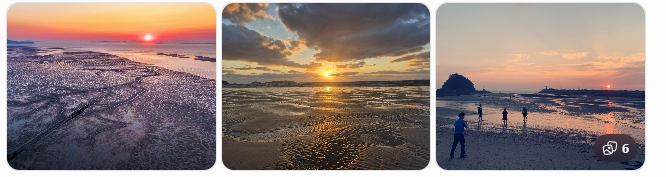
Korea’s Tidal Flats Are a UNESCO World Heritage Site
These mudflats are not simply empty stretches of mud.
They are among Korea’s most valuable natural ecosystems.
UNESCO’s Getbol, Korean Tidal Flats World Heritage property includes tidal-flat ecosystems along Korea’s western, southwestern and southern coasts.
Originally inscribed in 2021, the World Heritage property was expanded in 2026.
UNESCO records thousands of plant and animal species in these coastal wetlands, which also provide vital habitats for migratory birds.
Places including Seocheon, Gochang and Shinan are part of this extraordinary coastal ecosystem.
But for travelers, there is another reason getbol is fascinating:
You don’t always have to admire it from a distance.
You can actually walk into it.
Don’t Just Look at the Mudflat — Step Into It
One of the most memorable west-coast experiences is a Korean tidal-flat activity.
Put on rubber boots, walk onto the mudflat at low tide and you may be able to dig for clams and discover small creatures living beneath the surface.
For Korean families, experiences like these have long been a familiar form of coastal recreation.
For an international traveler, however, it can feel completely different from conventional sightseeing.
You are not looking at Korea through a bus window.
You are standing ankle-deep in it.
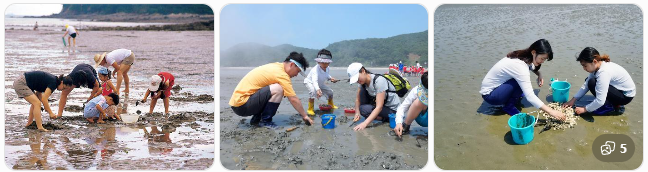
And after seeing where shellfish actually live, the seafood you eat later that day suddenly has a story behind it.
Yes, Koreans Even Turn Mud Into a Festival
If the idea of getting covered in mud sounds fun rather than frightening, there is one west-coast destination you should know:
Boryeong.
The Boryeong Mud Festival has become one of Korea’s best-known international summer festivals.
Visitors slide through mud, play in mud zones, paint themselves with mud and participate in mud beauty-care experiences.
It is one of those rare travel experiences where getting completely dirty is the entire point.
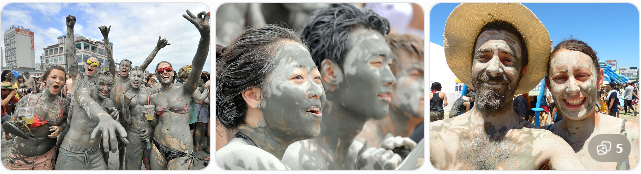
There is an important distinction, however.
The organized mud used for festival and beauty experiences should not be confused with simply scooping random mud from a natural tidal flat and applying it to your skin.
If you want the famous Korean “mud on your face” photo, an organized mud experience such as Boryeong is the better choice.
Then Comes the Best Part: Eating
For me, this is where Korea’s west coast becomes especially interesting.
The tidal flats are not separate from Korean food culture.
They helped create it.
Depending on where you travel and the season, western coastal regions are famous for foods involving clams, oysters, shrimp, blue crab, octopus and other seafood.
In some coastal areas, the experience can become a complete journey:
Walk across the tidal flat.
Experience the fishing village.
See where seafood comes from.
Watch the sunset.
Then eat local seafood nearby.
That is very different from ordering seafood in the middle of Seoul.
The food becomes connected to the landscape.
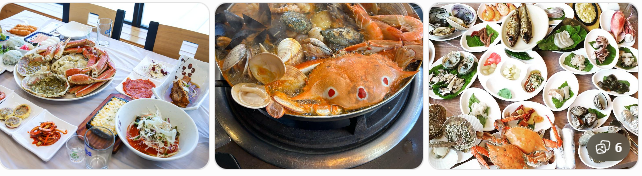
The West Coast Sunset Is Different
There is another reason Koreans travel west.
Sunset.
Because the western coast faces the Yellow Sea, there are countless places where the sun appears to fall directly toward the ocean.
But it is not only the sunset itself.
The combination of shallow water, exposed tidal flats, small islands and fishing boats can create incredibly quiet and almost poetic landscapes.
At low tide, pools of water left across the mudflat can reflect the evening sky.
Fishing villages slowly turn into silhouettes.
The sky changes from gold to orange and finally deep red.
Busan can be exciting.
The west coast can be emotional.
[IMAGE: Dramatic red-orange sunset reflected across a Korean tidal flat]
And the Food Changes as You Travel
Another mistake visitors sometimes make is thinking of “Korean food” as one cuisine that tastes roughly the same everywhere.
Travel outside Seoul and that idea quickly disappears.
Coastal food changes according to geography, season and what local fishermen bring ashore.
Different areas of Korea’s western and southwestern coast have their own relationships with shellfish, crab, shrimp, octopus, oysters, fermented seafood and countless local dishes.
This is one of the reasons I believe food is one of the best ways to travel through Korea.
Don’t only ask:
“What Korean food should I eat?”
Ask:
“What do people eat here?”
That one question can completely change your trip.
Busan or the West Coast?
You don’t necessarily have to choose.
They offer two very different versions of coastal Korea.
Choose Busan if you want a major city, famous beaches, nightlife, markets and excellent seafood with the convenience of an urban destination.
Explore the west coast if you want tidal flats, fishing villages, islands, sunsets, seafood experiences and a slower journey through Korea.
And if you have enough time?
Experience both.
The Korea Beyond Seoul Is Much Bigger Than Most Visitors Realize
Seoul is extraordinary.
But Seoul is not Korea.
The country changes remarkably quickly once you leave the capital.
Travel south and you can find the energy of Busan.
Travel west and the cityscape gives way to tidal flats, fishing villages and sunsets.
Go farther along the southwestern coast and you encounter islands, wetlands and regional food cultures that many international visitors still know very little about.
Perhaps the next stage of Korean tourism will not be about discovering another neighborhood in Seoul.
It will be about discovering another Korea outside Seoul.
And sometimes, the best way to discover it is simple:
Take off your city shoes.
Put on a pair of rubber boots.
Walk onto the tidal flat.
Watch the sun go down.
And then find out what the fishermen caught that day.