You bought a mouse trap.
You found the best bait.
You carefully added a tiny amount of peanut butter.
Then you waited.
Nothing.
The next morning, the trap is untouched.
But five feet away?
Fresh mouse droppings.
At this point, many homeowners blame the trap.
Or the bait.
Or perhaps they decide they are dealing with an unusually intelligent mouse.
But there may be a much simpler explanation:
Your mouse trap is in the wrong place.
When it comes to catching mice, where you put the trap can matter just as much as what you put on it.
In fact, homeowners and pest-control professionals on Reddit repeatedly emphasize the same point: proper placement can be more important than bait.
So instead of putting traps randomly around the house, let’s think like a mouse.
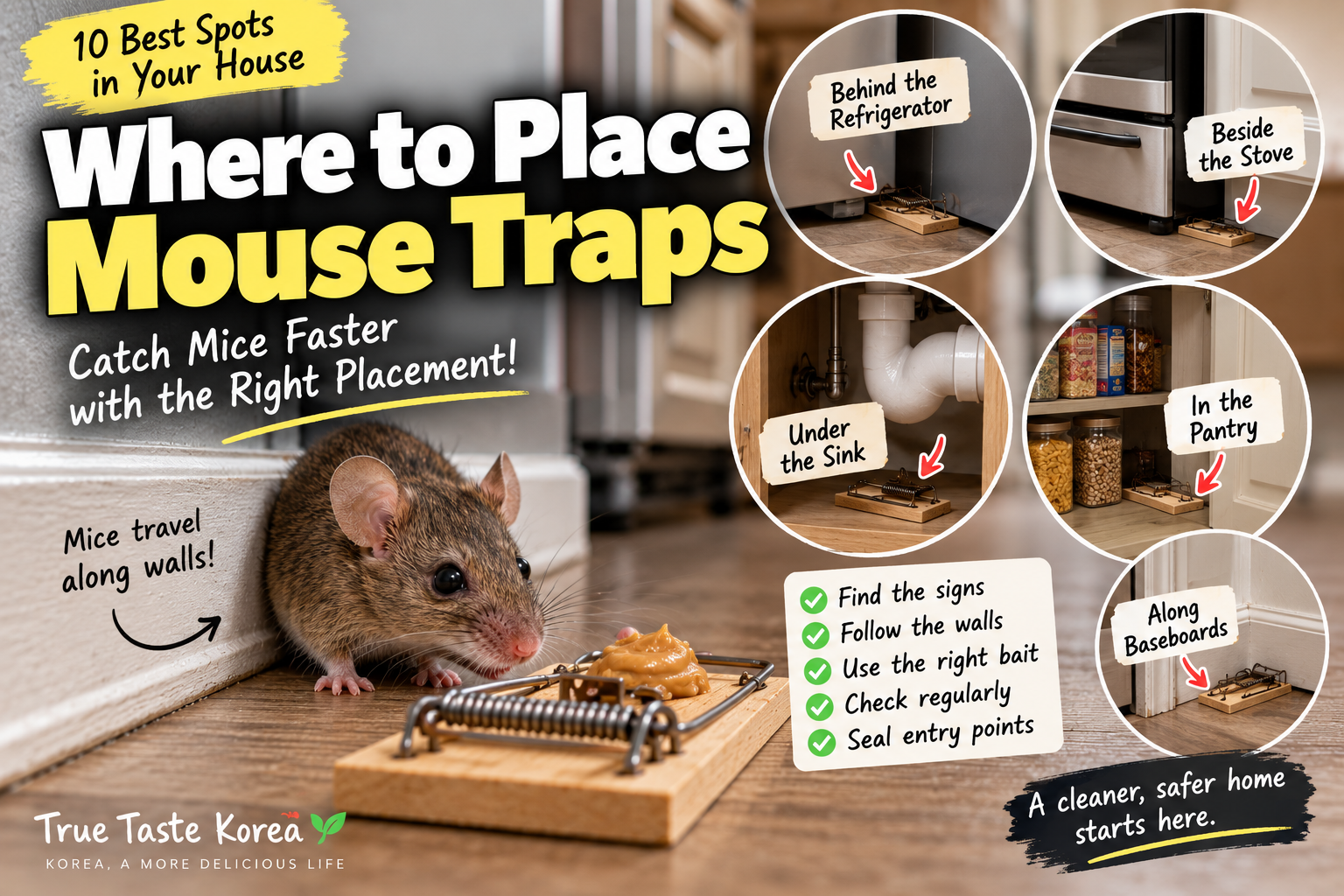
Here are 10 of the best places to put mouse traps in your home — and why they work.
First: Stop Thinking Like a Human
Imagine your kitchen.
You probably walk straight across the middle of the floor.
A mouse often doesn’t.
Mice tend to use protected routes near walls, cabinets, appliances and other objects rather than spending unnecessary time exposed in open spaces.
That changes everything about trap placement.
Suppose you put a trap here:
Middle of kitchen → ❌
But the mouse travels like this:
Behind refrigerator → along cabinet → behind stove → pantry → ✅
Your trap and the mouse may be living in completely different worlds.
That’s why your first job isn’t setting the trap.
It’s discovering the mouse highway.
How Do You Find a Mouse Highway?
Look for evidence.
Common signs include:
- Fresh droppings
- Gnaw marks
- Damaged food packaging
- Nesting material
- Scratching noises
- Greasy or dirty marks along frequently traveled areas
- Food mysteriously disappearing
- Holes or gaps near pipes and cabinets
Don’t just ask:
“Where did I see the mouse?”
Ask:
“Where is it traveling every night?”
A mouse that suddenly runs across your living room may have been frightened.
That doesn’t necessarily mean the middle of your living room is its normal route.
The Most Important Placement Rule: Follow the Wall
One of the simplest mouse-trapping rules is also one of the most important.
Put traps along walls and known travel routes.
This is also one of the strongest themes in homeowner and pest-control discussions online. In one Reddit discussion, a user with professional pest-control experience explained that mice tend to run alongside objects and recommended putting the trap’s snapping side toward the wall. Another commenter summarized the issue even more directly: proper placement is more important than bait.
This is why a trap sitting randomly in the middle of a room can remain untouched even while mice are active only a few feet away.
Now let’s find the best places.
1. Behind the Refrigerator
★★★★★ One of the first places I would check
If you have mice in the kitchen, start here.
Behind a refrigerator can offer several things mice like:
Cover. Warmth. Darkness. Crumbs. A protected travel route.
And because people rarely move their refrigerator, the area can remain undisturbed for long periods.
Reddit homeowners frequently report activity around refrigerators and ovens. In one pest-control thread, a homeowner described repeatedly finding evidence from a mouse believed to be traveling from underneath the refrigerator to underneath the oven.
Pull the refrigerator out carefully if it is safe to do so.
Look for:
- Droppings
- Food debris
- Gnawing
- Gaps around the wall or floor
- Evidence of travel along the baseboard
If you find fresh signs, this may be an excellent trapping location.
Placement tip
Don’t simply put the trap somewhere behind the refrigerator.
Put it on the route where the evidence appears, ideally along the wall while keeping it accessible for inspection.
2. Behind or Beside the Stove
★★★★★ Another kitchen hotspot
The stove is another area people rarely inspect.
Food particles can fall beside or underneath it.
It also provides cover.
If the mouse can move:
Refrigerator → wall → stove → cabinets
you may have found an entire travel corridor.
That’s far better information than simply knowing, “There’s a mouse in my kitchen.”
Check along the wall behind and beside the stove where safe and accessible.
Never place a trap where heat, electrical connections or moving appliances could create a hazard.
3. Under the Kitchen Sink
★★★★★ Check the pipes
Open the cabinet beneath your sink.
Now look where the plumbing enters the wall or floor.
Do you see gaps around the pipes?
These penetrations deserve attention because they may connect cabinets with hidden wall spaces or other parts of the building.
One 2026 Reddit homeowner described mice moving through a small opening near the sink and then entering cabinets.
If you find droppings or other evidence under the sink, placing a trap along an accessible travel edge may be useful.
But remember:
Catching the mouse isn’t the final solution if there’s still an entry point behind the cabinet.
We’ll come back to that.
4. Along the Pantry Wall
★★★★★ Food + cover = investigate here
If you were a mouse, where would you go?
Probably somewhere food is stored.
Check the pantry carefully for:
- Chewed boxes
- Damaged bags
- Droppings
- Spilled cereal or grains
- Pet food
- Nuts
- Seeds
Then inspect the wall edges and back corners.
Don’t put the trap in the middle of the pantry simply because that’s where you can see it easily.
Follow the evidence.
And move food into secure containers so your trap isn’t competing with an entire supermarket.
5. Inside the Back of Lower Cabinets
★★★★☆
Mice don’t care whether a space is convenient for humans.
A dark cabinet corner can provide a protected route between food, plumbing and wall openings.
This is particularly worth investigating when you find droppings inside cabinets.
Look especially at:
Back corners → pipe openings → gaps between cabinetry and walls.
If you place a trap inside a cabinet, make sure it remains accessible and cannot be reached accidentally by children or pets.
6. Along Baseboards Where You Find Droppings
★★★★★ Follow the evidence
This is one of the simplest strategies.
Fresh droppings can tell you where mouse activity is occurring.
In one Reddit discussion about mice inside walls, commenters recommended placing traps near the opening and where droppings had been found.
Don’t obsess over finding the theoretically perfect room.
If you repeatedly find fresh evidence along one wall, that’s telling you something.
Mouse droppings are clues.
Treat your house like a crime scene.
Where is the evidence concentrated?
Start there.
7. Near Suspected Entry Points
★★★★★ Critical for understanding the real problem
Suppose you discover a small gap near a pipe.
Or beneath a cabinet.
Or around a utility line.
And nearby you find fresh droppings.
You may have found more than a good trap location.
You may have found part of the reason mice are inside your house.
A Reddit DIY post showing a gap beneath a cabinet attracted dozens of comments focusing not only on trapping but on eventually closing the opening.
Another homeowner who discovered where mice were entering the kitchen used traps while waiting for an exterminator, with commenters discussing the importance of dealing with the infestation before permanently repairing the opening.
This is important:
Trapping and exclusion are two different jobs.
The trap deals with mice already inside.
Exclusion helps stop new mice from entering.
8. Garage Walls and Corners
★★★★☆
Garages can be mouse-friendly environments.
Think about what may be stored there:
Dog food.
Bird seed.
Grass seed.
Cardboard boxes.
Garbage.
Camping food.
Clutter.
And unlike the main living area, the garage may have larger gaps around doors and utility penetrations.
Inspect:
Garage-door edges, wall perimeters, storage areas and the boundary between the garage and the house.
Again, don’t scatter traps randomly.
Follow droppings and damage.
If children, pets or wildlife can access the area, exposed snap traps may not be appropriate; choose a protected setup or seek professional advice.
9. Attic or Crawlspace Access Areas
★★★★☆
Hearing scratching above your ceiling at night?
Don’t immediately start cutting holes into your house.
First investigate safely accessible transition points.
Look around:
- Attic access areas
- Crawlspace entrances
- Structural edges
- Utility penetrations
- Areas with droppings or nesting evidence
People discussing mice inside walls and ceilings on Reddit often describe how difficult the problem becomes when the animal is inside an inaccessible void.
If you’re dealing with electrical wiring, unsafe attic conditions, heavy contamination or inaccessible spaces, this is a good point to consider professional pest control rather than improvising.
10. Behind Furniture Along a Wall
★★★☆☆ Often overlooked
Bedrooms and living rooms aren’t usually the first place people think about mouse traps.
But if you’ve seen evidence there, investigate.
Large furniture creates hidden edges.
A mouse may move behind:
- Sofas
- Bookcases
- Entertainment centers
- Dressers
- Storage furniture
If fresh droppings repeatedly appear behind a sofa, putting a trap ten feet away in the center of the room makes little sense.
Put it where the activity is.
Exactly How Should a Snap Trap Face the Wall?
This small detail matters.
For a traditional snap trap, a common recommended setup is:
Wall
⬇
BAIT/TRIGGER END
TRAP
⬆
Open room
In other words, position the trap perpendicular to the wall with the bait/trigger side closest to the wall, so a mouse traveling along the wall encounters the trigger area.
This perpendicular placement also appears repeatedly in experienced Reddit pest-control advice.
Don’t just place a trap parallel to the wall because it looks neat.
You’re not decorating.
You’re intercepting a travel route.
Should You Put Two Traps Together?
Sometimes using multiple traps along active routes makes sense.
If you have clear evidence of repeated activity in a particular area, several properly positioned traps can increase the chances of intercepting the mouse.
This is particularly useful when you don’t know the exact direction of travel.
But don’t respond to uncertainty by placing 20 traps randomly around the house.
More traps in bad locations are still badly placed traps.
First find the activity.
Then concentrate your effort.
Where NOT to Put a Mouse Trap
This matters just as much.
❌ In the middle of an open room
Unless you have specific evidence mice are repeatedly crossing there.
❌ Somewhere you can’t check
A trap behind an inaccessible wall or permanently beneath built-in furniture creates another problem.
You should be able to inspect traps regularly.
❌ Where children can reach it
Snap traps can injure fingers.
❌ Where pets can reach it
Dogs and cats may investigate bait.
❌ On food-preparation surfaces
Don’t create unnecessary sanitation problems.
❌ Somewhere dangerous to access
Don’t climb into unsafe attic spaces or reach blindly around electrical wiring just because you heard scratching.
Safety comes first.
The Reddit Lesson: Stop Moving the Bait — Move the Trap
This is one of my favorite lessons from reading mouse discussions online.
Homeowners often go through this sequence:
Night 1: Peanut butter.
Nothing.
Night 2: Cheese.
Nothing.
Night 3: Chocolate.
Nothing.
Night 4: Bacon.
Nothing.
At some point, the question should stop being:
“What else will this mouse eat?”
and become:
“Is the mouse even walking past this trap?”
One Reddit discussion involved a mouse that had apparently lived inside a home for around six months despite multiple traps and several baits. The owners were seeing it travel between the refrigerator and oven — valuable information that mattered at least as much as the food placed on the traps.
Another discussion involving professional pest-control experience summarized it perfectly:
Proper placement is far more important than bait.
That’s the principle I would remember.
What If the Trap Is Still Empty After Several Nights?
Don’t automatically buy a different trap.
Reinspect.
Ask:
Are the droppings fresh?
Did new evidence appear somewhere else?
Is there another food source?
Did I actually place the trap on a travel route?
Has the mouse moved to another part of the house?
A trap isn’t a surveillance camera.
An empty trap tells you only that it didn’t catch a mouse there.
It doesn’t necessarily mean there are no mice.
A Cheap Camera Can Reveal a Lot
Here’s a clever idea that appears repeatedly in homeowner discussions.
Some people use inexpensive indoor security cameras to watch mouse activity overnight.
One Reddit homeowner who had identified a kitchen entry point said a camera helped show when rodents were active and whether the traps were working.
Another homeowner literally watched a difficult mouse moving around a kitchen while trying different trapping strategies.
This isn’t necessary for most infestations.
But when you’ve spent days guessing where the mouse goes, seeing the actual route can change everything.
You’re essentially doing nighttime reconnaissance.
What If You Hear Mice Inside the Wall?
This deserves its own future article because it’s a major search problem.
If you hear:
scratch… scratch… scratch…
inside the wall at 2 a.m., don’t panic.
The important question becomes:
Where do they come out to find food?
In a Reddit pest-control discussion about mice inside walls, one response recommended placing traps near the accessible opening because the mice eventually have to leave the void to forage.
Don’t blindly put poison inside inaccessible wall spaces or cut into walls without understanding what’s behind them.
If the infestation is inaccessible, persistent or involves electrical/plumbing hazards, professional help may be appropriate.
And yes:
We’re going to make “Mice in the Walls: What to Do When You Hear Scratching at Night” into a separate article later.
That’s another excellent search keyword.
Trap Placement Is Only Half the Solution
Suppose you place the trap perfectly.
You catch one mouse.
Then another.
Then another.
Congratulations.
But also:
Why are there so many mice entering your house?
At some point trapping becomes a symptom-management strategy.
The long-term job is finding how rodents are getting inside and preventing continued access.
Look around:
- Pipes
- Utility cables
- Door gaps
- Foundation openings
- Cabinet penetrations
- Garage entrances
- Exterior vents
- Damaged building materials
That’s why the next stage after successful trapping is mouse-proofing your home.
The 10 Best Mouse Trap Locations — Quick Guide
| Location | Priority | What to Look For |
|---|---|---|
| Behind refrigerator | ★★★★★ | Droppings, crumbs, wall routes |
| Behind/beside stove | ★★★★★ | Food debris, protected edges |
| Under kitchen sink | ★★★★★ | Pipe gaps, droppings |
| Pantry wall | ★★★★★ | Chewed food packages |
| Lower cabinets | ★★★★☆ | Droppings, plumbing gaps |
| Active baseboards | ★★★★★ | Fresh droppings/gnawing |
| Near entry points | ★★★★★ | Holes and utility gaps |
| Garage perimeter | ★★★★☆ | Food storage, door gaps |
| Attic/crawlspace access | ★★★★☆ | Nesting/activity signs |
| Behind furniture | ★★★☆☆ | Protected wall routes |
The ratings are practical editorial priorities, not a scientific ranking.
My Simple Mouse Trap Placement Strategy
If I discovered mice in my kitchen tonight, I wouldn’t begin by putting traps everywhere.
I’d do this:
Step 1 — Find fresh droppings and damage.
Step 2 — Check behind the refrigerator and stove.
Step 3 — Inspect beneath the sink and around pipes.
Step 4 — Identify the wall route connecting those areas.
Step 5 — Put traps directly on that route.
Step 6 — Remove accessible competing food.
Step 7 — Check the traps regularly.
Step 8 — Identify and eventually seal the entry points.
That’s a much better strategy than randomly putting traps around the house and hoping a mouse eventually finds one.
Best Bait + Best Location = Much Better Odds
This article connects directly with the previous two guides in our mouse-control series.
If your mouse is eating the bait without getting caught, read:
Mice Keep Stealing the Bait? Why Your Mouse Trap Isn’t Working
If you’re still deciding what food to use, read:
Best Mouse Trap Bait: Peanut Butter vs. Other Baits — What Actually Works?
And remember:
You don’t necessarily need increasingly exotic bait.
Sometimes the solution is moving the trap three feet closer to the wall where the mouse actually runs.
Final Answer: Where Should You Place Mouse Traps?
If you remember only three things from this article, remember these:
1. Follow the evidence.
Fresh droppings, gnawing and damaged food tell you where activity is occurring.
2. Follow the walls.
Mice commonly use protected edges and routes rather than crossing exposed spaces unnecessarily.
3. Find the entrance.
Catching the mouse already inside is useful.
Preventing the next mouse from entering is better.
The best mouse trap isn’t necessarily the expensive one.
And the best bait isn’t necessarily something exotic.
Sometimes the biggest improvement you can make costs absolutely nothing.
Move the trap to where the mouse actually is.
Next Guide in This Series
Mice in the Walls: What to Do When You Hear Scratching at Night
This is the next one I would write.
It has a completely different search intent from mouse trap bait and where to place mouse traps, while naturally connecting to both.
After that:
How Are Mice Getting Into My House? 10 Entry Points to Check
That would give us a very strong problem-solving cluster.
K-Beauty Shopping
Interested in Korean skincare and beauty products? You can browse K-Beauty products through OLIVE YOUNG Global.
Shop K-Beauty at OLIVE YOUNG Global
If you purchase through the link above, the site operator may receive a commission at no additional cost to you.