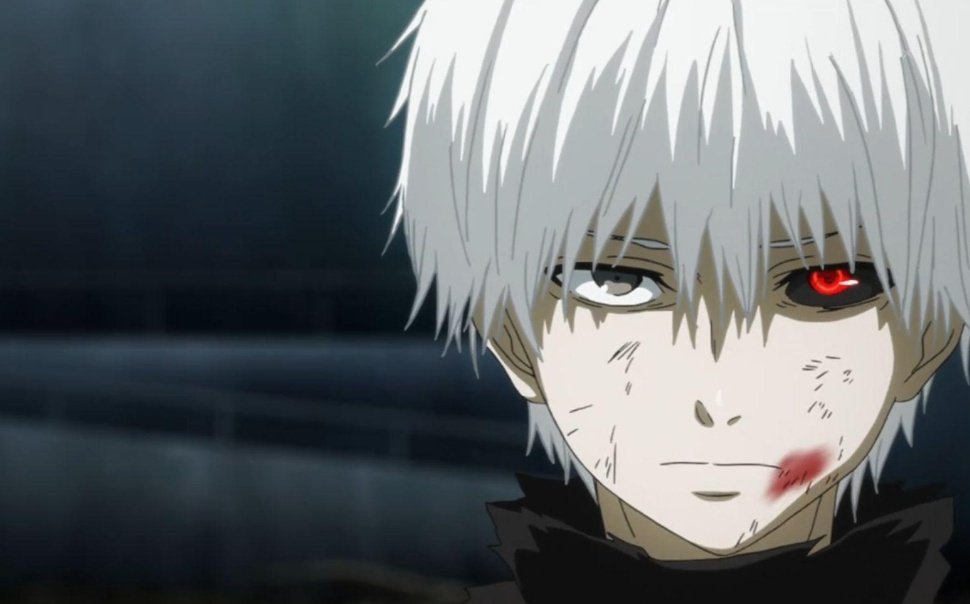
Ken Kaneki never wanted to become a monster.
Before his transformation, he was an ordinary college student who enjoyed books, avoided conflict, and preferred a quiet life. After a violent encounter with Rize Kamishiro, however, a medical operation turned him into something that belonged to neither the human world nor the ghoul world.
His new body demanded something he could barely accept: human flesh.
At first glance, Tokyo Ghoul appears to be a dark fantasy about a young man gaining monstrous powers. But beneath its violence lies a much more disturbing question:
If survival requires you to become something you hate, how much of yourself can you sacrifice before you lose your identity?
Kaneki’s journey is not simply about becoming stronger. It is about trying to remain human in a world where humanity is not guaranteed by biology.
1. Kaneki’s Transformation Was More Than a Physical Change
Kaneki’s transformation begins with his body, but its consequences reach much deeper.
He suddenly experiences hunger, physical instincts, and abilities that make his former human life almost impossible. Food that once gave him comfort becomes unbearable. His body no longer follows the rules he understood.
The frightening part is not simply that he has become a ghoul.
It is that he can still remember being human.
Kaneki carries his previous identity into a body that constantly contradicts it. Every meal, every encounter, and every attempt to return to normal life reminds him that he cannot simply reverse what happened.
His real struggle begins when he realizes that his old identity cannot protect him from his new reality.
2. Why Did Kaneki Initially Reject the Ghoul Inside Him?
Kaneki’s rejection of his ghoul nature is understandable.
Ghouls survive by consuming human flesh. From his former human perspective, this makes them terrifying predators. Accepting his new body therefore feels like accepting the behavior he once feared.
But his reaction also reveals something important about his personality.
Kaneki has a strong desire to avoid hurting others. He wants to believe that people can coexist without being forced into cruelty.
His problem is that his moral beliefs were formed in a world where he never had to experience the hunger of a ghoul.
Now he must confront a reality in which his own survival conflicts with the values he once considered unquestionable.
This is the first major contradiction in his character: he wants to remain morally innocent, but he has entered a world where innocence cannot guarantee survival.
3. Anteiku Showed Him That Monsters Could Have Ordinary Lives
Anteiku is one of the most important places in Kaneki’s development.
The café introduces him to ghouls who do not fit the image he previously imagined. They work, form relationships, protect one another, and attempt to live quietly despite the dangers surrounding them.
Yoshimura, Touka, and the others gradually show Kaneki that being a ghoul does not automatically determine someone’s moral character.
This changes his understanding of the world.
Before Anteiku, Kaneki believed the distinction between humans and ghouls was relatively clear. One group was human; the other was a threat.
Anteiku makes that distinction increasingly difficult to maintain.
The people who help him survive are ghouls. The people who hunt ghouls are humans. Neither category can be understood through biology alone.
Anteiku does not simply give Kaneki a place to stay.
It gives him his first opportunity to question the moral boundaries he inherited from his human life.
4. Touka Challenged His Comfortable View of Humanity
Touka is important because she does not allow Kaneki to remain comfortably confused.
Unlike Kaneki, she has lived with the consequences of being a ghoul for much longer. She understands the danger of the human world and the compromises necessary to survive.
Her anger and harshness sometimes make her difficult to approach, but they also expose Kaneki’s limitations.
Kaneki wants to understand both humans and ghouls, yet he often struggles to recognize how difficult that position is for someone who has suffered directly.
Touka represents a more practical response to the same conflict.
She does not have the luxury of treating the human-ghoul relationship as an abstract moral question. For her, it is a daily struggle involving survival, family, and discrimination.
Through Touka, Kaneki begins to understand that compassion without an understanding of reality can become another form of helplessness.
5. Jason’s Torture Forced Kaneki to Confront His Own Fear
The torture inflicted by Yamori, also known as Jason, is the turning point most viewers remember.
Kaneki is placed in a situation where his former values appear powerless. His body is subjected to extreme violence, and his mind is pushed toward collapse.
But the deeper significance of this sequence is not simply that Kaneki becomes stronger.
He is forced to confront a truth he has tried to avoid: refusing to acknowledge his own capacity for violence does not make him safe.
His desire to protect others has repeatedly left him vulnerable. He has struggled to defend himself because he fears becoming the kind of person he hates.
Jason destroys the illusion that he can survive indefinitely through passive resistance.
Kaneki’s transformation is therefore both physical and psychological.
He begins to recognize that protecting others sometimes requires the willingness to use the strength he has been rejecting.
6. The White-Haired Kaneki Was Not Simply a New Personality
The image of white-haired Kaneki has become one of the most recognizable symbols of the series.
It is often described as the moment Kaneki becomes cold, ruthless, or completely different from his former self.
But that interpretation is incomplete.
The transformation does not erase everything that came before. His desire to protect people remains. His sensitivity remains. His fear and emotional vulnerability do not simply disappear.
What changes is his willingness to acknowledge the violent side of his new existence.
The earlier Kaneki wanted to believe that he could protect people without becoming dangerous himself.
The later Kaneki understands that this may not be possible.
His new appearance represents a dramatic change, but the conflict inside him remains connected to the same person who entered Anteiku searching for a place to belong.
The tragedy is not that he becomes someone else.
It is that he must become stronger without knowing whether he can survive the process emotionally.
7. Why Did Kaneki Refuse to Become a Simple Monster?
Kaneki has opportunities to embrace the logic of power.
He could accept that the strongest survive, that weakness deserves punishment, and that anyone standing in his way is an enemy.
Yet he repeatedly struggles against this worldview.
His experiences have taught him that both humans and ghouls can be cruel. He has seen victims become perpetrators and protectors become sources of suffering.
This makes it difficult for him to accept a simple division between good and evil.
Kaneki’s resistance to becoming a monster is not based on the belief that he is incapable of violence.
It comes from his awareness that violence can become a way of life.
Once survival becomes the only measure of right and wrong, there is little left to prevent a person from repeating the cruelty that once harmed them.
Kaneki fears losing that final boundary.
8. His Greatest Weakness Was the Desire to Carry Everyone’s Pain
One of Kaneki’s most persistent characteristics is his willingness to take responsibility for other people’s suffering.
He wants to protect his friends. He wants to prevent unnecessary deaths. He wants to keep the people around him safe.
These intentions are admirable, but they also become dangerous.
Kaneki repeatedly treats his own suffering as an acceptable price for protecting others. He often believes that if he becomes stronger or suffers enough, he can prevent everyone else from being hurt.
This creates a destructive pattern.
Instead of sharing responsibility, he carries too much of it himself. Instead of trusting others, he tries to become the person who absorbs every consequence.
His self-sacrifice sometimes looks like courage, but it can also become an inability to accept that other people have their own choices and responsibilities.
The series suggests that protecting others is not the same as controlling every outcome.
9. Haise Sasaki Raised an Uncomfortable Question: Can a Person Escape Their Past?
In Tokyo Ghoul:re, Kaneki’s identity becomes even more complicated.
After losing his memories, he lives as Haise Sasaki and works within the CCG, the organization that investigates and fights ghouls.
Haise is not simply Kaneki pretending to be someone else.
He develops relationships, responsibilities, and a life that has meaning in its own right.
His role as a mentor to the Quinx Squad gives him something that Kaneki previously struggled to maintain: a relatively stable sense of belonging.
But the past has not disappeared.
The return of Kaneki’s memories forces him to confront the possibility that his previous life cannot be separated from the person he has become.
Haise raises a difficult question:
If a person loses their memories and builds a new identity, does that new life become less real when the past returns?
The answer is not easy.
Haise’s experiences matter, even if they do not erase Kaneki’s earlier suffering.
10. Was Haise the Person Kaneki Always Wanted to Be?
There is a temptation to view Haise as an artificial identity that must eventually disappear.
But this interpretation overlooks what makes his character interesting.
Haise has relationships and responsibilities that are not merely extensions of Kaneki’s previous life. He cares about the people under his protection and tries to create a stable environment for them.
In some ways, Haise represents a life Kaneki might have wanted before his transformation.
A life where he could protect people without constantly fighting against his own identity.
However, that life is built on missing memories and unresolved trauma.
Haise cannot remain completely separate from Kaneki because the experiences that shaped Kaneki still influence him.
The important question is not which identity is real.
It is whether a person can accept every part of their history without allowing the past to destroy the present.
11. Tokyo Ghoul Questions the Meaning of Being Human
One of the strongest ideas in Tokyo Ghoul is that humanity cannot be defined by appearance or biology alone.
Humans can commit terrible acts. Ghouls can show compassion. People who claim to protect society can become instruments of cruelty.
This does not mean that every human and every ghoul is morally equivalent.
The series does not need to deny the reality of violence or the suffering of victims to make its point.
Instead, it challenges the assumption that belonging to a particular species automatically makes someone good or evil.
Kaneki stands at the center of this contradiction.
His body belongs partly to the world he once feared, but his memories and relationships remain connected to the human world.
He becomes a living challenge to the categories both sides use to justify their actions.
Perhaps the most disturbing question is not whether Kaneki is human or ghoul.
It is why both sides need to believe that the other side is a monster.
12. Why the Manga Explains Kaneki Better Than the Anime
The anime adaptation delivers memorable imagery, music, and emotional scenes.
However, many readers and viewers on Reddit argue that the manga provides a more complete understanding of Kaneki’s psychology.
One major reason is the use of internal monologue.
The manga allows readers to follow Kaneki’s thoughts, doubts, memories, and changing interpretations of events. His transformation is not merely something that happens to his appearance.
It is a gradual shift in how he understands himself.
The difference becomes particularly important after the torture arc.
In the manga, Kaneki’s decisions and changing relationships receive more narrative development. The anime’s second season, Tokyo Ghoul √A, takes a substantially different route from the manga, while the later Tokyo Ghoul:re adaptation compresses significant material.
This can make the anime version of Kaneki appear more abruptly transformed than the manga version.
The anime is still worth experiencing for its atmosphere and visual storytelling.
But readers who want to understand the full reasoning behind Kaneki’s decisions will find the manga considerably more rewarding.
13. Was Kaneki’s Desire to Protect Others Actually Self-Destructive?
Kaneki’s compassion is often treated as his greatest strength.
But the series also shows how compassion can become dangerous when it is separated from self-respect.
He repeatedly places himself in situations where he believes he must suffer to protect someone else.
At first, this seems noble.
Over time, however, it becomes difficult to distinguish genuine responsibility from self-punishment.
Kaneki sometimes acts as if his own life matters less than everyone else’s. He tries to solve problems by sacrificing himself rather than accepting that some situations require cooperation, trust, and difficult compromises.
This is an important distinction.
A person can be compassionate without accepting unlimited suffering.
Protecting others does not require destroying oneself.
Kaneki’s development becomes more meaningful when we recognize that his struggle is not only about accepting his ghoul nature.
It is also about learning that he deserves to live.
14. The Real Meaning of Kaneki’s Journey Is Not Choosing One Side
A conventional transformation story often ends with the protagonist accepting a new identity.
Kaneki’s journey is more complicated.
He cannot simply return to his former human life. But he also cannot accept every value associated with the ghoul world.
His experiences repeatedly force him to recognize that both worlds contain people worth protecting and systems capable of cruelty.
This does not make him a perfect mediator.
He makes mistakes. He hurts people. His attempts to protect others sometimes create new dangers.
But his importance lies in his refusal to let the conflict define the limits of his moral imagination.
He does not need to pretend that humans and ghouls are identical.
He needs to recognize that neither group has an automatic monopoly on humanity.
That is a much harder position than simply choosing a side.
Conclusion: Kaneki Refused to Give Up His Humanity Because It Was All He Had Left
Ken Kaneki’s story begins with the loss of an ordinary human life.
His body changes, his relationships become more complicated, and his understanding of the world is repeatedly shattered.
Yet the central conflict remains remarkably consistent.
He wants to survive without becoming the kind of person who makes survival impossible for everyone else.
That desire is not always successful. Kaneki’s compassion sometimes becomes self-destruction, and his determination to protect others can lead him into terrible decisions.
But these contradictions are precisely what make him compelling.
Tokyo Ghoul is not simply a story about a human becoming a monster.
It is a story about someone discovering that the boundary between humanity and monstrosity is far more fragile than he ever imagined.
Kaneki did not refuse to become a ghoul. He refused to believe that becoming one meant he had to stop being human.
And that is why his struggle remains the emotional heart of Tokyo Ghoul.