K-Pop Tourism

  • Why Is an Entire City Turning Purple for BTS? Bogotá’s Extraordinary Welcome Explained

    BTS has been named an honorary guest of Colombia’s capital. With two sold-out concerts, special transportation, purple landmarks, and fans arriving from abroad, Bogotá is preparing for something much bigger than a music event.

    Imagine arriving in a city for a concert and discovering that the city itself has joined the celebration.

    The government buildings are glowing purple. A famous hilltop landmark is illuminated in the same color. Special buses are being prepared to take fans home after the show.

    And the performers?

    They have officially been named honorary guests of the city.

    This is what Bogotá, Colombia, is doing for BTS.

    On October 2 and 3, 2026, the seven-member Korean group is scheduled to perform at Estadio Nemesio Camacho El Campín, opening the Latin American leg of its ARIRANG world tour.

    But the biggest story may be happening outside the stadium.

    Why is an entire city preparing such an extraordinary welcome for a K-pop group?

    1. BTS Has Been Named an Honorary Guest of Bogotá

    On September 30, Bogotá Mayor Carlos Fernando Galán officially designated BTS as Huéspedes de Honor, or honorary guests.

    This is a formal civic recognition, not merely a promotional title created for the concert.

    According to reports citing the city government and BIGHIT MUSIC, Bogotá recognized BTS for its contribution to the international visibility of Korean music and culture and its influence on younger generations.

    The distinction also reflects the city’s ambition to establish itself as a destination for major cultural events.

    Mayor Galán described BTS as more than a band and expressed his hope that concert visitors would experience Bogotá itself.

    That statement reveals an important shift in how cities can view major international concerts.

    BTS is not simply bringing a show to Bogotá. The group is bringing an international audience.

    And Bogotá wants that audience to discover the city beyond the stage.

    2. Bogotá Is Turning Its Landmarks Purple

    Purple has a special meaning for BTS and ARMY, the group’s global fandom.

    For years, it has represented affection, trust, and a shared identity between the artists and their fans.

    Now Bogotá is using that color as a public welcome.

    Among the landmarks featured in the city’s purple-light celebrations are Palacio Liévano, the historic city hall building; Torre Colpatria, one of Bogotá’s recognizable towers; and the church on Monserrate, the mountain overlooking the capital.

    For international fans arriving in Colombia, the symbolism is easy to understand.

    They are visiting a city that appears to recognize their connection with BTS.

    For local residents, the illumination also makes the concerts part of the city’s visible cultural landscape.

    The purple lights are more than decoration.

    They turn a private fan identity into a public celebration.

    3. The Numbers Reveal Why Bogotá Is Paying Attention

    Bogotá’s tourism authorities expect the two BTS concerts to generate more than 99 billion Colombian pesos in spending across the local economy.

    That is approximately 40.6 billion Korean won, or around $30 million, according to contemporary reports.

    Importantly, this is a projection of economic activity, not a final count of money earned by the city.

    The estimate includes spending on food, accommodation, local transportation, shopping, and souvenirs.

    Official tourism data also reveals something remarkable about the audience.

    18.4% of ticket purchases were made from outside Colombia.

    The city’s tourism institute says this is roughly twice the international purchase share typically recorded for concerts in Colombia.

    Ecuador, Mexico, and Venezuela account for a substantial portion of the international ticket purchases.

    Flight reservations to Bogotá for September 30 through October 4 were also reported to be 46.6% higher than during the comparable period in 2025.

    These figures suggest that BTS’s concerts are influencing travel decisions well beyond Colombia’s borders.

    For some fans, seeing BTS means booking a flight, reserving a hotel, arranging transportation, and spending several days in a city they might not otherwise have visited.

    The concert becomes the reason for the journey.

    But the city itself becomes part of the experience.

    4. Even Bogotá’s Public Transportation Is Preparing for ARMY

    A concert attended by tens of thousands of people creates practical challenges.

    How do fans reach the venue?

    And perhaps more importantly, how do they return safely after the performance?

    Bogotá is responding with expanded transportation arrangements.

    The city’s TransMilenio system has announced eight special routes to help concertgoers travel from the stadium area toward major parts of the city after the shows.

    It may sound like a minor logistical detail compared with purple landmarks and honorary titles.

    But it tells another part of the story.

    A successful international concert depends not only on the performers but also on the people and infrastructure surrounding them.

    From public transit workers to hotels and restaurants, many parts of Bogotá are involved in welcoming the visitors.

    In that sense, the concert experience begins long before BTS walks onto the stage.

    5. Reddit Fans Want More Than a Concert — They Want the Stadium to Jump

    What are fans expecting from the Latin American leg of the tour?

    On October 2, the BTS community r/bts7 opened its South American concert discussion thread.

    Its opening message captured the excitement with a simple wish:

    “We are ready for the stadium to jump.”

    The message also called for loud cheering.

    That excitement is not a verified account of what happened at the Bogotá concerts. It is a fan-community expression of anticipation before the performances.

    But it reveals something important about the way many ARMYs imagine a BTS concert.

    They do not want to remain silent spectators.

    They want to sing, shout, jump, and participate.

    Other Reddit tour discussions have focused on ticketing, meeting fellow fans, and preparing to attend concerts.

    The conversations show that the experience extends beyond the music itself.

    For some fans, the anticipation includes finding someone to attend with.

    For others, it means traveling to another city or country.

    And for those who have spent years watching BTS concert videos, the dream is finally to become one of the voices inside the stadium.

    6. Why Does Singing Together Matter So Much?

    There is something fascinating about the relationship between BTS and its live audience.

    The group performs in Korean, yet fans across the world learn lyrics and sing along.

    A language that may be unfamiliar in everyday conversation becomes familiar through music.

    And when thousands of people sing the same chorus, the experience changes.

    The audience is no longer simply listening.

    It becomes part of the performance.

    This is one reason BTS concert videos can be so compelling even to someone watching from thousands of miles away.

    The energy moves in both directions.

    BTS performs with intensity.

    ARMY responds with its own enthusiasm.

    The result can feel less like a conventional performance and more like a conversation between the stage and the stadium.

    For Bogotá, that exchange is especially meaningful.

    The city is welcoming visitors from different countries who may speak different languages but share a connection through the same music.

    Korean lyrics, Latin American voices, and a Colombian stadium are about to meet in one place.

    7. From Korean Cinema to K-Pop: Bogotá’s Unexpected Cultural Connection

    For some Korean entertainment fans, the name Bogotá may already sound familiar.

    The Colombian capital provided the setting for the Korean film Bogotá: City of the Lost, starring Song Joong-ki and released in South Korea in late 2024.

    The film portrayed Bogotá through a story of migration, ambition, and the search for opportunity.

    Now the city is appearing in a very different Korean cultural story.

    This time, the central figures are BTS and the fans traveling to see them.

    The connection is coincidental, but it offers an interesting contrast.

    One Korean production used Bogotá as the setting for a fictional journey.

    BTS’s concerts are bringing real travelers to experience the city for themselves.

    And those visitors may return home with memories of Colombian food, streets, landmarks, and people alongside their memories of the concert.

    8. The Most Interesting Part of Bogotá’s Welcome

    The obvious headline is that BTS has received an honorary civic distinction.

    Another headline is the estimated economic impact.

    Both are significant.

    But the most interesting part may be what Bogotá is attempting to do with the attention.

    The city is not treating the concerts as isolated events taking place inside a stadium.

    It is connecting the performances to tourism, transportation, landmarks, and cultural identity.

    That approach raises a broader question.

    Can a K-pop concert become an introduction to an entire country?

    For some visitors, the answer may be yes.

    A fan might travel to Bogotá because of BTS but discover Colombian culture along the way.

    They might visit Monserrate, explore the Gold Museum, try local food, or meet Colombian ARMYs.

    When they return home, the stories they tell may include much more than the concert setlist.

    This is where the cultural significance of the event extends beyond ticket sales.

    K-pop brings visitors to a city.

    The city has an opportunity to introduce itself to those visitors.

    And the fans carry their experiences back across borders.

    The Concert Is Inside the Stadium. The Celebration Is Across Bogotá.

    BTS’s two concerts on October 2 and 3 mark the group’s first full-group performances in Colombia.

    The audience will come for the music, the choreography, the live vocals, and the chance to see seven performers together onstage.

    But outside El Campín, another kind of performance is taking shape.

    Purple lights are illuminating landmarks.

    Transportation services are preparing for the crowds.

    Hotels, restaurants, and businesses are welcoming visitors.

    And fans are getting ready to sing.

    It is too early to describe the actual atmosphere of the concerts before they take place.

    But one thing is already clear from Bogotá’s preparations.

    BTS may be performing inside the stadium, but Bogotá is creating a celebration across the city.

    And when tens of thousands of ARMYs finally sing together, the most powerful sound of the night may come not from the stage—

    but from the people singing back.


    Editor’s note: This article was prepared on October 2, 2026, ahead of the scheduled Bogotá concerts. Economic figures are official forecasts, and Reddit reactions reflect pre-concert anticipation rather than verified eyewitness accounts.
    Sources

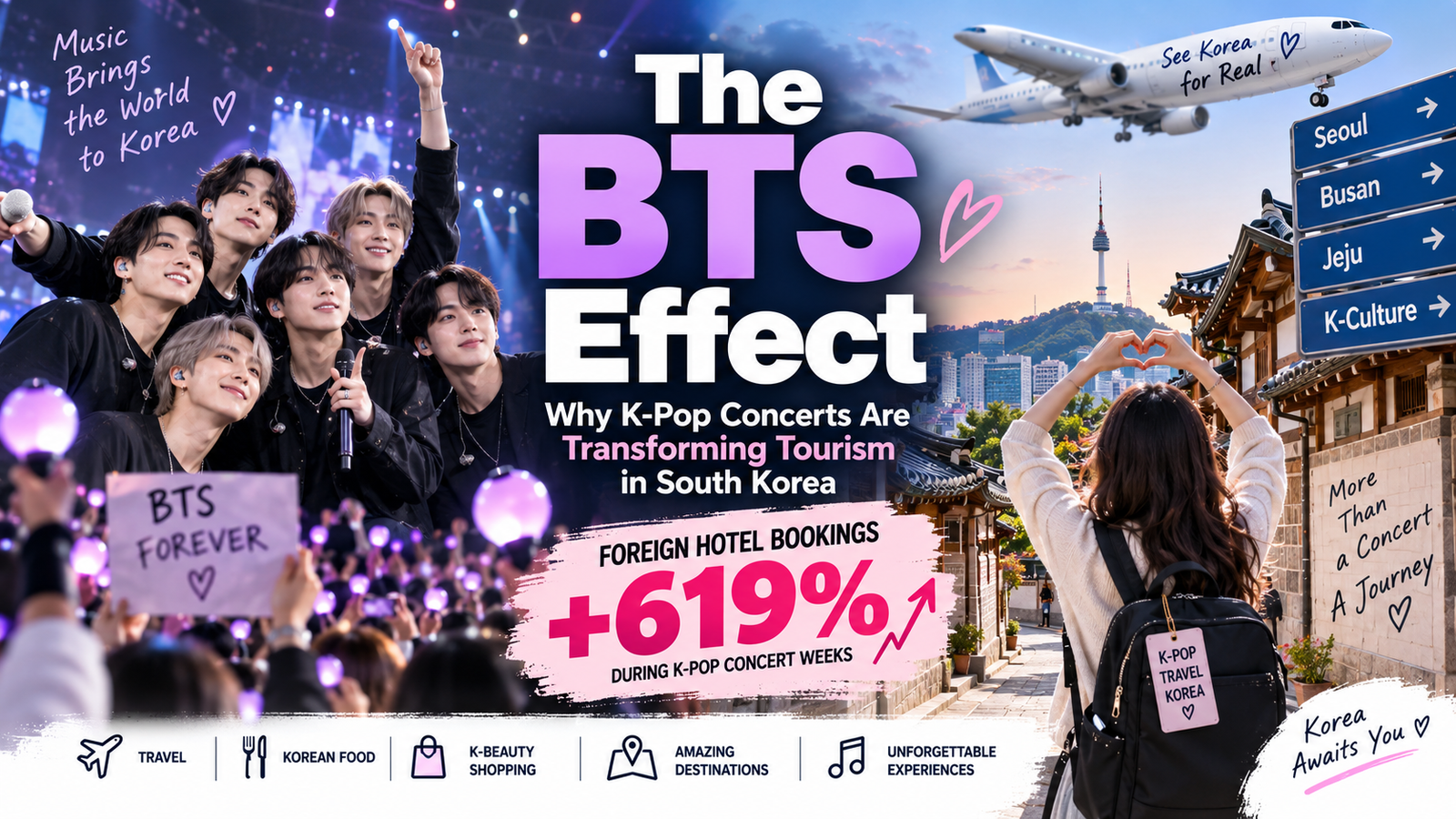
  • The BTS Effect: Why K-Pop Concerts Are Transforming Tourism in South Korea

    The BTS Effect: Why K-Pop Concerts Are Transforming Tourism in South Korea

    For millions of international travelers, a trip to South Korea once began with a familiar checklist:

    Seoul.

    Gyeongbokgung Palace.

    Myeongdong.

    Korean barbecue.

    Maybe Jeju Island or Busan.

    But a new kind of traveler is changing Korean tourism.

    Their trip may begin with something completely different:

    A concert ticket.

    A BTS performance.
    A BLACKPINK concert.
    A Stray Kids show.

    Fans fly thousands of miles to Korea for a few hours of music — but they rarely leave after the concert.

    They stay in hotels.

    They eat Korean food.

    They shop.

    They visit neighborhoods connected to their favorite artists.

    They travel to other cities.

    And increasingly, K-pop is becoming not simply something tourists enjoy while visiting Korea.

    K-pop is becoming the reason they visit Korea in the first place.

    New tourism data shows just how powerful this phenomenon has become.

    According to an analysis by the Korea Tourism Organization, accommodation bookings by foreign visitors surged 619.2% during weeks featuring concerts by three major K-pop acts compared with non-concert weeks in the dataset.

    And BTS provides perhaps the clearest example yet of what happens when global fandom turns into actual travel.

    Welcome to the new era of K-pop tourism in South Korea.


    The BTS Effect Is Bigger Than a Concert

    When BTS returned to the stage in South Korea in 2026, thousands of international ARMYs traveled to the country.

    But Korea’s Ministry of Culture, Sports and Tourism wanted to know something beyond concert attendance:

    What did those fans do after they arrived?

    Together with the Korea Culture & Tourism Institute and Korea Tourism Organization, the ministry surveyed concertgoers and analyzed mobile-network and credit-card data surrounding BTS performances in Seoul and Goyang.

    The results were remarkable.

    Foreign visitors who attended BTS’s March 21 Gwanghwamun performance stayed in South Korea for an average of:

    8.7 days

    and spent approximately:

    KRW 3.53 million per person.

    By comparison, the average international visitor during the first quarter of 2026 stayed 6.1 days and spent approximately KRW 2.45 million.

    In other words, BTS concert visitors stayed about 2.6 days longer and spent roughly KRW 1.08 million more per person than the average international tourist.

    That changes the way we should think about a K-pop concert.

    It is not simply a three-hour entertainment event.

    For international fans, it can become the anchor around which an entire Korean vacation is built.


    73.6% Came to Korea Primarily Because of BTS

    There is an even more important number.

    Among foreign visitors surveyed around BTS’s Gwanghwamun performance:

    73.6% said the BTS event was their primary reason for visiting South Korea.

    Another 17.4% were already visiting Korea for another purpose and added the event to their trip.

    Think about what that means.

    Without the concert, many of those international visitors might not have booked:

    a flight to Korea,

    a hotel room,

    airport transportation,

    restaurant meals,

    shopping trips,

    or visits to Korean attractions.

    The concert created the trip.

    This is why the phrase “BTS Effect” is more than fan language.

    It increasingly describes a measurable tourism phenomenon.


    BTS Fans Didn’t Just Attend the Concert and Go Home

    The Goyang concerts provide an even clearer picture.

    International fans attending BTS’s Goyang shows stayed in Korea for an average of 7.4 days and spent approximately KRW 2.91 million per person.

    And they traveled well beyond the stadium.

    Visitors connected their concert trips with places such as:

    Yongsan

    Myeongdong

    Dongdaemun Design Plaza (DDP)

    and the National Museum of Modern and Contemporary Art.

    These destinations were linked to the broader “BTS THE CITY Seoul” experience surrounding the performances.

    This is exactly why K-pop matters so much to tourism.

    A concert may last several hours.

    But the trip surrounding it can last more than a week.


    One BTS Concert Area Saw Foreign Spending Jump 38-Fold

    Perhaps the most dramatic evidence comes from the neighborhood surrounding the Goyang concert venue.

    The Korea Tourism Organization compared mobile and card data around Daehwa-dong, where the concerts took place, with the same period a year earlier.

    During the three BTS concert days, foreign visitors increased from 1,397 to 48,581.

    That’s approximately:

    35 times more foreign visitors.

    Foreign card spending in the area increased from approximately KRW 8.9 million to KRW 337.8 million.

    That’s roughly:

    38 times more spending.

    These numbers show why cities around the world compete aggressively to host major concerts.

    The economic impact does not stop at the ticket booth.

    It reaches:

    hotels,

    restaurants,

    cafés,

    convenience stores,

    taxis,

    subways,

    shopping centers,

    tourist attractions

    and local businesses.


    Then Came an Even Bigger Number: 619%

    BTS is not an isolated case.

    A newer Korea Tourism Organization analysis examined accommodation behavior surrounding major events.

    The results suggest that the concert-tourism effect extends across K-pop.

    During weeks featuring concerts by BTS, BLACKPINK and Stray Kids in the analyzed data, accommodation bookings increased dramatically.

    Domestic bookings rose around 99.4%.

    But bookings by foreign visitors increased by approximately:

    619%

    compared with non-concert periods in the analysis.

    That number deserves attention.

    Fans are not merely streaming Korean music from Los Angeles, Tokyo, Paris, Bangkok or London.

    Increasingly, they are getting on airplanes.


    K-Pop Has Changed the Meaning of a “Tourist Attraction”

    Traditionally, tourism promotion centered around physical landmarks.

    For Korea, that meant places such as:

    Gyeongbokgung Palace,

    Bukchon Hanok Village,

    N Seoul Tower,

    Jeju Island,

    or Haeundae Beach.

    Those places remain important.

    But younger international travelers increasingly build trips around something less traditional.

    They want to visit places connected to Korean culture they already love.

    A café visited by an idol.

    A music-video filming location.

    A neighborhood featured in Korean entertainment.

    A pop-up store.

    A concert venue.

    A K-pop agency district.

    A restaurant associated with an artist.

    A beauty store selling products used by Korean celebrities.

    The tourist attraction is no longer always a monument.

    Sometimes the attraction is a connection to a story, artist or fandom.


    Why K-Pop Fans Often Stay Longer

    Traditional sightseeing trips can be surprisingly short.

    A visitor might spend three or four days checking off famous attractions and then leave.

    Fandom tourism works differently.

    Imagine flying to Seoul for a Saturday concert.

    You may arrive several days early because international travel is expensive and you don’t want to risk missing the event.

    Then you discover that your favorite group has:

    a pop-up event,

    a merchandise store,

    a themed café,

    a photo exhibition,

    or related attractions elsewhere in the city.

    After the concert, you might add another few days for Korean food, shopping and sightseeing.

    Suddenly, a concert weekend becomes:

    a seven- or eight-day Korea vacation.

    The BTS data shows exactly this pattern.


    Where Do K-Pop Fans Go in Korea Beyond the Concert?

    This is where K-pop tourism becomes particularly interesting for first-time visitors.

    You don’t have to spend your entire vacation searching for idol-related locations.

    The best K-pop trip combines fandom with Korea itself.

    Here are several places that fit naturally into that itinerary.

    1. Hongdae

    Hongdae is one of Seoul’s most energetic neighborhoods.

    Street performances, cafés, fashion, nightlife and music culture make it especially popular with younger travelers.

    For a K-pop fan visiting Korea for the first time, Hongdae is one of the easiest places to experience contemporary Seoul.


    2. Myeongdong

    Myeongdong remains one of the most convenient areas for international visitors.

    You can combine:

    K-beauty shopping,

    Korean street food,

    restaurants,

    fashion

    and easy transportation.

    BTS concert visitors were also observed traveling to Myeongdong during their wider Korea itinerary.


    3. Yongsan

    Yongsan has become increasingly relevant to K-pop travelers.

    The area combines major transportation connections, shopping and proximity to entertainment-related destinations.

    It also appeared among locations visited by international BTS concertgoers.


    4. Dongdaemun Design Plaza

    DDP is one of Seoul’s most recognizable modern landmarks.

    It frequently hosts exhibitions, pop-ups, fashion events and cultural programs.

    Its late-night surroundings also make it easy to combine sightseeing with shopping and food.


    5. Seongsu

    If you want to understand modern Korean pop culture beyond music, visit Seongsu.

    The neighborhood has become known for:

    brand pop-ups,

    fashion,

    cafés,

    beauty launches

    and collaborations involving celebrities and entertainment brands.

    It represents another important part of contemporary Korean youth culture.


    6. The Han River

    Not everything needs to be a paid attraction.

    One of the simplest Seoul experiences is spending an evening along the Han River.

    Buy convenience-store food, order Korean fried chicken, sit by the river and watch Seoul slow down after sunset.

    For international visitors who first discovered Korea through highly produced music videos and dramas, ordinary experiences like this often become some of the most memorable moments of the trip.


    And K-Pop Tourism Is Moving Beyond Seoul

    This may ultimately be the most important change.

    Historically, international tourism to Korea has been heavily concentrated in Seoul.

    But recent tourism data shows foreign travelers are increasingly exploring other regions.

    The share of international visitors staying outside the greater Seoul region rose from 39.5% to 43%, according to the recent tourism analysis.

    Growth was particularly notable in destinations including:

    Busan

    Jeju

    Andong

    and Gyeongju.

    K-pop can accelerate that trend.

    If a major concert takes place outside central Seoul, thousands of international fans suddenly need:

    accommodation,

    transportation,

    food,

    shopping

    and things to do nearby.

    A concert can therefore become a gateway to regional Korea.


    Busan May Be the Perfect Example

    For many international visitors, Busan is already Korea’s obvious second destination after Seoul.

    It offers something completely different:

    beaches,

    seafood,

    traditional markets,

    mountains,

    coastal temples,

    night views

    and a more relaxed atmosphere.

    K-pop events can give travelers the initial reason to visit.

    But once they arrive, places such as:

    Haeundae,

    Gwangalli,

    Jagalchi Market,

    Gamcheon Culture Village

    and Haedong Yonggungsa Temple

    turn a concert trip into a broader Korean travel experience.

    This is the real tourism value of K-pop.

    Music gets people onto the plane.

    Korea gives them reasons to stay.


    K-Pop Is Also Selling Korean Food

    There is another powerful effect that tourism statistics alone don’t fully capture.

    Fans often arrive in Korea already familiar with Korean food.

    They have seen idols eating:

    tteokbokki,

    ramyeon,

    samgyeopsal,

    fried chicken,

    gimbap,

    kimchi jjigae

    and Korean convenience-store food.

    So when they finally visit Korea, eating those foods can feel like participating in the culture they have followed from abroad.

    This is one reason K-pop tourism connects naturally with food tourism.

    A fan who travels to Korea for BTS may return home remembering the concert.

    But they may also remember:

    their first Korean barbecue dinner,

    late-night fried chicken,

    tteokbokki from a street stall,

    or convenience-store ramyeon eaten beside the Han River.

    That emotional connection is extremely powerful.


    K-Pop Also Leads Travelers Into K-Beauty

    The same phenomenon occurs with Korean beauty.

    K-pop fans are constantly exposed to:

    Korean skincare,

    makeup,

    fashion,

    hairstyles

    and beauty trends.

    Once they arrive in Korea, stores in Myeongdong, Hongdae, Gangnam and Seongsu become part of the tourism experience.

    This is why the economic value of Korean popular culture extends far beyond music sales.

    One song can eventually influence spending on:

    travel,

    hotels,

    restaurants,

    beauty,

    fashion,

    transportation

    and entertainment.

    That is the larger K-Culture economy.


    K-Pop Tourism Is Different From Ordinary Celebrity Tourism

    Celebrity tourism is not new.

    People have always traveled to see musicians.

    But K-pop has several characteristics that make the effect unusually powerful.

    First, K-pop fandoms are highly organized internationally.

    Fans communicate through social media and online communities across national borders.

    When a concert is announced, information about:

    tickets,

    flights,

    hotels,

    transportation,

    restaurants

    and fan events

    can spread globally within hours.

    Second, K-pop provides a constant stream of content between concerts.

    Music videos, livestreams, variety shows, social media, documentaries and fan platforms create continuous engagement.

    For many international fans, Korea does not feel like a completely unfamiliar country by the time they arrive.

    They have already been experiencing parts of Korean culture digitally for years.

    The physical trip becomes the final step of a relationship that began online.


    From “Korean Wave” to “Travel to Korea”

    For years, people talked about the Korean Wave — Hallyu — primarily in terms of exports.

    Korean music was exported.

    Korean dramas were exported.

    Korean movies were exported.

    Korean beauty products were exported.

    But something more interesting is now happening.

    Instead of Korean culture only traveling overseas, overseas consumers are traveling to Korea.

    That represents a major change.

    A Spotify stream generates one type of economic value.

    A tourist who flies to Korea and stays for eight days generates something completely different.

    They may buy:

    airfare,

    accommodation,

    concert tickets,

    food,

    transportation,

    cosmetics,

    fashion,

    souvenirs

    and additional travel experiences.

    The BTS tourism data makes this difference visible.


    What This Means for Someone Planning a Korea Trip

    If you are considering traveling to Korea for a K-pop concert, there is one piece of advice worth remembering:

    Don’t make the concert your entire trip.

    Make it the beginning.

    If your concert is in Seoul or Goyang, consider spending several days exploring Seoul before or after the event.

    Then add another destination.

    For example:

    Days 1–4: Seoul
    Day 5: K-pop concert
    Days 6–7: Seoul neighborhoods and shopping
    Days 8–9: Busan or Gyeongju

    Even a shorter trip can combine K-pop with Korean food, history and everyday culture.

    And that is often where the best memories happen.


    The BTS Effect May Be Showing Us the Future of Korean Tourism

    The most interesting thing about the BTS tourism data isn’t simply that BTS is popular.

    We already knew that.

    What matters is what fans do because of that popularity.

    They cross borders.

    They stay longer.

    They spend more.

    They explore neighborhoods.

    They eat Korean food.

    They shop for Korean products.

    And increasingly, they travel beyond Seoul.

    Government data showed foreign visitors around BTS’s Goyang concert increased about 35-fold, while their card spending increased about 38-fold compared with the same period a year earlier.

    More recent tourism data found foreign accommodation bookings surging roughly 619% during selected major K-pop concert weeks.

    Those aren’t streaming numbers.

    They represent people physically moving around Korea.


    Final Thoughts: They Come for BTS — But They Discover Korea

    Perhaps the simplest way to understand K-pop tourism is this:

    Fans may buy the plane ticket because of BTS.

    But BTS isn’t necessarily what they remember most about every day of the trip.

    They may remember eating grilled pork with friends in Seoul.

    Getting lost on the subway.

    Walking along the Han River at night.

    Buying skincare in Myeongdong.

    Discovering a tiny restaurant they had never seen on TikTok.

    Taking the KTX to Busan.

    Seeing the Korean coastline for the first time.

    That is where K-pop’s tourism power becomes much larger than music.

    K-pop gives millions of people a reason to become curious about Korea.

    And once they arrive, Korea itself becomes the experience.

    That may be the real BTS Effect — not simply selling more concert tickets, but turning global music fans into travelers who want to experience the country behind the music.


    Official & Useful Korea Travel Resources

    For official travel planning, destinations, festivals and practical information, visit VisitKorea — Korea Tourism Organization.

    The Korean government’s analysis of BTS concert tourism is also available directly from the Ministry of Culture, Sports and Tourism.


    K-Beauty Shopping

    If your Korea trip includes K-beauty — or you want to shop Korean skincare and cosmetics from overseas — explore OLIVE YOUNG Global.

    Shop K-Beauty at OLIVE YOUNG Global

    If you purchase through the link above, the site operator may receive a commission at no additional cost to you.