K-Pop Concert

  • When BTS Stops Singing, Brazil Sings for Them — Why Is This Concert Different?

    BTS returns to Latin America with 14 stadium concerts. But beyond the tour dates lies a remarkable question: What happens when the audience becomes part of the performance?

    There is something extraordinary about watching an old BTS concert video from Brazil.

    Even through a screen, you can feel it.

    Thousands of people are singing, jumping, screaming, and waving their light sticks. The music is loud, but sometimes the audience seems even louder.

    And then comes a strange feeling.

    You don’t just want to watch the concert anymore.

    You want to be there, singing with everyone else.

    That is the magic of a BTS concert. At its most powerful, it doesn’t feel like seven performers entertaining thousands of spectators.

    It feels like an enormous exchange of energy.

    And now, that energy is heading back to Latin America.

    BTS Begins Its Latin American Tour in Bogotá

    On October 2, 2026, BTS is scheduled to begin the Latin American leg of its ARIRANG world tour at Estadio El Campín in Bogotá, Colombia.

    The group will perform 14 concerts across five countries during October, including stops in Peru, Chile, Argentina, and Brazil.

    For fans who have waited years to experience BTS together onstage, the return is more than another set of tour dates.

    It is a chance to finally become part of the crowd they have watched in countless concert videos.

    And the anticipation extends far beyond the people holding tickets.

    Across online fan communities, ARMYs have been discussing everything from ticket availability to the excitement of meeting other fans.

    But one country carries a particularly powerful memory of BTS’s live performances.

    Brazil.

    Why Do BTS Concerts in Brazil Feel So Different?

    To understand the excitement surrounding the upcoming São Paulo shows, it helps to revisit BTS’s performances in Brazil in 2019.

    Those concerts left behind videos of enormous crowds singing along, chanting, and reacting passionately to the group.

    What makes these moments fascinating is not simply the volume of the audience.

    It is the participation.

    At many concerts, the artist performs and the audience responds.

    At a BTS concert, those roles can begin to overlap.

    The members sing. The fans sing back.

    The members dance. Thousands of people move with them.

    The performers give their energy to the stadium, and the stadium returns it.

    The audience is no longer just watching the show. It is helping create the show.

    That may explain why people who have never attended a BTS concert still return to old performance videos.

    They are not only watching their favorite songs being performed.

    They are watching what happens when thousands of strangers feel connected by the same music.

    BTS May Be Even More Compelling Live

    Some artists are defined by their studio recordings.

    Others reveal something different onstage.

    For many BTS fans, the group’s live performances create an experience that cannot be fully captured by listening to an album.

    There is the intensity of the choreography, the interaction between the members, the spontaneous reactions, and the moments when the audience unexpectedly becomes the loudest voice in the stadium.

    A Reddit user who attended an August 2026 concert described being overwhelmed by the group’s energy, even while acknowledging that the choreography was limited and their view was partly obstructed.

    The same fan felt that songs from ARIRANG became more compelling in a live setting.

    Another concertgoer, writing about a Tampa performance, praised the vocals and stage presence.

    Not every review has been equally enthusiastic. Some attendees have criticized sound quality, production choices, and the difficulty of hearing the performers over the crowd.

    That distinction matters.

    A powerful concert experience is personal, and a passionate audience does not guarantee that every aspect of a show will satisfy everyone.

    But the recurring theme in enthusiastic accounts is striking.

    Fans often describe the experience as something larger than the songs themselves.

    Why Do Fans Sing Korean Lyrics Thousands of Miles From Seoul?

    Here is perhaps the most interesting question.

    How can a stadium in Brazil sing along to songs performed largely in Korean?

    The answer begins with music, but it doesn’t end there.

    BTS’s international audience has spent years learning lyrics, watching performances, sharing translations, and building communities around the group’s music.

    For some fans, singing the Korean words is an act of dedication.

    For others, it is simply what happens after listening to a beloved song hundreds of times.

    But inside a stadium, something changes.

    Individual voices become a collective voice.

    A lyric that may once have seemed unfamiliar becomes something thousands of people know together.

    The audience does not need to share the performers’ native language to share the emotional experience.

    This is one reason the phrase “language barrier” can feel inadequate when discussing BTS.

    Language still matters. Understanding lyrics can deepen the meaning of a song.

    Yet a live concert demonstrates that participation, rhythm, familiarity, and shared emotion can connect people across languages.

    You do not have to come from the same country to sing the same song together.

    What Reddit Reveals About the ARMY Concert Experience

    The anticipation surrounding the Latin American tour is reflected in online fan discussions.

    In Reddit communities, fans have talked about the challenge of securing tickets, finding other ARMYs to attend with, and preparing for their first BTS concert.

    One discussion expressed the desire to see an entire stadium jumping together.

    That small detail reveals something important.

    For these fans, the dream is not simply to stand close to BTS.

    It is to experience the entire stadium reacting as one.

    Meanwhile, first-time attendees from earlier stops on the 2026 tour have described the emotional impact of hearing familiar songs surrounded by thousands of other fans.

    There is a difference between listening to BTS alone with headphones and hearing an entire crowd sing the same chorus.

    One is a personal experience.

    The other is a shared memory being created in real time.

    And that shared memory is what many Latin American fans are waiting for.

    São Paulo: Three Nights to Watch

    The Brazilian leg of the tour is scheduled for October 28, 30, and 31 at Estádio do Morumbis in São Paulo.

    Those three nights will be particularly interesting because BTS already has a history of memorable performances in Brazil.

    But there is an important distinction between memory and expectation.

    The 2019 concert footage shows how passionate the audience was during that period.

    It does not tell us exactly what will happen in October 2026.

    The setlist, the atmosphere, the interactions, and the unexpected moments will belong to the new concerts.

    Still, the anticipation is understandable.

    For returning fans, the shows offer an opportunity to reconnect with a group they have followed for years.

    For first-time attendees, they may finally answer a question that concert videos cannot fully resolve:

    What does it actually feel like when an entire stadium sings with BTS?

    The Real Secret of a BTS Concert Isn’t Just BTS

    There is a reason some people keep watching the same concert videos.

    They already know the songs.

    They know the choreography.

    They may even remember what the members will say next.

    And yet they watch again.

    Perhaps it is because they are searching for a feeling rather than a performance.

    The feeling of being surrounded by people who know every chorus.

    The feeling of hearing thousands of voices rise together.

    The feeling that, for a few hours, the distance between the stage and the audience almost disappears.

    BTS brings the music, the performance, and the energy.

    ARMY brings its own voice.

    And when those two forces meet, the concert becomes something neither side could create alone.

    That is why the most unforgettable moment of a BTS concert may not be when the members sing.

    It may be when the entire stadium sings back.

    As the ARIRANG tour arrives in Latin America, the question is no longer simply how many people will attend.

    It is what those thousands of people will create together.

    And in Brazil, the world will be listening.


    BTS Latin America Tour Dates — October 2026

    CountryCityDates
    ColombiaBogotáOctober 2–3
    PeruLimaOctober 7, 9–10
    ChileSantiagoOctober 14, 16–17
    ArgentinaBuenos AiresOctober 21, 23–24
    BrazilSão PauloOctober 28, 30–31

    Tour dates are based on published event listings as of October 2, 2026. The article discusses anticipation before the scheduled Brazilian concerts, not eyewitness reporting from those future performances.
    Sources and Further Reading

  • ENHYPEN Is Taking a Concert to 42 Cities—Without Actually Being There

    Imagine seeing ENHYPEN perform just inches away from you.

    They make eye contact.

    They perform right in front of you.

    You can even choose which member you want to follow through the story.

    There’s just one catch:

    ENHYPEN isn’t actually in the room.

    The K-pop group has launched its second VR concert, “ENHYPEN VR CONCERT: DESTINY,” with screenings planned across 42 cities worldwide — described by organizers as the widest city rollout yet for a VR concert.

    And this may be much more interesting than simply watching a concert through a headset.

    Wait—How Can ENHYPEN Perform in 42 Cities?

    “DESTINY” opened in Seoul on September 18 before expanding internationally.

    Official listings include cities across Asia, Europe and the United States, including Singapore, Bangkok, London, Tokyo, New York, Chicago, Washington D.C., Los Angeles and others.

    Fans attend participating theaters and watch through VR headsets.

    According to the official experience description, the technology is designed to make ENHYPEN appear extremely close to the viewer — including simulated eye contact from only inches away.

    So technically, ENHYPEN can be “performing” in Seoul, New York, London and Tokyo without flying between those cities for each show.

    That’s where things get interesting.

    This Isn’t Just a Recorded Concert

    A normal concert film gives everyone essentially the same experience.

    “DESTINY” doesn’t.

    The production contains nine performances connected through ENHYPEN’s vampire-themed universe.

    More importantly, viewers can choose a member, and that choice changes parts of the storyline and which scenes they experience.

    The viewer effectively becomes part of an escape story alongside the selected member.

    That means two ENGENEs sitting near each other could theoretically experience different versions of the same concert.

    Suddenly, watching it once might not feel like enough.

    ENHYPEN Already Tested Whether Fans Would Pay for VR

    “DESTINY” isn’t ENHYPEN’s first experiment with this format.

    Their previous VR concert, “IMMERSION,” attracted around 30,000 viewers in Korea, according to Korea JoongAng Daily.

    Now the second production is expanding to 42 cities.

    That scale suggests an interesting possibility for K-pop.

    Traditional world tours have obvious limits.

    Artists need arenas.

    They need transportation.

    They need equipment, crews and schedules.

    And an artist can only physically perform in one city at a time.

    VR changes that equation.

    Reddit Fans Immediately Asked One Question

    When the 42-city expansion was shared on ENHYPEN’s subreddit, one of the immediate reactions was simple:

    Will this come to the U.S.?

    It is.

    Official schedules currently include multiple U.S. stops, from Chicago and New York through Houston, Dallas, San Francisco, Seattle and Los Angeles.

    That reaction is revealing.

    For international fans who may never get a concert stop close to home, VR isn’t necessarily competing with seeing ENHYPEN live.

    It may be competing with not seeing them at all.

    Could This Be Part of K-Pop’s Next Touring Model?

    A VR concert obviously isn’t the same thing as standing inside an arena with thousands of fans while the actual members perform onstage.

    But maybe it doesn’t have to replace that.

    It can be something else.

    A group can continue performing traditional world tours while also bringing an immersive version of itself to cities that might otherwise never receive a tour stop.

    And ENHYPEN is an especially interesting group to test the idea.

    Their vampire universe already revolves around fantasy, storytelling and immersion.

    Now fans aren’t simply watching that universe.

    They’re being placed inside it.

    42 cities. Nine performances. Multiple story paths.

    And the strangest part?

    ENHYPEN doesn’t even have to be there.

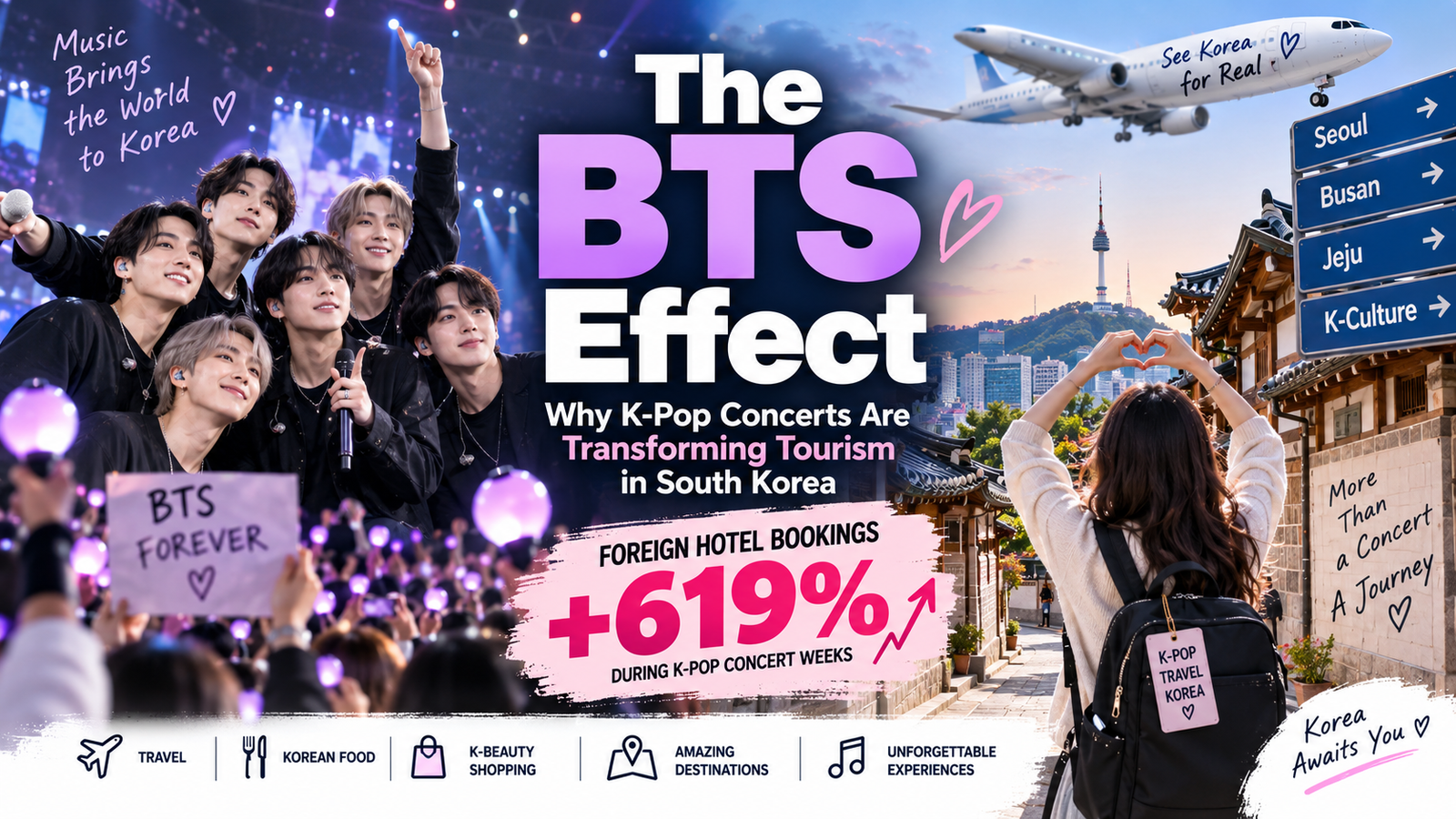
  • The BTS Effect: Why K-Pop Concerts Are Transforming Tourism in South Korea

    The BTS Effect: Why K-Pop Concerts Are Transforming Tourism in South Korea

    For millions of international travelers, a trip to South Korea once began with a familiar checklist:

    Seoul.

    Gyeongbokgung Palace.

    Myeongdong.

    Korean barbecue.

    Maybe Jeju Island or Busan.

    But a new kind of traveler is changing Korean tourism.

    Their trip may begin with something completely different:

    A concert ticket.

    A BTS performance.
    A BLACKPINK concert.
    A Stray Kids show.

    Fans fly thousands of miles to Korea for a few hours of music — but they rarely leave after the concert.

    They stay in hotels.

    They eat Korean food.

    They shop.

    They visit neighborhoods connected to their favorite artists.

    They travel to other cities.

    And increasingly, K-pop is becoming not simply something tourists enjoy while visiting Korea.

    K-pop is becoming the reason they visit Korea in the first place.

    New tourism data shows just how powerful this phenomenon has become.

    According to an analysis by the Korea Tourism Organization, accommodation bookings by foreign visitors surged 619.2% during weeks featuring concerts by three major K-pop acts compared with non-concert weeks in the dataset.

    And BTS provides perhaps the clearest example yet of what happens when global fandom turns into actual travel.

    Welcome to the new era of K-pop tourism in South Korea.


    The BTS Effect Is Bigger Than a Concert

    When BTS returned to the stage in South Korea in 2026, thousands of international ARMYs traveled to the country.

    But Korea’s Ministry of Culture, Sports and Tourism wanted to know something beyond concert attendance:

    What did those fans do after they arrived?

    Together with the Korea Culture & Tourism Institute and Korea Tourism Organization, the ministry surveyed concertgoers and analyzed mobile-network and credit-card data surrounding BTS performances in Seoul and Goyang.

    The results were remarkable.

    Foreign visitors who attended BTS’s March 21 Gwanghwamun performance stayed in South Korea for an average of:

    8.7 days

    and spent approximately:

    KRW 3.53 million per person.

    By comparison, the average international visitor during the first quarter of 2026 stayed 6.1 days and spent approximately KRW 2.45 million.

    In other words, BTS concert visitors stayed about 2.6 days longer and spent roughly KRW 1.08 million more per person than the average international tourist.

    That changes the way we should think about a K-pop concert.

    It is not simply a three-hour entertainment event.

    For international fans, it can become the anchor around which an entire Korean vacation is built.


    73.6% Came to Korea Primarily Because of BTS

    There is an even more important number.

    Among foreign visitors surveyed around BTS’s Gwanghwamun performance:

    73.6% said the BTS event was their primary reason for visiting South Korea.

    Another 17.4% were already visiting Korea for another purpose and added the event to their trip.

    Think about what that means.

    Without the concert, many of those international visitors might not have booked:

    a flight to Korea,

    a hotel room,

    airport transportation,

    restaurant meals,

    shopping trips,

    or visits to Korean attractions.

    The concert created the trip.

    This is why the phrase “BTS Effect” is more than fan language.

    It increasingly describes a measurable tourism phenomenon.


    BTS Fans Didn’t Just Attend the Concert and Go Home

    The Goyang concerts provide an even clearer picture.

    International fans attending BTS’s Goyang shows stayed in Korea for an average of 7.4 days and spent approximately KRW 2.91 million per person.

    And they traveled well beyond the stadium.

    Visitors connected their concert trips with places such as:

    Yongsan

    Myeongdong

    Dongdaemun Design Plaza (DDP)

    and the National Museum of Modern and Contemporary Art.

    These destinations were linked to the broader “BTS THE CITY Seoul” experience surrounding the performances.

    This is exactly why K-pop matters so much to tourism.

    A concert may last several hours.

    But the trip surrounding it can last more than a week.


    One BTS Concert Area Saw Foreign Spending Jump 38-Fold

    Perhaps the most dramatic evidence comes from the neighborhood surrounding the Goyang concert venue.

    The Korea Tourism Organization compared mobile and card data around Daehwa-dong, where the concerts took place, with the same period a year earlier.

    During the three BTS concert days, foreign visitors increased from 1,397 to 48,581.

    That’s approximately:

    35 times more foreign visitors.

    Foreign card spending in the area increased from approximately KRW 8.9 million to KRW 337.8 million.

    That’s roughly:

    38 times more spending.

    These numbers show why cities around the world compete aggressively to host major concerts.

    The economic impact does not stop at the ticket booth.

    It reaches:

    hotels,

    restaurants,

    cafés,

    convenience stores,

    taxis,

    subways,

    shopping centers,

    tourist attractions

    and local businesses.


    Then Came an Even Bigger Number: 619%

    BTS is not an isolated case.

    A newer Korea Tourism Organization analysis examined accommodation behavior surrounding major events.

    The results suggest that the concert-tourism effect extends across K-pop.

    During weeks featuring concerts by BTS, BLACKPINK and Stray Kids in the analyzed data, accommodation bookings increased dramatically.

    Domestic bookings rose around 99.4%.

    But bookings by foreign visitors increased by approximately:

    619%

    compared with non-concert periods in the analysis.

    That number deserves attention.

    Fans are not merely streaming Korean music from Los Angeles, Tokyo, Paris, Bangkok or London.

    Increasingly, they are getting on airplanes.


    K-Pop Has Changed the Meaning of a “Tourist Attraction”

    Traditionally, tourism promotion centered around physical landmarks.

    For Korea, that meant places such as:

    Gyeongbokgung Palace,

    Bukchon Hanok Village,

    N Seoul Tower,

    Jeju Island,

    or Haeundae Beach.

    Those places remain important.

    But younger international travelers increasingly build trips around something less traditional.

    They want to visit places connected to Korean culture they already love.

    A café visited by an idol.

    A music-video filming location.

    A neighborhood featured in Korean entertainment.

    A pop-up store.

    A concert venue.

    A K-pop agency district.

    A restaurant associated with an artist.

    A beauty store selling products used by Korean celebrities.

    The tourist attraction is no longer always a monument.

    Sometimes the attraction is a connection to a story, artist or fandom.


    Why K-Pop Fans Often Stay Longer

    Traditional sightseeing trips can be surprisingly short.

    A visitor might spend three or four days checking off famous attractions and then leave.

    Fandom tourism works differently.

    Imagine flying to Seoul for a Saturday concert.

    You may arrive several days early because international travel is expensive and you don’t want to risk missing the event.

    Then you discover that your favorite group has:

    a pop-up event,

    a merchandise store,

    a themed café,

    a photo exhibition,

    or related attractions elsewhere in the city.

    After the concert, you might add another few days for Korean food, shopping and sightseeing.

    Suddenly, a concert weekend becomes:

    a seven- or eight-day Korea vacation.

    The BTS data shows exactly this pattern.


    Where Do K-Pop Fans Go in Korea Beyond the Concert?

    This is where K-pop tourism becomes particularly interesting for first-time visitors.

    You don’t have to spend your entire vacation searching for idol-related locations.

    The best K-pop trip combines fandom with Korea itself.

    Here are several places that fit naturally into that itinerary.

    1. Hongdae

    Hongdae is one of Seoul’s most energetic neighborhoods.

    Street performances, cafés, fashion, nightlife and music culture make it especially popular with younger travelers.

    For a K-pop fan visiting Korea for the first time, Hongdae is one of the easiest places to experience contemporary Seoul.


    2. Myeongdong

    Myeongdong remains one of the most convenient areas for international visitors.

    You can combine:

    K-beauty shopping,

    Korean street food,

    restaurants,

    fashion

    and easy transportation.

    BTS concert visitors were also observed traveling to Myeongdong during their wider Korea itinerary.


    3. Yongsan

    Yongsan has become increasingly relevant to K-pop travelers.

    The area combines major transportation connections, shopping and proximity to entertainment-related destinations.

    It also appeared among locations visited by international BTS concertgoers.


    4. Dongdaemun Design Plaza

    DDP is one of Seoul’s most recognizable modern landmarks.

    It frequently hosts exhibitions, pop-ups, fashion events and cultural programs.

    Its late-night surroundings also make it easy to combine sightseeing with shopping and food.


    5. Seongsu

    If you want to understand modern Korean pop culture beyond music, visit Seongsu.

    The neighborhood has become known for:

    brand pop-ups,

    fashion,

    cafés,

    beauty launches

    and collaborations involving celebrities and entertainment brands.

    It represents another important part of contemporary Korean youth culture.


    6. The Han River

    Not everything needs to be a paid attraction.

    One of the simplest Seoul experiences is spending an evening along the Han River.

    Buy convenience-store food, order Korean fried chicken, sit by the river and watch Seoul slow down after sunset.

    For international visitors who first discovered Korea through highly produced music videos and dramas, ordinary experiences like this often become some of the most memorable moments of the trip.


    And K-Pop Tourism Is Moving Beyond Seoul

    This may ultimately be the most important change.

    Historically, international tourism to Korea has been heavily concentrated in Seoul.

    But recent tourism data shows foreign travelers are increasingly exploring other regions.

    The share of international visitors staying outside the greater Seoul region rose from 39.5% to 43%, according to the recent tourism analysis.

    Growth was particularly notable in destinations including:

    Busan

    Jeju

    Andong

    and Gyeongju.

    K-pop can accelerate that trend.

    If a major concert takes place outside central Seoul, thousands of international fans suddenly need:

    accommodation,

    transportation,

    food,

    shopping

    and things to do nearby.

    A concert can therefore become a gateway to regional Korea.


    Busan May Be the Perfect Example

    For many international visitors, Busan is already Korea’s obvious second destination after Seoul.

    It offers something completely different:

    beaches,

    seafood,

    traditional markets,

    mountains,

    coastal temples,

    night views

    and a more relaxed atmosphere.

    K-pop events can give travelers the initial reason to visit.

    But once they arrive, places such as:

    Haeundae,

    Gwangalli,

    Jagalchi Market,

    Gamcheon Culture Village

    and Haedong Yonggungsa Temple

    turn a concert trip into a broader Korean travel experience.

    This is the real tourism value of K-pop.

    Music gets people onto the plane.

    Korea gives them reasons to stay.


    K-Pop Is Also Selling Korean Food

    There is another powerful effect that tourism statistics alone don’t fully capture.

    Fans often arrive in Korea already familiar with Korean food.

    They have seen idols eating:

    tteokbokki,

    ramyeon,

    samgyeopsal,

    fried chicken,

    gimbap,

    kimchi jjigae

    and Korean convenience-store food.

    So when they finally visit Korea, eating those foods can feel like participating in the culture they have followed from abroad.

    This is one reason K-pop tourism connects naturally with food tourism.

    A fan who travels to Korea for BTS may return home remembering the concert.

    But they may also remember:

    their first Korean barbecue dinner,

    late-night fried chicken,

    tteokbokki from a street stall,

    or convenience-store ramyeon eaten beside the Han River.

    That emotional connection is extremely powerful.


    K-Pop Also Leads Travelers Into K-Beauty

    The same phenomenon occurs with Korean beauty.

    K-pop fans are constantly exposed to:

    Korean skincare,

    makeup,

    fashion,

    hairstyles

    and beauty trends.

    Once they arrive in Korea, stores in Myeongdong, Hongdae, Gangnam and Seongsu become part of the tourism experience.

    This is why the economic value of Korean popular culture extends far beyond music sales.

    One song can eventually influence spending on:

    travel,

    hotels,

    restaurants,

    beauty,

    fashion,

    transportation

    and entertainment.

    That is the larger K-Culture economy.


    K-Pop Tourism Is Different From Ordinary Celebrity Tourism

    Celebrity tourism is not new.

    People have always traveled to see musicians.

    But K-pop has several characteristics that make the effect unusually powerful.

    First, K-pop fandoms are highly organized internationally.

    Fans communicate through social media and online communities across national borders.

    When a concert is announced, information about:

    tickets,

    flights,

    hotels,

    transportation,

    restaurants

    and fan events

    can spread globally within hours.

    Second, K-pop provides a constant stream of content between concerts.

    Music videos, livestreams, variety shows, social media, documentaries and fan platforms create continuous engagement.

    For many international fans, Korea does not feel like a completely unfamiliar country by the time they arrive.

    They have already been experiencing parts of Korean culture digitally for years.

    The physical trip becomes the final step of a relationship that began online.


    From “Korean Wave” to “Travel to Korea”

    For years, people talked about the Korean Wave — Hallyu — primarily in terms of exports.

    Korean music was exported.

    Korean dramas were exported.

    Korean movies were exported.

    Korean beauty products were exported.

    But something more interesting is now happening.

    Instead of Korean culture only traveling overseas, overseas consumers are traveling to Korea.

    That represents a major change.

    A Spotify stream generates one type of economic value.

    A tourist who flies to Korea and stays for eight days generates something completely different.

    They may buy:

    airfare,

    accommodation,

    concert tickets,

    food,

    transportation,

    cosmetics,

    fashion,

    souvenirs

    and additional travel experiences.

    The BTS tourism data makes this difference visible.


    What This Means for Someone Planning a Korea Trip

    If you are considering traveling to Korea for a K-pop concert, there is one piece of advice worth remembering:

    Don’t make the concert your entire trip.

    Make it the beginning.

    If your concert is in Seoul or Goyang, consider spending several days exploring Seoul before or after the event.

    Then add another destination.

    For example:

    Days 1–4: Seoul
    Day 5: K-pop concert
    Days 6–7: Seoul neighborhoods and shopping
    Days 8–9: Busan or Gyeongju

    Even a shorter trip can combine K-pop with Korean food, history and everyday culture.

    And that is often where the best memories happen.


    The BTS Effect May Be Showing Us the Future of Korean Tourism

    The most interesting thing about the BTS tourism data isn’t simply that BTS is popular.

    We already knew that.

    What matters is what fans do because of that popularity.

    They cross borders.

    They stay longer.

    They spend more.

    They explore neighborhoods.

    They eat Korean food.

    They shop for Korean products.

    And increasingly, they travel beyond Seoul.

    Government data showed foreign visitors around BTS’s Goyang concert increased about 35-fold, while their card spending increased about 38-fold compared with the same period a year earlier.

    More recent tourism data found foreign accommodation bookings surging roughly 619% during selected major K-pop concert weeks.

    Those aren’t streaming numbers.

    They represent people physically moving around Korea.


    Final Thoughts: They Come for BTS — But They Discover Korea

    Perhaps the simplest way to understand K-pop tourism is this:

    Fans may buy the plane ticket because of BTS.

    But BTS isn’t necessarily what they remember most about every day of the trip.

    They may remember eating grilled pork with friends in Seoul.

    Getting lost on the subway.

    Walking along the Han River at night.

    Buying skincare in Myeongdong.

    Discovering a tiny restaurant they had never seen on TikTok.

    Taking the KTX to Busan.

    Seeing the Korean coastline for the first time.

    That is where K-pop’s tourism power becomes much larger than music.

    K-pop gives millions of people a reason to become curious about Korea.

    And once they arrive, Korea itself becomes the experience.

    That may be the real BTS Effect — not simply selling more concert tickets, but turning global music fans into travelers who want to experience the country behind the music.


    Official & Useful Korea Travel Resources

    For official travel planning, destinations, festivals and practical information, visit VisitKorea — Korea Tourism Organization.

    The Korean government’s analysis of BTS concert tourism is also available directly from the Ministry of Culture, Sports and Tourism.


    K-Beauty Shopping

    If your Korea trip includes K-beauty — or you want to shop Korean skincare and cosmetics from overseas — explore OLIVE YOUNG Global.

    Shop K-Beauty at OLIVE YOUNG Global

    If you purchase through the link above, the site operator may receive a commission at no additional cost to you.