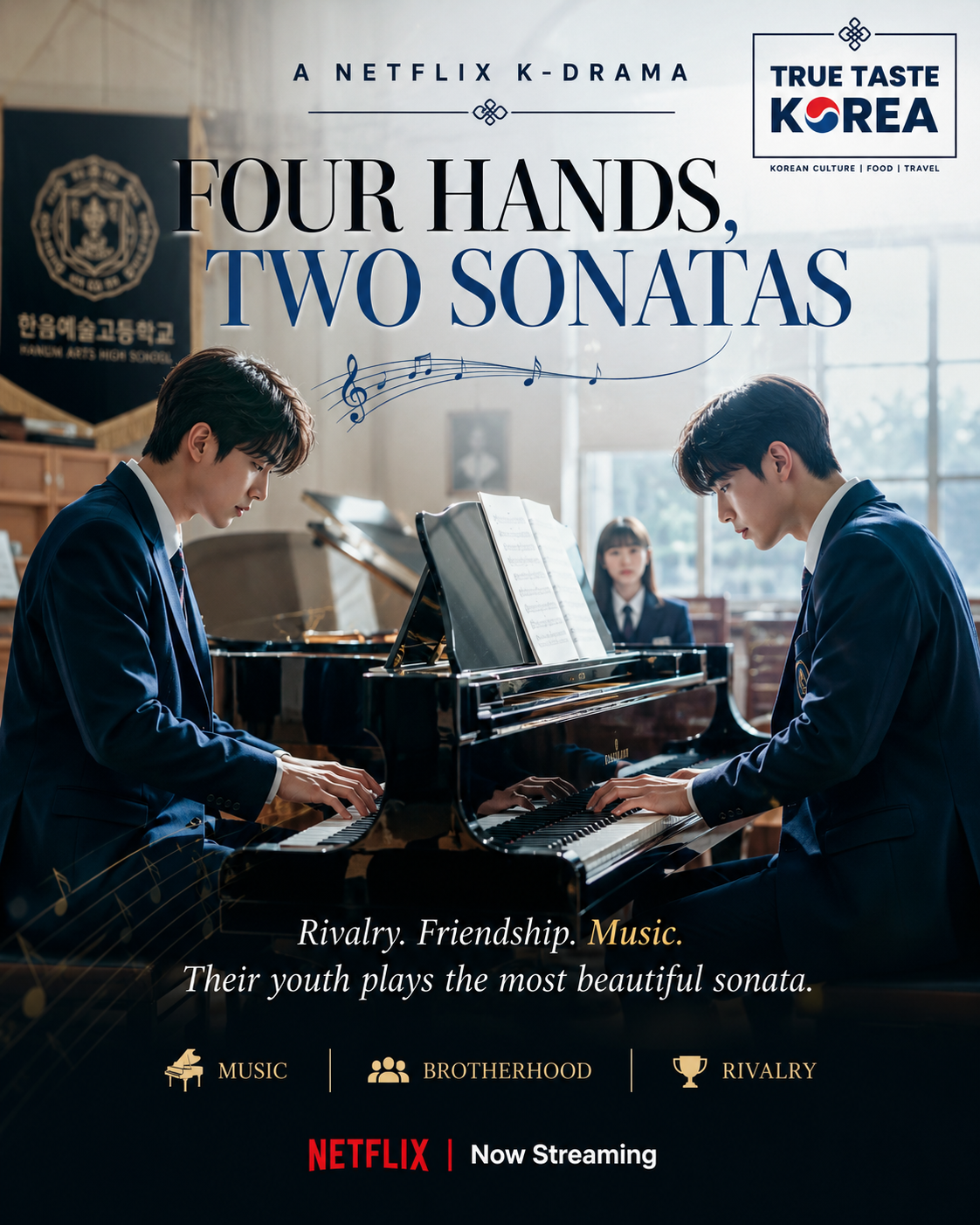
One of the most painful moments in Four Hands, Two Sonatas comes when Kang Pi-o realizes that his grandfather, legendary conductor Kang Seung-woon, has chosen Choi Jeong-yo instead of him for a major audition opportunity.
Pi-o cannot understand it.
Why Jeong-yo?
Why not his own grandson?
For Pi-o, this is much more than losing a musical opportunity. It feels like confirmation of the fear he has carried for years: no matter how hard he works, he may never receive the recognition he desperately wants from his grandfather.
After Episode 4, many Korean viewers criticized the adults surrounding these two young pianists, particularly Pi-o’s grandfather and mother.
But there is another way to look at Seung-woon’s decision.
What if choosing Jeong-yo was actually the fair thing to do?
Why Pi-o Is So Hurt by His Grandfather’s Decision
Pi-o has spent much of his life trying to become the pianist other people expect him to be.
His mother, Kang Ji-hye, recognized his talent early and pushed him relentlessly toward competitions and success. His grandfather, meanwhile, is a world-renowned conductor and an uncompromising perfectionist.
Before the drama even premiered, the character description for Seung-woon emphasized that he does not soften his musical judgment even for family.
That coldness has left Pi-o with an enormous desire to earn his grandfather’s approval.
By Episode 4, Pi-o finally begins questioning the life he has been living. He tells his mother that he feels like he has been a “competition machine” since childhood and admits that he does not even understand why people say his music lacks soul.
Then Jeong-yo enters his life.
And everything becomes more complicated.
Jeong-yo Has Something Pi-o Cannot Ignore
Pi-o is not simply jealous of Jeong-yo.
He recognizes his talent.
While helping Jeong-yo practice, Pi-o repeatedly discovers just how extraordinary his friend’s natural musical ability is. That realization creates a painful contradiction.
Pi-o likes Jeong-yo.
He wants to help him.
He even wants to make music with him.
But every time Jeong-yo shines, Pi-o is forced to confront his own deepest insecurity.
Netflix itself presents the two characters as contrasting young pianists: Pi-o has followed a path toward technical perfection while carrying tremendous anxiety and pressure, whereas Jeong-yo possesses a raw, instinctive musical brilliance despite his difficult upbringing.
Their rivalry works precisely because neither young man is simply “better” in every way.
They possess different kinds of talent.
Then Grandpa Chooses Jeong-yo
The emotional explosion finally comes when Pi-o discovers that Seung-woon has encouraged Jeong-yo to audition.
Pi-o confronts him:
Why Jeong-yo instead of me?
It is easy to understand Pi-o’s pain.
This is his grandfather.
This is the man whose recognition he has wanted for years.
And now that man appears to see something extraordinary in the boy Pi-o has only recently brought into his world.
For Pi-o, the decision does not feel like an objective musical judgment.
It feels personal.
But should Seung-woon have chosen Pi-o simply because Pi-o is his grandson?
What If Grandpa Had Chosen Pi-o Because He Was Family?
This is where my interpretation differs from some of the criticism I have seen from Korean viewers.
Imagine the opposite situation.
Suppose Seung-woon genuinely believed Jeong-yo was the more suitable or exceptional musician for the opportunity, but chose Pi-o anyway for one reason:
Pi-o is my grandson.
Would that really have been the more responsible decision?
I don’t think so.
Seung-woon is not only Pi-o’s grandfather. He is also one of the most respected musicians in the story.
If he is making a professional musical decision, blood should not automatically outweigh talent.
Choosing Pi-o simply because he is family would be favoritism.
And it would be unfair to Jeong-yo, a young musician who has already had far fewer opportunities because of his background.
Ironically, it might also hurt Pi-o in a different way.
If Pi-o eventually realized that he had been chosen because he was Seung-woon’s grandson rather than because of his music, would that really heal his insecurity?
Or would it create a new one?
He might begin wondering:
“Did I earn this, or was it given to me because of my family?”
Choosing Jeong-yo Wasn’t Necessarily the Problem
This is why I think two questions need to be separated.
Was Seung-woon wrong to choose Jeong-yo?
And:
Was Seung-woon right in the way he treated Pi-o afterward?
Those are not the same question.
Choosing Jeong-yo on musical grounds can be defended.
But recognizing the better musician in a particular moment does not give an adult permission to humiliate the other young musician.
And this is where Seung-woon’s behavior becomes much harder to defend.
When Pi-o confronts him, Seung-woon does more than explain his musical judgment.
He compares the two boys in a way that strikes directly at Pi-o’s deepest insecurity.
Even when Jeong-yo defends Pi-o and insists that Pi-o was the person who guided him, Seung-woon warns about which of the two will ultimately be emotionally destroyed by their relationship.
That is a very different matter from simply choosing the musician he believes deserves an opportunity.
An Adult Can Make the Right Decision in the Wrong Way
This may be one of the most interesting ideas in Four Hands.
Seung-woon may be right about music and still be wrong about people.
He may accurately recognize Jeong-yo’s extraordinary talent.
He may also recognize Pi-o’s weaknesses.
But Pi-o is not merely a pianist being evaluated by a conductor.
He is also a young man desperately seeking recognition from his grandfather.
Seung-woon knows that.
And that creates a responsibility beyond musical judgment.
Choosing Jeong-yo was not necessarily wrong.
But making the correct professional decision does not remove an adult’s responsibility to care for the young person hurt by that decision.
That distinction matters.
Pi-o’s Mother Makes the Situation Even More Complicated
Pi-o’s mother, Ji-hye, represents almost the opposite problem.
While Seung-woon can be brutally detached, Ji-hye is intensely invested in her son’s success.
When Pi-o says he no longer wants to compete and describes himself as having lived like a competition machine, she does not truly engage with what he is telling her.
Instead, his refusal threatens the future she has imagined for him.
Her hostility toward Jeong-yo also grows as he becomes a genuine rival to her son.
So Pi-o is trapped between two adults.
One seems to measure him too coldly.
The other may love him so fiercely that she cannot separate his happiness from his achievement.
And between them stands Pi-o, asking a much more basic question:
What kind of musician do I actually want to become?
This Is Why Jeong-yo Is So Dangerous to Pi-o — and So Important
Jeong-yo threatens Pi-o precisely because he represents something Pi-o has never been allowed to possess freely.
Jeong-yo’s life is chaotic and painful, but his relationship with music feels instinctive.
Pi-o has training, technique and privilege.
Yet he struggles to understand why he plays.
That makes their relationship much more interesting than a simple rivalry between two piano prodigies.
Jeong-yo may become the person who destroys Pi-o’s old identity.
But he may also be the person who finally helps Pi-o discover his own music.
That is why the grandfather’s warning is so fascinating.
Perhaps one of them really will be devastated by this relationship.
But being devastated is not always the same thing as being destroyed.
Sometimes the identity that needs to collapse is the one other people built for you.
My Take
I understand why many Korean viewers are angry with the adults in Four Hands.
Pi-o and Jeong-yo are young people carrying emotional burdens that the adults around them helped create.
But I would not criticize Seung-woon simply for choosing Jeong-yo.
If he believed Jeong-yo deserved the opportunity, choosing his grandson instead because of blood would have created another kind of injustice.
For me, the real issue is what happened after the choice.
A fair decision can still be delivered cruelly.
And an adult who makes the right decision still has a responsibility toward the child who is wounded by it.
That may ultimately be one of the most important conflicts in Four Hands:
Not simply who is the better pianist.
But whether these young musicians can discover who they are before the expectations, failures and unresolved wounds of the adults around them decide it for them.