K-Beauty

  • Why Are Korean Sunscreens So Popular? The Secret Isn’t Just SPF 50

    K-Beauty Deep Dive — Episode 03
    TTK Original — Beyond the Headlines

    A woman in Mumbai buys a sunscreen with SPF 50.

    It promises excellent protection. But within minutes, her face feels greasy. A pale residue makes her skin look unnatural, and the product becomes uncomfortable in the afternoon heat.

    The next morning, she decides not to wear it.

    Now imagine a different sunscreen.

    It spreads like a lightweight moisturizer, blends into her skin without an obvious white cast, and feels comfortable beneath makeup.

    Both products may offer high UV protection.

    But which one is she more likely to use every day?

    This simple question helps explain one of K-beauty’s biggest international success stories.

    Why are Korean sunscreens becoming so popular when nearly every country already sells sunscreen?

    The answer is not that Korean products have magically discovered how to block sunlight better than everyone else.

    It is that some Korean brands have approached sunscreen as something more than a protective product.

    They have made it part of the everyday skincare experience.

    And that difference can change consumer behavior.

    1. The Real Sunscreen Problem Isn’t Always Protection

    Most consumers understand that sunscreen is important.

    It helps protect against sunburn, premature skin aging, and skin cancer.

    But knowing that sunscreen is useful does not guarantee that someone will wear it consistently.

    Traditional complaints are familiar.

    Some formulas feel heavy.

    Others leave a greasy finish.

    Certain products create a visible white cast.

    Some sting the eyes or feel uncomfortable when layered with makeup.

    These experiences can discourage regular use.

    Korean beauty brands have gained attention by offering products designed to address some of those frustrations.

    Lightweight creams, gels, fluid textures, and serum-like sunscreens have become recognizable features of the category.

    The appeal is practical.

    A sunscreen that people enjoy wearing has a better chance of becoming a daily habit.

    That does not mean every Korean sunscreen is comfortable or every non-Korean sunscreen is unpleasant.

    The distinction is about product design, not nationality.

    2. Why Do Korean Sunscreens Feel Like Skincare?

    Many Korean sunscreen products are marketed around their cosmetic feel.

    Instead of emphasizing only the SPF number, brands may highlight hydration, a lightweight finish, or compatibility with everyday makeup.

    Some formulas contain familiar moisturizing ingredients such as glycerin, hyaluronic acid, or other skin-conditioning compounds.

    These ingredients do not replace the UV filters responsible for sun protection.

    Their role is to influence how the product feels and behaves on the skin.

    A moisturizing sunscreen may reduce the need for a separate daytime cream for some users.

    A lightweight formula may be more comfortable for someone with oily or combination skin.

    And a product that spreads easily may feel less like an additional chore.

    This approach helps explain why sunscreen has become such an important part of the K-beauty conversation.

    It is no longer presented only as something to wear at the beach.

    It becomes a product that fits into an ordinary morning routine.

    3. Why Did Beauty of Joseon Become a Global Sunscreen Phenomenon?

    One of the clearest examples is Beauty of Joseon.

    Its Relief Sun: Rice + Probiotics sunscreen became widely discussed for its moisturizing texture and comfortable finish.

    The brand’s international visibility expanded through online reviews, social media, and beauty retail channels.

    In 2026, Beauty of Joseon was recognized by Euromonitor International as the leading K-beauty sun-care brand in global online retail sales for 2025.

    The recognition was specific to K-beauty sun care and online sales. It did not mean the brand was the world’s largest sunscreen manufacturer across all channels.

    That distinction matters.

    The commercial success is still significant.

    It shows that a product category once dominated in public discussion by familiar Western and Japanese brands now includes Korean names with considerable international influence.

    Beauty of Joseon’s success also illustrates a broader change.

    Consumers are not necessarily searching for the highest SPF number available.

    They are looking for protection combined with a finish they actually enjoy.

    4. Is SPF 50 Really Much Better Than SPF 30?

    SPF stands for Sun Protection Factor.

    It primarily measures protection against sunburn caused by ultraviolet radiation, especially UVB.

    Under standardized conditions, SPF 30 filters approximately 97% of UVB radiation.

    SPF 50 filters approximately 98%.

    The difference may sound small.

    But neither number represents complete protection.

    And neither means a person can remain outdoors indefinitely without reapplying sunscreen.

    SPF also does not tell the whole story about UVA protection.

    That is why dermatologists recommend broad-spectrum products that protect against both UVA and UVB.

    The American Academy of Dermatology recommends broad-spectrum SPF 30 or higher sunscreen, ideally with water resistance.

    Higher SPF can offer additional protection when used correctly.

    But a product’s SPF rating does not compensate for applying too little, missing exposed areas, or failing to reapply.

    A comfortable SPF 50 sunscreen can be an excellent choice.

    It is not automatically superior in every practical situation to a properly used SPF 30 product.

    5. What Does PA++++ Mean on Korean Sunscreens?

    Consumers shopping for Korean sunscreens frequently encounter two ratings.

    SPF 50+ and PA++++.

    They do not describe exactly the same thing.

    SPF relates primarily to protection against sunburn-producing UV radiation.

    The PA system communicates a level of UVA protection, based on a standardized UVA protection measurement.

    More plus signs indicate a higher category of UVA protection.

    PA++++ is the highest category in that labeling system.

    UVA radiation contributes to skin aging and can play a role in pigmentation changes.

    It also contributes to skin cancer risk.

    But PA++++ is not a promise that all UVA radiation is blocked.

    Nor does it mean the product will remain effective after sweating, swimming, or rubbing the skin.

    A useful sunscreen label should be understood as a collection of information rather than a single impressive number.

    SPF, UVA protection, water resistance, and directions for use all matter.

    6. Why Is White Cast Such a Big Issue for Indian Consumers?

    White cast refers to a visible pale residue left by some sunscreens.

    It can be especially noticeable on medium and deeper skin tones.

    Certain formulations containing mineral UV filters, such as zinc oxide or titanium dioxide, may leave this effect.

    But the result depends on the entire formulation.

    Not all mineral sunscreens leave the same amount of residue, and some tinted versions blend more naturally.

    Many popular Korean sunscreens use organic UV filters in formulas designed for a transparent-looking finish.

    That can be attractive to Indian consumers who want sun protection without an obvious pale layer.

    However, no-white-cast claims should not be accepted blindly.

    A product that appears invisible on a light-skinned model may look different on deeper skin.

    And a transparent finish does not prove that a sunscreen provides adequate protection.

    The most useful approach is to evaluate both cosmetic appearance and verified sun-protection labeling.

    For consumers with pigmentation concerns, tinted sunscreen containing iron oxides may offer an additional benefit: protection against some visible light that can contribute to dark spots.

    A completely transparent sunscreen does not necessarily provide that same visible-light benefit.

    7. Are Korean Sunscreens Better for Hot and Humid Indian Weather?

    Some may be more comfortable, but this depends on the product and the activity.

    A lightweight sunscreen may feel pleasant during a normal day in an air-conditioned office.

    It may also work well for someone who dislikes thick creams.

    But hot weather introduces another important factor.

    Sweat.

    A sunscreen that feels elegant indoors may not be the best option for outdoor exercise, swimming, or extended exposure to intense heat.

    Water resistance becomes especially important in those situations.

    In the United States, tested water-resistant sunscreens are labeled for 40 or 80 minutes of water exposure.

    Other markets have their own testing and labeling requirements.

    Not every Korean sunscreen is water-resistant.

    A product designed primarily for comfortable daily wear should not automatically be treated as a sports sunscreen.

    For someone spending long periods outdoors in Chennai, Mumbai, or Delhi, the most suitable sunscreen may be different from the one they use during a mostly indoor workday.

    Comfort matters, but protection under actual conditions matters more.

    8. Are Korean Sunscreens Safer Than Western Sunscreens?

    There is no sound basis for declaring an entire country’s sunscreens safer than another country’s products.

    Sunscreen safety and effectiveness depend on the specific ingredients, formulation, manufacturing standards, testing, and applicable regulations.

    Different countries approve and regulate sunscreen ingredients through different systems.

    In the United States, sunscreen is regulated as an over-the-counter drug.

    In South Korea and other markets, the regulatory frameworks and permitted ingredients differ.

    Some UV filters used in Korean or European products have historically not been available in US sunscreen formulations.

    That has sometimes led online commentators to describe Korean sunscreen technology as more advanced.

    But the regulatory picture is not static.

    In 2026, the American Academy of Dermatology reported the addition of bemotrizinol to the list of sunscreen active ingredients used in the United States.

    That development illustrates why claims about which country has access to particular filters must be checked against current rules.

    More importantly, the availability of a particular UV filter does not establish that every product containing it is superior.

    Consumers should look for legitimately marketed products with appropriate protection claims rather than assuming imported products are automatically better.

    9. Why Do Korean Sunscreens Sometimes Have Different Formulas Abroad?

    A consumer may discover that a sunscreen sold in Korea is not identical to a similarly named product sold in another country.

    This can happen because manufacturers develop formulations for different regulatory markets.

    Sunscreen ingredients, permitted concentrations, labeling requirements, and product classifications can vary.

    A brand may therefore offer one formula for the Korean market and another for the United States or another destination.

    Packaging and ingredient lists may differ.

    This does not automatically mean one version is counterfeit or inferior.

    But it does mean that consumers should not assume an online review applies to every regional version.

    The best approach is to check the exact product name, ingredient list, SPF claim, and market-specific packaging.

    When shopping internationally, product identity matters more than a viral nickname.

    10. Can Korean Sunscreen Replace Moisturizer?

    For some people, yes.

    A sunscreen with a sufficiently moisturizing formula may feel comfortable without a separate daytime moisturizer.

    This can simplify a morning routine.

    For someone living in humid weather with oily skin, fewer layers may be preferable.

    But people with very dry skin may still benefit from applying moisturizer first.

    The answer depends on the skin and the product.

    The sunscreen must still be applied in the quantity required for adequate protection.

    Using only a tiny amount because the product doubles as a moisturizer defeats the purpose.

    The goal is not to use less sunscreen.

    It is to avoid unnecessary products while maintaining sufficient sun protection.

    11. Do Korean Sunscreens Really Help Prevent Dark Spots?

    Proper sun protection can help prevent the worsening of some pigmentation concerns.

    This is particularly relevant to people dealing with melasma or post-inflammatory hyperpigmentation.

    But sunscreen does not instantly erase existing dark spots.

    And it should not be advertised as a way to change someone’s natural skin color.

    The American Academy of Dermatology notes that visible light can contribute to pigmentation, especially in darker skin tones.

    For that reason, tinted sunscreens containing iron oxides can be useful for some people with dark spots.

    A Korean sunscreen that provides excellent UV protection but no visible-light protection may still be a good product.

    It simply may not address every aspect of a particular pigmentation concern.

    The best sunscreen is the one suited to the user’s skin, goals, and exposure conditions.

    For persistent melasma or significant pigmentation problems, professional dermatological advice may be necessary.

    12. What Are the Biggest Korean Sunscreen Myths?

    Several claims appear repeatedly in online beauty discussions.

    Myth: Korean sunscreen is always better than Western sunscreen.

    Reality: Product performance depends on the formula, testing, and proper use.

    Myth: SPF 50 means you can stay outside all day.

    Reality: Sunscreen must be reapplied as directed, especially during outdoor exposure, swimming, and sweating.

    Myth: A sunscreen with no white cast is automatically superior.

    Reality: Appearance and protection are separate considerations.

    Myth: Korean sunscreen is suitable for every skin type.

    Reality: Fragrance, texture, filters, and other ingredients may not suit everyone.

    Myth: Sunscreen makes brown skin lighter.

    Reality: Sunscreen helps protect against UV damage and can reduce the worsening of some pigmentation concerns. It does not change a person’s genetically determined natural skin tone.

    Myth: A sun stick is always enough for full protection.

    Reality: Sticks can be convenient, but applying enough product evenly is essential. A few quick swipes may not deliver the labeled protection.

    These misconceptions matter because sunscreen is a health-related product, not merely a beauty accessory.

    13. Why Has Social Media Made Korean Sunscreen So Popular?

    Korean sunscreen is particularly well suited to visual demonstrations.

    A creator applies the product to one side of the face.

    Viewers see how easily it spreads.

    They compare the finish.

    They look for shine, greasiness, or white cast.

    This kind of content is easy to understand without lengthy explanation.

    It also translates well across languages.

    A viewer in India can watch a Korean or American creator demonstrate a sunscreen and immediately understand its cosmetic appeal.

    But social media has limitations.

    A short video cannot reliably establish the product’s real-world SPF performance.

    It may not reveal irritation that develops later.

    Lighting can conceal residue.

    And sponsored content may emphasize positive features while omitting weaknesses.

    Consumer demonstrations are useful for understanding texture and appearance.

    They should not replace reliable protection information.

    14. What Should Indian Consumers Look for Before Buying Korean Sunscreen?

    Instead of choosing solely by brand popularity, evaluate the following factors.

    UV protection: Look for appropriate broad-spectrum protection and SPF 30 or higher.

    Water resistance: Prioritize it for outdoor activity, swimming, and heavy sweating.

    Skin compatibility: Consider dryness, oiliness, acne, sensitivity, and known allergies.

    White cast: Check how the formula appears on your own skin tone.

    Pigmentation concerns: Consider whether a suitable tinted product with iron oxides would better meet your needs.

    Product authenticity: Purchase from reputable sellers and inspect labeling and expiration information.

    Daily comfort: Choose a texture you can tolerate in sufficient quantity.

    Price: A product you can afford to use consistently may be more practical than an expensive sunscreen you apply sparingly.

    These criteria apply to Korean, Indian, Japanese, European, and American sunscreens alike.

    A good sunscreen should fit your actual life.

    15. The Biggest Lesson Korean Sunscreens Have Taught the Beauty Industry

    The success of Korean sunscreen reveals an important truth about skincare.

    Consumers do not make decisions based only on technical performance.

    They also care about how a product feels.

    Does it blend easily?

    Can it be worn beneath makeup?

    Does it leave an unwanted residue?

    Is it comfortable enough to use every morning?

    Korean brands have gained international attention by making these questions central to product design and marketing.

    That is a meaningful contribution.

    But it does not eliminate the need for effective UV protection, proper application, or honest labeling.

    The ideal sunscreen combines both sides of the equation.

    It protects the skin.

    And it makes people willing to keep using it.

    The Real Reason Korean Sunscreens Are So Popular

    Korean sunscreens did not become popular simply because they display SPF 50+ on their packaging.

    Many products around the world offer high SPF protection.

    What made certain Korean formulas stand out was their ability to make sunscreen feel less like an obligation and more like an ordinary skincare product.

    Their lightweight textures, moisturizing finishes, and reduced visible residue have helped attract international attention.

    For Indian consumers, these qualities can be especially appealing when dealing with humid weather, makeup, or white-cast concerns.

    But comfort alone is not enough.

    A sunscreen must also provide suitable protection for the conditions in which it is used.

    The real innovation behind popular Korean sunscreens is not making sunlight less dangerous. It is making daily sun protection easier to live with.

    And that may be the most valuable beauty trend of all.

    Because the sunscreen that protects your skin best in everyday life is not necessarily the one with the most impressive advertisement.

    It is the one that offers appropriate protection—and that you actually use correctly, every day.


    TTK Original — Beyond the Headlines
    K-Beauty Deep Dive | Episode 03

    Editorial note: This article provides general sun-care information and is not individualized medical advice.
  • Why Does Korean Skin Look So Good? The Truth Behind Glass Skin

    TTK Original — Beyond the Headlines
    K-Beauty Deep Dive | Episode 01

    A Korean actress appears on screen.

    Her skin looks smooth, luminous, and almost impossibly clear. There are no obvious pores, barely any visible blemishes, and a soft glow that seems to come from beneath the surface.

    Then you look in the mirror.

    Your skin has texture. You can see pores. Perhaps there are a few dark spots, fine lines, or signs of fatigue.

    And suddenly, a familiar question appears.

    Why does Korean skin look so good?

    Is it genetics? A secret skincare routine? Expensive cosmetics? Or something that beauty advertisements rarely explain?

    The answer is more interesting than any single miracle product.

    Korea’s famous glass skin look is created through a combination of skincare, cosmetic techniques, individual skin characteristics, and sometimes professional treatments.

    But there is another factor that deserves much more attention.

    What looks like perfect skin on a screen is not necessarily what healthy skin looks like in real life.

    1. What Is Korean Glass Skin?

    Glass skin is a K-beauty term describing skin that appears exceptionally smooth, clear, hydrated, and luminous.

    The name comes from the impression that light reflects evenly across the face, creating a polished, almost transparent appearance.

    It does not literally mean that skin becomes transparent.

    Nor does it mean that pores disappear.

    Human skin naturally contains pores, fine lines, follicles, and variations in texture. These features remain present even when the skin is healthy.

    The glass skin aesthetic emphasizes a particular visual effect: a complexion that looks hydrated and reflects light smoothly.

    That distinction matters because achieving a dewy appearance and achieving healthy skin are related goals, but they are not identical.

    A moisturizer can temporarily make skin appear smoother.

    Makeup can create a luminous finish.

    Lighting can soften shadows and reduce the visibility of texture.

    None of these effects necessarily means that the underlying skin has fundamentally changed.

    2. Is Korean Skin Naturally Better Because of Genetics?

    Genetics influence many aspects of skin.

    They can affect pigmentation, oil production, sensitivity, and certain characteristics of skin aging.

    But there is no scientific basis for claiming that every Korean person is born with flawless skin.

    Korean people experience acne, eczema, pigmentation concerns, dryness, and other skin conditions just as people elsewhere do.

    There is also considerable variation among individuals.

    Age, hormones, environment, medical conditions, and daily habits all influence the appearance of skin.

    What international audiences often see, however, is a highly selective image of Korea.

    Actors, idols, influencers, and beauty models are not representative samples of the country’s population.

    Their appearances may reflect professional makeup, carefully controlled lighting, skincare, styling, and digital editing.

    Some may also use professional dermatological treatments.

    So when someone compares their everyday reflection with a Korean celebrity’s promotional photograph, they are not making a fair comparison.

    They are comparing ordinary skin with an image created for public presentation.

    3. Why Is Hydration So Important to the Glass Skin Look?

    One of the most important elements of glass skin is hydration.

    When the outer layer of the skin is adequately hydrated, it can appear smoother and more supple.

    Dryness may make fine lines and rough patches more noticeable.

    Moisturizing products help by attracting water, supporting the skin’s protective surface, or reducing moisture loss.

    Common ingredients include glycerin, hyaluronic acid, and ceramides.

    They work in different ways.

    Glycerin and hyaluronic acid help attract and retain moisture.

    Ceramides are lipids that support the skin barrier.

    But applying multiple hydrating products does not guarantee better results.

    The skin can only benefit from products it tolerates.

    For some people, a gentle moisturizer is enough.

    Others may prefer a hydrating serum followed by a cream.

    The goal is not to make the face permanently wet or shiny.

    It is to maintain comfortable, adequately moisturized skin.

    4. The Skin Barrier: The Part Beauty Advertisements Often Overlook

    The skin barrier is the outer protective system that helps limit water loss and defend against environmental irritants.

    When it is functioning well, skin is generally better able to retain moisture.

    When it is irritated or disrupted, symptoms can include dryness, stinging, flaking, and sensitivity.

    This is why a skincare routine that constantly exfoliates, scrubs, or introduces strong active ingredients can backfire.

    Someone may be trying to make their skin smoother while actually increasing irritation.

    That irritation can make the skin look worse.

    For people prone to post-inflammatory hyperpigmentation, irritation may also contribute to dark marks.

    A gentler routine can therefore be more useful than an aggressive attempt to eliminate every visible imperfection.

    The real secret is not necessarily adding another serum.

    Sometimes it is knowing when to stop.

    5. Why Is Sunscreen So Important in Korean Skincare?

    One of the most practical habits associated with maintaining healthy-looking skin is sun protection.

    Ultraviolet radiation contributes to premature skin aging and increases skin cancer risk.

    It can also worsen some pigmentation concerns.

    The American Academy of Dermatology recommends broad-spectrum sunscreen with SPF 30 or higher, along with protective clothing and shade.

    Sunscreen does not create instant glass skin.

    Its value is primarily preventive.

    It helps reduce damage that can accumulate over time.

    And sun protection matters for every skin tone.

    Darker skin contains more melanin, but that does not make it immune to sun damage.

    For people concerned about dark spots or melasma, tinted sunscreens containing iron oxides may provide additional protection against visible light that contributes to pigmentation.

    This is especially relevant to readers in India and other regions with strong sunlight.

    The goal should be protecting the skin, not making it lighter.

    Healthy skin is possible in every natural skin tone.

    6. Does the Korean 10-Step Skincare Routine Actually Work?

    K-beauty became internationally associated with elaborate routines involving cleansers, toners, essences, serums, masks, moisturizers, and sunscreen.

    But the idea that everyone needs ten steps is misleading.

    A skincare routine is not more effective simply because it contains more products.

    Each additional product introduces another possibility of irritation, incompatibility, or unnecessary expense.

    Dermatologists often recommend beginning with a much simpler foundation.

    A gentle cleanser.

    A moisturizer suited to the skin type.

    And appropriate sun protection during the day.

    Additional treatments can be introduced for specific concerns, such as acne or pigmentation.

    For example, someone with persistent acne may benefit from evidence-based acne treatments rather than another hydrating essence.

    Someone with dry, sensitive skin may need a richer moisturizer rather than frequent exfoliation.

    The best routine is not the one with the most steps.

    It is the one that addresses the person’s actual skin needs without creating new problems.

    7. Why Does Korean Makeup Make Skin Look So Smooth?

    Skincare is only part of the visual story.

    Korean beauty trends have also influenced the way makeup is applied.

    Cushion foundations, lightweight complexion products, and luminous finishes can create the impression of hydrated, even-looking skin.

    Makeup artists may use thin layers to avoid emphasizing texture.

    A carefully selected base product can help even out visible color differences.

    Highlighters and other reflective products can create additional shine in particular areas.

    Then lighting changes everything.

    Soft, frontal lighting reduces the shadows that make pores and fine lines more visible.

    Camera angles, image processing, and retouching can further alter the result.

    This does not mean every Korean beauty image is fake.

    It means that the final appearance is often a combination of real skin and visual presentation.

    Understanding that difference can help consumers set more realistic expectations.

    8. Can Skincare Really Make Pores Disappear?

    No skincare product can permanently erase normal pores.

    Pores are part of the skin’s anatomy.

    Their visibility varies according to genetics, oil production, age, and other factors.

    Some treatments and skincare ingredients may reduce the appearance of enlarged or congested pores.

    For example, products that address excess oil or clogged pores may improve the look of certain areas.

    But the idea of completely poreless skin is not a realistic biological goal.

    Even people with beautiful, healthy skin have visible texture when examined closely.

    A photograph that shows absolutely no pores may reflect distance, lighting, makeup, or digital smoothing.

    Consumers should be cautious of products promising permanently invisible pores.

    A better goal is comfortable skin with concerns managed appropriately.

    9. Why Do Korean Celebrities Look Different From Ordinary People?

    Professional appearance is part of a celebrity’s job.

    Actors and idols may have access to experienced makeup artists, stylists, skincare professionals, and dermatologists.

    They may receive treatments that ordinary consumers do not use regularly.

    They are also filmed and photographed under controlled conditions.

    Their public images are selected from many possible photographs and camera angles.

    That creates a distorted comparison.

    An ordinary person sees their own face in bathroom lighting, often from just a few inches away.

    They see a celebrity through a carefully produced image.

    The difference may say as much about image production as it does about skin quality.

    And it is worth remembering that celebrities can experience skin problems too.

    Perfect-looking photographs do not reveal someone’s complete dermatological history.

    10. Does Diet Explain the Korean Glass Skin Look?

    Korean food is sometimes presented as a secret explanation for beautiful skin.

    Kimchi, seaweed, vegetables, and other familiar Korean ingredients are often mentioned in beauty discussions.

    A balanced diet can support overall health, including skin health.

    But there is no convincing evidence that eating kimchi or following a Korean diet automatically produces glass skin.

    Dietary patterns vary widely among Koreans.

    Skin conditions are influenced by multiple factors.

    And no single food can replace appropriate skincare or medical treatment.

    The relationship between diet and skin can be important in certain situations, including some cases of acne.

    But broad claims about one national cuisine creating flawless skin are oversimplified.

    Korean food deserves appreciation for its culinary and cultural value without being turned into a miracle beauty treatment.

    11. Can Indian Skin Achieve the Glass Skin Look?

    Yes, people with many different natural skin tones can achieve a hydrated, luminous appearance.

    Glass skin is an aesthetic description, not a particular skin color.

    It should never be confused with becoming fairer.

    For Indian consumers, the more useful considerations are individual skin type, climate, product tolerance, and specific concerns.

    Someone living in a hot, humid environment may prefer lightweight moisturizers.

    Someone with dry skin may need a richer cream.

    People prone to acne or post-inflammatory hyperpigmentation may need products selected with those concerns in mind.

    The American Academy of Dermatology emphasizes that irritation can worsen dark spots in some skin tones.

    That makes gentle skincare and appropriate sun protection especially important.

    There is no reason to imitate another person’s exact routine simply because they are Korean.

    The objective should be to improve the condition and comfort of your own skin.

    Not to change your natural identity.

    12. What Is the Simplest Routine for Healthy, Glowing Skin?

    For many people, a straightforward routine is a sensible starting point.

    Morning

    Cleanse gently if needed.

    Apply a suitable moisturizer.

    Use broad-spectrum SPF 30 or higher sunscreen before outdoor exposure, and reapply as directed.

    Evening

    Remove makeup and sunscreen thoroughly without harsh scrubbing.

    Cleanse gently.

    Apply moisturizer.

    That basic routine can be adjusted according to skin type and medical needs.

    Targeted ingredients may help with acne, uneven pigmentation, or signs of aging, but they should be introduced thoughtfully.

    Persistent acne, eczema, melasma, or significant irritation may require professional evaluation.

    And if a product causes burning, swelling, or a persistent rash, continuing to use it in pursuit of a beauty trend is not a good strategy.

    Healthy skin should not require enduring ongoing discomfort.

    13. Is Glass Skin an Unrealistic Beauty Standard?

    It can become one.

    The original appeal of glass skin is understandable.

    People like the appearance of smooth, hydrated, luminous skin.

    But social media can turn an aesthetic preference into an impossible expectation.

    When every visible pore is treated as a flaw, ordinary skin begins to look abnormal.

    When every photograph is edited, viewers may forget what natural texture looks like.

    The result can be a cycle of unnecessary purchases and disappointment.

    Someone buys a product expecting a celebrity’s complexion.

    Their skin becomes more hydrated, but their pores remain visible.

    They assume the product failed.

    Then they buy another.

    The problem may not be the skincare routine.

    It may be the expectation created by the image.

    This is why responsible K-beauty coverage should distinguish between skin health and beauty marketing.

    14. So Why Does Korean Skin Look So Good?

    The answer is not one secret.

    Some Korean people have naturally smooth-looking skin.

    Some maintain consistent skincare habits.

    Some use products that improve hydration and comfort.

    Some receive professional treatments.

    And many of the images that shape global perceptions of Korean beauty are influenced by makeup, lighting, and digital presentation.

    All these factors can contribute to the glass skin image.

    But they should not be confused with a universal biological characteristic of Korean people.

    Nor should they convince anyone that healthy skin must look completely poreless.

    The most valuable lesson from K-beauty may be simpler than its most elaborate routines suggest.

    Care for your skin consistently.

    Protect it from unnecessary sun exposure.

    Support its moisture barrier.

    Choose products according to your needs rather than trends.

    And remember that visible texture is normal.

    The Real Truth Behind Korean Glass Skin

    The global fascination with Korean glass skin reveals something bigger than a beauty trend.

    It shows how a carefully presented image can become an international ideal.

    But the image and the underlying reality are not always the same.

    Healthy skin can have pores.

    It can have texture.

    It can have freckles, pigmentation, and occasional blemishes.

    And it can exist in every natural skin tone.

    The real secret behind beautiful-looking skin is not making your face look like glass. It is learning the difference between caring for your skin and chasing an image of perfection.

    That may be the most useful K-beauty lesson of all.


    TTK Original — Beyond the Headlines
    K-Beauty Deep Dive | Episode 01

    Editorial note: This article provides general skincare information, not individualized medical advice.

  • Why Tourists Are Shopping at Korean Pharmacies Instead of Just Olive Young

    For years, one store has dominated the shopping lists of beauty-loving tourists visiting South Korea:

    Olive Young.

    Walk through Myeongdong or Hongdae and you will see international visitors filling baskets with Korean sunscreens, masks, serums and cleansers.

    But something interesting is happening in Korea in 2026.

    Some tourists are adding a completely different stop to their K-beauty shopping route:

    the Korean pharmacy.

    Foreign spending at Korean pharmacies has surged, tourist-oriented pharmacies are appearing in major shopping districts, and travelers on Reddit are increasingly asking what skincare products they should buy from Korean pharmacies.

    So why are tourists suddenly going to pharmacies for beauty products?

    Korean Pharmacies Are Becoming Part of the K-Beauty Trip

    This is no longer just a niche trend.

    According to Korean tourism-industry data reported by The Korea Times, foreign visitors’ spending at Korean pharmacies in May 2026 increased 206.1% from a year earlier.

    The trend is especially visible in Myeongdong, one of Seoul’s busiest tourist districts.

    At some pharmacies catering heavily to international visitors, foreigners reportedly account for more than 90% of sales.

    That is an extraordinary change.

    A pharmacy used to be somewhere tourists visited because they were sick.

    Now, for some travelers, it is becoming another stop on the Korean shopping itinerary.

    Reddit Shows What Tourists Are Actually Asking

    The interesting part is what travelers are talking about online.

    In Korea travel and beauty communities on Reddit, visitors ask questions such as:

    What skincare products are worth buying at a Korean pharmacy?

    Are Myeongdong pharmacies overpriced?

    What should I buy at a pharmacy that I cannot easily find at Olive Young?

    Discussions frequently move toward products associated with skin barriers, pigmentation, acne care and ingredients such as PDRN.

    That tells us something important.

    These tourists are not simply looking for another place selling Korean cosmetics.

    They are looking for products they perceive as being closer to Korean dermatology and pharmacy culture.

    Olive Young and a Korean Pharmacy Are Not the Same Thing

    This is probably the most important distinction for first-time visitors.

    Olive Young is primarily a health and beauty retailer.

    It is an excellent place to find:

    • Korean skincare brands
    • sunscreen
    • sheet masks
    • makeup
    • hair products
    • beauty devices
    • supplements
    • trending K-beauty products

    A Korean pharmacy serves a different purpose.

    It is first and foremost a pharmacy, where pharmacists dispense medicines and provide professional guidance.

    Depending on the pharmacy, you may also find dermatological skincare products and other skin-related items that are less visible in mainstream beauty stores.

    So it should not really be:

    Olive Young vs. Korean pharmacy.

    For many visitors, the better approach is:

    Olive Young + Korean pharmacy.

    They serve different needs.

    Why Myeongdong Is at the Center of the Trend

    If you visit Myeongdong today, the change is difficult to miss.

    The neighborhood already attracts huge numbers of international shoppers because of its cosmetics stores, fashion shops, street food and department stores.

    Pharmacies have increasingly adapted to those customers.

    Some display information in multiple languages.

    Some prominently show skincare-related products.

    And some have become destinations that tourists intentionally search for rather than places they enter only when they need medicine.

    This creates a fascinating new shopping route:

    K-beauty store → pharmacy → skincare clinic → Korean food → more shopping.

    Beauty and wellness are increasingly becoming part of the travel experience itself.

    But Don’t Assume Everything at a Pharmacy Is a Cosmetic

    This is where international visitors should be careful.

    A product being popular on TikTok, Instagram or Reddit does not automatically mean it should be used like an ordinary cosmetic.

    Korean pharmacies sell medicines as well as non-drug products.

    Some products may have specific instructions, precautions or intended uses.

    So rather than buying something simply because it has gone viral, ask the pharmacist:

    What is this product for?

    How should I use it?

    How often should I use it?

    And if you have allergies, sensitive skin, take other medications, or have a significant skin condition, mention that too.

    The pharmacist is not just the person standing behind the counter.

    Professional advice is one of the reasons to visit a pharmacy in the first place.

    Are Tourist Pharmacies in Myeongdong More Expensive?

    This question appears repeatedly among travelers.

    And it is a reasonable one.

    Pharmacy prices in Korea can vary depending on the product and store, particularly for non-prescription items.

    A pharmacy in a major tourist district may not always offer the same price as a neighborhood pharmacy elsewhere in Seoul.

    So if you plan to buy several skincare-related products, it can be worth checking prices rather than assuming every pharmacy charges exactly the same amount.

    This is particularly important when social media turns one product into a must-buy item overnight.

    Popularity can make tourists focus on the product before they even know what a reasonable price is.

    Why This Trend Is Bigger Than Skincare

    There is a larger story behind the pharmacy boom.

    Korean tourism is changing.

    Visitors are no longer coming only for palaces, shopping and Korean food.

    Increasingly, they are interested in experiences connected to Korea’s beauty and wellness culture.

    Korean skincare.

    Dermatology.

    Beauty treatments.

    Health checkups.

    And now pharmacies.

    What began as global fascination with K-beauty is expanding into a broader curiosity about how Koreans actually manage beauty, skin and wellness in everyday life.

    Should You Visit a Korean Pharmacy?

    If you are traveling to Korea specifically because you love Korean skincare, the answer is:

    It can definitely be worth visiting one.

    But don’t go expecting a secret version of Olive Young.

    Go because it is something different.

    Visit Olive Young for the enormous world of mainstream Korean beauty.

    Visit a Korean pharmacy if you want to explore another side of Korean skincare and speak with a pharmacist about products appropriate for your needs.

    And don’t feel that you have to shop only in Myeongdong.

    Sometimes an ordinary neighborhood pharmacy can be one of the most interesting places to experience everyday Korea.

    That may be the most surprising part of this new travel trend.

    One of Korea’s newest tourist shopping destinations was never designed to be a tourist attraction at all.

    It was simply the local pharmacy.

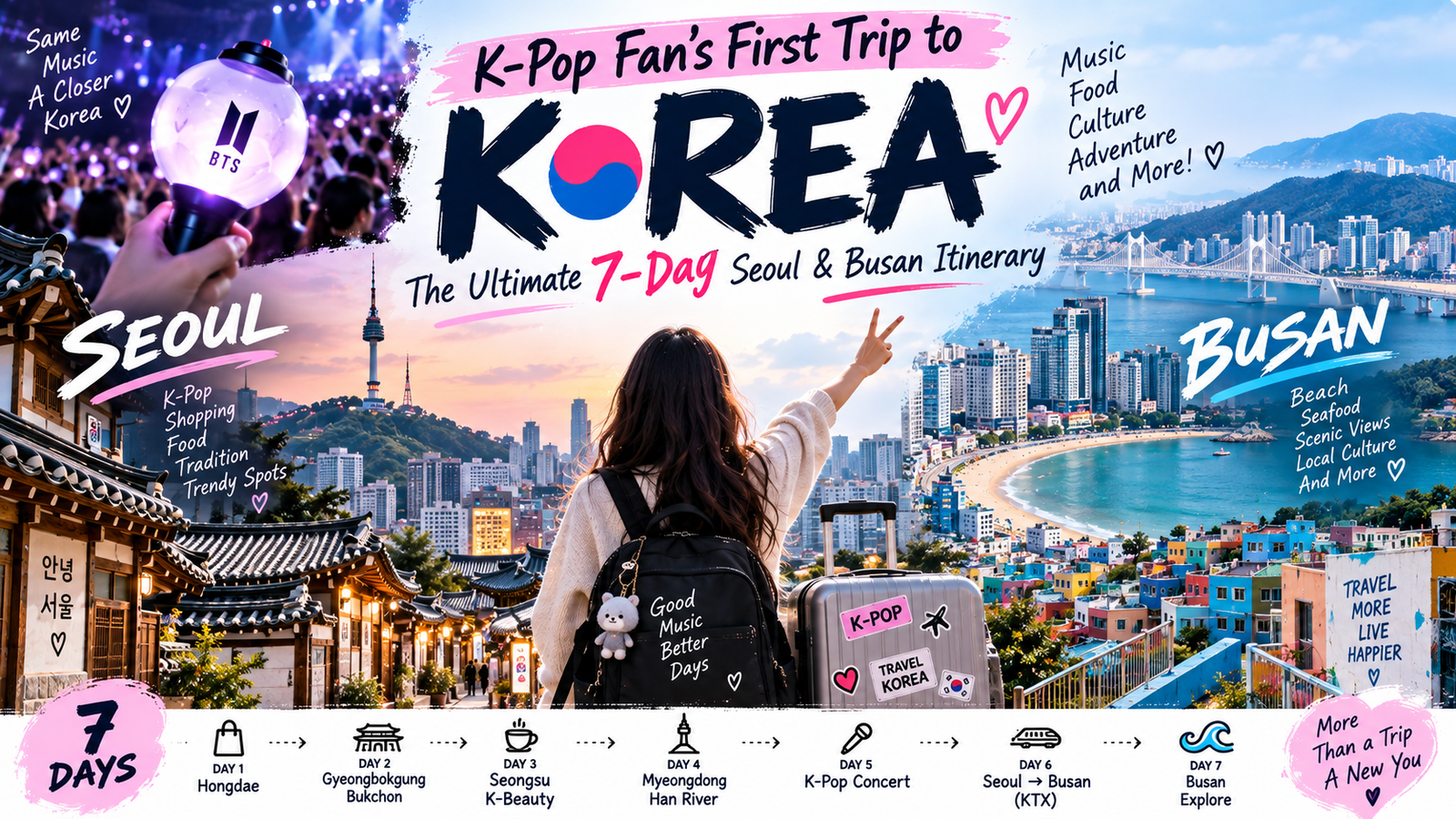
  • K-Pop Fan’s First Trip to Korea: The Ultimate 7-Day Seoul & Busan Itinerary

    K-Pop Fan’s First Trip to Korea: The Ultimate 7-Day Seoul & Busan Itinerary

    You finally got the ticket.

    Maybe it is BTS.

    Maybe BLACKPINK, Stray Kids, SEVENTEEN, aespa, IVE or another artist you’ve followed from thousands of miles away.

    The concert may last only a few hours.

    But if you are flying all the way to South Korea, don’t make the concert your entire trip.

    Make it the beginning.

    K-pop fans are increasingly traveling to Korea not only to see their favorite artists, but to experience the country behind the music.

    And for a first visit, there is one itinerary I recommend more than almost any other:

    5 Days in Seoul + 2 Days in Busan

    Seven days is long enough to experience modern Seoul, traditional Korea, K-pop culture, Korean food, K-beauty and the country’s most famous coastal city — without turning your vacation into an exhausting race between tourist attractions.

    This itinerary is designed especially for a first-time international visitor to South Korea who loves K-pop.

    You don’t need to spend seven days visiting idol-related locations.

    Instead, we’ll use K-pop as the doorway and experience the Korea that exists beyond the concert.


    Why 7 Days Is a Great First Korea Trip

    You can technically visit Seoul in three or four days.

    But if you are flying from North America, Europe or another long-distance destination, that can feel painfully short.

    Seven days gives you time for:

    K-pop

    Korean food

    K-beauty

    traditional Korea

    modern Seoul

    shopping

    the Han River

    and

    Busan

    without changing hotels every night.

    There is another advantage.

    If your main reason for visiting Korea is a concert, arriving several days early gives you protection against flight delays.

    Never schedule an international arrival only hours before a concert you spent months trying to attend.

    For this itinerary, I would ideally place the concert around Day 4 or Day 5.


    Before You Arrive: The Three Things You Need

    Before discussing the itinerary, prepare three things.

    1. A Transportation Card

    Seoul’s subway and bus network makes traveling around the city relatively easy.

    A rechargeable transportation card can be used across much of Korea’s public transit system.

    You’ll use public transportation constantly, so this should be one of the first things you organize after arriving.


    2. Korean Map Apps

    One surprise for many international travelers is that Google Maps is not always the best navigation option in South Korea.

    Install at least one Korean navigation app before your trip.

    Naver Map and KakaoMap are widely used for navigating Korean cities.

    Save your hotel and important destinations in advance.

    This will make your first day considerably easier.


    3. Comfortable Shoes

    This sounds trivial.

    It isn’t.

    You are going to walk.

    A lot.

    Subway stations can be large, neighborhoods are best explored on foot, and several attractions involve hills or long walking routes.

    Your fashionable concert shoes and your sightseeing shoes do not necessarily need to be the same pair.

    Your feet will thank you by Day 5.


    DAY 1 — Arrive in Seoul, Hongdae and Your First Korean Night

    Don’t plan too much for your first day.

    After immigration, baggage collection and transportation from the airport, you may already be tired.

    Check into your hotel, take a short break and begin with one of Seoul’s easiest neighborhoods for younger international visitors.

    Hongdae

    Hongdae is an excellent introduction to modern Seoul.

    The neighborhood is filled with:

    cafés,

    restaurants,

    fashion shops,

    street performers,

    music,

    beauty stores

    and nightlife.

    If K-pop was your introduction to Korea, Hongdae will probably feel surprisingly familiar and completely new at the same time.

    Don’t spend your first evening checking boxes on a sightseeing list.

    Walk.

    Explore.

    Eat.

    Watch the city.


    What Should You Eat on Your First Night?

    For your first Korean meal, keep it fun.

    Try:

    samgyeopsal — Korean grilled pork belly

    or

    Korean fried chicken

    If you are traveling with friends, Korean barbecue is particularly good because eating together around the grill is part of the experience.

    And if you still have energy afterward?

    Find a Korean convenience store.

    Buy a drink and some snacks.

    Congratulations.

    Your Korea trip has officially started.


    DAY 2 — Traditional Korea: Gyeongbokgung, Bukchon and Insadong

    Yesterday was modern Korea.

    Today, go backwards in time.

    Start at:

    Gyeongbokgung Palace

    Built during the Joseon Dynasty, Gyeongbokgung is one of Seoul’s most important historical landmarks.

    If this is your first visit to Korea, don’t skip it simply because it appears on every tourist itinerary.

    There is a reason it does.

    The contrast between the palace architecture and modern Seoul surrounding it is one of the city’s defining experiences.

    Many visitors also rent hanbok, traditional Korean clothing, near the palace.

    If that interests you, allow extra time.


    Walk Toward Bukchon

    After the palace, explore the traditional streets around Bukchon Hanok Village.

    But remember something important:

    Bukchon is not a theme park.

    People actually live there.

    Keep your voice down, respect restricted areas and avoid blocking residential entrances while taking photographs.

    That small amount of consideration makes tourism better for everyone.


    Lunch: Try a Traditional Korean Meal

    This is a good day to move beyond the most internationally famous Korean foods.

    Consider:

    bibimbap

    bulgogi

    mandu

    samgyetang

    or a Korean set meal with multiple side dishes.

    One of the best parts of traveling in Korea is discovering that Korean food is much larger than barbecue and kimchi.


    Finish the Day in Insadong

    Insadong is an easy continuation from the palace area.

    You’ll find:

    traditional crafts,

    tea houses,

    souvenirs,

    galleries

    and smaller streets worth exploring.

    If Day 1 showed you the Korea of K-pop, Day 2 shows you part of the cultural foundation underneath modern Korea.


    DAY 3 — Seongsu, K-Beauty and Contemporary Seoul

    Today is about the Korea that is changing right now.

    Head to:

    Seongsu

    Seongsu has become one of Seoul’s most interesting neighborhoods for fashion, beauty, cafés and pop-up culture.

    This is particularly relevant for K-pop fans.

    K-pop does not exist separately from Korean:

    fashion,

    beauty,

    design,

    brands

    and youth culture.

    They constantly influence one another.

    And Seongsu is one of the easiest places to see those worlds overlap.


    Don’t Overplan Seongsu

    This is important because pop-ups change constantly.

    A store that everyone was posting about three months ago may already be gone.

    Instead of building your entire itinerary around one old viral TikTok, check what events and pop-ups are operating shortly before your trip.

    Then spend time simply exploring the neighborhood.

    Sometimes the most interesting place will be something that did not exist when you booked your flight.


    K-Beauty Shopping

    If you’ve wanted to try Korean skincare or makeup, today is a good day.

    But don’t feel that you need to buy everything immediately.

    Korean beauty stores are everywhere in Seoul.

    Compare products.

    Check what actually suits your skin.

    And remember that a giant shopping bag becomes much less exciting after carrying it around for six hours.


    DAY 4 — Myeongdong, Namsan and the Han River

    Start with one of Korea’s most famous shopping districts.

    Myeongdong

    Myeongdong is touristy.

    And that’s perfectly fine.

    For a first-time visitor, it is convenient.

    You can find:

    K-beauty,

    fashion,

    restaurants,

    cafés,

    street food,

    currency exchange

    and easy transportation.

    It is also a good place to buy gifts for people back home.


    Try Korean Street Food

    Depending on what is available, look for foods such as:

    tteokbokki

    hotteok

    eomuk

    dakgangjeong

    and various grilled snacks.

    Don’t worry about eating every famous Korean dish in one afternoon.

    You have seven days.


    N Seoul Tower and Namsan

    From Myeongdong, you can continue toward Namsan.

    Whether you actually go to the top of N Seoul Tower is up to you.

    The more important experience is seeing Seoul from above and understanding just how enormous the city really is.


    Evening: Do Something Very Korean — Nothing

    After several busy days, slow down.

    Go to the:

    Han River

    Buy food.

    Get a drink.

    Sit.

    Talk.

    Watch bicycles pass.

    Look at Seoul’s skyline.

    If you’ve watched Korean dramas, variety shows or idol content, you’ve probably seen people spending time beside the Han River.

    It may not sound as exciting as a palace or concert.

    But ordinary experiences are often what travelers remember most.


    DAY 5 — K-Pop Day and Concert Night

    This is the day you came for.

    But don’t ruin it by exhausting yourself beforehand.

    Keep the daytime schedule light.

    Sleep a little longer.

    Eat properly.

    Charge your phone.

    Check your ticket.

    Check the venue’s official rules.

    Check transportation.

    Check prohibited items.

    And most importantly:

    Follow the organizer’s official instructions rather than random social-media posts.

    Concert procedures can change.


    What to Do Before a K-Pop Concert

    If official merchandise is being sold, queues can be long.

    There may also be:

    fan events,

    pop-up stores,

    photo zones,

    special cafés,

    album events

    or citywide promotions.

    Plan those around your concert rather than trying to squeeze them into the final hour.

    If the venue is outside central Seoul — for example, Goyang or Incheon — allow significantly more transportation time than the map initially seems to suggest.

    Thousands of other people may be traveling to the same place.


    The Most Important Concert Tip: Plan the Trip Home

    Everyone plans how to reach the concert.

    Fewer people think carefully about what happens when tens of thousands of fans leave simultaneously.

    Before entering the venue, know:

    your subway route,

    the last train time,

    alternative routes,

    taxi possibilities,

    and where you will meet friends if your phones stop working.

    Your concert ends when you are safely back at your hotel.

    Not when the encore ends.


    DAY 6 — Take the KTX to Busan

    Now we change cities.

    And this is where your first Korea trip becomes much more interesting.

    Take the KTX high-speed train from Seoul to Busan.

    The journey is roughly 2.5 to 3 hours depending on the service.

    For many international visitors, the train ride itself becomes part of the experience.

    You leave the enormous capital behind and begin seeing a different side of Korea.


    First Stop in Busan: The Sea

    Seoul is one of the world’s great metropolitan cities.

    Busan feels different almost immediately.

    It is Korea’s largest port city, surrounded by mountains and the sea.

    For a short first visit, I would focus on a few major areas rather than trying to see everything.


    Haeundae Beach

    Haeundae is one of Korea’s most famous beaches.

    Walk along the coast, explore nearby restaurants and enjoy the slower atmosphere.

    If your Seoul days have been packed with subway transfers and shopping streets, the contrast feels wonderful.


    Gwangalli at Night

    If you can choose only one Busan night view, Gwangalli is hard to beat.

    The illuminated Gwangan Bridge stretches across the water in front of you.

    Find somewhere to eat nearby or simply walk along the beach.

    This is one of those moments when you’ll realize:

    Korea is much more than Seoul.


    What to Eat in Busan

    Busan has its own strong food identity.

    Depending on your preferences, consider trying:

    dwaeji gukbap — pork soup with rice

    milmyeon — wheat noodles

    eomuk — Busan-style fish cake

    and, if you enjoy seafood, visit one of the city’s seafood districts.

    This is exactly why adding Busan to a K-pop trip is worthwhile.

    The music may be the same.

    But the Korea around you has changed.


    DAY 7 — Gamcheon, Jagalchi and Goodbye to Korea

    Your final day should combine one more memorable neighborhood with food and a little shopping.

    Start with:

    Gamcheon Culture Village

    Gamcheon is famous for its colorful hillside houses and narrow streets.

    It has become one of Busan’s most recognizable destinations.

    Take your time.

    The neighborhood is hilly.

    Again: comfortable shoes.


    Jagalchi Market

    Then experience another side of Busan at Jagalchi Market, one of Korea’s best-known seafood markets.

    Even if you don’t eat seafood, the area around the market offers an interesting look at Busan’s identity as a port city.

    Nearby streets are also good for exploring traditional markets and local food.


    One Last Korean Meal

    Your final meal does not need to be expensive.

    In fact, one of the joys of Korea is that memorable meals can come from very ordinary places.

    A small gukbap restaurant.

    A noodle shop.

    A gimbap restaurant.

    A market stall.

    A neighborhood barbecue restaurant.

    By Day 7, you’ll probably already have your own opinion about which Korean food deserves one final meal.

    That’s when you know you’ve actually traveled.


    The Complete 7-Day Korea Itinerary

    Here is the entire route in one place:

    DayDestinationMain Experience
    Day 1HongdaeArrival, modern Seoul, Korean food
    Day 2Gyeongbokgung–Bukchon–InsadongTraditional Korean culture
    Day 3SeongsuK-pop culture, cafés, K-beauty, pop-ups
    Day 4Myeongdong–Namsan–Han RiverShopping, street food, Seoul lifestyle
    Day 5Concert DayK-pop concert and fan experiences
    Day 6Seoul → BusanKTX, Haeundae, Gwangalli
    Day 7BusanGamcheon, Jagalchi, local food

    Where Should a First-Time Visitor Stay in Seoul?

    For this particular itinerary, three areas stand out.

    Hongdae

    Best if you want:

    youthful atmosphere,

    nightlife,

    cafés,

    easy airport access

    and lots of restaurants.

    Excellent for younger travelers and K-pop fans.


    Myeongdong

    Best if you want:

    central location,

    shopping,

    K-beauty,

    tourist convenience

    and relatively easy access to major attractions.

    For a first visit to Korea, Myeongdong is difficult to beat for convenience.


    Seoul Station Area

    Best if you plan to take the KTX to Busan and value transportation convenience.

    It is not necessarily the neighborhood I would choose purely for atmosphere, but it makes moving around Korea easier.


    How Much Money Should You Budget?

    There is no single answer because Korea can accommodate very different travel styles.

    Your biggest expenses are likely to be:

    international airfare,

    hotel,

    concert ticket,

    and shopping.

    Public transportation and everyday Korean food can be relatively affordable compared with many major global cities.

    A budget traveler can use:

    guesthouses,

    subways,

    local restaurants

    and convenience stores.

    A higher-budget traveler can easily spend much more on:

    hotels,

    fine dining,

    beauty treatments,

    taxis,

    shopping

    and premium concert experiences.

    The important thing is to separate your concert budget from your daily travel budget.

    K-pop merchandise has a mysterious ability to make carefully planned budgets disappear.


    Should You Visit Only K-Pop Locations?

    I wouldn’t.

    And I’m saying that in a guide specifically written for K-pop fans.

    If BTS, BLACKPINK, Stray Kids or another artist made you curious about Korea, that’s wonderful.

    Visit the places connected to them.

    Go to the concert.

    Buy the album.

    Take the photos.

    But don’t leave Korea having experienced only your fandom.

    Spend one day learning about Korean history.

    Eat food you’ve never seen your favorite idol eat.

    Visit a neighborhood you discovered by accident.

    Talk to people.

    Take the train to another city.

    Sit beside the Han River without doing anything.

    Let K-pop bring you to Korea.

    Then let Korea surprise you.


    Why This Trip Is Bigger Than K-Pop

    Recent tourism data shows that K-pop concerts can have a remarkable effect on international travel to Korea.

    Foreign accommodation bookings during selected major K-pop concert weeks rose dramatically compared with non-concert periods, while government research around BTS performances found international concertgoers staying longer and spending more than the average foreign visitor.

    That’s the phenomenon I explored in our previous article:

    The BTS Effect: Why K-Pop Concerts Are Transforming Tourism in South Korea

    But statistics only tell half the story.

    The other half begins when the fan walks out of the stadium.

    What happens next?

    They eat tteokbokki.

    They discover Seongsu.

    They walk beside the Han River.

    They shop in Myeongdong.

    They ride the KTX.

    They see Busan.

    And suddenly the concert they flew across the world to attend becomes only one chapter of a much bigger memory.


    A Few Mistakes First-Time Korea Travelers Should Avoid

    Don’t schedule your flight too close to the concert.

    Don’t rely entirely on one navigation app without preparing alternatives.

    Don’t carry your passport, wallet and every valuable item carelessly in one place.

    Don’t try to visit ten Seoul neighborhoods in one day.

    Don’t assume every viral restaurant is worth waiting two hours for.

    Don’t forget that residential areas such as parts of Bukchon require respectful behavior.

    And don’t spend your entire vacation looking through your phone camera.

    You traveled a long way.

    Look at Korea with your own eyes too.


    What If You Have More Than 7 Days?

    Excellent.

    Then I would not add more Seoul.

    I would add more Korea.

    With 9–10 days, consider:

    Seoul → Gyeongju → Busan

    Gyeongju offers a completely different experience from both Seoul and Busan.

    It was the capital of the ancient Silla kingdom and is filled with archaeological and historical sites.

    With 10–12 days, you could consider adding Jeju Island.

    That gives you four dramatically different versions of Korea:

    Seoul — modern metropolis

    Gyeongju — history

    Busan — coastal city

    Jeju — nature

    That’s a far richer introduction to Korea than spending the entire trip in one city.


    Final Thoughts: Come for the Concert, Stay for Korea

    Maybe your journey starts with a notification.

    “World Tour Announced.”

    Then comes the ticket battle.

    The flight search.

    The hotel reservation.

    The countdown.

    Finally, you arrive in Korea.

    And for one night, thousands of people inside a stadium sing the same songs together.

    That may be the reason you came.

    But years later, you might remember something else just as clearly.

    The smell of Korean barbecue on your first night.

    The rooflines of Gyeongbokgung.

    A random café in Seongsu.

    Convenience-store ramyeon beside the Han River.

    The KTX pulling out of Seoul Station.

    The lights of Gwangan Bridge reflecting on the sea.

    That is the wonderful thing about traveling because of music.

    K-pop may give you the ticket to Korea.

    But Korea gives you the journey.

    So if you’re traveling thousands of miles for a concert, don’t simply attend the show and fly home.

    Give yourself seven days.

    Explore.

    Eat.

    Walk.

    Get slightly lost.

    Take the train south.

    And discover the country behind the music.

    You may arrive as a K-pop fan.

    You may leave as a fan of Korea.


    Useful Korea Travel Resources

    For current entry information, destinations, festivals and practical travel guidance, use VisitKorea — Korea Tourism Organization.

    For rail schedules and KTX reservations, use KORAIL. Because schedules, fares, concert rules, pop-ups and opening hours can change, verify these details shortly before traveling.


    K-Beauty Shopping

    If you want to explore Korean skincare, cosmetics and beauty products before or after your trip, you can browse OLIVE YOUNG Global.

    Shop K-Beauty at OLIVE YOUNG Global

    If you purchase through the link above, the site operator may receive a commission at no additional cost to you.

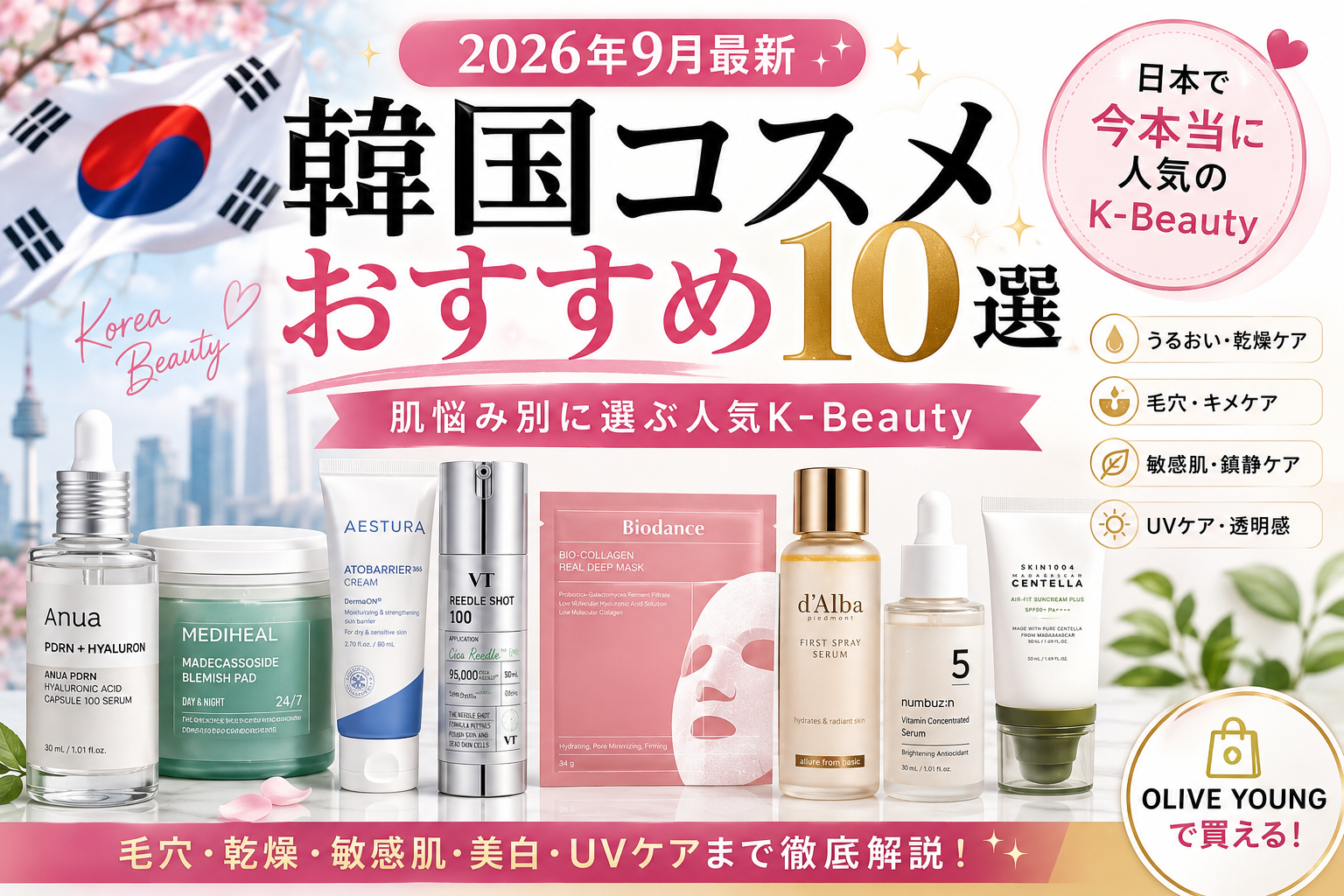
  • 2026年9月最新|韓国コスメおすすめ10選!肌悩み別に選ぶ人気K-Beauty

    2026年9月最新|韓国コスメおすすめ10選!肌悩み別に選ぶ人気K-Beauty

    韓国コスメが気になるけれど、

    「種類が多すぎて、どれを選べばいいかわからない」

    「SNSで人気の商品が、本当に自分の肌に合うの?」

    そんなふうに迷っていませんか?

    2026年の韓国スキンケアは、単に人気ブランドから選ぶのではなく、毛穴・乾燥・敏感肌・肌荒れ・ハリ・UVケアなど、自分の肌悩みに合わせて選ぶことがポイントです。

    日本でも、PDRN美容液やトナーパッド、CICA、韓国の日焼け止めなどへの関心が高まっています。特にPDRNは、2026年に入って日本の美容メディアでも特集や比較記事が相次いでいる注目成分です。

    今回は、日本からもチェックしやすい人気K-Beautyを中心に、肌悩み別おすすめ韓国コスメ10選を紹介します。


    まずチェック!肌悩み別おすすめ韓国コスメ

    肌悩み注目したいアイテム・成分
    乾燥・うるおい不足PDRN・ヒアルロン酸
    毛穴トナーパッド・角質ケア
    敏感肌・ゆらぎ肌CICA・ドクダミ・バリアケア
    ハリ不足PDRN・ペプチド
    肌荒れが気になるCICA・ツボクサ由来成分
    透明感を意識したいナイアシンアミド・ビタミンC
    紫外線対策韓国サンセラム・UVケア

    日本の@cosmeでも、トナーパッドは乾燥肌ならヒアルロン酸やセラミド、敏感肌なら低刺激処方、毛穴ケアならビタミンCやAHAなど、肌タイプ・目的別に選ぶ方法が紹介されています。

    1.Anua PDRN ヒアルロン酸カプセル100セラム

    おすすめ:乾燥・うるおい・ハリ不足

    2026年に韓国コスメを選ぶなら、まず知っておきたいのがPDRN。

    その中でも注目度が高いのがAnuaのPDRN美容液です。

    PDRNとヒアルロン酸を組み合わせた美容液で、乾燥によるうるおい不足やハリ感を意識したスキンケアを探している人にチェックしてほしいアイテム。

    PDRN配合コスメは現在、日本でも美容液だけでなくクリーム、化粧水、パックなど幅広く紹介されています。

    こんな人におすすめ

    乾燥しやすい人、韓国の最新美容成分を試してみたい人、ツヤのある肌を目指したい人。

    2.MEDIHEAL トナーパッド

    おすすめ:毛穴・肌のキメ・時短ケア

    日本でもかなり定着してきた韓国発アイテムがトナーパッドです。

    化粧水や美容液を含ませたパッドで肌を拭き取ったり、気になる部分に数分置いて部分パックとして使ったりできます。

    2026年上半期の『美的』韓国ベストコスメでは、MEDIHEALのマデカッソシド ブレミッシュパッドがトナーパッド部門1位に選ばれています。

    忙しい朝のスキンケアにも使いやすいカテゴリーです。

    3.AESTURA アトバリア365

    おすすめ:敏感肌・乾燥・バリアケア

    刺激の強いスキンケアよりも、肌をうるおしてコンディションを整えることを重視したい人にはAESTURA。

    アトバリア365シリーズは韓国の代表的なバリアケアシリーズの一つです。

    2026年上半期の『美的』韓国ベストコスメでは、AESTURAのアトバリア365 ハイドロスーディングクリームがクリーム部門1位、ジェントルフォーミングクレンザーも洗顔部門1位となりました。

    こんな人におすすめ

    乾燥しやすい人、季節の変わり目に肌がゆらぎやすい人、シンプルな保湿ケアを重視したい人。

    4.VT リードルショット

    おすすめ:キメ・攻めのスキンケア

    韓国コスメの中でも独特な存在がVTのリードルショット。

    微細な美容針のような使用感を特徴とするスピキュール系スキンケアとして日本でも知られるようになりました。

    ただし、刺激を感じる場合があるので、初めて使う人は使用頻度や濃度に注意しましょう。

    敏感肌の場合は無理に流行を追う必要はありません。

    5.Biodance リアルディープマスク

    おすすめ:乾燥・スペシャルケア

    韓国コスメの楽しさを感じやすいカテゴリーがフェイスマスク。

    中でもBiodanceのハイドロゲル系マスクは、一般的なシートマスクとは違う使用感でSNSでも話題になっています。

    2026年上半期の『美的』韓国ベストコスメでは、BiodanceのキャビアPDRN リアルディープマスクがシートマスク部門1位に選ばれました。

    普段使いというより、週末や大切な日の前のスペシャルケアとして取り入れるのもおすすめです。

    6.SKIN1004 センテラシリーズ

    おすすめ:敏感肌・肌荒れが気になる人

    韓国スキンケアで長く人気なのがCICA(ツボクサ由来成分)。

    SKIN1004はセンテラをブランドの中心に据えた韓国スキンケアブランドです。

    刺激の強い美容成分よりも、毎日のスキンケアで肌を整えたい人に向いています。

    特に季節の変わり目など、肌のコンディションが不安定になりやすい時期にもチェックしたいカテゴリーです。

    7.d’Alba ホワイトトリュフ ファーストスプレーセラム

    おすすめ:乾燥・ツヤ・時短ケア

    ミストタイプの美容液を探しているならd’Alba。

    スプレーするだけで使えるので、朝のスキンケアだけでなく乾燥が気になるときにも取り入れやすいのが魅力です。

    韓国コスメ初心者でも比較的使い方がわかりやすいアイテムです。

    8.numbuzin 5番シリーズ

    おすすめ:くすみ・透明感を意識したケア

    成分を見ながら韓国コスメを選びたい人から支持されているのがnumbuzin。

    特に5番シリーズはグルタチオンやビタミン系成分などを特徴とした商品が展開されています。

    「なんとなく人気だから」ではなく、自分がどんな肌を目指したいかから商品を選びたい人に向いています。

    9.韓国サンセラム・日焼け止め

    おすすめ:UVケア・軽い使用感が好きな人

    韓国旅行でぜひチェックしたいのが日焼け止め。

    韓国では美容液のような使用感を意識した「サンセラム」タイプの商品が多くあります。

    ベタつく日焼け止めが苦手な人や、毎日のメイク前に使いやすいUVケアを探している人はチェックしてみてください。

    SKIN1004やd’Albaなど、人気韓国ブランドからもさまざまなUVアイテムが発売されています。

    10.韓国フェイスマスク

    おすすめ:韓国コスメ初心者・プチプラ・お土産

    「韓国コスメを試したいけれど、いきなり美容液やクリームを買うのは不安」

    そんな人におすすめなのがシートマスクです。

    価格が比較的手頃で、いろいろなブランドを試しやすいのが魅力。

    2026年の日本の美容メディアでも韓国パックは大きなカテゴリーとして扱われ、保湿など肌悩み別の選び方が紹介されています。

    韓国旅行のお土産にも選びやすいアイテムです。

    迷ったら「人気」より肌悩みで選ぼう

    韓国コスメは新商品やトレンドの移り変わりが速いため、SNSで人気の商品を全部試す必要はありません。

    まず、

    乾燥なのか?
    毛穴なのか?
    敏感肌なのか?
    ハリ不足なのか?

    自分が一番気になる肌悩みを一つ決めること。

    そのうえで、PDRN、ヒアルロン酸、CICA、ナイアシンアミドなど、目的に合った成分や商品タイプを選ぶと商品を絞り込みやすくなります。

    日本の2026年韓国コスメ情報でも、肌悩み+配合成分で選ぶ考え方が紹介されています。

    2026年、特に注目したいのはPDRN

    この10商品の中から、次のトレンドを一つ選ぶならPDRNです。

    2026年8月には『LDK the Beauty』によるPDRN美容液13商品の比較記事が公開され、9月にもPDRNコスメの最新ランキングが更新されています。つまり日本でもPDRNは一過性ではなく、独立した商品カテゴリーとして検索・比較され始めています。

    次の記事では、

    Anua・VT・medicubeなど人気ブランドのPDRN美容液を比較して、どれを選べばいいのか

    を詳しく紹介します。

    → 関連記事:韓国PDRN美容液おすすめ5選
    ※次の記事を公開したらここから内部リンク。

    よくある質問

    Q. 韓国コスメ初心者は何から始めればいい?

    最初から何種類も変えるより、化粧水・美容液・クリーム・マスクなど一つの商品から試す方法がおすすめです。肌に合わない場合は使用を中止してください。

    Q. 敏感肌でも韓国コスメを使える?

    韓国コスメにも低刺激を意識した商品があります。ただし「韓国コスメだから敏感肌に向いている」というわけではありません。成分表示や使用方法を確認し、心配ならパッチテストから始めましょう。

    Q. 毛穴ケアなら何を選ぶ?

    トナーパッドや角質ケア系の商品が候補になります。ただし毛穴の原因は一つではないため、強いピーリングを繰り返すより自分の肌状態に合わせて選ぶことが重要です。

    Q. 2026年に注目されている韓国コスメ成分は?

    特にPDRNへの注目が高まっています。日本でも美容液・クリーム・マスクなど多くのPDRN配合商品が紹介されています。

    韓国で今注目のK-Beauty ✨
    韓国で話題のビューティーアイテムをOLIVE YOUNG GLOBALでチェック!

    🛍️ 人気の韓国コスメを見る →

    ※本記事にはアフィリエイトリンクが含まれています。リンク経由で購入された場合、当サイトが報酬を受け取ることがあります。

    PR
    🇰🇷 韓国で今注目のK-Beauty ✨
    Anua PDRN ヒアルロン酸カプセル100セラム

    韓国で話題のPDRNスキンケアをチェック。
    人気K-BeautyをOLIVE YOUNG GLOBALで見てみませんか?

    🛍️ OLIVE YOUNGで商品を見る →

    ※本記事にはアフィリエイトリンクが含まれています。 リンク経由で購入された場合、当サイトが報酬を受け取ることがあります。

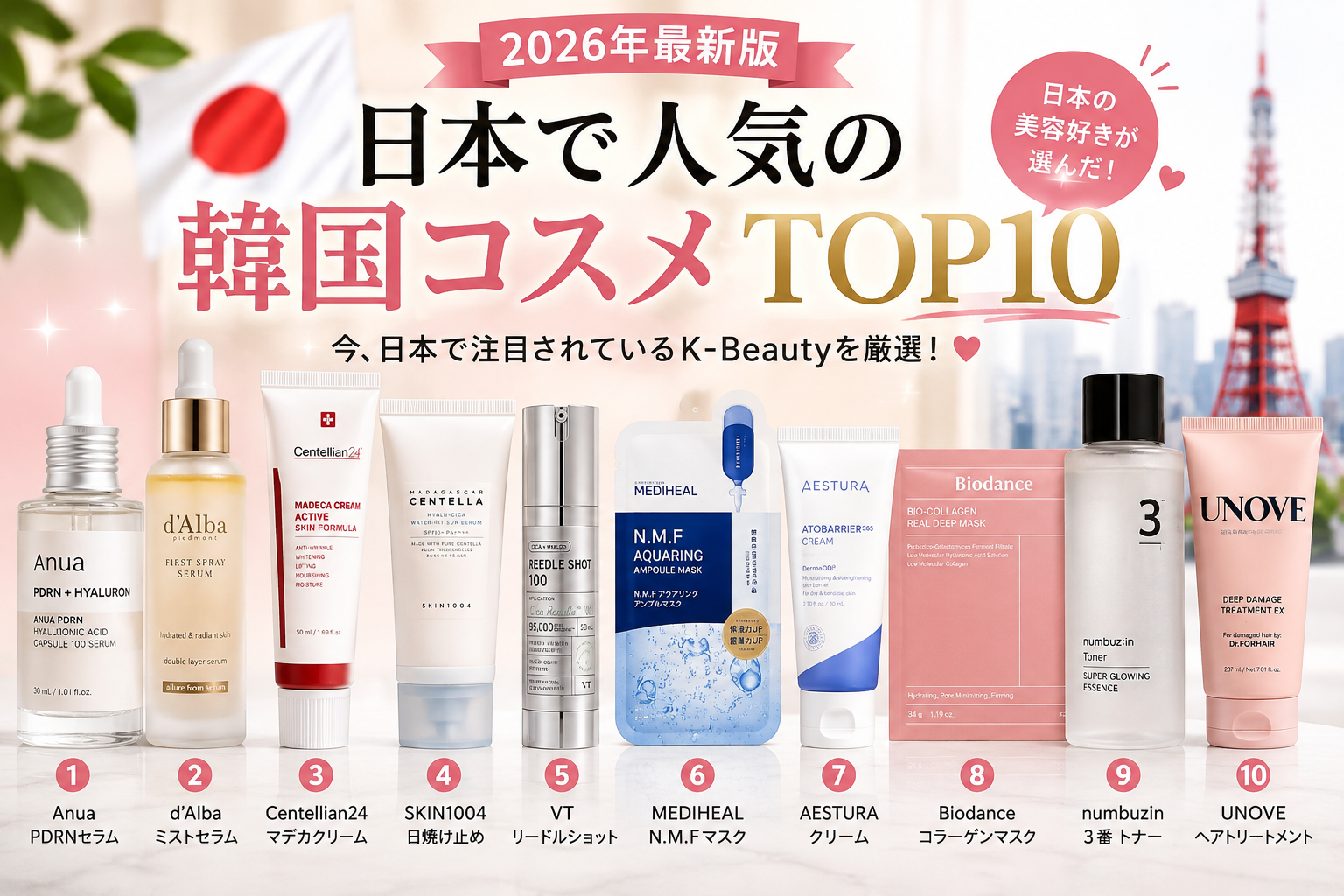
  • 2026年最新|日本で人気の韓国コスメTOP10!今注目のK-Beautyを徹底紹介

    2026年最新|日本で人気の韓国コスメTOP10!今注目のK-Beautyを徹底紹介

    韓国コスメは、もう一時的なブームではありません。

    2026年上半期、日本の化粧品輸入額で韓国は821億8,000万円を記録し、国別で1位を維持しました。前年同期比でも13.3%増加しています。特にベースメイク・皮膚用化粧品では、韓国製品のシェアが49.4%まで拡大しました。

    では、2026年の日本ではどんな韓国コスメが注目されているのでしょうか?

    今回は、オリーブヤングの日本向けランキングや2026年上半期の美容トレンドをもとに、今チェックしたい韓国コスメを10アイテム紹介します。

    1.Anua PDRN ヒアルロン酸カプセル100セラム

    2026年の韓国スキンケアで特に注目したいキーワードがPDRNです。

    Anuaの「PDRN ヒアルロン酸カプセル100セラム」は、オリーブヤングの日本向けランキングでも上位に入り、6月末のランキングでは1位を記録しています。

    PDRN配合コスメそのものも日本で注目されており、美容液だけでなく化粧水、クリーム、パックなど商品ラインアップが広がっています。

    こんな人にチェックしてほしい:
    乾燥やハリ不足が気になる人、韓国の最新スキンケア成分を試してみたい人。

    2.d’Alba ホワイトトリュフ ファーストスプレーセラム

    韓国コスメ好きにはおなじみのd’Alba。

    「ホワイトトリュフ ファーストスプレーセラム」は、オリーブヤング日本向けランキングでも上位に登場しています。

    ミストタイプなので、普段のスキンケアだけでなく、乾燥が気になるときにも使いやすいのが特徴です。

    2026年には海外美容メディアでも韓国フェイスミストの代表的なアイテムの一つとして紹介されています。

    3.Centellian24 マデカクリーム タイムリバース

    韓国スキンケアの強みの一つが、保湿・肌コンディションを重視したアイテムです。

    Centellian24の「マデカクリーム タイムリバース」も、日本向けオリーブヤングランキングの上位に入っています。

    2026年のK-Beautyでは、強い刺激で一気に変えるというより、保湿や肌のバリアを意識しながら長期的にケアする**「スローエイジング」**という考え方も注目されています。

    4.SKIN1004 センテラ サンセラム

    韓国旅行で買いたいアイテムとして外せないのが韓国の日焼け止めです。

    韓国のサンケアは、紫外線対策だけでなく、美容液のような軽い使用感や保湿感を重視した商品が豊富。

    SKIN1004のセンテラ系サンセラムも、韓国で人気のサンケア商品として注目されています。2026年のK-Beautyでは「sun serum」のような軽いテクスチャーの商品への関心も高まっています。

    5.d’Alba ウォータフル トーンアップ サンクリーム

    d’Albaでもう一つ注目したいのがトーンアップ系UVケア。

    日焼け止めと肌をきれいに見せるベースメイク的な役割を一つでこなせるため、朝のメイクをシンプルにしたい人にも使いやすいタイプです。

    日本のZ世代を対象とした2026年上半期の美容調査でも、d’Albaのウォータフルトーンアップサンクリームが時短コスメ部門2位に選ばれています。

    6.VT リードルショット

    日本でも知名度が高くなった韓国コスメの一つがVTのリードルショット。

    2026年のK-Beautyでは、スピキュールやマイクロニードル系の技術を応用したスキンケアが引き続き注目されています。

    日本のZ世代調査でも「VT リードルショット300」がランクインしており、日本での関心の高さがうかがえます。

    最近ではVTからPDRN×リードルショットを組み合わせた商品も登場しており、次のトレンドにも注目です。

    7.MEDIHEAL PDRN リフティングパッド

    韓国コスメ独特の人気アイテムとして定着したのがトナーパッドです。

    コットンのように拭き取るだけでなく、気になる部分に数分置いてミニパックのように使えるのも特徴。

    MEDIHEALの「PDRN リフティングパッド」は、日本の美容誌sweetの2026年上半期韓国コスメ企画でトナーパッド部門1位に選ばれました。

    PDRNとトナーパッドという、2026年らしいトレンドを組み合わせたアイテムです。

    8.AESTURA アトバリア365シリーズ

    敏感肌や乾燥肌向けの韓国スキンケアで注目したいブランドが**AESTURA(エストラ)**です。

    韓国のオリーブヤングランキングでもアトバリア365クリームが上位に入り、海外でも肌バリアを意識した韓国スキンケアとして紹介されています。

    2026年は派手な成分だけでなく、毎日続けやすいバリアケア・保湿ケアも重要なK-Beautyトレンドです。

    9.Biodance コラーゲンマスク

    SNSをきっかけに世界的に知られるようになったのが、Biodanceなどのハイドロゲル・コラーゲンマスク。

    2026年のK-Beautyでは、長時間使用するオーバーナイトマスクがさらに進化し、コラーゲンだけでなくPDRNやペプチドなどを組み合わせた商品も注目されています。

    韓国旅行で「ちょっと変わった韓国コスメを買いたい」という人にも面白いカテゴリーです。

    10.numbuzin 5番 グルタチオンC美容液

    日本でもファンが多い韓国ブランドnumbuzin(ナンバーズイン)。

    「5番 グルタチオンC美容液」は、日本向けオリーブヤングランキングでも上位に入っています。

    商品名から目的を理解しやすいのもナンバーズインの特徴。

    PDRNだけでなく、ビタミンC、ナイアシンアミド、グルタチオンなど、成分から韓国コスメを選ぶ人にもチェックしてほしいブランドです。

    2026年の韓国コスメ、注目キーワードは?

    2026年にK-Beautyを選ぶなら、商品名だけでなくトレンド成分やカテゴリーにも注目してみましょう。

    特に今年はPDRN、リードル・スピキュール系、トナーパッド、サンセラム、カプセルクリーム、オーバーナイトマスク、スローエイジングなどが重要なキーワードです。

    なかでもPDRNの勢いは強く、Olive Youngでは2026年初頭のPDRN関連検索が前年同期比で90%以上増加したと報じられています。

    つまり2026年は「ブランドで選ぶ韓国コスメ」から、自分の肌悩みに合わせて成分や機能で選ぶK-Beautyへと変化していると言えそうです。

    今、日本でK-Beautyが面白い理由

    日本で韓国コスメへの関心が高まっていることを象徴するイベントも始まります。

    東京・駐日韓国文化院では、**2026年9月5日から11月7日まで「GLOBAL K-ZONE K-BEAUTY JOURNEY」**を開催。

    9月は韓国の聖水(ソンス)・明洞(ミョンドン)、10月は**江南(カンナム)・北村(プクチョン)**をテーマに、韓国の最新ビューティー商品を紹介します。AI肌診断やコスメ体験なども予定されています。

    特に9月5日~11日にはオープニングイベント「BEAUTY DAY」が開催され、韓国で話題のコスメを先着でプレゼントする企画なども予定されています。

    東京に住んでいるK-Beautyファンなら、チェックしてみても面白そうです。

    よくある質問(FAQ)

    Q. 2026年、日本で人気の韓国コスメは?
    Anua、d’Alba、VT、MEDIHEAL、AESTURA、numbuzinなどのブランドが日本向けランキングや日本の美容ランキングで確認できます。特にPDRN配合スキンケアへの関心が高まっています。

    Q. 2026年に注目のK-Beauty成分は?
    PDRNをはじめ、ナイアシンアミド、ヒアルロン酸、コラーゲン、マデカッソシドなどが注目されています。

    Q. 韓国旅行でコスメを買うならどこ?
    オリーブヤングは代表的な選択肢です。特に明洞や聖水は複数のブランドショップも回りやすく、K-Beautyを目的に韓国を訪れる旅行者にも便利なエリアです。

    PR・アフィリエイトリンクを含みます
    🇰🇷 韓国で人気のK-Beautyを
    OLIVE YOUNG GLOBALでチェック
    PDRN・リードルショット・韓国の日焼け止めなど、
    話題の韓国コスメを日本からオンラインでチェックできます。
    🛍️ OLIVE YOUNGで人気コスメを見る
    ※本ページにはアフィリエイトリンクが含まれています。
    リンク経由で購入された場合、当サイトが報酬を受け取ることがあります。

    ※本記事にはアフィリエイトリンクが含まれています。リンクを通じて商品を購入された場合、当サイトが報酬を受け取ることがあります。購入者の追加負担はありません。

  • 日本人の海外旅行先1位は韓国!228万人が訪韓、なぜ今「韓国旅行」が人気?

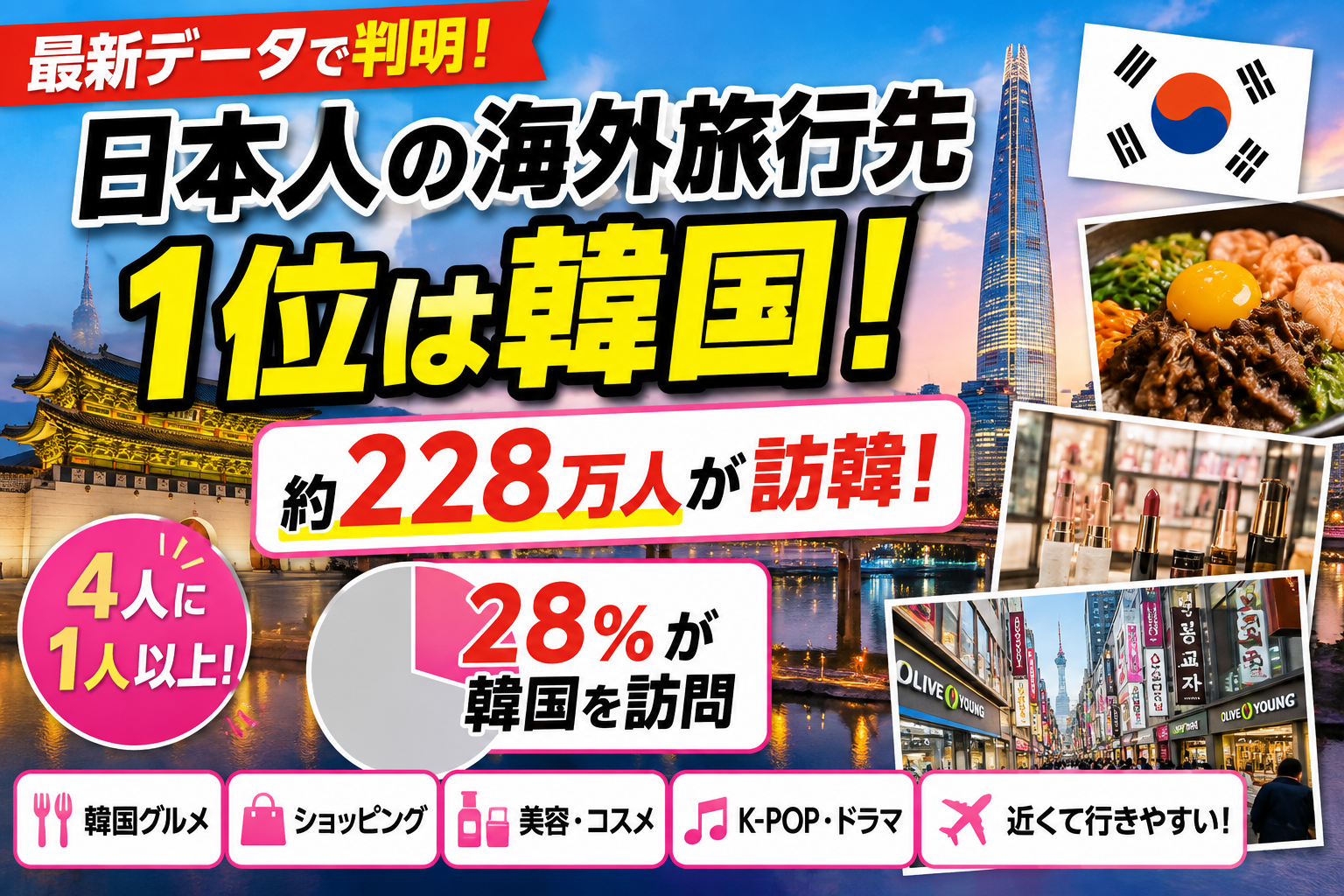
    日本人の海外旅行先1位は韓国!228万人が訪韓、なぜ今「韓国旅行」が人気?

    「日本人が今、一番多く訪れている海外旅行先はどこ?」

    ハワイ、台湾、タイを思い浮かべる人も多いかもしれません。

    しかし、2026年に日本人が最も多く訪れている海外旅行先は韓国です。

    2026年1月から7月までに海外へ出国した日本人は約814万人。

    そのうち**約228万人が韓国を訪れ、全体の約28%**を占めました。

    つまり、海外旅行に出かけた日本人の4人に1人以上が韓国を訪れた計算になります。

    しかも、韓国を訪れる日本人は前年同期より18.8%増加しています。

    なぜ今、日本人の韓国旅行がこれほど人気なのでしょうか?

    最新データとともに、その理由を見ていきましょう。

    2026年、日本人の海外旅行先1位は韓国

    2026年1~7月に海外へ出国した日本人は813万5903人。

    このうち韓国を訪れた日本人は228万159人でした。

    日本人海外旅行者に占める割合は**28.03%**です。

    前年同期の24.56%から約3.5ポイント上昇し、過去最高水準となりました。

    主な海外旅行先を比較すると、

    1位 韓国:約28.0%

    2位 アメリカ:約13.1%

    3位 台湾:約9.4%

    4位 タイ:約6.8%

    5位 ベトナム:約6.1%

    となっています。

    韓国は2位のアメリカの2倍以上。

    日本人の海外旅行先として、韓国の存在感が非常に大きくなっていることが分かります。

    韓国を訪れる日本人は18.8%増加

    さらに注目したいのが、その増加スピードです。

    2026年1~7月に海外旅行へ出かけた日本人全体は、前年同期比で4.1%増加しました。

    一方、韓国を訪れた日本人は18.8%増加。

    日本人の海外旅行市場全体よりも、韓国旅行の伸びが大幅に上回っています。

    では、なぜ韓国なのでしょうか?

    理由① 日本から近い

    韓国旅行の大きな魅力の一つが、日本からの近さです。

    東京や大阪だけでなく、福岡をはじめ日本各地から韓国への航空便が運航されています。

    ソウルだけでなく、釜山や済州などを目的地にする旅行者もいます。

    長期休暇を取らなくても比較的旅行しやすく、週末を利用した短期旅行とも相性が良いのが韓国です。

    理由② K-POPや韓国ドラマだけではない

    以前は「韓国が好き」と聞くと、K-POPや韓国ドラマをイメージする人も多かったかもしれません。

    しかし現在、日本人が韓国を訪れる目的はさらに広がっています。

    韓国グルメ、カフェ、コスメ、美容、ファッション、ショッピングなど、韓国の日常文化そのものを楽しむ旅行が増えています。

    好きなアーティストのライブやロケ地をきっかけに韓国を訪れ、そこで食事や買い物、美容などを楽しむ人もいます。

    理由③ 韓国グルメ

    韓国旅行で外せないのが食事です。

    サムギョプサル、タッカンマリ、トッポッキ、キンパ、チキンなど、日本でも知られている韓国料理は数多くあります。

    しかし、実際に韓国へ行くと、日本ではまだあまり知られていない料理や地元の人気店にも出会えます。

    コンビニや市場、屋台などを巡るだけでも韓国独特の食文化を楽しめます。

    「韓国で本場の韓国料理を食べたい」

    これも韓国旅行の大きな魅力です。

    理由④ K-Beauty・コスメ・美容

    韓国コスメやK-Beautyの人気も韓国旅行を後押ししています。

    日本でも韓国コスメは身近になりましたが、韓国では日本未発売の商品や新商品に出会えることがあります。

    オリーブヤングなどでコスメを購入したり、韓国の美容トレンドを体験したりすること自体が旅行目的になるケースもあります。

    グルメと同じように「韓国でしかできない体験」を求める旅行者が増えているのです。

    理由⑤ ソウルだけではない韓国旅行

    そして今後注目したいのが、ソウル以外の韓国旅行です。

    釜山、済州、大邱、仁川など、日本人旅行者が楽しめる場所は韓国各地にあります。

    有名観光地だけではなく、韓国人が実際に訪れる市場、飲食店、海辺の街、地方の観光地などにも魅力があります。

    初めてならソウル。

    2回目、3回目なら、まだ日本ではあまり知られていない韓国へ。

    そんな旅行スタイルも面白いのではないでしょうか。

    True Taste Koreaで「本当の韓国」を紹介します

    True Taste Koreaでは、有名観光地だけを紹介するのではなく、日本人旅行者が実際に韓国を訪れたときに役立つ情報を発信していきます。

    韓国人が食べる本当の韓国料理。

    まだあまり知られていない旅行先。

    韓国旅行で困ったときの対処法。

    交通、買い物、病院、トラブルなど、旅行前に知っておきたい情報。

    「観光ガイドだけでは分からない韓国」を、日本の皆さんに分かりやすく紹介していきます。

    まとめ|日本人の4人に1人以上が韓国へ

    2026年1~7月、日本から海外へ出国した約814万人のうち、約228万人が韓国を訪れました。

    その割合は約28%。

    日本人の海外旅行先で韓国が1位となっています。

    そして訪韓日本人は前年同期より18.8%増加しました。

    近さ、韓国グルメ、K-POP、ドラマ、ショッピング、コスメ、美容。

    韓国を訪れる理由は人それぞれです。

    あなたが韓国へ行きたい一番の理由は何ですか?

    そして次の韓国旅行では、どんな韓国を見てみたいですか?

    🎥 30秒でわかる!日本人の海外旅行先1位は韓国?

    2026年、日本人が最も多く訪れている海外旅行先は韓国!

    約228万人が韓国を訪れ、日本人海外旅行者の約28%を占めています。

    なぜ今、これほど多くの日本人が韓国を訪れているのでしょうか?

    👇 まずは30秒のショート動画でチェックしてみてください!

    韓国旅行が人気の理由や最新データ、グルメ・ショッピング・美容・K-POPなど、日本人が韓国を訪れる理由については以下で詳しく紹介しています。