What makes someone a villain?
Is it the harm they cause, the desires they refuse to suppress, or the way society chooses to remember their story?
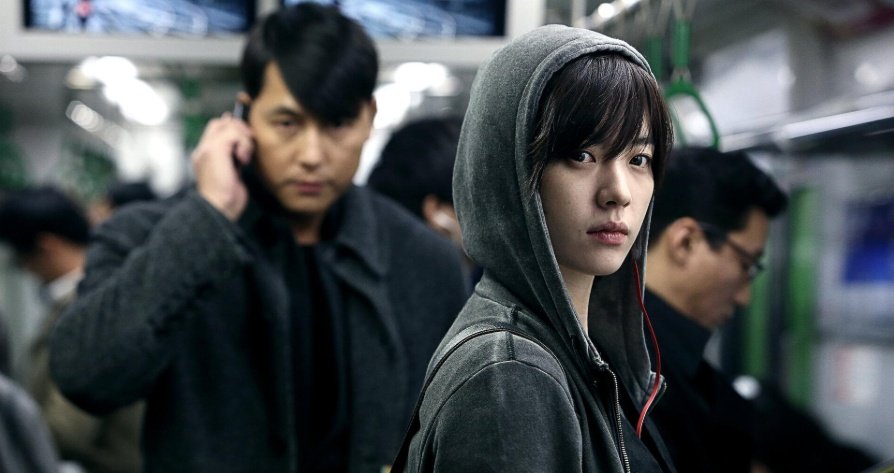
The Korean film Scarlet Innocence (2014), directed by Yim Pil-sung and starring Jung Woo-sung and Esom, approaches these questions through an unusual reinterpretation of one of Korea’s most familiar traditional narratives: Simcheongga.
The original story celebrates filial devotion through Simcheong, a daughter who sacrifices herself to restore her blind father’s sight. Ppaengdeok, a secondary figure associated with selfishness and greed, occupies a very different moral position in the traditional narrative.
But what happens when the story moves away from the devoted daughter and begins examining the woman traditionally remembered as the villain?
Scarlet Innocence transforms this familiar moral landscape into a contemporary story of desire, betrayal, blindness, and revenge. Its most provocative question is not whether Deok-yi is innocent. It is whether the standards used to judge her are applied equally to the man whose actions help create the tragedy.
1. A Familiar Korean Tale Told from an Unfamiliar Perspective
To understand Scarlet Innocence, international audiences first need to understand its literary foundation.
Simcheongga is one of the five surviving traditional Korean pansori narratives. Pansori is a distinctive form of musical storytelling in which a singer and drummer communicate an extended dramatic story through performance.
The best-known part of the narrative concerns Simcheong, whose devotion to her blind father becomes the defining measure of her character.
The traditional story is built around filial duty, sacrifice, and the restoration of sight. Ppaengdeok is associated with a contrasting set of qualities, particularly selfishness and appetite.
Yim Pil-sung takes this familiar moral structure and moves its attention elsewhere.
Instead of simply retelling the story of a devoted daughter, he creates a darker narrative in which the desires and suffering of the characters become the central forces.
This is not a straightforward modernization of the original. It is a deliberate rearrangement of its moral priorities.
2. Deok-yi: A Woman Who Wants to Be Loved
Esom plays Deok-yi, a young woman living in a small rural town.
Her life changes when Shim Hak-kyu, a university professor played by Jung Woo-sung, arrives after a scandal forces him away from his previous position.
Their relationship develops into an affair, despite Hak-kyu being married and having a daughter.
At first glance, Deok-yi may appear to be a young woman caught in an unequal relationship with an older, more experienced man.
But the film does not present her as entirely passive. She knows that Hak-kyu has a family, and she actively participates in their relationship.
That detail complicates the usual victim narrative.
Deok-yi is capable of making choices, including morally questionable ones. Yet her willingness to enter the affair does not excuse Hak-kyu’s later treatment of her.
The distinction between responsibility and innocence is essential to understanding this film.
3. Hak-kyu: The Man Who Wants Everything Without Paying the Price
Hak-kyu is not simply a man who falls in love with someone outside his marriage.
He is a character who repeatedly places his immediate desires above the consequences experienced by other people.
He seeks excitement, pleasure, and escape from the limitations of his ordinary life. Deok-yi becomes part of that escape.
But the relationship is fundamentally unequal.
For Deok-yi, the affair develops into something emotionally significant. For Hak-kyu, it is an experience that can be abandoned when returning to his previous life becomes convenient.
His greatest weakness is not necessarily his desire. It is his unwillingness to accept responsibility for what that desire does to others.
This is why the film’s tragedy cannot be understood simply as the result of a woman becoming obsessed with a man.
Hak-kyu’s decisions are part of the chain of events that makes the later revenge possible.
4. The Difference Between Being Hurt and Being Innocent
One of the film’s most interesting moral questions concerns Deok-yi’s position as both a person who has been hurt and a person who makes harmful choices.
Audiences may sympathize with her abandonment and humiliation. However, sympathy does not automatically make every subsequent action acceptable.
The film refuses to offer a comfortable division between an innocent victim and a completely evil antagonist.
Deok-yi understands the circumstances of the affair. She is not unaware that Hak-kyu is married. Her decisions contribute to the destruction of an existing family, even though Hak-kyu bears substantial responsibility for his own betrayal.
Later, her desire for revenge becomes increasingly destructive.
This creates an uncomfortable question:
Can someone be a victim in one chapter of their life and become an aggressor in another?
The answer is yes. Human beings do not remain permanently inside a single moral category.
That complexity is more interesting than simply declaring Deok-yi either innocent or evil.
5. The Eight-Year Gap: Revenge Becomes an Identity
The story takes a major turn when the narrative moves forward eight years.
Hak-kyu’s life has deteriorated. He is now experiencing the consequences of his earlier behavior, including the loss of his sight and the breakdown of his relationship with his daughter.
Deok-yi returns under a different identity.
She becomes Se-jung, a woman who enters Hak-kyu’s life and gradually moves closer to the family she once lost.
The passage of eight years is important because revenge is no longer simply an immediate emotional reaction.
It has become a long-term project.
Deok-yi has had time to transform her appearance, construct a new identity, and organize her actions around the destruction of the people she associates with her suffering.
But there is a cost.
When revenge becomes the central purpose of someone’s existence, the original injury may no longer be the only thing controlling that person’s life.
The person seeking justice can become increasingly dependent on the suffering of others.
6. Why Does Deok-yi Return as Se-jung?
Deok-yi’s new identity is more than a disguise.
It allows her to approach Hak-kyu from a position in which he does not recognize the history between them.
The irony is powerful.
The man who once abandoned her becomes dependent on the kindness of a woman whose real identity he does not understand.
He accepts help without recognizing the person behind it.
This reversal creates a different kind of power relationship. Deok-yi is no longer the young woman waiting for Hak-kyu to choose her. She controls information that he does not possess.
However, this power is not necessarily freedom.
Her new identity exists to serve the revenge she has planned. She may control the situation, but she remains psychologically tied to the original betrayal.
The film suggests that changing one’s identity does not automatically mean escaping the past.
7. The Daughter: The Forgotten Center of the Original Story
One of the most important changes in Scarlet Innocence is the way it treats Hak-kyu’s daughter, Cheong-yi.
In the traditional Simcheongga, the daughter is the moral center of the narrative. Her sacrifice is what gives the story its emotional and ethical structure.
In the film, however, the relationship between father and daughter is damaged and complicated.
Cheong-yi is no longer simply the symbol of filial devotion. She becomes part of a contemporary family tragedy shaped by the selfish decisions of adults.
Her presence also connects the original narrative to Deok-yi’s revenge.
The daughter is caught between a father who has failed in his responsibilities and a woman whose desire for revenge threatens to consume the family.
This creates an important question: what happens to the people who did not create the original conflict but are forced to live with its consequences?
The film has an opportunity to explore this deeply, although Cheong-yi’s characterization is one of the areas that some critics consider insufficiently developed.
8. Blindness: More Than a Physical Condition
Blindness is one of the most recognizable symbols inherited from the original Korean story.
In Simcheongga, the restoration of the father’s sight represents a dramatic resolution connected to his daughter’s sacrifice.
In Scarlet Innocence, blindness takes on a darker psychological meaning.
Hak-kyu loses his sight, but his inability to see is not limited to his physical condition.
Throughout the story, he has repeatedly failed to recognize the emotional consequences of his actions.
He does not fully understand the damage caused by his selfishness until the consequences become impossible to ignore.
This creates an interesting reversal.
The man whose sight once represented the central problem of the traditional narrative becomes someone who has been morally blind long before his physical deterioration.
The film does not need to treat blindness as a moral punishment to make this symbolic connection meaningful. Its deeper point concerns the difference between seeing the world and understanding one’s responsibility within it.
9. The Problem with Calling Deok-yi an Evil Woman
The traditional image of Ppaengdeok is closely associated with negative moral qualities.
When the film gives this figure a more complex history, it raises a question about the way women in traditional narratives are categorized.
A woman who follows the expectations of filial duty or self-sacrifice can be celebrated.
A woman who expresses sexual desire, jealousy, ambition, or anger may be judged much more harshly.
This does not mean that Deok-yi’s actions should be excused.
Rather, the important issue is whether the same moral standards are applied to Hak-kyu.
He pursues pleasure outside his marriage, abandons a relationship when it becomes inconvenient, and repeatedly prioritizes himself. Yet the story initially allows him to retain the social position of a respected man.
Deok-yi, by contrast, becomes increasingly defined by the label of the dangerous woman.
The film becomes especially interesting when viewed through this imbalance.
Perhaps the question is not whether Ppaengdeok is secretly good. Perhaps it is why the moral judgment of a woman’s desire can become more severe than the judgment of a man’s selfishness.
10. Revenge Does Not Automatically Create Justice
Revenge stories often give audiences a satisfying emotional structure.
Someone is hurt. The person responsible escapes punishment. The victim returns stronger and forces the offender to experience the consequences of their actions.
But Scarlet Innocence complicates this structure.
Deok-yi’s revenge does not simply restore the balance that existed before the betrayal.
Her actions create additional suffering and draw other people into a conflict they did not originally choose.
This is where the distinction between justice and revenge becomes essential.
Justice seeks accountability for wrongdoing. Revenge seeks to make another person suffer, often because suffering is believed to restore a lost sense of power.
The two can overlap emotionally, but they are not identical.
Deok-yi may have legitimate reasons to feel betrayed. That does not mean the destruction she pursues can be understood as a fair solution.
The film’s tragedy lies partly in the fact that the original injury continues to generate new injuries.
11. A Modern Retelling That Changes the Moral Center
The most significant adaptation choice is the decision to shift the story away from the traditional emphasis on filial sacrifice.
The original narrative gives the audience a relatively clear moral framework. Simcheong’s devotion provides the emotional center, while other characters are understood in relation to that virtue.
The film replaces this clarity with a more unstable world.
Hak-kyu, Deok-yi, and Cheong-yi are all connected through desire, resentment, and damaged relationships.
The audience is no longer simply asked to admire a virtuous daughter.
Instead, viewers must decide how to interpret people whose actions are shaped by selfishness, pain, and responsibility.
This transformation is one of the film’s most interesting artistic decisions.
It also explains why the title Scarlet Innocence is so suggestive. The idea of innocence becomes difficult to define when nearly every character has participated in some form of moral failure.
12. Why the Film’s Second Half Divides Viewers
The film has an ambitious premise, but ambition does not guarantee consistent execution.
Some international reviews praise the performances and the visual atmosphere while criticizing the way the narrative changes direction after the eight-year time jump.
The early relationship between Hak-kyu and Deok-yi develops as an erotic melodrama. The later story moves toward revenge, psychological manipulation, and a darker thriller structure.
This transition can feel abrupt.
Cheong-yi’s role also offers considerable dramatic potential, but the film does not always give her enough development to make every later event emotionally convincing.
These weaknesses matter because the story depends on complicated relationships.
For revenge to have its full emotional impact, audiences need to understand not only what characters do but also how their feelings and motivations evolve.
The film has compelling ideas, but some of them are stronger than the dramatic construction used to express them.
13. The Ending and the Unequal Price of Desire
The ending deserves particular attention because it returns to the traditional story’s most recognizable symbol: sight.
In the original narrative, the restoration of the father’s sight is connected to a larger moral and emotional resolution.
In Scarlet Innocence, the meaning is transformed.
The conclusion gives the characters a deeply unequal experience of loss and recovery. Hak-kyu’s sight is restored, while Deok-yi’s fate moves toward another form of blindness and destruction.
This reversal invites a critical interpretation.
The man whose selfishness helped create the tragedy is given the possibility of physical restoration. The woman whose desire has become destructive is left facing a devastating outcome.
The film can therefore be read in two ways.
On one level, it is a tragedy in which revenge consumes the person who pursues it.
On another level, it repeats an older narrative pattern in which a woman’s desire ends in punishment while a man’s return to ordinary life remains possible.
A 2025 academic study of the film’s relationship with Simcheongga examines this transformation and the way the film rearranges the meanings of sight, sacrifice, and female desire.
The ending is not simply a neat moral lesson. It leaves an uncomfortable question about whose wrongdoing receives punishment and whose suffering is allowed to end.
14. Was Ppaengdeok Created by Society, or by Her Own Choices?
This is the central question that makes the film worth discussing.
It would be too easy to argue that Deok-yi becomes destructive only because Hak-kyu betrays her.
She has agency. She makes choices. Her later actions cannot be separated from her own responsibility.
But it would also be too easy to describe her as an inherently evil woman.
Her transformation takes place within a relationship shaped by unequal expectations, abandonment, and the emotional consequences of male selfishness.
The film invites us to examine the process through which a person becomes the villain of someone else’s story.
The most useful interpretation is not that society alone creates villains or that individuals alone are responsible for everything they become.
It is that personal choices and social judgments interact.
Hak-kyu’s actions help create the circumstances of the tragedy. Deok-yi’s decisions determine what she does with her suffering. The traditional story, meanwhile, provides a cultural framework through which audiences may judge her.
The result is a character who cannot be understood through a single moral label.
15. The Woman History Remembered as a Villain
The most valuable achievement of Scarlet Innocence is its decision to look again at a character who traditionally occupied the margins of a familiar Korean story.
The film does not turn Deok-yi into a perfect heroine. Nor does it completely free her from responsibility for the suffering she causes.
Instead, it gives her a history, a desire, and a complicated relationship with the man whose actions help shape her future.
That choice changes the way we approach the original narrative.
Perhaps the most revealing question is not whether Ppaengdeok deserves sympathy.
It is why some characters are remembered primarily for their moral failures while others are allowed to remain sympathetic despite causing considerable harm.
The film’s reinterpretation of Simcheongga opens a space to examine that imbalance.
Final Thoughts: Who Gets to Decide Who the Villain Is?
Scarlet Innocence is an ambitious reinterpretation of a classic Korean narrative. Its story of desire, betrayal, and revenge does not always maintain the dramatic precision its premise deserves, but its central questions remain compelling.
Deok-yi is neither completely innocent nor simply evil. Hak-kyu is neither merely a victim of revenge nor a man whose suffering erases his earlier choices.
Their tragedy emerges from a chain of decisions in which desire repeatedly takes priority over responsibility.
But the film’s most provocative idea extends beyond these two characters.
It asks us to reconsider the moral language inherited from traditional stories. Why is a woman’s desire so easily transformed into evidence of her corruption? Why can a man’s selfishness be treated as a personal weakness while a woman’s anger becomes proof that she is dangerous?
Perhaps Ppaengdeok was never simply a villain waiting to be exposed.
Perhaps she was a character whose side of the story was rarely considered important enough to tell.
And that may be the most interesting transformation of all: not making the villain innocent, but finally allowing the audience to ask how she became one.