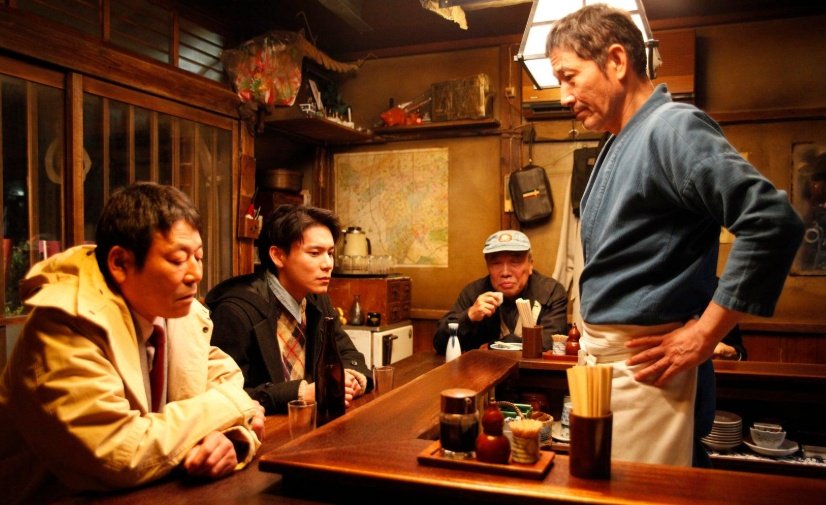
There is a small restaurant hidden in the backstreets of Shinjuku, Tokyo. It opens at midnight and closes at seven in the morning. Its menu is limited, but the owner, known simply as Master, is willing to prepare almost anything a customer requests.
The people who enter are not ordinary restaurant customers.
Some are lonely. Some are carrying painful memories. Others are struggling with relationships, failed dreams, financial difficulties, or the simple exhaustion of getting through another day.
They come for food, but they often leave with something harder to find.
A little understanding.
At first glance, Midnight Diner appears to be a gentle Japanese drama about food and everyday life. Yet its emotional power comes from a deeper question:
Why do strangers sometimes feel more like family than the people we already know?
The answer may have less to do with food than with the kind of place Master has created.
1. The Diner Is More Than a Place to Eat
The restaurant in Midnight Diner is unusually small.
There are no elaborate decorations, no fashionable atmosphere, and no complicated menu. Its appeal comes from its simplicity.
People sit close to one another. They eat, talk, listen, and gradually become familiar with each other’s lives.
In most restaurants, customers arrive, order, eat, pay, and leave.
But Master’s diner operates differently.
A person can return again and again without needing to explain why. Familiar faces become part of the atmosphere. Even customers who rarely speak can feel connected simply because they share the same space.
The diner becomes more than a commercial establishment.
It becomes a place where people are allowed to exist without constantly explaining themselves.
That distinction is central to understanding the series.
2. Why Does Midnight Attract Lonely People?
The restaurant’s opening hours are not just a charming detail.
Midnight is a particular kind of emotional territory.
During the day, people are expected to work, communicate, fulfill responsibilities, and maintain their public identities.
At night, many of those expectations become quieter.
The people who visit Master’s restaurant often belong to worlds that do not easily overlap during ordinary hours. They may work unusual schedules, live unconventional lives, or simply have nowhere else they want to go.
Night also changes how people experience loneliness.
A problem that feels manageable in the afternoon can become overwhelming when the streets grow quiet.
The diner offers a small interruption to that loneliness.
It does not promise to change anyone’s life. It simply provides somewhere to sit when going home does not feel like the most comfortable option.
3. Master Understands That Not Every Problem Needs Advice
One of the most interesting things about Master is what he does not do.
He rarely behaves like a therapist, a motivational speaker, or a moral authority.
He listens.
Sometimes he asks a question. Sometimes he offers a short comment. Often, he simply prepares the food someone has requested.
This restraint is important.
People do not always need someone to tell them what they should do. Sometimes they need to speak without being interrupted, judged, or immediately corrected.
The director Joji Matsuoka has described the diner as a place where characters can confess their stories and find the courage to take another step in life.
That idea explains much of the show’s emotional structure.
Master does not need to solve a customer’s problem to make the encounter meaningful.
Sometimes the act of being heard is enough to help someone move forward.
4. Food Is a Language That Memories Understand
In Midnight Diner, food rarely exists only to satisfy hunger.
A particular dish can bring back a childhood memory, an old relationship, a lost family member, or a period of life that someone thought they had forgotten.
This is why the same simple meal can carry different meanings for different customers.
A dish may remind one person of a parent. For another, it may represent a relationship that ended years ago. Someone else may order it because it is the only thing that makes an unfamiliar place feel familiar.
Food has an unusual ability to connect the present with the past.
A smell or taste can bring back a memory before a person has even decided to think about it.
The show understands this emotional connection.
The food is not simply an attractive part of the setting. It is often the reason a character finally begins telling a story.
5. Why Does the Master Remember What People Eat?
The Master’s attention to individual requests is one of the quietest expressions of care in the series.
He remembers what people order. He notices their preferences. He prepares something familiar when someone needs it.
These gestures may seem ordinary, but they communicate something important.
Someone has paid attention.
In everyday life, people often feel invisible because their needs are too small to attract attention. A favorite meal, a familiar routine, or a remembered preference can become surprisingly meaningful.
Master does not make dramatic promises.
He remembers.
That is one reason his relationship with customers feels different from a typical service relationship.
The diner may be a business, but its emotional value comes from the attention people receive there.
6. The Customers Become a Family Without Becoming One
The regular customers are not related by blood.
They have different jobs, personalities, backgrounds, and personal problems. Some might never have become friends under ordinary circumstances.
Yet they gradually develop a shared identity through repeated encounters.
They recognize each other. They notice when someone is absent. They sometimes become involved in one another’s difficulties.
This is not exactly a traditional family.
There are no formal obligations requiring them to care about each other. They are free to come and go.
That freedom is part of the appeal.
The diner creates a community based on repeated presence rather than inherited responsibility.
People become familiar not because they have to, but because they keep choosing to return.
7. The Japanese Idea of Ibasho Explains the Diner’s Emotional Power
A useful concept for understanding Midnight Diner is the Japanese word ibasho (居場所).
The word can refer to a place where someone feels accepted, comfortable, and able to belong.
It is not necessarily a person’s home.
A school, workplace, community, or small gathering place can become an ibasho if someone feels they have a legitimate place within it.
Master’s diner functions in precisely this way.
The customers do not need to be successful. They do not need to be popular. They do not need to present a perfect version of themselves.
They can arrive with their problems and sit among people who may understand more than they initially expect.
This interpretation is also explored in academic research on the series, which connects the diner to community support, inclusion, and emotional healing.
The restaurant offers something that modern life often makes difficult to find:
A place where people can belong without first proving their worth.
8. Why Does the Show Avoid Making Master a Hero?
It would have been easy to turn Master into a mysterious figure who knows everything and gives every customer the perfect advice.
But that would change the meaning of the series.
Master is important precisely because he does not dominate the stories.
He provides a stable presence, but the customers remain responsible for their own decisions.
He cannot restore a lost relationship. He cannot erase someone’s past. He cannot guarantee that a person will make the right choice.
His influence is smaller and more realistic.
He creates the conditions in which people can face their own lives.
This makes him different from the conventional television mentor.
He is not the answer to every problem.
He is the person who keeps the door open.
9. Why Do Some Stories Feel Sadder Than Others?
The emotional range of Midnight Diner is one of its greatest strengths.
Not every story ends happily. Some characters find love, some reconnect with people from their past, and others must accept that certain things cannot be recovered.
The series does not treat sadness as a temporary obstacle that can always be overcome.
Sometimes people lose someone permanently.
Sometimes an apology comes too late.
Sometimes the future does not become what a person imagined.
Yet the show rarely turns these experiences into overwhelming melodrama.
Instead, it allows sadness to exist alongside ordinary activities.
Someone can be heartbroken and still need dinner. Someone can miss a person who has died and still laugh with a stranger.
This combination of warmth and melancholy makes the stories feel unusually human.
10. The Diner Offers Comfort Without Demanding Happiness
Many television dramas use emotional scenes to move characters toward a clear resolution.
Midnight Diner is often more patient.
A character may not completely solve a problem during one visit. They may return later with the same uncertainty or a different difficulty.
This repetition is not necessarily a weakness.
Real life rarely provides a perfect ending after one conversation.
People often need time to understand what happened to them. They need time to change their minds, make mistakes, and try again.
The diner does not require its customers to become happy before they are welcome.
They can arrive disappointed, confused, or emotionally exhausted.
They can simply sit down.
That may be the show’s most comforting idea.
11. Why Do the Regular Customers Matter So Much?
The returning customers give the series a sense of continuity.
Individual episodes introduce new characters and their stories, but the familiar faces remind viewers that the diner has a life beyond any single episode.
The regulars become part of the restaurant’s emotional architecture.
Their presence makes the place feel lived in.
When someone returns after a long absence, the audience experiences a small form of reunion. It is not always necessary for the character to explain everything that happened during the gap.
Their presence is already meaningful.
This is also why the return of familiar cast members in the 2026 season matters.
After seven years away, the characters and the viewers have both experienced the passage of time. The diner is not simply repeating the past. It is reopening a shared space in which everyone has grown older.
12. The Diner Is a Quiet Alternative to Modern Loneliness
Modern life offers more ways to communicate than ever before.
People can message friends instantly, join online communities, and remain connected across enormous distances.
But communication is not always the same as belonging.
A person can receive dozens of messages and still feel that nobody truly knows them.
Master’s diner offers a different kind of connection.
People share physical space. They recognize familiar faces. They listen to stories without needing to turn every conversation into an exchange of information.
There is no pressure to build a personal brand or present an impressive identity.
The customers can simply be people.
This is one reason the series feels relevant beyond Japan.
Its setting is culturally specific, but the loneliness it portrays is widely recognizable.
13. Why Does a Simple Meal Sometimes Feel Like Forgiveness?
Food in the series can also create opportunities for reconciliation.
Sharing a meal does not automatically repair a damaged relationship, but it can make a difficult conversation possible.
Sitting across from someone, eating together, and remembering something familiar can soften the distance between people.
A meal can become a small gesture of acceptance.
It may say:
You are still welcome here.
That does not mean the past no longer matters. Nor does it mean every conflict should be forgiven.
Rather, the shared meal creates a moment in which people can look at one another without being defined entirely by what happened before.
In a series where many characters carry regret, this quiet possibility is deeply meaningful.
14. Why Did Midnight Diner Return After Seven Years?
The return of Midnight Diner in 2026 is more than a nostalgic reunion.
The new season arrives after a long gap and brings back the familiar world of Master’s restaurant. The first episode addresses the restaurant’s pandemic-era closure, while the returning cast allows viewers to see what time has changed.
That premise gives the revival an interesting emotional dimension.
A place can remain familiar even after the people who depend on it have changed.
The customers may be older. Their relationships may have shifted. Some memories may have become more painful, while others may have become easier to carry.
The restaurant’s reopening therefore becomes a reminder that belonging is not always permanent or guaranteed.
Sometimes a place disappears for a while.
And when its doors open again, people discover how much it meant to them.
The new season does not need to reinvent the series to justify its return. Its greatest strength may be the simple act of allowing familiar people to meet again.
Conclusion: Sometimes the Greatest Comfort Is Having Somewhere to Return
Midnight Diner is often remembered for its food, its quiet atmosphere, and the unusual characters who gather in a small Tokyo restaurant.
But its deeper subject is belonging.
The customers arrive because they are hungry, but many of them stay because the diner offers something that food alone cannot provide.
They are remembered.
They are allowed to speak.
They can sit beside people who do not necessarily understand their entire lives but are willing to share a little of the night with them.
Master rarely changes anyone’s destiny. He does not need to.
He cooks the requested meal, listens when someone wants to talk, and keeps the restaurant open for people who need somewhere to go.
That may be why the diner feels like family.
Not because everyone there loves each other perfectly, but because nobody has to earn the right to sit down.
In a world where so many people are searching for a place to belong, Master’s greatest gift is not the food he serves. It is the simple assurance that the door will still be open when they return.