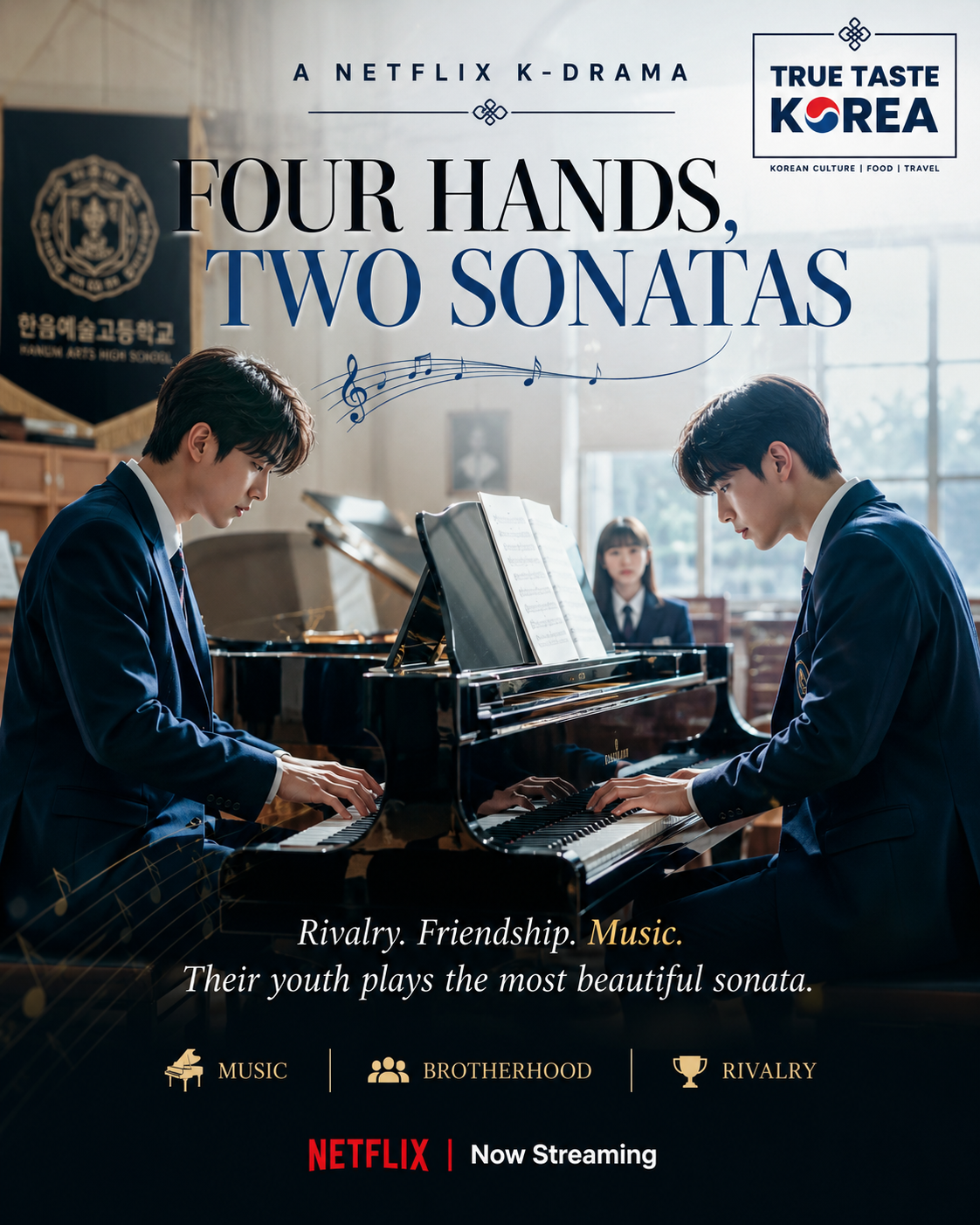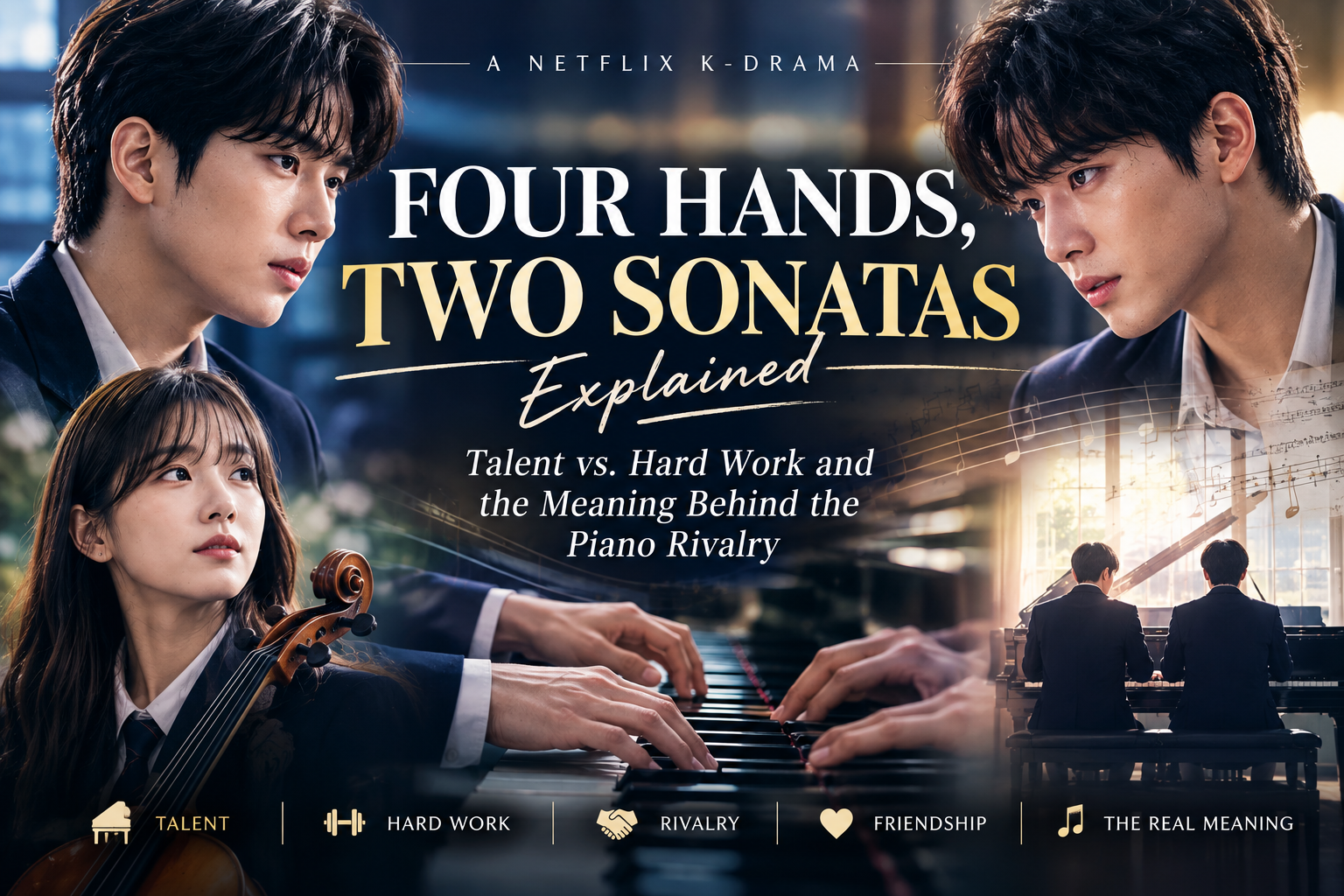
When I first wrote about Four Hands, Two Sonatas, I focused on a simple question:
Why could this Korean drama connect with international viewers?
But after watching the story more closely, I realized that there is another, much more interesting question.
What is Four Hands, Two Sonatas actually trying to say?
On the surface, it is a coming-of-age drama about two gifted young pianists at an elite Korean arts high school.
Look deeper, however, and the drama becomes a story about something almost everyone has experienced:
What happens when someone who has worked his entire life to become the best suddenly meets someone who seems to possess naturally what he has spent years trying to perfect?
That is the conflict between Kang Pi-o, played by Song Kang, and Choi Jeong-yo, played by Lee Jun-young.
One has discipline, education, technique and an environment built around music.
The other has lived a far more difficult life and has been forced away from the piano, yet possesses an instinctive musical talent that cannot easily be taught.
One represents perfection.
The other represents freedom.
And somewhere between them lies the real meaning of Four Hands, Two Sonatas.
This is not simply a drama about deciding which pianist is better.
It is a story about why neither of them may be complete without the other.
Two Geniuses — But Two Completely Different Kinds of Genius
One of the smartest decisions in Four Hands, Two Sonatas is that it does not create a simple relationship between a genius and an ordinary rival.
Both young men are gifted.
That makes their conflict much more interesting.
Kang Pi-o has been walking toward musical excellence for most of his life.
Choi Jeong-yo, meanwhile, possesses extraordinary talent but has spent much of his life unable—or unwilling—to pursue it.
Netflix describes Pi-o as an elite pianist who has followed a steady path toward perfection, while Jeong-yo is portrayed as a late-blooming, raw and free-spirited talent whose difficult childhood interrupted his musical journey.
That difference creates the central question of the drama:
What exactly makes a great musician?
Is it thousands of hours of disciplined practice?
Is it perfect technique?
Is it natural talent?
Is it emotion?
Or does true greatness require all of them?
Pi-o and Jeong-yo appear to represent different answers.
But I don’t think the drama ultimately wants us to choose only one.
Kang Pi-o: The Genius Who Has Spent His Life Proving Himself
At first glance, Kang Pi-o seems to have everything.
He comes from an influential musical family.
He receives elite training.
He excels academically.
He wins competitions.
His piano technique is exceptional.
He is exactly the kind of student people imagine when they hear the words “Korean elite education.”
Yet Pi-o may actually be one of the least free characters in the story.
Why?
Because almost everything he does carries an invisible question:
“Am I good enough?”
Song Kang himself described piano as both Pi-o’s way of communicating with the world and something through which he constantly has to prove himself.
That distinction matters.
For some people, music is freedom.
For Pi-o, music has also become judgment.
Every performance can become a test.
Every competition produces another ranking.
Every mistake becomes evidence that perfection has not yet been reached.
And every success simply creates the expectation that he must succeed again.
The Problem With Being Number One
Being first sounds like the safest position.
In reality, it can be the most frightening.
If you are second, you can chase first place.
If you are first, there is only one direction you can fall.
Pi-o has built much of his identity around excellence.
That means Jeong-yo’s arrival threatens more than his position at school.
It threatens Pi-o’s understanding of himself.
Imagine spending years practicing, sacrificing and refining every detail of your technique.
Then someone enters your world who has not followed the same path.
His technique may be less polished.
His education may be incomplete.
Yet when he plays, people stop and listen.
How would that feel?
This is where Four Hands, Two Sonatas becomes more than a school rivalry drama.
Jeong-yo represents a question Pi-o cannot solve simply by practicing longer.
The Grandfather Behind Pi-o’s Perfectionism
Pi-o’s pressure does not come only from school.
It is deeply connected to his family.
His grandfather, Kang Seung-woon, is a world-renowned conductor and an uncompromising perfectionist.
Official character material describes him as someone who demands absolute excellence even from his own family. His attitude leaves Pi-o longing for his recognition.
This helps explain something important about Pi-o.
His obsession with becoming better is not merely ambition.
Part of it is emotional.
Winning becomes connected to recognition.
Technique becomes connected to approval.
Music becomes connected to love.
That is a dangerous combination.
Because if your value depends on being exceptional, what happens when another exceptional person appears?
Jeong-yo doesn’t simply challenge Pi-o musically.
He touches the deepest insecurity Pi-o has carried for years.
Choi Jeong-yo: The Genius Who Was Forced Away From His Gift
Jeong-yo’s story is almost the reverse.
If Pi-o grew up surrounded by music, Jeong-yo grew up surrounded by problems that made music difficult to pursue.
According to Lee Jun-young’s character interview, Jeong-yo lost his mother at a young age and had to care for his alcoholic father, becoming the family’s breadwinner while still young.
He loved the piano, but reality forced him to keep his dream at a distance.
This creates a very different relationship with music.
For Pi-o, piano can feel like an obligation.
For Jeong-yo, piano is something he has lost.
That difference is enormous.
Pi-o sometimes needs freedom from the piano.
Jeong-yo needs the freedom to return to it.
Why “Freedom” Is the Perfect Word for Jeong-yo
Lee Jun-young chose one word to describe Jeong-yo:
Freedom.
He explained that Jeong-yo does not naturally want to live inside a predetermined mold.
That personality is reflected in his music.
Jeong-yo has not been shaped by the same institutional system as Pi-o.
He therefore lacks some of Pi-o’s polish—but he also lacks some of his restraints.
He can play from instinct.
From emotion.
From memory.
From pain.
And perhaps that is precisely why Pi-o finds him so disturbing.
Jeong-yo represents something Pi-o cannot easily acquire through another thousand hours of practice:
freedom of expression.
Talent vs. Hard Work Is Actually the Wrong Question
Many viewers will naturally ask:
Who is the real genius—Pi-o or Jeong-yo?
But I think that question misses the point.
Pi-o is talented too.
Jeong-yo must work too.
The drama isn’t really saying:
One succeeds through effort while the other succeeds through talent.
The more interesting contrast is this:
Pi-o has learned how to control music.
Jeong-yo has learned how to feel it.
Pi-o needs some of Jeong-yo’s freedom.
Jeong-yo needs some of Pi-o’s discipline.
And that is why their rivalry is necessary.
Each man possesses something the other lacks.
Jeong-yo Is Not Simply Pi-o’s Enemy
This is where I think Four Hands, Two Sonatas becomes particularly interesting.
In an ordinary rivalry story, Jeong-yo would exist to defeat Pi-o.
But here, his greater role may be to change Pi-o.
And Pi-o may ultimately do the same for him.
Jeong-yo forces Pi-o to hear music differently.
Pi-o forces Jeong-yo to confront the talent and dream he tried to abandon.
They threaten each other.
But they also awaken each other.
That is a much more interesting relationship than simply asking who wins a competition.
Why the Title “Four Hands” Is the Key to Understanding the Drama
The title practically tells us what the drama is about.
In piano terminology, four hands means two pianists playing one piano together.
Two people.
One instrument.
Four hands.
But think about what that requires.
You cannot simply play whatever you want.
You have to listen to the other person.
You have to understand their timing.
You have to control your own ego.
Sometimes you lead.
Sometimes you follow.
Sometimes you must create space for the other musician.
The goal is no longer:
“I must sound better than you.”
The goal becomes:
“We must create one piece of music together.”
That is why the title is so clever.
From Competition to Cooperation
Director Park Hyun-suk explained that the title relates to the journey of two friends moving together toward musical completion.
That changes how we should view the rivalry.
The rivalry isn’t necessarily the destination.
It is the beginning.
At first, the two musicians compare themselves.
Who is better?
Who has more talent?
Who deserves recognition?
But four-hands performance demands an entirely different question:
Can I understand the person sitting beside me?
And perhaps that is the deeper coming-of-age story.
Growing up means discovering that life isn’t always a solo performance.
Two Sonatas May Also Describe Two Lives
The English title adds another interesting phrase:
Two Sonatas.
I read this less literally and more symbolically.
Pi-o and Jeong-yo are like two separate musical compositions.
Each has his own rhythm.
His own history.
His own pain.
His own tempo.
Their lives do not begin in the same place.
Yet the drama gradually places those two lives beside each other.
Four hands.
Two sonatas.
One piano.
It is a beautiful metaphor for friendship.
You don’t need to become the same person to create harmony with someone else.
Hong Jae-in Is More Important Than a Typical Love-Triangle Character
Hong Jae-in, played by Jang Gyuri, could easily have been written simply as the woman positioned between two talented men.
But her musical identity makes her much more interesting.
Jae-in is not a pianist.
She is a violist.
And official character material confirms something particularly important:
She has perfect pitch.
She can accurately distinguish individual notes by ear and is among the first people capable of recognizing the extraordinary talent of both Pi-o and Jeong-yo.
That makes her role symbolically interesting.
Pi-o and Jeong-yo are busy competing.
Jae-in is listening.
Jae-in Represents the Listener
Music doesn’t exist only between performer and instrument.
It also exists between performer and listener.
Jae-in can hear something in both young men that they may not yet fully understand about themselves.
She knows Pi-o’s excellence.
But she can also immediately recognize Jeong-yo’s unusual talent.
In that sense, she becomes a third perspective on their rivalry.
Pi-o asks:
“Am I better?”
Jeong-yo may ask:
“Do I even belong in this world?”
Jae-in can hear that both questions are incomplete.
Both musicians have something worth hearing.
Jang Gyuri has described music as essentially Jae-in’s entire life and said that her character sees music as both a dream and a source of comfort.
That makes her much more than a romantic device.
She is part of the drama’s argument about what music means.
The Adults Are Creating the Competition Too
Another layer becomes visible when we look beyond the three young characters.
The rivalry doesn’t exist in isolation.
Adults surround them.
Parents.
Grandparents.
Teachers.
School administrators.
People who recognize talent—and people who want to shape it.
Pi-o’s mother has devoted herself to supporting her son’s career, but official character descriptions indicate that Jeong-yo’s appearance creates anxiety because she wants Pi-o to remain the best.
Meanwhile, school chairwoman Yoon Sun-joo recognizes Jeong-yo’s potential and supports him, although her motives are not entirely simple.
And pianist Do Hyun-soo becomes a teacher to both young men.
His task is fascinating:
Not to make them identical, but to help two opposite musicians strengthen their weaknesses and discover their own musical identities.
That may be one of the drama’s most important ideas.
A good teacher does not manufacture copies.
A good teacher helps different talents become themselves.
Four Hands Is Also a Story About Korean Competition
Watching this drama in Korea, I find another layer difficult to ignore.
Competition is deeply familiar in Korean society.
Students compete for universities.
Workers compete for jobs.
Athletes compete for limited professional positions.
Artists compete for auditions and recognition.
And when someone grows up inside a highly competitive system, success can easily become part of personal identity.
Pi-o fits naturally into that world.
He has learned to win.
But the drama asks a more uncomfortable question:
What happens after you become number one?
Does being first automatically make you fulfilled?
Can someone technically perfect still feel incomplete?
Those questions extend far beyond piano.
Why Classical Music Works So Well for This Story
Classical music might initially seem like a difficult subject for a mainstream K-drama.
But it is actually ideal.
There are no lyrics telling us exactly what to feel.
The same composition can sound different depending on who performs it.
Jang Gyuri made a similar observation while preparing for her role: because classical music has no lyrics, its expression can change according to the performer’s condition and emotional state. She compared that quality to acting.
That observation could almost describe the entire drama.
Pi-o and Jeong-yo can look at the same sheet music.
The notes are identical.
But the music is not.
Because the person playing those notes is different.
The Actors Had to Learn the Language of Their Characters
Another reason the musical scenes matter is that the actors did significant preparation.
Song Kang said he began piano lessons months before filming.
Lee Jun-young, who did not already play piano, said he memorized entire pieces and relied on detailed direction while preparing his performance scenes.
Jang Gyuri practiced viola, listened extensively to classical music and attended performances to develop her musical sensitivity.
That matters because hands are difficult to fake in a music drama.
A viewer may not be a professional pianist, but awkward movement can immediately break the illusion.
The actors weren’t simply learning dialogue.
They had to learn enough of their characters’ physical language to make us believe that music had shaped their lives.
Pi-o and Jeong-yo Are More Similar Than They First Appear
This may ultimately be the most important point.
They look like opposites.
Rich and poor.
Structured and free.
Polished and raw.
Disciplined and instinctive.
But underneath those differences, they share something.
Both have been hurt by circumstances they did not choose.
Pi-o carries the burden of expectation and approval.
Jeong-yo carries the burden of hardship and responsibility.
Pi-o has had access to the piano but struggles to become emotionally free.
Jeong-yo has emotional freedom in his playing but has struggled to gain access to the life of a pianist.
Each is trapped in a different way.
That is why they can eventually understand each other.
The Rival You Hate May Be the Person You Need Most
This is perhaps the most universal idea in Four Hands, Two Sonatas.
Sometimes the person who irritates us most is the person exposing something we lack.
Pi-o looks at Jeong-yo and sees freedom.
Jeong-yo looks at Pi-o and sees the life of a musician he might have had.
That can produce jealousy.
Anger.
Competition.
But it can also produce growth.
A weak rival merely tries to defeat you.
A great rival changes you.
And the best rival may eventually become the person capable of playing beside you.
So Who Is the Real Genius?
If you came here looking for my answer, here it is:
Both of them.
But neither represents complete musical genius alone.
Pi-o shows us the power of discipline, technique and relentless work.
Jeong-yo shows us the power of instinct, emotion and freedom.
The interesting question isn’t:
Pi-o vs. Jeong-yo — who wins?
It is:
What happens when each begins learning what the other already knows?
That is the story I want to keep watching.
The Deeper Meaning of Four Hands, Two Sonatas
For me, the title can ultimately be reduced to one idea:
You can become excellent alone. But some forms of greatness require another person.
Pi-o has spent his life becoming a brilliant soloist.
Jeong-yo has survived by relying heavily on himself.
Neither is naturally prepared to surrender space to someone else.
Yet four hands cannot work without trust.
You have to listen.
You have to adjust.
You have to share the keyboard.
You have to accept that the final music belongs neither entirely to you nor entirely to the person beside you.
It belongs to both.
And perhaps that is why a drama about classical piano can become a drama about growing up.
Because adulthood also requires learning that the world is not a solo performance.
Sometimes the person sitting next to you isn’t there to take your place.
Sometimes that person is there to help you play something you could never play alone.
That, more than the competitions or rankings, may be the real meaning of Four Hands, Two Sonatas.
Read My First Four Hands, Two Sonatas Review
If you’re new to the drama, start with my first article, where I explain the story, introduce the main characters, and discuss why I believe Four Hands, Two Sonatas could connect strongly with international K-drama viewers.
👉 Four Hands, Two Sonatas: Why This K-Drama Could Be a Global Hit
Official & Further Reading
For more information about the drama and its cast, these sources offer useful background:
Netflix – Four Hands, Two Sonatas
Watch the series and find official information about the drama on Netflix.
Song Kang on Playing Kang Pi-o
Read more about Song Kang’s interpretation of Pi-o and why he chose the music-centered drama.
Lee Jun-young on Playing Choi Jeong-yo
Learn more about Jeong-yo’s difficult childhood, relationship with the piano, and Lee Jun-young’s approach to the character.