Indian Cinema

  • Pooja Meri Jaan Explained: Why Is Pooja Blamed for Saying No?

    TTK Original — Beyond the Headlines

    A woman rejects a marriage proposal. The man dies by suicide. Suddenly, she is the one standing trial. But when did saying no become a crime?

    That is the uncomfortable question at the heart of Pooja Meri Jaan, the 2026 Hindi crime and courtroom drama starring Mrunal Thakur and Huma Qureshi.

    Released on ZEE5 on October 2, the film follows Pooja Dogra, a young woman whose decision to reject the romantic advances of her longtime friend Aniket Srivastava leads to devastating consequences.

    After Aniket’s death, Pooja faces accusations of abetting his suicide.

    But the film’s most important mystery is not simply what happened to Aniket.

    It is why so many people are willing to hold Pooja responsible for a decision she had every right to make.

    Why Aniket’s Proposal Was Never Just Romantic

    Public marriage proposals are often presented in movies as grand expressions of love.

    The crowd watches. The music swells. Everyone waits for the woman to say yes.

    But what happens if she does not want to?

    In Pooja Meri Jaan, Aniket proposes to Pooja in public, placing her in a deeply uncomfortable position.

    He has romantic feelings for her, but their longstanding friendship does not mean she shares those feelings.

    That difference is crucial.

    A proposal is supposed to be a question. Yet when it takes place before an audience, it can become a form of pressure.

    The person being asked must respond not only to the proposer but also to the expectations of everyone watching.

    If she accepts, the moment becomes a celebration.

    If she refuses, the rejection can be treated as humiliation.

    The film challenges that imbalance.

    Pooja’s refusal is not evidence that she intended to hurt Aniket. It is an expression of her own choice.

    Why Friendship Does Not Create a Right to Love

    One of the most revealing aspects of the story is that Pooja and Aniket already know each other.

    Their relationship is not a brief encounter between strangers.

    They share a history, familiarity, and emotional connections.

    That makes Aniket’s feelings understandable, but it does not make them automatically mutual.

    This is where the film exposes a common misunderstanding about romance.

    Sometimes, affection is treated as an investment.

    A person offers friendship, attention, or support and gradually begins to expect a romantic relationship in return.

    But love does not work like a financial transaction.

    Time spent together cannot create an obligation to marry.

    Kindness cannot guarantee attraction.

    And a close friendship does not give either person ownership over the other’s future.

    Pooja’s rejection becomes controversial because the people around her struggle to separate Aniket’s disappointment from her right to decide.

    Why Aniket’s Death Changes the Story

    Following the rejection, Aniket dies by suicide.

    His death is a tragedy, and the grief experienced by his family deserves to be taken seriously.

    But grief and legal responsibility are different questions.

    Aniket’s mother seeks to hold Pooja accountable, and the conflict moves into the courtroom.

    The emotional logic is easy to understand.

    When someone dies unexpectedly, surviving family members often search desperately for an explanation.

    They may revisit conversations, arguments, and missed warning signs, trying to identify the moment when everything went wrong.

    In this story, Pooja becomes the focus of that search.

    But a sequence of events does not automatically establish legal causation.

    The fact that a rejection preceded a death does not, by itself, prove that the person who rejected the proposal encouraged or intentionally caused the death.

    That distinction is central to understanding the film’s conflict.

    Why Pooja Becomes the Accused

    The film places Pooja in a position where her private decisions are examined publicly.

    Her relationships, behavior, and reactions become part of a larger argument about responsibility.

    This creates a second injustice beyond the original tragedy.

    Instead of being judged only on evidence relevant to the accusation, she must also confront assumptions about how a woman should behave.

    Should she have rejected Aniket more gently?

    Should she have answered his calls?

    Should she have recognized his distress?

    These questions may arise naturally in discussions about the characters, but they can also become a way of shifting responsibility.

    Pooja’s freedom to decline a relationship should not depend on whether another person responds to that decision calmly.

    A healthy understanding of consent requires accepting that rejection is possible.

    Without that possibility, consent loses its meaning.

    Why Sana’s Defense Matters

    Huma Qureshi plays Sana Mehfooz, the lawyer defending Pooja.

    Her role gives the film an important counterweight to the emotional accusations surrounding Aniket’s death.

    In a courtroom, grief cannot be ignored, but it cannot replace evidence.

    The defense must distinguish between a painful interpersonal conflict and conduct that meets the legal requirements of a criminal offense.

    This is why the legal setting matters to the story.

    The courtroom forces competing narratives into the same space.

    Aniket’s family seeks accountability.

    Pooja seeks to defend herself against an accusation arising from her rejection.

    The legal process must evaluate what can actually be established, rather than simply deciding which person appears more sympathetic.

    The film’s conflict becomes most interesting when those emotional and evidentiary questions collide.

    Why Jatin Represents Another Perspective

    Vijay Raaz plays advocate Jatin Trivedi, who argues the case against Pooja.

    His presence ensures that the courtroom is not simply a stage for one character to deliver the correct answer.

    The prosecution gives voice to the accusations and demands for accountability that emerge after Aniket’s death.

    But a persuasive accusation still requires proof.

    The audience must distinguish between what a character believes, what an argument suggests, and what the available evidence demonstrates.

    That distinction is essential in a story built around blame.

    The film asks viewers to examine not only the characters’ actions but also their own willingness to accept a simple explanation for a complicated tragedy.

    Why Love and Possession Are Not the Same

    The title Pooja Meri Jaan sounds affectionate.

    Yet the story examines the unsettling point at which affection can become entitlement.

    Love involves recognizing another person’s independence.

    Possession attempts to control that independence.

    The difference becomes visible when someone hears the word no.

    A person may feel disappointed, rejected, or heartbroken. Those emotions are real.

    But another person’s refusal does not remove their right to choose.

    Aniket’s inability to accept the relationship he wanted is therefore central to the film’s exploration of unhealthy romantic expectations.

    The problem is not that he experienced unreturned love.

    It is the idea that unreturned love can create a claim over another person’s decisions.

    Why the Film’s Message Matters Beyond Its Mystery

    Several early reviews praised the relevance of the subject while criticizing the screenplay and execution.

    That is an important distinction.

    A film can address a meaningful social problem without fully succeeding as a piece of storytelling.

    Pooja Meri Jaan has been criticized for uneven dramatic development and a courtroom narrative that some reviewers found insufficiently compelling.

    Those weaknesses do not make its central question irrelevant.

    In fact, the controversy surrounding the premise may be more interesting than the mechanics of the thriller itself.

    The film invites viewers to consider how easily sympathy for one person can turn into hostility toward another.

    It also asks whether society sometimes mistakes emotional pain for evidence of wrongdoing.

    Is Pooja Responsible for Aniket’s Death?

    The central question must be approached carefully.

    Aniket’s death is tragic.

    His family’s suffering is real.

    Pooja’s rejection is also a legitimate personal choice.

    These statements can all be true at the same time.

    A moral judgment about how someone handled a difficult conversation is not identical to a legal finding of responsibility.

    Nor should the outcome of a criminal case be determined by whether an audience likes the accused person’s personality.

    The film’s deeper argument lies in that separation.

    Responsibility must be examined through conduct and evidence, not merely through the intensity of another person’s grief.

    The Real Question Behind Pooja Meri Jaan

    At first glance, Pooja Meri Jaan appears to be a courtroom thriller about a young woman accused after a man’s death.

    But beneath the legal conflict is a question about personal freedom.

    Can a woman reject a man without becoming responsible for everything that follows?

    Can society acknowledge a family’s grief without automatically assigning blame?

    And can love still be called love when it refuses to accept another person’s decision?

    Pooja’s most controversial action is also her simplest: she says no. The film asks why that single word can become the beginning of a public trial.

    That is the uncomfortable question that makes Pooja Meri Jaan worth examining beyond its courtroom drama.


    TTK Original — Beyond the Headlines. We explore not just what happens in a story, but why it matters.

    More From Pooja Meri Jaan

    ➤ Why Was Pooja Found Not Guilty in Pooja Meri Jaan? The Courtroom Ending Explained
  • Drishyam 3: Can Vijay Salgaonkar Really Escape His Past?

    TTK Original — Beyond the Headlines

    What happens when a father saves his family by hiding the truth, only to discover that the past refuses to disappear?

    That question has haunted the Drishyam franchise for years. Now, with Drishyam: The Conclusion arriving in Indian theaters on October 2, 2026, Ajay Devgn returns as Vijay Salgaonkar for what is being presented as the final chapter of the Hindi crime-thriller series.

    But the most interesting question is not simply whether Vijay can outsmart the police again.

    It is whether he can ever truly escape the consequences of what he has done.

    Why Vijay Salgaonkar Is Such a Complicated Hero

    Vijay is not a conventional action hero. He does not defeat his enemies through physical strength, political influence, or wealth.

    His greatest weapon is his ability to understand how people think.

    In the earlier films, Vijay constructed an elaborate defense around his family’s involvement in a young man’s death. His knowledge of movies, human behavior, and investigative assumptions helped him create a version of events that authorities struggled to dismantle.

    For viewers, that intelligence made him fascinating.

    But there is a moral contradiction at the center of his character.

    Vijay protects the people he loves by manipulating the truth.

    The audience understands his motivation, yet understanding his motivation is not the same as proving that every decision he makes is right.

    That tension is what makes Drishyam more than an ordinary police thriller.

    Why the Past Still Threatens Vijay

    The first two films established something important: escaping punishment does not necessarily mean escaping consequences.

    Even when an investigation appears to reach a dead end, the people involved continue living with suspicion, grief, and fear.

    Vijay’s family cannot simply return to the innocence they once had.

    Every new question threatens to reopen an old wound.

    In Drishyam: The Conclusion, Meera Deshmukh returns, and the investigation faces a new phase involving another senior crime officer.

    The conflict therefore becomes larger than one clever man trying to defeat the police.

    It becomes a struggle between two families whose lives were permanently changed by the same tragedy.

    For Vijay, the past represents a danger to his family.

    For Meera, that same past represents a truth that cannot be abandoned.

    Neither perspective can be dismissed without ignoring the emotional foundation of the story.

    Is Vijay Protecting His Family or Protecting Himself?

    This is perhaps the most uncomfortable question in the entire franchise.

    At the beginning, Vijay’s choices are driven by an understandable instinct: a father wants to prevent his family from being destroyed.

    But as the deception grows more elaborate, another possibility emerges.

    What happens when protecting your family becomes inseparable from protecting the lies you created?

    Vijay has spent years maintaining control over the narrative surrounding the incident.

    His intelligence has allowed him to anticipate questions, prepare explanations, and identify weaknesses in an investigation.

    Yet the more complicated a deception becomes, the more difficult it is to separate genuine protection from the need to preserve that deception.

    This does not mean Vijay has stopped loving his family.

    It means his love has placed him inside a moral trap.

    He may believe that admitting the truth would destroy everything he has worked to protect.

    But continuing to hide it also prevents his family from fully escaping the past.

    That is the central tragedy of Vijay Salgaonkar.

    Why October 2 Matters So Much

    The release date of Drishyam: The Conclusion is not an arbitrary marketing choice.

    October 2 has special significance within the franchise because it is tied to the carefully constructed timeline of Vijay’s original alibi.

    By releasing the concluding film on October 2, 2026, the filmmakers connect the franchise’s ending to one of its most recognizable story elements.

    The date becomes more than a reference for longtime fans.

    It symbolizes the central idea of Drishyam: how a specific sequence of events can be transformed into a story that other people believe.

    The franchise has always understood that memory is not merely about what happened.

    It is also about what people can be persuaded to remember.

    Why the Hindi and Malayalam Versions Are Taking Different Paths

    There is another reason this third installment deserves attention.

    The Hindi Drishyam films were adapted from the Malayalam franchise led by Mohanlal, whose central character is Georgekutty.

    However, the filmmakers have explained that the third Hindi installment and the third Malayalam installment follow different scripts and treatments.

    This creates an unusual opportunity.

    Two versions of a familiar premise can explore different consequences for their central characters.

    Rather than treating one ending as a simple reproduction of the other, audiences can examine how each version approaches family loyalty, guilt, justice, and survival.

    For TTK readers, this distinction matters because discussions of one version’s ending should not automatically be treated as explanations of the other.

    The two stories must be evaluated on their own terms.

    Why Drishyam Is Really About the Limits of Intelligence

    Many crime thrillers ask whether the police can catch the criminal.

    Drishyam asks something more unsettling.

    Can intelligence become a substitute for accountability?

    Vijay’s greatest advantage has always been his ability to think several steps ahead.

    He knows how investigators build cases. He understands how ordinary details can become convincing evidence. And he recognizes that people often trust a coherent story more readily than an uncomfortable truth.

    But intelligence has limits.

    It can manipulate circumstances, delay consequences, and expose weaknesses in a system.

    It cannot automatically erase grief.

    It cannot restore the innocence of a family.

    And it cannot guarantee that everyone involved will eventually find peace.

    This is why Vijay remains such a compelling protagonist even after multiple films.

    His brilliance solves immediate problems while leaving deeper moral questions unresolved.

    Can Vijay Finally Escape His Past?

    The title The Conclusion suggests that Vijay’s long struggle is approaching a decisive endpoint.

    But a meaningful conclusion does not have to be defined only by whether he is arrested or remains free.

    The more interesting question is what freedom would actually mean for him.

    If Vijay avoids punishment but his family continues living in fear, has he truly won?

    If the truth emerges and destroys the people he tried to protect, can that outcome be called justice without considering its human cost?

    And if the people on opposite sides of the tragedy can never agree on what justice means, is a completely satisfying ending even possible?

    These are interpretive questions, not claims about the film’s final scenes.

    They are also the questions that make the franchise worth discussing beyond its twists and box-office performance.

    The Real Question Behind Drishyam 3

    Drishyam: The Conclusion brings audiences back to a man who has repeatedly demonstrated that he can outthink powerful institutions.

    Yet the defining conflict may never have been Vijay versus the police.

    It has always been Vijay versus the consequences of his own choices.

    The audience can admire his intelligence, sympathize with his family, and still question the morality of the deception that protects them.

    That contradiction is the franchise’s greatest strength.

    Vijay Salgaonkar may be able to escape an investigation. But can anyone truly escape a past that has changed so many lives?

    That is the question Drishyam leaves us confronting.


    TTK Original explores the deeper questions behind movies, television, and global entertainment — not just what happened, but why it matters.

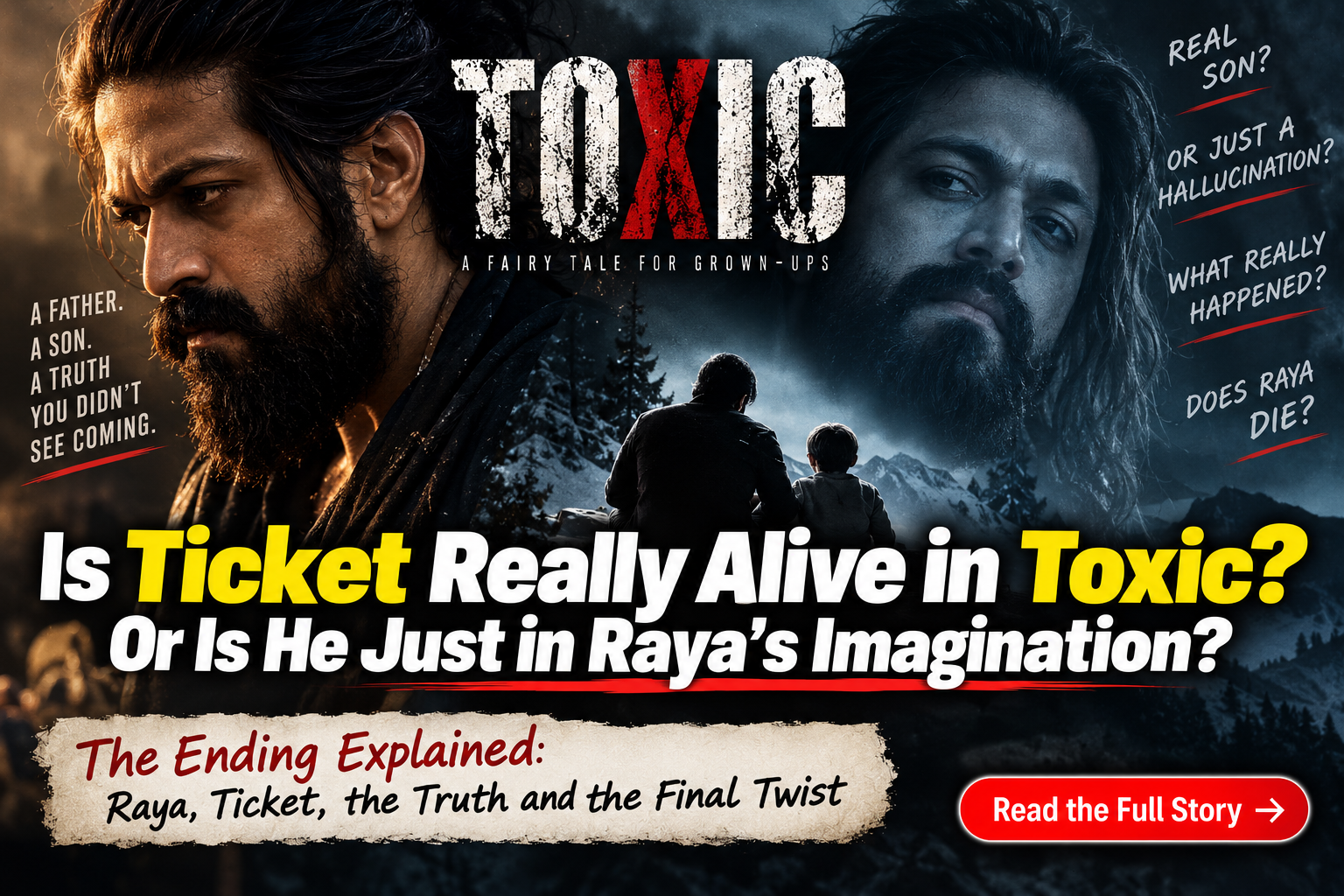
  • Is Ticket Really Alive in Toxic? Or Is He Just in Raya’s Imagination?

    Is Ticket Really Alive in Toxic? Or Is He Just in Raya’s Imagination?

    Major Spoiler Warning: This article reveals the ending and biggest twist of Toxic: A Fairy Tale for Grown-Ups.

    If you just walked out of Toxic thinking:

    Wait… was Ticket even real?

    You’re asking exactly the question the ending wants you to ask.

    For much of the movie, Ticket appears to be Raya’s grown-up son.

    He narrates the story.

    He confronts his father.

    He attacks the empire Raya spent years building.

    He even appears to threaten Raya’s other son, Adam.

    So naturally, we assume:

    Ticket survived childhood and came back for revenge.

    Then the ending changes everything.

    No — the adult Ticket is not actually alive.

    The climax reveals that the real Ticket died years earlier.

    The adult Ticket we’ve been watching is a manifestation of Raya’s guilt, grief and fractured state of mind.

    And once you understand that twist, a huge part of Toxic suddenly looks different.


    What Really Happened to Ticket in Toxic?

    Ticket is Raya and Nadia’s son.

    The film initially encourages us to believe that Ticket survived his traumatic childhood and eventually grew into the adult man played by Yash.

    But that’s not what really happened.

    Raya had tried to kill Ticket when he was a child.

    He later changed his mind.

    But by then, according to the film’s final reveal, it was too late.

    Ticket died.

    Raya couldn’t save him.

    That truth becomes one of the defining psychological wounds of Raya’s life.

    Instead of fully processing what he did, Raya’s mind eventually creates something else:

    an adult version of the son who never got to grow up.

    That is the Ticket we spend so much time watching.


    Then Who Is the Adult Ticket?

    The simplest explanation is:

    Ticket is Raya’s guilt given a human form.

    He’s the son Raya lost.

    He’s also the consequence Raya cannot escape.

    Ticket grows up in Raya’s mind because the real child never had the opportunity to.

    That makes the casting particularly important.

    Yash plays both Raya and Ticket.

    At first, that looks like a conventional dual role.

    By the ending, it means something completely different.

    The apparent father-versus-son conflict has also been:

    Raya versus Raya.

    India Today describes Ticket as part of Raya’s imagination, created by a mind unable to cope with the guilt and trauma of the child’s death.


    Why Does Raya Imagine Ticket?

    Because Raya cannot escape what he did.

    His criminal empire gives him power.

    It doesn’t give him peace.

    Over the course of the story, he also suffers devastating losses, including Ganga and Nadia.

    As those losses accumulate, his psychological state deteriorates.

    Ticket becomes the physical representation of something Raya has spent years suppressing:

    his guilt over his son.

    That’s why Ticket is much more than an imaginary friend.

    He’s almost Raya’s punishment.

    Every time Ticket threatens Raya’s family, power or empire, the movie can be read as showing Raya’s unresolved trauma destroying the life he built.


    Why Does Ticket Want Revenge on Raya?

    Before the twist, the answer seems obvious.

    Ticket believes his father tried to kill him.

    So he grows up.

    Returns.

    And wants revenge.

    But after the reveal, Ticket’s behavior becomes much stranger.

    He says he hates Raya.

    Yet he doesn’t simply kill him when he gets the opportunity.

    At another point, he even saves Raya.

    Why?

    Because Ticket isn’t an independent revenge-seeking son.

    He exists inside Raya’s fractured psychological world.

    So Ticket’s contradictory behavior reflects Raya’s own conflict with himself.

    Part of Raya wants punishment.

    Part wants forgiveness.

    Part wants to forget.

    And another part desperately wants the son he lost to still exist.

    Ticket embodies all of those contradictions.


    Wait — If Ticket Isn’t Real, Who Has Been Narrating Toxic?

    Now we’ve reached the really clever part.

    Ticket.

    The imaginary character.

    Ticket narrates much of the story.

    That means Toxic gives us an unreliable narrator.

    Once the movie reveals that the person telling us the story doesn’t physically exist in the present timeline, we’re forced to reconsider everything we’ve watched.

    And that’s why the ending isn’t simply:

    “Surprise! Ticket was imaginary.”

    The bigger question becomes:

    How much of Toxic actually happened exactly the way we saw it?

    India Today explicitly raises this problem: if Ticket exists inside Raya’s fractured psyche, some events may be real, some distorted by memory and guilt, and some potentially internal to Raya’s mind.

    The film doesn’t neatly label every scene for us.

    That’s deliberate.


    Was Everything in Toxic Just Raya’s Imagination?

    No — that’s going too far.

    The reveal does not necessarily mean:

    “None of the movie happened.”

    The criminal world exists.

    Raya exists.

    His relationships and losses exist within the story.

    What becomes uncertain is our perception of events involving Ticket and how accurately Raya’s fractured mind has presented parts of the story.

    So a better interpretation is:

    The movie happened, but we cannot completely trust the version of reality we were shown.

    That’s very different from saying:

    “It was all a dream.”


    Did Ticket Really Kidnap Adam?

    This becomes one of the most interesting questions after the reveal.

    Before we know the truth, Ticket appears to kidnap Adam and attempt to recreate the violence Raya once inflicted on him.

    But Ticket doesn’t physically exist as the independent adult man we thought he was.

    So who is really responsible?

    The ending pushes us toward a darker interpretation:

    Raya himself is the danger.

    The imaginary Ticket is the form through which Raya’s collapsing mind expresses that danger.

    People around Raya also appear to recognize that something is seriously wrong with him.

    This makes the second half considerably darker on a rewatch.

    Raya isn’t fighting an enemy coming to destroy his family.

    His own unresolved trauma is destroying it.


    Why Are Raya and Ticket Both Played by Yash?

    Before the ending, it’s a star-driven dual role.

    After the ending, the casting becomes part of the clue.

    Raya sees his son as an adult.

    But the adult Ticket is also an extension of Raya himself.

    Having Yash play both characters visually reinforces that idea.

    Father and son appear to be fighting each other.

    Psychologically, Raya is fighting himself.

    The movie therefore disguises an internal conflict as an external gangster rivalry for much of its runtime.

    That’s why the final reveal changes the meaning of earlier scenes rather than merely adding one last surprise.


    What Does Ticket Symbolize?

    Ticket can be interpreted as several things simultaneously.

    He represents:

    Raya’s dead son

    Raya’s guilt

    Raya’s grief

    the consequences of his violence

    and ultimately

    the part of Raya he cannot suppress anymore.

    The criminal empire may have survived enemies, betrayals and attacks.

    But Raya cannot defeat his own memory.

    That’s arguably the central idea behind the title’s psychological ending.

    The most dangerous thing in Raya’s life isn’t another gangster.

    It’s Raya himself.


    Why Does Ticket Save Raya If He Hates Him?

    This makes far more sense after the twist.

    If Ticket were simply a real son seeking revenge, his inconsistent behavior might seem strange.

    He wants to punish Raya.

    But he repeatedly stops short of completely destroying him.

    And he even saves him.

    After the reveal, the contradiction becomes meaningful.

    Ticket isn’t operating with his own independent psychology.

    He’s part of Raya.

    Raya simultaneously hates himself and wants to survive.

    He wants punishment and forgiveness.

    He wants Ticket gone and wants Ticket alive.

    That contradiction is exactly what the imaginary Ticket represents.


    What Happens in Toxic’s Final Avalanche Scene?

    The movie’s final moments move away from conventional gangster logic.

    An avalanche approaches Raya.

    Instead of giving viewers a straightforward victory or defeat, the scene becomes psychological.

    Raya finally embraces Ticket.

    But now we know what Ticket actually represents.

    Raya isn’t simply embracing his grown son.

    He’s finally embracing the child he failed.

    And, metaphorically, he’s accepting the guilt and trauma he spent years trying to escape.

    Then the film cuts to black.

    Which creates another major question.


    Does Raya Die at the End of Toxic?

    The film deliberately makes this less certain than Ticket’s fate.

    Ticket’s truth is revealed:

    the real Ticket died years earlier.

    Raya’s final fate is more ambiguous.

    The avalanche approaches.

    Raya doesn’t receive the kind of clean, conventional death scene that would remove all doubt before the cut to black.

    Some coverage interprets the climax as Raya’s death, while other explanations emphasize that the film leaves his literal survival unresolved.

    That distinction matters.

    So the safest answer is:

    Toxic clearly resolves who Ticket is, but leaves more room to interpret exactly what happens to Raya.

    And that is likely another reason viewers leave the theatre arguing about the ending.


    Why Does Raya Stop Running?

    Because by this point, physical survival isn’t really the center of the scene anymore.

    Earlier, Raya tried to control everything.

    His empire.

    His enemies.

    His family.

    His future.

    But the one thing he couldn’t control was the past.

    By embracing Ticket as the avalanche approaches, Raya finally stops fighting the memory of his son.

    On a psychological level:

    he accepts Ticket.

    he accepts what he did.

    and he accepts what he has become.

    Whether that acceptance arrives too late is part of the tragedy.


    Is Ticket Raya’s Split Personality?

    You’ll probably see this phrase used online.

    But it’s better to be careful.

    The movie presents Ticket as a manifestation or figment of Raya’s fractured mind. Entertainment coverage also uses terms such as hallucination, imagination and unreliable narrator.

    That doesn’t automatically justify diagnosing Raya with a specific real-world psychiatric disorder.

    For understanding the movie, you don’t need a medical label.

    The important storytelling point is simply:

    Adult Ticket exists inside Raya’s psychological reality rather than as the living adult son we initially believed him to be.


    Why Is the Ending Called Ambiguous If Ticket’s Death Is Revealed?

    Because there are actually two mysteries, not one.

    Mystery 1: Is Ticket alive?

    This receives a fairly clear answer.

    No.

    The real Ticket died as a child.

    Mystery 2: How much of what we watched can we trust?

    This remains much less certain.

    Because Ticket narrated the story and exists inside Raya’s fractured perspective, the film deliberately destabilizes our understanding of earlier events.

    That’s the clever part.

    The movie answers one question and creates a much bigger one.


    So Was Ticket Ever Real?

    Yes.

    And this distinction is important.

    Ticket was a real child.

    He was Raya and Nadia’s son.

    What isn’t real in the present-day story is the adult Ticket who appears to have survived, grown up and returned to confront Raya.

    The real child died.

    Raya’s mind created the adult he might have become.

    So saying:

    “Ticket never existed”

    would be wrong.

    The better answer is:

    Ticket existed, but the adult Ticket we follow later does not exist independently of Raya’s mind.


    The Simple Answer: Is Ticket Alive in Toxic?

    If you came here because the ending confused you, here’s the shortest possible explanation.

    No. The adult Ticket isn’t really alive.

    The real Ticket died when he was young after Raya tried to kill him and later failed to save him.

    Unable to live with that guilt, Raya’s fractured mind creates an adult version of Ticket.

    That’s why Ticket can:

    return

    confront Raya

    attack his empire

    threaten Adam

    and ultimately

    stand face-to-face with his father.

    Ticket is Raya’s dead son transformed into a manifestation of guilt and trauma.

    And that’s why the final embrace matters.

    For most of the movie, Raya appears to be fighting Ticket.

    By the end, we understand:

    Raya has been fighting himself.

    The gangster who spent his life defeating enemies finally meets the one enemy he can’t kill—

    his own past.