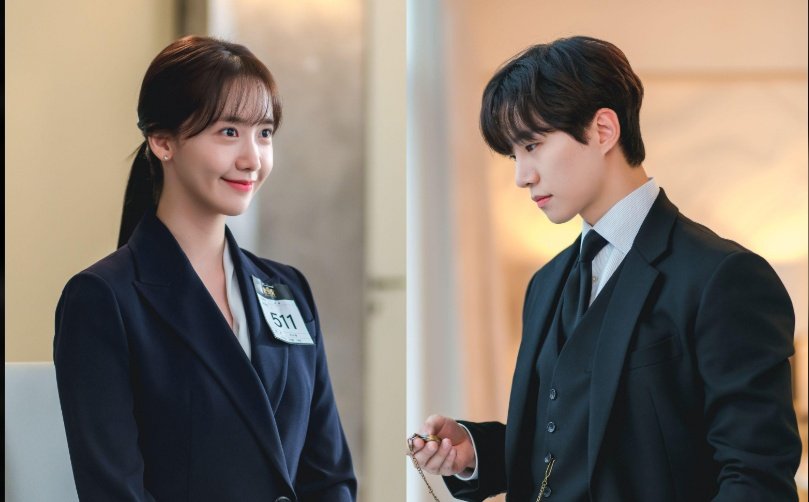
Spoiler Warning: This article discusses major character developments and the ending of the Korean drama King the Land.
At first glance, King the Land is a familiar romantic fantasy: a wealthy hotel heir falls in love with an ordinary employee who seems completely different from him.
Gu Won has money, status, and access to almost everything. Cheon Sa-rang has built her career through hard work, patience, and an ability to make guests feel welcome. Their worlds collide inside King Hotel, where a smile can be part of a luxury experience and where the person giving the service rarely has the same power as the person receiving it.
But the drama raises a more interesting question than whether two people from different backgrounds can fall in love.
Can a romance truly overcome a class divide when one person has the power to change the rules and the other must work within them?
The relationship between Gu Won and Sa-rang is charming because they gradually learn to understand each other. Yet the hotel, the family inheritance struggle, and the treatment of employees reveal a world in which affection alone cannot explain inequality.
Even Gu Hwa-ran, the character often positioned as the antagonist, deserves a closer examination. Her ambition is not entirely separate from the unequal family structure that gives Gu Won a different path to power.
The real story of King the Land may therefore be less about escaping class differences through love and more about imagining what happens when people begin to question the privileges they have always taken for granted.
1. King Hotel: A Beautiful Place Built on Invisible Labor
King Hotel is presented as a world of luxury, elegance, and carefully managed hospitality.
Guests enter a space designed to make them feel important. Their rooms are prepared, their requests are anticipated, and employees are expected to maintain a pleasant atmosphere regardless of the difficulties happening behind the scenes.
But the hotel has two very different experiences depending on where someone stands.
For guests, the hotel is a place of comfort.
For employees, it is a workplace where comfort must be produced continuously.
This distinction is central to the drama. The luxury experience does not create itself. It depends on workers who manage complaints, hide frustration, maintain appearances, and deliver service even when customers behave unfairly.
The hotel therefore becomes more than a romantic setting. It represents a hierarchy in which some people pay to avoid inconvenience while others are paid to absorb it.
The most revealing question is not whether King Hotel is luxurious. It is who performs the work that makes luxury possible.
2. Cheon Sa-rang: A Successful Employee Before She Becomes a Romantic Heroine
Cheon Sa-rang is often described through her kindness and constant smile.
However, reducing her to a cheerful woman who wins the heart of a wealthy heir misses an important part of her character.
She has developed professional skills through experience. She understands how to communicate with guests, manage difficult situations, and maintain standards under pressure.
Her smile is not simply a natural expression of happiness. It is also part of her professional identity.
That creates a contradiction.
Sa-rang genuinely values hospitality, but the workplace also expects her to perform friendliness as part of her job. Her personal feelings and professional responsibilities are not always the same thing.
This is why her character is more interesting than a conventional Cinderella figure.
She is not waiting for a rich man to give her value. She already has professional competence, ambition, and a sense of what makes her work meaningful.
The romance changes her personal life, but it does not create the abilities that made her successful.
3. Gu Won: A Rich Heir Who Must Learn What Work Looks Like
Gu Won initially dislikes fake smiles.
His reaction is connected to his childhood experiences and his painful memories of his mother. He associates artificial expressions with concealment, abandonment, and emotional dishonesty.
Sa-rang challenges this assumption because her smile has a different meaning.
She may be required to smile at work, but that does not mean every expression is false. Her kindness can be genuine even when the circumstances require her to perform it professionally.
This becomes an important lesson for Gu Won.
He gradually learns that employees are not simply part of the hotel’s atmosphere. They are individuals with responsibilities, ambitions, and personal difficulties.
Yet there is another issue that deserves attention.
Gu Won can afford to reject artificial smiles because he occupies a position of privilege. Sa-rang cannot always make the same choice. Her livelihood depends partly on how well she manages the expectations of customers and management.
His personal preference is therefore not equivalent to her professional freedom.
The drama becomes more meaningful when Gu Won begins to understand that difference.
4. The Cinderella Formula: Why Does the Rich Man Still Need to Rescue the Woman?
The relationship between Gu Won and Sa-rang follows a familiar romantic structure.
A wealthy man meets a hardworking woman. Their backgrounds are different, but their emotional connection gradually becomes stronger than their social differences.
There is nothing inherently wrong with this fantasy. Romantic fiction has always explored relationships that challenge social boundaries.
The problem appears when love becomes the main solution to structural inequality.
Sa-rang experiences workplace difficulties, but Gu Won’s position gives him the ability to intervene in situations that ordinary employees could not easily change.
A difficult customer can become manageable when the hotel heir steps in. An unfair workplace situation can change when someone with authority decides to act.
This is emotionally satisfying, but it also raises an uncomfortable question.
What happens to employees who do not have a powerful person willing to defend them?
A workplace should not require a romantic relationship with the owner’s family before an employee can receive fair treatment.
The fantasy of rescue is attractive precisely because it makes complicated problems appear solvable through personal affection.
But real workplace justice requires more than a generous individual.
5. The Smile: A Symbol of Emotional Labor
The contrast between Gu Won’s dislike of fake smiles and Sa-rang’s professional smile is one of the drama’s most effective ideas.
In hospitality, a smile can be both sincere and required.
An employee may be exhausted, worried about family, or upset by a customer’s behavior, yet still be expected to remain pleasant.
This is emotional labor: managing and presenting feelings as part of a job.
The drama does not need to explain the concept academically for viewers to recognize the tension.
Sa-rang’s smile is valuable to the hotel because it helps create the experience that guests expect. But the emotional cost of maintaining that experience is not always visible.
Gu Won’s character development becomes significant when he begins to recognize the person behind the service.
However, the deeper question extends beyond their romance.
If a company profits from employees’ emotional labor, should it also take responsibility for protecting their dignity and well-being?
A smile should not be treated as proof that an employee is happy with every condition of employment.
The drama’s strongest workplace message appears when it reminds viewers that service workers are people, not decorations in a luxury environment.
6. Gu Hwa-ran: Is She Simply a Villain, or a Product of the Same Family System?
Gu Hwa-ran is one of the most interesting characters to examine because her conflict with Gu Won is not merely personal jealousy.
She is already deeply involved in the King Group’s business. She has responsibilities, experience, and a strong desire to protect her position.
Then Gu Won becomes a serious competitor in the family power structure.
Their father’s treatment of the two children is not neutral. The difference in how he approaches their ambitions and personal lives contributes to the conflict.
Hwa-ran’s resentment therefore has a context.
She has spent years building her position, but the arrival of her half-brother creates the possibility that the family’s priorities may shift toward him.
This does not excuse her treatment of employees or her willingness to use power harshly.
But it makes her more interesting than a simple jealous older sister.
She represents a person who has learned to survive inside a competitive family system and has come to believe that losing power means losing everything.
The question is whether her ambition is truly about managing the company or whether the struggle has become inseparable from her need for recognition.
7. The Family Inheritance Battle: Who Deserves to Lead?
The conflict between Gu Won and Hwa-ran is often presented as a contest between two different leadership styles.
Gu Won gradually becomes more attentive to employees and their working conditions. Hwa-ran is associated with a more aggressive approach to business performance and corporate authority.
This contrast makes Gu Won appear morally preferable.
But the family structure itself deserves scrutiny.
Neither sibling’s position is determined entirely by an open competition in which every employee or stakeholder has an equal voice. Their authority comes from their relationship to the chairman and their place within the family.
The hotel is a large business, but its future is heavily shaped by private family decisions.
This creates a contradiction.
The drama wants us to judge the characters by their leadership abilities, yet the system that gives them the opportunity to lead is based on inheritance.
Gu Won may become a more humane executive, but he is still a beneficiary of the same privileged structure.
Hwa-ran’s behavior can be criticized without pretending that Gu Won has earned his starting position through the same conditions faced by ordinary employees.
The deeper issue is not simply which sibling should win.
It is why so much power over a workplace belongs to a family in the first place.
8. Sa-rang’s Friends: The Story Is Bigger Than One Couple
Oh Pyeong-hwa and Kang Da-eul are important because they expand the drama beyond the central romance.
They work in different parts of the service economy, but they encounter similar pressures.
Their experiences reveal workplace expectations that are not limited to King Hotel.
Employees are judged by performance, appearance, seniority, and their ability to endure difficult situations without creating trouble.
Da-eul’s workplace experiences are particularly useful for understanding the gap between a company’s public image and the reality of its employees.
A company may promote teamwork and customer satisfaction while leaving workers to deal with unreasonable demands from customers or managers.
Pyeong-hwa’s professional struggles also show how career development can be constrained by workplace hierarchy and personal circumstances.
These characters matter because they prevent Sa-rang’s story from becoming an isolated Cinderella fantasy.
Their lives remind viewers that workplace problems are shared by many people who will never meet a hotel heir willing to intervene on their behalf.
9. The Hotel Industry: When Customer Satisfaction Becomes More Important Than Employees
A luxury hotel sells an experience.
Guests are not simply paying for a bed or a meal. They are paying for convenience, attention, comfort, and the feeling that their needs matter.
That business model depends heavily on employees.
But the expectations placed on workers can become unreasonable when customer satisfaction is treated as the only measure of success.
The drama occasionally reveals this imbalance through demanding guests and difficult workplace situations.
An employee may be expected to accept disrespect because the customer is important to the business.
This creates a question that extends beyond the fictional King Hotel.
Does excellent service require employees to surrender their dignity?
There is a difference between professionalism and submission. A worker can be polite without accepting abuse.
The most meaningful version of hospitality would protect both sides of the interaction: the guest’s reasonable expectations and the employee’s right to respectful treatment.
Gu Won’s development is partly about recognizing this distinction.
His leadership becomes more valuable when he understands that a hotel cannot genuinely provide a welcoming experience if the people producing that experience are treated as disposable.
10. Is Sa-rang’s Success a Triumph of Merit or a Convenient Fantasy?
Sa-rang is presented as a capable employee who earns recognition through hard work.
This is an appealing message.
Her story suggests that determination and professional ability can create opportunities even when someone does not come from a wealthy family.
But there is a limitation to this narrative.
Hard work does not always overcome unequal access to education, networks, financial security, and career opportunities.
Sa-rang’s success is therefore both empowering and idealized.
The drama celebrates her abilities while allowing the romantic fantasy to soften the structural barriers that might otherwise make her career much more difficult.
This is not necessarily a flaw in a romantic comedy. The genre is allowed to create hopeful outcomes.
However, the difference between individual success and social equality should remain clear.
One exceptional employee advancing through a company does not prove that the company’s opportunities are equally accessible to everyone.
Sa-rang’s achievement is meaningful because of her work, not because her success magically eliminates the inequalities surrounding her.
11. Gu Won’s Transformation: Does Becoming a Better Man Make Him a Better Leader?
Gu Won’s emotional development is closely connected to his relationship with Sa-rang.
He begins as someone who distrusts artificial expressions and struggles to understand the people around him.
Through Sa-rang, he learns to recognize emotional sincerity, respect different experiences, and communicate more openly.
These changes make him a more sympathetic romantic partner.
But becoming a better partner and becoming a better leader are not exactly the same thing.
A leader must make decisions that affect people who are not personally close to him.
It is relatively easy to defend someone you love. It is harder to create a workplace where people receive fair treatment even when no one powerful is watching.
The drama sometimes allows Gu Won’s personal goodness to stand in for a broader solution to workplace inequality.
That is where the story could have gone further.
His greatest achievement should not simply be winning Sa-rang’s trust. It should be learning to use his authority responsibly, including when the people affected by his decisions are strangers.
12. Why the Romance Works Even When the Plot Feels Predictable
One reason King the Land attracted such divided reactions is that its romantic appeal and its narrative complexity are not always equally strong.
Some viewers criticize its predictable dialogue and familiar plot developments. Others strongly praise the chemistry between Lee Jun-ho and Im Yoon-ah.
These reactions are not contradictory.
A romantic comedy does not always need an intricate plot to create emotional satisfaction.
Sometimes viewers want to spend time with characters they enjoy. They want playful exchanges, affectionate moments, and the pleasure of watching two people become comfortable with each other.
The chemistry between the leads helps make those moments convincing.
But chemistry cannot automatically solve every storytelling weakness.
When conflicts are introduced and then resolved too quickly, the audience may feel that the story has avoided the consequences of its own ideas.
The drama is most successful when its romantic scenes reveal something about the characters rather than simply repeating the message that they are attracted to each other.
The relationship works best when it gives Gu Won and Sa-rang opportunities to understand the differences between their lives.
13. The Ending: Does Love Overcome the Class Divide?
The ending gives Gu Won and Sa-rang the opportunity to build a future together.
Their relationship survives the pressures created by family expectations, business conflicts, and their different backgrounds.
For viewers invested in the romance, this is a satisfying conclusion.
But does their happiness mean the class divide has disappeared?
Not necessarily.
Gu Won remains connected to wealth and corporate power. Sa-rang’s professional journey remains important, but her relationship with the hotel heir changes the possibilities available to her.
The couple can choose each other, yet the wider social structure remains largely intact.
This is the difference between a romantic resolution and a social transformation.
Their love challenges the idea that people must remain within their original social circles. It does not automatically change how workers are treated throughout the company or how corporate power is inherited.
The ending therefore works best as a personal victory rather than proof that inequality has been solved.
The drama offers emotional freedom to its central couple, but it leaves the larger economic structure mostly untouched.
14. The Real Meaning of King the Land: Who Makes Luxury Possible?
Ultimately, King the Land is more interesting when viewed as a story about the people behind a luxury experience.
The hotel is built around the promise that wealthy guests can enjoy comfort without having to think about the work required to provide it.
Sa-rang and her colleagues occupy the other side of that promise.
They are expected to be visible enough to deliver excellent service, yet invisible enough that their personal difficulties do not interrupt the guest’s experience.
Gu Won begins to understand this contradiction through his relationship with Sa-rang.
Hwa-ran reveals another side of the same world: the competition for power among those who already possess privilege.
And the employees remind us that the success of a company cannot be measured only by the wealth of its owners or the satisfaction of its most important customers.
The central question of King the Land is not simply whether a hotel heir can fall in love with an ordinary employee. It is whether someone born into power can learn to see the people whose labor makes that power valuable.
Sa-rang does not become worthy because Gu Won loves her. She was already worthy.
The more important change is that Gu Won begins to recognize a value that his position had allowed him to overlook.
That is the most meaningful possibility hidden inside this familiar romantic fantasy: love may bring two people together, but respect requires us to see the world from the other person’s side.
