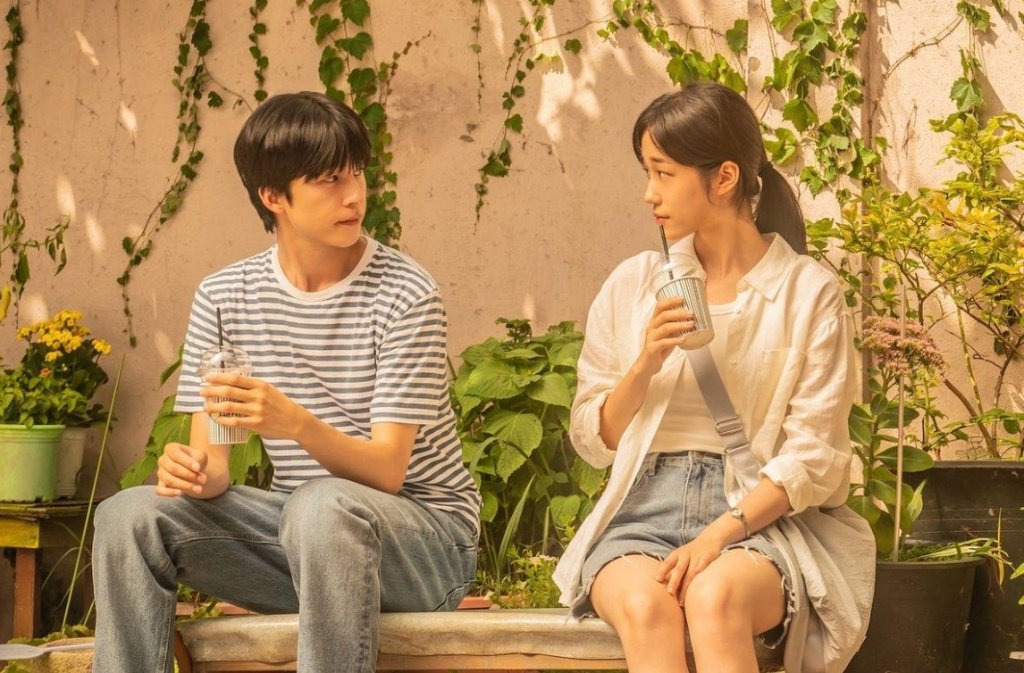
1. A Love Story That Begins Without Words
Most romantic films introduce love through conversation.
Two people meet, exchange words, misunderstand each other, and gradually discover that they have feelings they cannot easily express.
Hear Me: Our Summer takes a different approach.
Yong-jun meets Yeo-reum while delivering lunchboxes to a swimming pool. He is immediately attracted to her, but their relationship develops through a language that requires more than listening.
Yeo-reum communicates with her younger sister Ga-eul through Korean Sign Language. As Yong-jun tries to get closer to Yeo-reum, he also begins learning how to communicate in a different way.
The film’s central idea is simple but meaningful: understanding someone is not necessarily about hearing their voice.
It is about paying attention to how they express themselves.
2. Yong-jun: A Young Man Who Has Not Found His Direction
Yong-jun is a recent graduate who has not figured out what he wants from life.
He helps with his parents’ lunchbox business, but his future remains uncertain. He does not have a clear professional ambition or a convincing plan.
His encounter with Yeo-reum changes his daily routine.
At first, his attraction is straightforward. He finds her beautiful and wants to know her better. But the relationship gradually asks more of him than simply expressing romantic interest.
He must learn to communicate in a way that is meaningful to her.
This is an important part of Yong-jun’s coming-of-age journey.
He begins as someone who does not know what direction to take. Through his relationship with Yeo-reum, he discovers that growing up sometimes means making an effort to understand a world beyond one’s own experience.
3. Yeo-reum: The Older Sister Who Has Put Her Own Life Aside
Yeo-reum’s life revolves around supporting her younger sister.
Ga-eul is a talented swimmer with hearing impairment, and Yeo-reum is deeply involved in helping her pursue her athletic ambitions.
Her dedication is admirable, but it also creates an emotional problem.
Yeo-reum has become so accustomed to putting her sister first that she struggles to recognize her own desires.
When Yong-jun enters her life, she experiences feelings that do not fit neatly into the responsibilities she has accepted.
She enjoys his attention, but she also feels guilty about spending time on a relationship when her sister’s future remains her priority.
Yeo-reum’s conflict is not simply whether she likes Yong-jun.
It is whether she is allowed to have a life that does not revolve entirely around someone else’s needs.
4. Ga-eul: A Dream That Belongs to More Than One Person
Ga-eul is not merely the younger sister who brings the romantic leads together.
She has her own ambitions.
Her swimming career represents independence, discipline, and the possibility of building a future through her abilities.
But her dream is closely connected to Yeo-reum’s sacrifices.
This creates an important tension between the sisters.
Yeo-reum wants Ga-eul to succeed, but the more she organizes her life around that goal, the harder it becomes to distinguish her sister’s dream from her own.
Ga-eul also has to confront the expectations placed on her.
Being supported by someone does not mean she must remain permanently dependent on that person.
The film becomes more meaningful when we recognize that both sisters need room to grow.
5. Why Sign Language Changes the Meaning of Romance
The most distinctive feature of Hear Me: Our Summer is its use of sign language.
In conventional romantic films, spoken dialogue often carries the emotional weight of a scene.
Here, the audience must pay attention to hands, facial expressions, eye contact, and body language.
A small gesture can communicate affection. A delayed response can express hesitation. Looking away can carry emotional meaning that a spoken explanation might make less powerful.
Sign language is not simply a substitute for speech.
It is a complete language with its own grammar and expressive structure. Facial expression and movement are important parts of communication.
The film uses this visual language to change the audience’s viewing experience.
Instead of waiting for characters to explain their feelings, we are encouraged to observe how those feelings appear.
6. Yong-jun Learns That Attraction Is Not the Same as Understanding
Yong-jun’s initial attraction to Yeo-reum is based on appearance and curiosity.
That is a familiar beginning for a romance.
But a relationship cannot remain at that level.
To communicate with Yeo-reum, he has to make an effort. He cannot assume that his usual way of speaking will be enough.
This changes the meaning of his pursuit.
He is not simply trying to persuade someone to like him. He is learning to meet another person in a language that matters to her.
That distinction is important.
Romantic stories often celebrate persistence, but persistence alone is not always admirable. What matters is whether someone is willing to respect the other person’s way of communicating.
Yong-jun’s growth comes from learning that love requires attention, patience, and adaptation.
7. Silence Does Not Mean the Absence of Emotion
One of the film’s strengths is its use of quiet scenes.
Because much of the communication takes place through sign language, the characters do not constantly fill the soundtrack with spoken explanations.
The audience has to watch more carefully.
This can make ordinary interactions feel unusually intimate.
A glance, a smile, or a hesitant movement of the hands can become the emotional center of a scene.
The quietness also challenges a common assumption about communication.
People sometimes equate conversation with connection. But talking frequently does not necessarily mean understanding someone.
Conversely, a person who communicates differently is not necessarily less expressive.
The film’s best moments demonstrate that emotion does not depend on volume.
8. When Supporting Someone Becomes a Form of Self-Sacrifice
Yeo-reum’s relationship with Ga-eul raises a question that extends beyond disability or sport.
How much should someone sacrifice for a person they love?
At first, Yeo-reum’s dedication appears unquestionably positive. She helps her sister train, supports her ambitions, and makes practical decisions around Ga-eul’s future.
But the arrangement becomes complicated when Yeo-reum begins to want something for herself.
Her romantic feelings create a conflict between personal happiness and family responsibility.
The film does not suggest that caring for a family member is a mistake.
Instead, it asks whether love should require one person to put their own life on hold indefinitely.
A relationship can become unhealthy even when it begins with sincere affection.
Sometimes the most loving thing a person can do is allow another person to become independent.
9. Ga-eul Also Needs the Freedom to Choose
There is another side to the sisters’ relationship.
Yeo-reum may believe she is protecting Ga-eul, but Ga-eul also has her own ambitions and emotional needs.
Support can become restrictive when it leaves no room for the person receiving it to make decisions.
This is particularly important in stories involving disability.
A disabled character should not exist only to inspire another character or provide a reason for someone else’s sacrifice.
Ga-eul has her own identity as an athlete, a younger sister, and a young woman with a future she wants to shape.
Her challenges should not be reduced to the emotional burden they create for Yeo-reum.
The film is strongest when it treats Ga-eul as a person with her own choices rather than simply the reason her older sister cannot pursue happiness.
10. The Representation of Hearing Impairment: What the Film Gets Right and What It Risks
The film deserves attention for placing sign language near the center of a mainstream romance.
It encourages hearing audiences to pay attention to visual communication and recognize that spoken dialogue is not the only way people build relationships.
The actors’ performances also require a different kind of concentration. Their expressions and gestures carry much of the emotional information.
However, the film’s representation is not beyond criticism.
A review in the South China Morning Post argued that its portrayal of the Deaf community was problematic and objected strongly to the final revelation.
That criticism matters because representation is not automatically successful simply because a film includes Deaf or hard-of-hearing characters.
A film must also consider whether those characters are given full identities, realistic experiences, and meaningful agency.
There is an important distinction between using sign language as a beautiful cinematic device and portraying the actual diversity of Deaf experiences.
Both deserve attention, but they are not the same achievement.
11. The Remake Question: Does the Korean Version Have Its Own Identity?
Hear Me: Our Summer is a Korean remake of the 2009 Taiwanese film Hear Me.
Remakes face a difficult challenge.
If they change too much, audiences may question why the original story was remade. If they change too little, the new version may feel unnecessary.
The Korean adaptation preserves the basic romantic premise while reshaping the family relationships around Yeo-reum and Ga-eul.
This gives the sisters a stronger presence in the emotional structure of the story.
The original film is remembered for its gentle romance and use of sign language. The Korean version attempts to preserve that spirit while placing greater emphasis on the responsibilities and sacrifices within a family.
Some viewers appreciate this approach because it retains the original’s sincerity.
Others may prefer the original’s pacing and storytelling.
A remake does not have to replace its source material. But it should offer a reason to experience the story again.
12. Why the Film’s Final Revelation Divides Viewers
The film’s later revelation changes how the audience understands some of the characters and their relationships.
For some viewers, this adds emotional weight to the story.
For others, the twist feels abrupt and raises questions about the choices the characters have made.
This division is reflected in the critical response.
A positive review in ZAPZEE praised the film’s sincerity, performances, and visual storytelling, while also acknowledging that the late twist might feel sudden.
The South China Morning Post was much harsher, arguing that the revelation undermined the story.
These contrasting reactions reveal an important weakness in the film’s structure.
Its emotional power comes from the gradual development of relationships, but a major revelation near the end risks redirecting attention away from that development.
The question is not simply whether the twist is surprising.
It is whether the new information deepens the characters or makes the audience reconsider the story in a less satisfying way.
13. What Reddit Viewers Appreciated About the Film
The available Reddit discussion is relatively small, so it should not be treated as a representative survey of all international viewers.
Still, several reactions are worth noting.
In a discussion in r/Koreanfilm, one viewer described the movie as a warm and healing experience, praising its sincerity and emotional effect. Other commenters expressed affection for the Korean adaptation and compared it with the original Taiwanese film.
A separate discussion in r/iZone praised Kim Min-ju’s performance as Ga-eul, particularly her ability to communicate emotion through gestures and facial expressions.
These reactions suggest that the film’s appeal is not limited to the central romance.
The performances, the relationship between the sisters, and the unusual communication style all contribute to its emotional impact.
At the same time, some viewers recommended watching the original Taiwanese film, showing that the remake comparison remains part of the audience conversation.
The broader picture is therefore mixed but interesting: many viewers found the film heartfelt, while comparisons with the original and criticism of the late twist remain relevant.
14. Is Love About Hearing Someone, or Learning Their Language?
Hear Me: Our Summer begins with a young man falling in love with a woman he meets while delivering lunchboxes.
But its deeper subject is the effort required to understand another person.
Yong-jun has to move beyond attraction. Yeo-reum has to recognize that her own happiness matters. Ga-eul has to be seen as someone with ambitions and choices of her own.
Their relationships are not solved simply because they care about one another.
They must learn to communicate, recognize boundaries, and allow each other to grow.
The film’s use of sign language gives this idea a visual form.
It reminds us that communication is not merely the exchange of words. It is the willingness to pay attention to someone whose experiences may be different from our own.
Perhaps the most important lesson is not that love can overcome every barrier.
It is that love becomes meaningful when people stop expecting others to communicate only in the way they find easiest.
If loving someone means learning how they communicate, how many of us are truly willing to listen?