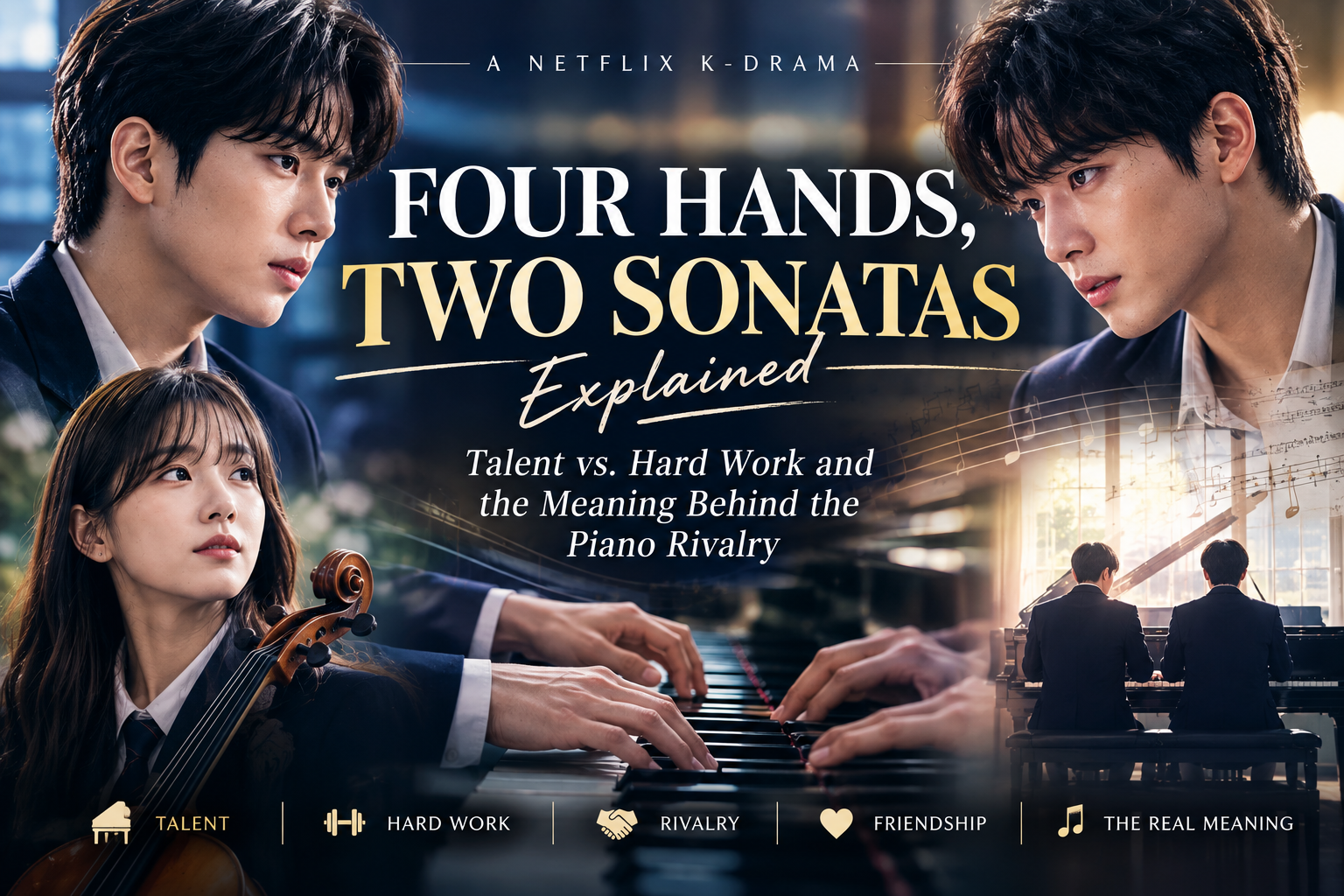
When two gifted pianists compete, the obvious question is: Who is more talented?
But Four Hands, Two Sonatas asks something more interesting.
What happens when a pianist who has spent his entire life pursuing perfection meets someone whose musical ability developed under completely different circumstances?
Kang Pi-o (Song Kang) has the training, discipline, recognition, and technical control expected of an elite young pianist. Choi Jeong-yo (Lee Jun-young), despite possessing extraordinary musical ability, has been pushed away from the piano by a difficult childhood.
They are both gifted. Yet they approach music from almost opposite directions.
At first, their relationship looks like a competition between natural talent and years of practice. But the deeper meaning of the drama is not about deciding which one is the better musician.
It is about discovering what each person lacks—and why another person may be necessary to overcome it.
Pi-o has learned to pursue perfection. Jeong-yo reminds him that music must also be felt.
And through their rivalry, the drama explores a larger idea: sometimes the person challenging your place in the world is also the person who helps you become more complete.
1. Two Pianists, Two Different Relationships With Music
The central contrast in Four Hands, Two Sonatas is not simply rich versus poor or disciplined versus naturally gifted.
It is the difference between two relationships with the same instrument.
Pi-o has grown up inside a world organized around musical achievement. He is an outstanding student, an accomplished pianist, and someone whose future appears to have been planned around success.
Jeong-yo has a very different history. He possesses exceptional musical ability, but family hardship forces him to put his dream aside. His relationship with the piano is shaped not only by talent but also by loss and the circumstances that kept him from pursuing music.
Netflix’s official introduction describes Pi-o as a pianist on a steady path toward perfection and Jeong-yo as a free-spirited talent whose difficult childhood interrupted his musical journey.
That contrast establishes the drama’s central question:
Does musical greatness come from perfect technique, natural instinct, emotional expression, or a combination of all three?
The story gradually suggests that none of these qualities is enough on its own.
2. Kang Pi-o: The Pianist Who Cannot Afford to Make Mistakes
At first glance, Kang Pi-o seems to have everything necessary to become a great musician.
He has talent, education, discipline, and a record of achievement. He is accustomed to being at the top, both academically and musically.
But his greatest strength also becomes a source of pressure.
Pi-o has spent so much of his life proving his ability that music begins to feel like a test he must pass repeatedly.
Every performance becomes an opportunity to demonstrate his worth. Every mistake threatens the image he has worked so hard to maintain.
This is especially important because Pi-o is not simply trying to become a better pianist.
He also wants recognition from his grandfather, Kang Seung-woon, a world-renowned conductor and demanding perfectionist.
The grandfather’s standards are so severe that even Pi-o’s impressive abilities do not automatically earn his approval. His expectations shape the young pianist’s understanding of success and leave him longing for recognition.
This makes Pi-o’s relationship with music emotionally complicated.
He loves the piano, but he also carries the burden of what the piano is expected to prove.
For Pi-o, being excellent is not always the same as feeling fulfilled.
3. The Problem With Always Being Number One
Being the best sounds like a position of security.
But for someone whose identity depends on remaining at the top, it can become a trap.
If Pi-o is first, he has to protect that position. If another pianist approaches his level, the possibility of losing becomes difficult to ignore.
That is why Jeong-yo’s arrival affects him so deeply.
Jeong-yo does not follow the same path. He has not received the same continuous training or enjoyed the same opportunities.
Yet he possesses something that cannot be measured simply by awards or technical exercises.
His musical instincts make Pi-o reconsider what excellence actually means.
The threat is not only that Jeong-yo might become a better pianist.
It is that Pi-o may have misunderstood what makes someone a great musician.
His rivalry with Jeong-yo therefore becomes a challenge to his identity, not merely his school ranking.
4. Choi Jeong-yo: The Talent That Life Interrupted
Jeong-yo’s story is almost the reverse of Pi-o’s.
He has an extraordinary gift for music, but his childhood does not provide the stability needed to develop it.
After losing his mother at a young age, he has to take responsibility for his alcoholic father and becomes the family’s breadwinner while still young.
The piano remains important to him, but pursuing it as a professional dream becomes increasingly difficult.
This is a crucial distinction.
Jeong-yo is not someone who suddenly discovers a hidden talent as a teenager. He is someone whose musical development has been interrupted by circumstances beyond his control.
That history changes the way he approaches the instrument.
For Pi-o, music has become connected to achievement and expectations.
For Jeong-yo, it represents something he once loved but could not freely pursue.
The piano is both a dream and a reminder of what he has lost.
Lee Jun-young described Jeong-yo as someone who wants to face the piano but struggles to do so after the difficult experiences that forced him away from it.
That emotional conflict makes his musical return more meaningful than a conventional story about an undiscovered genius.
5. Why Jeong-yo Represents Freedom
Lee Jun-young used the word freedom when describing his character.
It is an effective way to understand Jeong-yo’s contrast with Pi-o.
Jeong-yo has not spent his entire life inside the same competitive musical system. His experience is less structured, and his relationship with the piano is shaped by personal feeling as much as formal training.
This does not mean he has nothing to learn.
His circumstances have limited the opportunities available to him, and raw ability cannot replace the years of development that a professional pianist needs.
But his approach offers something different.
He can remind Pi-o that music is not simply about playing every note correctly.
It is also about communicating something that cannot be fully explained through technique.
The contrast is not that Pi-o works while Jeong-yo does not.
Both have talent. Both need to grow.
The difference is what each has learned—and what each still needs to discover.
6. Talent vs. Hard Work Is the Wrong Question
It is tempting to divide the two characters into familiar categories:
- Pi-o represents hard work.
- Jeong-yo represents natural talent.
But that interpretation is too simple.
Pi-o is naturally gifted as well as highly disciplined. Jeong-yo has extraordinary ability, but his return to music also requires effort, adjustment, and renewed commitment.
The more interesting contrast is between their musical weaknesses.
Pi-o has developed extraordinary control, but he struggles with the emotional freedom that makes a performance feel personal.
Jeong-yo has instinctive musical expression, but he has not had the same opportunity to develop his abilities through continuous elite training.
One has learned to control music.
The other reminds us why music needs to move people.
Neither approach is complete.
This is where the drama moves beyond the familiar question of whether talent or hard work matters more.
A great musician needs both the ability to master the instrument and the ability to express something through it.
Pi-o and Jeong-yo are not proof that one path is superior.
They are two examples of what happens when one important part of musical development is missing.
7. Why Jeong-yo Is More Than Pi-o’s Rival
In a conventional competition drama, a rival exists to defeat the protagonist.
But Jeong-yo’s role is more complicated.
His arrival forces Pi-o to confront the limitations of his own understanding of music.
At the same time, Pi-o represents a world that Jeong-yo has struggled to enter: the life of a trained musician with access to education, teachers, and professional opportunities.
They challenge each other because they possess different strengths.
But that same difference creates the possibility of mutual growth.
Jeong-yo can help Pi-o rediscover the emotional side of playing.
Pi-o can help Jeong-yo confront the musical future he once had to abandon.
Their rivalry therefore has two directions.
They are competing against each other, but they are also being changed by each other.
That is a more meaningful relationship than a simple contest over who deserves first place.
8. The Meaning of the Title: Why Four Hands Matter
The title contains one of the drama’s most important ideas.
In piano terminology, four hands refers to two pianists playing together on a single piano.
The performers share the keyboard and create one musical performance.
This requires more than individual ability.
They must listen to one another, coordinate their timing, understand the other person’s movements, and make room for each other’s part.
A pianist cannot simply play as if the other person were not there.
The performance depends on cooperation.
Director Park Hyun-seok has explained that the title refers to two people traveling through their musical journeys together.
That explanation connects the musical technique directly to the characters’ development.
At the beginning, Pi-o and Jeong-yo see each other primarily as competitors.
They compare their abilities and question who deserves recognition.
But playing four hands demands a different attitude.
The question is no longer:
Can I play better than you?
It becomes:
Can we listen to each other well enough to create something together?
That is the emotional movement at the heart of the title.
9. Two Sonatas: Two Individual Lives, Not One Identical Path
The phrase “Two Sonatas” offers another way to think about the relationship.
A sonata is an independent musical composition. Each has its own structure, development, and character.
The title can therefore be read symbolically as well as musically.
Pi-o and Jeong-yo have different histories.
One has been shaped by expectations and a demanding musical environment. The other has been shaped by hardship and an interrupted dream.
They do not begin at the same place, and they do not need to become identical.
Their development is not about one person copying the other.
Instead, the drama explores whether two people with different musical identities can move forward together.
This is an important distinction.
Harmony does not require two people to lose their individuality.
It requires them to recognize and respect what the other person brings.
10. Hong Jae-in: The Listener Who Recognizes What Others Miss
Hong Jae-in, played by Jang Gyu-ri, is more than a character caught between two young pianists.
She is a viola major with exceptional musical sensitivity, including perfect pitch. Her ability to recognize individual notes helps her identify the unusual qualities of both Pi-o’s and Jeong-yo’s playing.
Her role is especially interesting because she approaches music from a different position.
Pi-o and Jeong-yo are performers.
Jae-in is also a listener.
She recognizes the value of their music before the two young men fully understand what their differences mean.
Jang Gyu-ri has explained that music is central to Jae-in’s life. It is both her dream and a source of comfort, and her character is naturally excited when she encounters extraordinary musical talent.
That makes her an important perspective within the story.
While Pi-o and Jeong-yo are focused on competition, Jae-in can hear what makes each of them special.
She does not need to turn their differences into a simple ranking.
She can appreciate both.
Her presence reinforces one of the drama’s central ideas: music is not only about the person performing. It is also about the person capable of listening and understanding.
11. The Adults Around Them: Who Gets to Define Musical Success?
The young pianists are not developing in isolation.
Their musical lives are influenced by family members, teachers, and people who hold power within the institution.
Pi-o’s grandfather represents the uncompromising standards of the classical music world. His mother is deeply invested in her son’s career and wants him to remain at the top.
Jeong-yo encounters a different set of adult influences. School chairwoman Yoon Sun-joo recognizes his potential and supports his entry into the musical environment he was previously unable to access.
Pianist Do Hyun-soo also becomes important as a teacher to both young men.
His role is particularly meaningful because Pi-o and Jeong-yo are not the same kind of student.
They have different strengths and weaknesses. A teacher who simply demands that both follow an identical path would fail to recognize what makes each musician distinctive.
The better approach is to help them develop what they lack without destroying what makes them unique.
That is one of the more valuable ideas in the drama:
Good teaching should develop individuality, not manufacture identical performers.
12. Jae-in and the Meaning of Music Beyond Competition
Jae-in also helps broaden the drama’s understanding of music.
A performance is not simply a technical demonstration. It is a form of communication.
The same piece can sound different depending on the musician’s emotional state, interpretation, and experience.
Jang Gyu-ri discussed this while explaining her preparation for the role. She observed that classical music has no lyrics, allowing the same composition to be expressed differently depending on the performer’s condition and state of mind.
She compared this to acting: the same script can produce a different result depending on the person delivering it.
That observation fits the drama particularly well.
Pi-o and Jeong-yo may play the same notes, but the music they create can communicate different things.
The score provides the structure.
The performer gives it a voice.
And the listener completes the experience by responding to what is heard.
This is why Jae-in’s musical sensitivity matters. She represents the emotional connection between the performance and the person receiving it.
13. The Actors Had to Learn the Physical Language of Music
The musical performances also required preparation from the cast.
Song Kang revealed that he began taking piano lessons several months before filming. Lee Jun-young explained that he had less experience playing the instrument and concentrated on memorizing the required movements and musical passages.
Jang Gyu-ri practiced the viola, listened extensively to classical music, and attended performances to develop her understanding of the musical world surrounding her character.
These details matter because music is not expressed through dialogue alone.
The movement of the hands, the position of the body, the timing of a performance, and the emotional response to the instrument all contribute to the credibility of a music drama.
The actors had to understand enough of that physical language to make their characters believable.
Their preparation also reflects the distinction between the characters themselves.
Pi-o’s performances demand control and precision.
Jeong-yo’s musical identity depends on a different kind of expression.
Jae-in’s role requires the sensitivity of someone who listens closely.
The music is therefore not just background decoration. It is part of the characters’ identities.
14. What the Rivalry Says About Korean Competition
There is another reason Pi-o’s story can feel familiar to Korean viewers.
The pressure to achieve is deeply recognizable.
Students compete for grades and university places. Young professionals compete for limited opportunities. Artists compete for recognition, auditions, and positions.
In such an environment, success can become more than an achievement.
It can become a measure of personal worth.
Pi-o embodies that pressure.
He has learned to pursue excellence, but he also struggles with the expectation that he must always remain exceptional.
Jeong-yo represents a different problem: what happens when someone has ability but lacks the circumstances needed to develop it?
Their situations are not identical, but both reveal the limits of judging people only by their visible achievements.
One person may have every opportunity and still feel trapped.
Another may have extraordinary potential but struggle to find a way forward.
The drama asks viewers to look beyond rankings and consider what each person has experienced.
That is why the rivalry can speak to people who have never touched a piano.
It is ultimately about the pressure to prove yourself and the difficulty of discovering what you actually want.
15. The Real Genius May Be the Person Who Learns From Someone Else
So who is the greater genius: Pi-o or Jeong-yo?
The most satisfying answer is that both are gifted, but neither has everything the other can offer.
Pi-o has discipline, technique, and an environment that has trained him to pursue perfection.
Jeong-yo has instinct, emotional expression, and a relationship with music shaped by hardship.
Their differences create conflict, but they also create the possibility of growth.
The important change is not simply that one becomes better than the other.
It is that both begin to understand what they could not learn alone.
A rival can expose your weaknesses.
A friend can help you face them.
And sometimes those two roles belong to the same person.
The Deeper Meaning of Four Hands, Two Sonatas
For me, the central message of Four Hands, Two Sonatas is not that talent and hard work should be balanced in equal amounts.
It is that excellence becomes more meaningful when it is connected to something beyond personal achievement.
Pi-o has spent years learning how to become an outstanding pianist. Jeong-yo has spent years struggling to return to the music he loves.
Their paths are different, but both have something to learn from the other.
The title captures that idea beautifully.
Four hands cannot create a shared performance if each pianist only listens to himself.
They must coordinate, adjust, and recognize the presence of another person.
But they do not have to become the same musician.
They can remain two individuals, with different histories and different musical identities, while creating something together.
That is the real significance of the title.
You can pursue excellence on your own. But some kinds of harmony are impossible without another person.
And perhaps that is the most universal lesson of this piano rivalry.
The person sitting beside you does not always have to be someone you defeat.
Sometimes, that person is the one who helps you discover what you were missing.
Related Reading
If you are new to the drama, read our first article introducing the story, its characters, and its international appeal:
Four Hands, Two Sonatas: Why This K-Drama Could Be a Global Hit