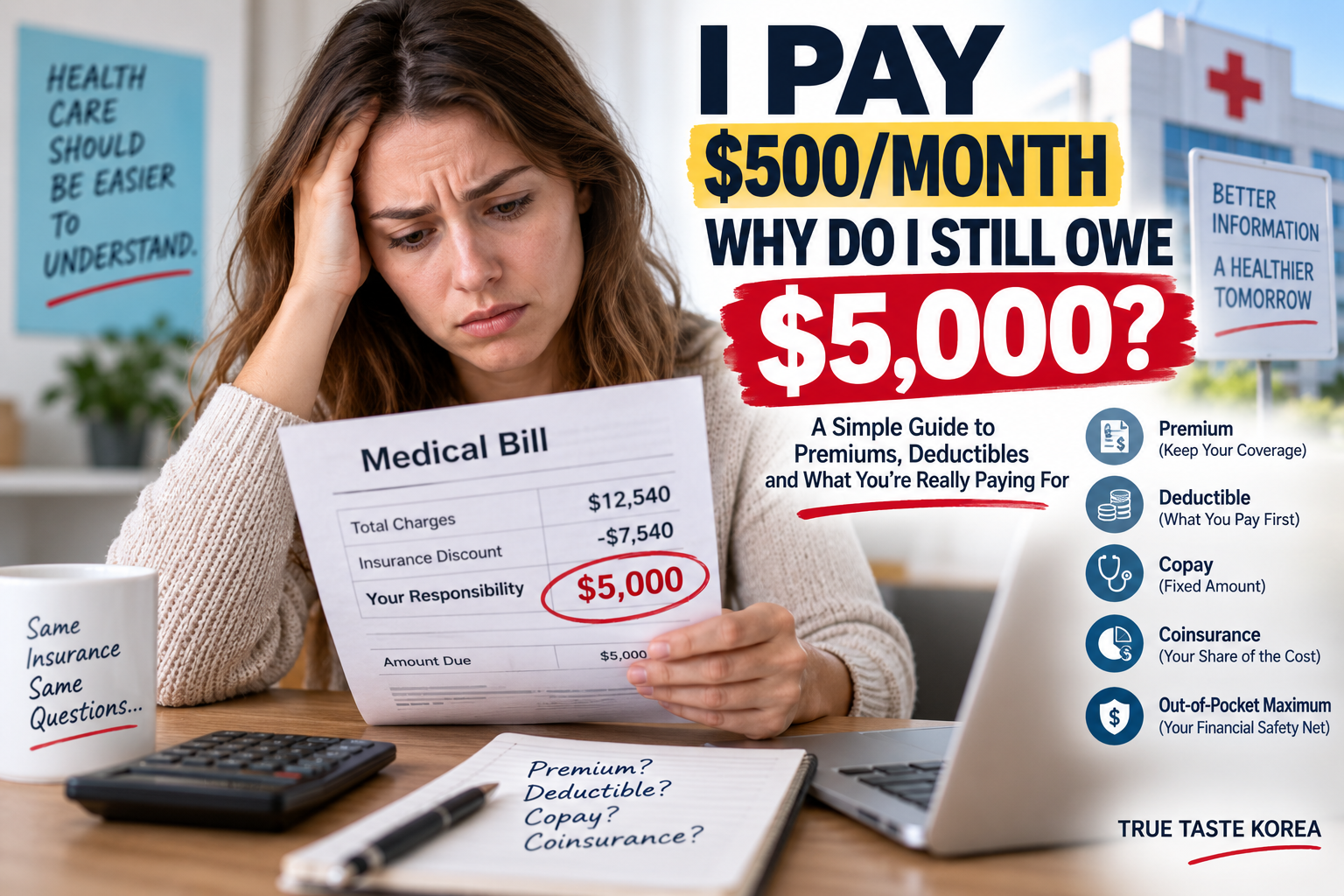
You pay $500 every month for health insurance.
That is $6,000 a year before you even walk into a doctor’s office.
Then you actually need medical care.
And suddenly you discover something called a:
$5,000 deductible.
Wait.
You already paid thousands of dollars for insurance.
Now you’re being told you may have to pay thousands more before your insurance starts paying for many services?
So what exactly were those monthly premiums paying for?
If you’ve ever looked at your health insurance plan and thought:
“This makes absolutely no sense.”
You’re asking one of the most important questions in American health care.
And the answer starts with understanding that your premium and deductible are two completely different costs.
First: Your Premium Does NOT Pay Your Deductible
This is the part that surprises many people.
Your premium is what you pay to keep your health insurance active.
Think of it like the membership fee.
If your premium is $500 per month:
$500 × 12 = $6,000 per year
You may pay that amount even if you never visit a doctor.
Your deductible, on the other hand, is an amount you may have to pay toward covered medical services before your insurance begins paying its share for many types of care.
So yes:
You can pay thousands of dollars in premiums…
and still have a deductible of several thousand dollars.
The premium generally does not count toward your deductible.
And it generally does not count toward your out-of-pocket maximum either. CMS specifically explains that monthly premiums are excluded from the Marketplace out-of-pocket limit.
That’s the first key to understanding the system.
Then What Am I Paying $500 a Month For?
This is the natural next question.
If insurance doesn’t immediately pay every medical bill, why pay the premium at all?
Because you’re not buying unlimited free health care.
You’re buying financial protection against covered medical costs under the rules of your plan.
Your insurance may provide:
- negotiated in-network prices
- preventive services covered without cost sharing when applicable
- prescription drug benefits
- copays for certain services
- partial payment after the deductible
- protection against very large covered medical expenses
- an annual out-of-pocket maximum for covered in-network care, subject to plan rules
That last item is especially important.
Health insurance is partly designed to protect you from a catastrophic medical bill—not necessarily to make every doctor’s visit free.
Here’s How the Money Actually Works
Let’s make this simple.
Imagine a hypothetical plan:
Monthly premium: $500
Annual premium: $6,000
Deductible: $5,000
Coinsurance: 20%
Out-of-pocket maximum: $8,000
These numbers are just an example.
Now imagine you need expensive medical treatment.
Stage 1: You Pay the Premium
Every month:
You pay $500.
This keeps your insurance coverage active.
That money is separate from your deductible.
Stage 2: You Start Using Medical Care
Depending on the service and your plan, you may pay costs until you’ve met the deductible.
Suppose you eventually accumulate:
$5,000 toward your deductible.
Now you’ve met it.
That doesn’t necessarily mean everything becomes free.
Stage 3: Coinsurance May Begin
Your plan might now pay, for example:
80%
while you pay:
20%.
That’s coinsurance.
Stage 4: You Reach the Out-of-Pocket Maximum
Once your eligible spending reaches your plan’s annual out-of-pocket maximum, the plan generally pays 100% of covered in-network benefits for the rest of the plan year, subject to the policy’s terms.
For 2026 Marketplace plans, the federal maximum out-of-pocket limit can be as high as $10,600 for an individual and $21,200 for a family, although many plans have lower limits. Premiums do not count toward those limits.
That’s why the out-of-pocket maximum may actually be one of the most important numbers on your insurance plan.
Premium vs. Deductible vs. Copay vs. Coinsurance
American health insurance becomes much easier to understand once you separate these four words.
Premium
The amount you pay to maintain your insurance coverage.
Think:
“My insurance membership fee.”
Deductible
The amount you generally pay toward certain covered services before your plan begins sharing those costs.
Think:
“The amount I may have to cover first.”
Copay
A fixed amount for a service.
For example:
$30 for a doctor visit.
Depending on the plan, some copays may apply even before you’ve met your deductible.
Coinsurance
Instead of a fixed dollar amount, you pay a percentage.
For example:
Insurance pays 80%.
You pay 20%.
Out-of-Pocket Maximum
This is the annual ceiling on what you pay for covered in-network services that count toward the limit.
Think:
“My financial safety net.”
But remember:
your premiums generally sit outside that ceiling.
So Can I Really Pay $6,000 in Premiums AND Thousands More for Medical Care?
Yes.
That’s exactly why many Americans become frustrated with health insurance.
Using our hypothetical example:
Annual premiums:
$6,000
Potential covered medical cost sharing:
up to the plan’s applicable out-of-pocket maximum
Those are separate buckets.
So a household can spend substantial money maintaining insurance and still face significant costs when someone actually becomes sick.
And this isn’t just a theoretical concern.
The latest comprehensive KFF employer survey available found that the average annual premium for employer-sponsored health insurance in 2025 reached:
$9,325 for single coverage
and:
$26,993 for family coverage.
Workers didn’t personally pay all of that—the employer typically paid a substantial share—but workers contributed an average of $6,850 toward family coverage.
That’s roughly:
$571 per month from the worker’s paycheck for family coverage.
And that’s before considering many forms of cost sharing when health care is actually used.
“My Employer Pays Part of My Insurance. Why Is It Still So Expensive?”
Because the number deducted from your paycheck isn’t necessarily the full cost of your health insurance.
This is one of the hidden features of employer-sponsored insurance.
Suppose your paycheck shows:
Health insurance: $500
You might naturally think your insurance costs $500.
But your employer may be paying another substantial amount behind the scenes.
KFF found that the average total employer-sponsored family premium was nearly $27,000 in 2025.
The employee contribution is only one portion of that total.
This is why changing jobs—or losing employer coverage—can produce such a shocking realization about the full price of health insurance.
Why Are Deductibles So High?
There isn’t one universal reason.
But there is an important tradeoff in insurance design:
Lower premium → often higher deductible
and
Higher premium → often lower deductible
Not always, but commonly.
A high-deductible plan shifts more routine or initial medical spending to the patient while providing insurance protection against larger covered expenses.
That can make the monthly premium cheaper than a more generous plan.
For someone who rarely uses medical care, that tradeoff may look attractive.
For someone who needs frequent treatment, prescriptions, specialists or planned surgery, it may look very different.
High Deductibles Are Not Rare
This isn’t an unusual corner of the American insurance market.
KFF found that 88% of covered workers with single coverage in 2025 were enrolled in a plan with a general annual deductible.
Among workers whose plans had a deductible, the average was:
$1,886.
And 34% of covered workers were enrolled in a plan with a general annual deductible of $2,000 or more for single coverage.
Workers at smaller companies faced particularly high deductibles.
For covered workers at firms with 10–199 employees, the average single deductible among plans with a deductible was:
$2,631
compared with:
$1,670
at larger employers.
That’s a major difference.
Deductibles Have Also Increased Over Time
Here’s another reason people feel squeezed.
Among covered workers with a general annual deductible, KFF reports that the average single deductible increased from:
$1,320 in 2015
to:
$1,886 in 2025.
That’s an increase of about 43% over ten years.
So when Americans say:
“I have insurance, but I still can’t afford to use it,”
there is a real economic tension behind that complaint.
Having insurance and having inexpensive access to medical care are not necessarily the same thing.
“But I Thought Insurance Pays for Doctor Visits”
It can.
This is where things get complicated because plans differ.
Some services may be covered before you meet your deductible.
Certain preventive services can be covered without cost sharing under applicable rules.
Your plan might also offer a doctor’s visit for a fixed copay even before you’ve met the full deductible.
Prescription drugs may have separate rules.
Emergency care may work differently.
Specialists may work differently.
That’s why saying:
“I have a $5,000 deductible, so insurance pays absolutely nothing until I’ve spent $5,000”
isn’t always accurate.
You need to read your actual plan.
The $10,000 Medical Bill That Doesn’t Necessarily Cost You $10,000
Here’s another important benefit people overlook.
Suppose a hospital’s sticker price for a service is:
$10,000.
Your insurer may have negotiated an allowed in-network price of:
$6,000.
Depending on your plan, your cost sharing is generally calculated using that negotiated structure rather than simply paying whatever sticker price appears on the original bill.
This is one reason insurance can have value even before the insurer itself appears to be paying most of the bill.
But there is an enormous warning attached:
network status matters.
Out-of-network care can operate under different rules and potentially expose patients to greater costs, depending on the circumstances and applicable protections.
Why Doesn’t My Premium Count Toward My Out-of-Pocket Maximum?
This is probably the part consumers dislike most.
Because these are fundamentally different categories in the insurance contract.
Premium:
the cost of having coverage
Out-of-pocket spending:
your share of covered health-care expenses
CMS explicitly says Marketplace monthly premiums don’t count toward the out-of-pocket limit.
So imagine someone pays:
$6,000 in annual premiums
and also reaches:
$8,000 in covered out-of-pocket costs
in our hypothetical plan.
Their total health-related insurance and cost-sharing spending could reach:
$14,000
before considering expenses the plan doesn’t cover.
That’s why looking only at the monthly premium can be a huge mistake when choosing health insurance.
The Cheapest Premium May NOT Be the Cheapest Health Plan
This is one of the most important lessons in this article.
Imagine two plans.
Plan A
Premium: $300/month
Deductible: $6,000
Out-of-pocket maximum: $9,000
Plan B
Premium: $500/month
Deductible: $1,500
Out-of-pocket maximum: $5,000
Plan A looks cheaper when you look only at the paycheck deduction.
But suppose you know you’ll need:
regular specialist appointments,
expensive medication,
imaging,
physical therapy,
or surgery.
Suddenly Plan B might produce lower total annual spending.
The right question isn’t:
“Which plan has the lowest premium?”
It’s:
“What could this plan cost me in total under the medical care I’m likely to use?”
A Better Way to Compare Health Insurance
Before choosing a plan, write down these numbers:
- Monthly premium
- Annual premium
- Deductible
- Copays
- Coinsurance
- Out-of-pocket maximum
- Prescription drug costs
- Network
- Employer HSA/HRA contribution, if any
Then run three scenarios.
Scenario A: Healthy Year
Almost no medical care.
How much do you spend?
Scenario B: Normal Year
Several doctor visits, prescriptions and maybe testing.
How much do you spend?
Scenario C: Very Bad Year
Hospitalization, surgery or another major medical event.
What’s the maximum financial damage?
That third scenario is especially important.
Insurance exists partly because nobody knows which year will become the bad year.
Don’t Ignore an Employer HSA Contribution
If you’re comparing high-deductible plans, check whether your employer contributes money to an HSA or HRA.
This can materially change the calculation.
KFF found that employer account contributions can offset a meaningful part of high deductibles for some workers. After accounting for employer HRA/HSA contributions, the share of covered workers effectively facing deductibles of $2,000 or more fell from 34% to 26% in its analysis.
So don’t compare deductibles alone.
A $3,000 deductible accompanied by a substantial employer contribution isn’t economically identical to a $3,000 deductible with no employer contribution.
“So What Is My Health Insurance Actually Protecting Me From?”
This may be the most useful way to think about it.
Health insurance isn’t necessarily designed to eliminate every medical expense.
It is designed to share covered costs and limit your exposure to potentially catastrophic covered medical expenses, subject to the terms of your plan.
A $150 doctor’s visit is unpleasant.
A $1,000 test is painful.
But a serious illness or major accident can generate bills vastly larger than either.
That’s when the difference between:
uninsured
and
insured with an out-of-pocket limit
can become financially enormous.
The frustrating part is that Americans can still face substantial costs before reaching that protection.
Both things can be true.
Why Does Health Insurance Feel More Expensive Even When Your Employer Helps?
Because households experience health-care costs in several different places.
You see:
money disappearing from every paycheck
Then:
the deductible
Then:
copays
Then:
coinsurance
Then:
prescription costs
Because these charges arrive separately, it can feel like you’re paying for the same thing again and again.
In reality, they’re different pieces of the same insurance cost-sharing system.
That doesn’t make them cheap.
But it explains why they exist simultaneously.
Before Choosing Your 2027 Health Plan, Don’t Look Only at the Premium
This is where understanding the system can save real money.
During open enrollment, many people naturally look at one number:
“How much comes out of my paycheck?”
Don’t stop there.
A plan that’s $100 cheaper per month saves:
$1,200 per year in premiums.
Great.
But if it increases your deductible by $3,000 and your out-of-pocket maximum by $4,000, the cheaper premium may not be the cheaper choice for someone expecting significant medical care.
Conversely, a healthy person with adequate savings might reasonably prefer a different cost structure.
There is no universally cheapest plan.
There is only a plan whose combination of premium + expected medical spending + financial risk fits you better.
The Five Numbers You Should Find on Your Health Plan Today
If you have health insurance but don’t really understand it, don’t try to read every page of the policy tonight.
Start with five numbers:
1. Monthly premium
How much are you actually paying?
2. Deductible
How much could you need to pay before major cost sharing kicks in?
3. Coinsurance
After the deductible, what percentage might still be yours?
4. Out-of-pocket maximum
What’s your ceiling for eligible covered in-network expenses?
5. Employer HSA/HRA contribution
Is your employer giving you money that offsets some of that risk?
Once you know those five numbers, your insurance becomes much easier to understand.
Bottom Line
So:
If I pay $500 a month for health insurance, why do I still have a $5,000 deductible?
Because the two payments serve different purposes.
Your premium buys and maintains the insurance coverage.
Your deductible determines how much you may need to spend on certain covered medical care before the plan begins sharing many of those costs.
Then copays and coinsurance may apply.
Finally, the out-of-pocket maximum limits eligible annual cost sharing for covered in-network services—but your monthly premiums generally don’t count toward that limit.
And this isn’t a small issue.
The latest comprehensive KFF employer survey found average family premiums approaching $27,000 per year, while millions of covered workers also face substantial deductibles.
That’s why the question:
“If I’m already paying so much for insurance, why am I paying again when I get sick?”
isn’t foolish at all.
It’s actually the question that unlocks how American health insurance works.
The next time you compare plans, don’t ask only:
“What’s the monthly premium?”
Ask:
“What could this insurance cost me in a good year—and what could it cost me in a terrible year?”
That is the number that matters.
This article is for general informational purposes only and is not medical, legal, insurance or financial advice. Health insurance benefits and rules vary by plan, employer and state.