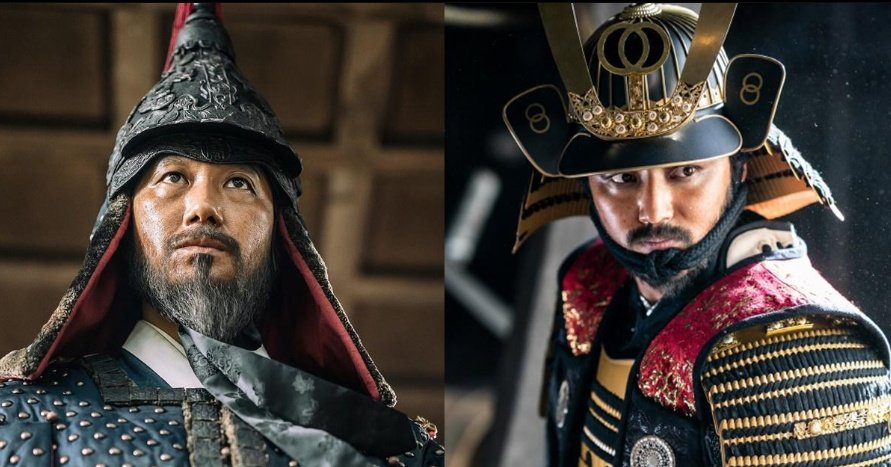
What makes a great military commander?
Is it the courage to fight against overwhelming odds? The ability to inspire soldiers? Or the intelligence to recognize that a battle should never be fought on the enemy’s terms?
Hansan: Rising Dragon (2022), directed by Kim Han-min, explores the last of these questions through the story of the Battle of Hansan Island in 1592.
The film depicts Admiral Yi Sun-sin preparing to confront the Japanese navy during the early stages of the Japanese invasions of Korea. His opponent is Wakisaka Yasuharu, an ambitious Japanese commander who believes that his fleet can defeat the Korean forces through aggressive naval tactics.
But Yi does not simply wait for the enemy to attack.
He studies the opposing fleet, considers the limitations of his own ships, and develops a strategy designed to control where and how the battle will take place.
The resulting confrontation is remembered for the Korean fleet’s use of the crane-wing formation, known as Hakikjin, and the dramatic appearance of the turtle ship.
Yet the most interesting aspect of the film is not the spectacle of the naval battle.
It is the strategic thinking behind it.
Yi Sun-sin does not win simply because he is portrayed as a brilliant hero. He wins because he understands that the conditions of a battle can be more important than the number of ships participating in it.
This raises a question that extends beyond military history:
Can a commander create victory before the first weapon is fired by controlling the choices available to the enemy?
1. Why Does Hansan Focus on Strategy Rather Than Heroic Survival?
Kim Han-min’s earlier film, The Admiral: Roaring Currents (2014), focused on the Battle of Myeongnyang.
That battle presented an extraordinary situation: Yi Sun-sin faced a much larger Japanese fleet with a severely limited number of Korean warships.
The dramatic question was obvious.
How could a commander survive when the numerical balance was so unfavorable?
Hansan: Rising Dragon approaches the story differently.
The Battle of Hansan Island took place earlier in 1592, when Yi was developing the naval strategy that would help establish Korean control of the surrounding waters.
The film is therefore less interested in portraying a desperate commander fighting for survival.
Instead, it shows a commander preparing the conditions for a decisive engagement.
This changes the nature of the drama.
In The Admiral, the audience watches a commander respond to an apparently impossible situation.
In Hansan, the audience watches a commander attempt to shape the situation before the enemy can dictate its terms.
The difference is important.
One story emphasizes endurance under pressure.
The other emphasizes preparation, intelligence, and strategic control.
2. Why Was Wakisaka Yasuharu Such a Dangerous Opponent?
A strategic victory becomes meaningful only when the opposing commander presents a genuine challenge.
Wakisaka Yasuharu is therefore essential to the film.
He is not portrayed simply as an enemy who makes obvious mistakes.
He is an experienced Japanese commander with confidence in his naval forces and a strong desire to defeat Yi Sun-sin.
His approach creates a contrast with Yi’s.
Wakisaka seeks an opportunity to engage and overwhelm the Korean fleet.
Yi understands that allowing the Japanese commander to choose the conditions of battle could be dangerous.
The two commanders therefore represent different approaches to warfare.
Wakisaka is confident in his ability to exploit an opportunity once it appears.
Yi is more concerned with controlling the circumstances in which that opportunity can emerge.
This is what makes their confrontation interesting.
A battle between two fleets is also a battle between two ways of thinking.
The film’s strongest strategic tension comes from the possibility that the commander who appears more aggressive may actually be the one responding to the other commander’s plan.
3. Why Did Yi Sun-sin Refuse to Fight on the Enemy’s Terms?
In naval warfare, the number of ships is important, but it is not the only factor that determines the result.
The location of the engagement, the movement of the fleets, the condition of the ships, the ability to use artillery, and the coordination of individual commanders all influence the outcome.
Yi Sun-sin understood that a battle should not be approached as a simple contest of strength.
If the Japanese fleet could use its preferred tactics, the Korean fleet might face serious disadvantages.
Yi therefore needed to influence the environment in which the battle would occur.
The Battle of Hansan Island became a demonstration of this principle.
Rather than simply pursuing the enemy, the Korean fleet used a planned formation to draw the Japanese ships into a position where the Korean forces could attack from multiple directions.
The important point is not that Yi possessed some magical ability to predict every movement.
It is that he prepared a strategy capable of responding to the enemy’s behavior.
A good military plan does not require perfect knowledge of the future.
It requires an understanding of what the opponent is likely to do and how to turn that behavior into an advantage.
4. What Made the Crane-Wing Formation So Effective?
The crane-wing formation, known as Hakikjin, is one of the central elements of the film.
Its name comes from the shape of a crane spreading its wings.
The formation was designed to surround or envelop an opposing force, allowing the Korean fleet to attack from multiple directions.
Rather than treating each ship as an isolated fighting unit, the formation organized the fleet into a coordinated structure.
This matters because naval combat is not simply about the strength of individual vessels.
Ships must maintain position, communicate, coordinate their movements, and use their weapons effectively.
A fleet that loses coordination can become vulnerable even if its individual ships are powerful.
The crane-wing formation sought to create the opposite situation.
The Korean ships could establish a broad attacking arrangement and concentrate their fire against the Japanese fleet as it entered the engagement area.
The film visualizes this strategy through its large-scale naval sequences.
However, it is important not to treat every movement shown on screen as a precise historical reconstruction.
The historical battle is associated with the crane-wing formation, but the exact details of every maneuver and its execution remain subjects for historical discussion.
The essential point is that the formation represents a deliberate attempt to control the structure of the battle.
5. Why Was the Turtle Ship More Than a Powerful Weapon?
The turtle ship, or Geobukseon, is perhaps the most recognizable symbol of Yi Sun-sin’s naval achievements.
In the film, its appearance is designed to create a dramatic turning point.
The ship looks different from conventional warships, with a covered upper structure and a distinctive shape.
Its visual design communicates protection and aggression at the same time.
But its historical importance should not be reduced to the idea that it was simply a ship designed to ram enemy vessels.
The turtle ship is generally understood as a specialized warship whose defensive construction and weapons made it particularly useful in close engagements.
Its covered structure helped protect the crew against enemy boarding attacks, while its guns provided offensive power.
The exact configuration of the turtle ship remains a subject of historical debate because surviving records do not provide every technical detail.
This is why the film’s spectacular depictions should be understood partly as cinematic interpretation.
The historical question is more interesting than a simple debate about whether the ship could smash through an enemy vessel.
Its potential advantage came from combining protection, firepower, and the ability to operate in dangerous positions within an enemy formation.
The turtle ship was not merely a symbol of technological superiority.
It was part of a broader naval system.
6. Why Did Yi Need More Than Just the Turtle Ship?
One of the easiest mistakes when watching a historical war film is to assume that a single extraordinary weapon explains the victory.
But military success rarely comes from one weapon alone.
The Korean fleet depended on different types of vessels performing different functions.
The Panokseon, the principal Korean warship of the period, provided a strong platform for artillery and naval engagement.
The turtle ship had a more specialized role.
The effectiveness of the fleet depended on how these ships worked together.
This is a crucial distinction.
A weapon can be impressive, but its usefulness depends on the strategy in which it is employed.
A powerful ship without coordination may become isolated.
A defensive ship without supporting forces may be overwhelmed.
The film is at its most interesting when it shows the relationship between the individual vessels and the larger battle plan.
Yi’s achievement was not simply possessing an unusual ship.
It was understanding how different capabilities could be combined into a coordinated force.
7. Why Was Intelligence So Important Before the Battle?
The film also emphasizes the importance of information.
Yi’s decisions depend on understanding the Japanese fleet, its commanders, and its likely movements.
Military intelligence is valuable because a commander cannot make sound decisions without knowing the conditions of the battlefield.
But information alone is not enough.
It must be interpreted correctly.
A commander may receive accurate information and still make a poor decision if its significance is misunderstood.
The challenge is to identify which details matter.
How does the enemy prefer to attack?
Which ships are most dangerous?
What conditions would make the opposing fleet vulnerable?
What happens if the enemy refuses to follow the expected plan?
These are the questions that turn information into strategy.
Yi’s preparation demonstrates a form of leadership based on disciplined observation.
He does not need to know everything about the Japanese fleet.
He needs to understand enough to make its strengths less decisive.
8. Why Is the Battle Also a Psychological Contest?
A naval battle is fought with weapons, but it is also shaped by expectations.
Commanders form assumptions about the opponent.
They anticipate certain movements, calculate risks, and make decisions based on what they believe the enemy is capable of doing.
A commander who can manipulate those expectations may gain an advantage before the main engagement begins.
The crane-wing strategy can be understood in this context.
The Korean fleet’s movements were designed to create an opportunity to engage the Japanese forces in a favorable arrangement.
The opposing commander had to make decisions without possessing complete information about the Korean plan.
This uncertainty matters.
A fleet that believes it is approaching a vulnerable opponent may move into a position that is actually dangerous.
The film uses this strategic tension to create suspense.
The audience knows that the two commanders are trying to understand one another, but neither can fully predict what the other will do.
This is why the battle feels like more than a contest between ships.
It is a contest between competing interpretations of the same situation.
9. Why Did the Korean Fleet Need to Control the Sea?
The Battle of Hansan was not simply an isolated military encounter.
It formed part of a larger conflict in which control of the surrounding waters was strategically important.
The Japanese invasion of Korea in 1592 depended heavily on maritime transportation.
Troops, supplies, weapons, and other resources had to move across the sea.
The Japanese army’s ability to continue its operations was therefore closely connected to the security of its maritime routes.
Korean naval victories could disrupt those movements and make the wider invasion more difficult to sustain.
This gives the Battle of Hansan significance beyond the number of ships destroyed.
A successful naval engagement could influence the strategic balance of the entire war.
The Korean fleet was not merely defending individual coastal locations.
It was challenging the enemy’s ability to move and supply forces by sea.
This broader perspective helps explain why the battle remains an important part of Korean military history.
10. Why Does the Film Give Attention to Both Commanders?
A historical war film becomes more compelling when the opposing commander is not simply an obstacle waiting to be defeated.
Wakisaka’s presence gives the battle a human and strategic dimension.
The audience can understand why the Japanese commander believes his fleet has an opportunity to win.
This creates tension because the outcome is not presented as inevitable from the beginning.
Yi’s strategic intelligence becomes more meaningful when it is tested against an opponent who is also capable of making decisions.
The film therefore creates a confrontation between two different military perspectives.
One seeks an opportunity to engage and overpower the enemy.
The other attempts to shape the battlefield so that the enemy’s preferred approach becomes less effective.
The result is a story in which victory depends not only on courage but also on the ability to recognize the opponent’s assumptions.
This is a more interesting way to portray a historical hero.
Instead of asking the audience to admire Yi simply because he is famous, the film asks them to understand why his decisions mattered.
11. Was the Historical Battle Exactly Like the Film?
This is where the distinction between historical record and cinematic storytelling becomes essential.
Hansan: Rising Dragon is a historical film, not a documentary.
The Battle of Hansan was a real event, and Yi Sun-sin’s use of naval formations is a central part of its historical significance.
However, the exact appearance of the ships, the timing of individual maneuvers, and the personal conversations between commanders cannot all be reconstructed with complete certainty.
The film uses dramatic dialogue, visual composition, and carefully staged combat to make the historical event understandable to modern audiences.
The turtle ship is a particularly good example.
Historical sources support its existence and military use, but the exact technical design and operational details remain debated.
The film’s depiction of it charging into enemy vessels should therefore be treated as cinematic interpretation rather than unquestionable historical fact.
This does not make the film less valuable.
It means viewers should understand the difference between the historical battle and the dramatic reconstruction.
The strongest historical films encourage curiosity about the real events rather than replacing them.
12. Why Is Yi Sun-sin’s Leadership More Than Personal Bravery?
Yi Sun-sin is often remembered for extraordinary courage and determination.
But the Battle of Hansan suggests another aspect of his leadership.
He understood that the lives of his soldiers depended on the decisions he made before and during combat.
A commander who seeks personal glory may pursue a dramatic victory even when the risks are excessive.
A responsible commander must consider the survival of the entire force.
This does not mean that every soldier can be protected.
War is inherently dangerous, and no plan can eliminate every possible loss.
But preparation can reduce unnecessary exposure.
Coordination can prevent units from becoming isolated.
Intelligence can help avoid unfavorable engagements.
A carefully chosen battlefield can make a numerical disadvantage less decisive.
These are not merely tactical achievements.
They reflect an understanding that military leadership involves responsibility for other people’s lives.
The film’s portrayal of Yi is most persuasive when it emphasizes this dimension.
His greatness is not only that he is willing to fight.
It is that he thinks carefully about how his people can fight and survive.
13. Why Does the Battle of Hansan Matter Beyond Korean National History?
For Korean audiences, the Battle of Hansan is part of a deeply important historical narrative.
But its strategic lessons can also be understood internationally.
Military history contains many examples of commanders who overcame disadvantages by changing the structure of a conflict.
Numerical superiority does not guarantee victory.
Technological superiority does not guarantee victory.
Even a highly experienced army can become vulnerable when it is forced to operate in unfamiliar conditions.
The Battle of Hansan offers an example of how planning, coordination, intelligence, and geography can influence the outcome of a naval engagement.
This is why the film can appeal to audiences interested in military history beyond Korea.
Its central subject is not simply national pride.
It is the relationship between strategy and power.
The most important question is not how many ships each side possessed.
It is how the commanders used the resources available to them.
14. What Makes Hansan Different From Other Historical War Films?
Many historical war films are built around a familiar emotional structure.
A nation faces an overwhelming enemy. A heroic commander rises above the crisis. Soldiers make sacrifices, and the final victory becomes a symbol of collective identity.
Hansan uses some of these conventions, but it also places unusual emphasis on the process of military planning.
The audience spends time watching decisions develop.
The enemy’s movements matter.
The organization of the fleet matters.
The weapons and their functions matter.
The final confrontation becomes meaningful because viewers have been given some understanding of the strategic problem.
Reddit reactions to the film have highlighted this distinction, particularly comparisons with The Admiral: Roaring Currents. Some viewers preferred Hansan because they felt it relied less on emotional exaggeration and gave more attention to strategy and the opposing forces. <Cite refs={[“turn560620reddit20”]}/>
That does not mean every viewer prefers this approach.
Some may find the film’s tactical discussions less emotionally immediate than the intense survival drama of The Admiral.
But the difference is valuable.
The film offers a different way to understand what made Yi Sun-sin an exceptional commander.
15. How Did Yi Sun-sin Win Before the Battle Even Began?
The most important achievement of Yi Sun-sin in the Battle of Hansan was not simply defeating the Japanese fleet.
It was preparing a situation in which the Korean fleet could use its strengths effectively.
He studied the enemy.
He considered the limitations of his own forces.
He developed a formation designed to create a favorable engagement.
He understood the importance of coordination between different types of ships.
And he recognized that controlling the conditions of battle could be more valuable than relying on courage alone.
This is why Hansan: Rising Dragon is more interesting than a straightforward story of military triumph.
It shows that victory is often the result of decisions made long before the decisive moment.
The battle itself is only the visible conclusion of a much longer process of observation, preparation, and judgment.
Wakisaka may have believed that the opportunity to defeat the Korean fleet was approaching.
But Yi was attempting to make that opportunity serve his own strategy.
The greatest commander is not necessarily the one who fights the hardest.
It may be the one who understands what must happen before fighting becomes necessary.
And that is the deeper lesson of Hansan: Rising Dragon:
A commander does not demonstrate genius only by winning a battle. He demonstrates it by creating the conditions in which his people have the best chance to survive and win.