Hallyu

  • Why Are Indian K-Pop Fans Learning Korean? The Surprising Reason Goes Beyond BTS

    India Meets Korea — Episode 03
    Two Cultures, Unexpected Connections
    TTK Original — Beyond the Headlines
    Why would an 85-year-old woman in India decide to learn an entirely new language because of a Korean boy band?

    It sounds like an unusual story.

    But a Korean-language teacher in Kota, Rajasthan, described exactly such a student in an interview published by the Korean Cultural Centre India.

    The elderly learner was reportedly fascinated by BTS.

    Her interest had become strong enough to motivate her to study Korean.

    That story challenges one of the most common assumptions about K-pop fandom.

    We often imagine that Korean music appeals primarily to teenagers and young adults.

    But its influence can reach people of different generations, backgrounds, and interests.

    More importantly, it raises a fascinating question.

    Why do Indian fans want to learn Korean when subtitles, translations, and English-language interviews are already available?

    The answer reveals how entertainment can develop into something much deeper: a desire to understand another culture from the inside.

    1. Why Isn’t Listening to K-Pop Enough?

    Imagine discovering a song that immediately captures your attention.

    You love the melody.

    You recognize the voices.

    You watch the performance repeatedly.

    But you do not understand the words.

    At first, that may not matter.

    Music can communicate excitement, sadness, longing, and confidence without translation.

    Yet curiosity often grows with familiarity.

    What does that particular phrase mean?

    Why do fans laugh when an idol uses a certain expression?

    Why does a lyric sound different when translated into English?

    These questions can turn casual listening into active learning.

    For some Indian K-pop fans, Korean is no longer simply the language used by their favorite artists.

    It becomes the key to understanding the emotional details that translations may not fully capture.

    2. Why Do BTS Fans Want to Understand the Original Lyrics?

    BTS has played a major role in introducing international audiences to Korean-language music.

    Their songs explore subjects including ambition, insecurity, friendship, identity, and personal struggle.

    Fans can understand these themes through translated lyrics.

    But translation always involves interpretation.

    A Korean word may carry several shades of meaning.

    A phrase may sound formal, intimate, humorous, or emotionally restrained depending on how it is used.

    Wordplay can be especially difficult to reproduce in another language.

    For fans who care deeply about a song, learning Korean offers the possibility of discovering those details directly.

    The goal is not necessarily perfect fluency.

    Sometimes understanding a single expression in its original context can change how a listener experiences an entire verse.

    That is one reason music can become a powerful motivation for language learning.

    3. Why Do BLACKPINK and Other K-Pop Artists Inspire Language Learning?

    BTS is not the only influence.

    BLACKPINK, Stray Kids, SEVENTEEN, TWICE, and other Korean artists have international fan communities that regularly interact with Korean-language content.

    Fans encounter the language in music videos, livestreams, interviews, variety programs, and behind-the-scenes clips.

    These formats create repeated exposure.

    A learner may recognize a greeting before understanding its grammar.

    Later, they begin identifying common words.

    Eventually, they may understand a short sentence without reading subtitles.

    That progress can be rewarding because it connects directly to something the learner already enjoys.

    Instead of studying vocabulary only for an examination, fans encounter words in emotionally meaningful situations.

    This can make learning feel less abstract.

    The artist provides the initial motivation, but the learner gradually develops a relationship with the language itself.

    4. Why Does Korean Sound Different From Hindi and Other Indian Languages?

    For Indian learners, Korean presents both unfamiliar features and interesting points of comparison.

    Korean uses Hangul, an alphabetic writing system developed in fifteenth-century Korea.

    Learning its basic letters is often more approachable than beginners initially expect.

    But recognizing letters is only the beginning.

    Korean grammar, pronunciation, verb endings, and levels of politeness require sustained practice.

    Interestingly, Korean and several major Indian languages share a common basic sentence-order pattern.

    Hindi and Korean frequently place the verb at the end of a sentence.

    For example, a simple Hindi sentence can follow a subject–object–verb structure.

    Korean commonly does the same.

    This does not make the languages closely related, and it does not mean their grammar is identical.

    But the structural resemblance can provide a useful point of comparison for some learners.

    India’s linguistic diversity also matters.

    A Hindi speaker, Tamil speaker, Bengali speaker, and Malayalam speaker may approach Korean with different linguistic experiences.

    There is no single Indian experience of learning Korean.

    5. Why Do K-Pop Fans Want to Understand Idols Without Subtitles?

    One of the most powerful motivations is the desire for direct communication.

    K-pop artists frequently speak Korean during livestreams, interviews, and fan interactions.

    Translations may appear later.

    Some broadcasts provide subtitles immediately, while others do not.

    But a fan who understands Korean can follow more of the conversation as it happens.

    They may recognize a joke, an affectionate nickname, or a spontaneous comment.

    That creates a different kind of connection.

    Instead of waiting for someone else to explain what was said, the listener can interpret the words independently.

    Of course, understanding Korean does not create a personal relationship with an artist.

    The interaction remains largely one-sided.

    But language learning can make the experience feel more immediate and personally meaningful.

    That is a genuine motivation, even when the connection begins with entertainment.

    6. Is Korean Language Learning Really Growing in India?

    There is clear evidence of growing institutional interest in Korean-language education.

    The Korean Cultural Centre India has continued offering Korean classes in New Delhi.

    Its September 2026 beginner-level program included weekday and weekend groups.

    In Chennai, the InKo Centre’s King Sejong Institute has also offered Korean courses for learners interested in Korean entertainment, culture, education, and other opportunities.

    The InKo Centre explicitly connects rising interest in Korean classes with the popularity of K-pop and K-dramas.

    The trend is not limited to India.

    According to the King Sejong Institute Foundation, worldwide enrollment reached 239,020 learners in 2025, compared with 210,374 in 2024.

    These are global enrollment figures, not an India-only total.

    They nevertheless show the wider growth of interest in studying Korean.

    For India, the existence of organized courses and recurring enrollment opportunities demonstrates that language learning has developed beyond informal fan curiosity.

    7. What Do Indian Fans Say About Learning Korean?

    A 2025 study published by the Korea Centre examined the influence of the Korean Wave on young Indian audiences.

    Among its 60 respondents, 19 reported taking lessons or courses inspired by Korean entertainment, including language, music, or dance.

    That is approximately 31.7% of the sample.

    The finding is interesting, but it must be interpreted carefully.

    The question covered several types of lessons, not Korean-language classes alone.

    The sample was also small and cannot represent all Indian K-pop fans.

    Still, it offers a useful glimpse into how cultural interest can influence behavior.

    Some fans do more than watch videos or listen to songs.

    They begin investing time in new skills.

    And once that happens, the relationship between entertainment and education changes.

    8. Why Can K-Pop Make Language Learning Easier to Maintain?

    Learning a foreign language takes time.

    Initial enthusiasm can disappear when grammar becomes difficult or progress slows.

    K-pop can provide a recurring source of motivation.

    A new song gives learners fresh vocabulary.

    An interview introduces conversational expressions.

    A variety show provides examples of humor and informal speech.

    Fans may also study together, exchange explanations, or practice recognizing words in songs.

    These activities do not replace structured education.

    Song lyrics can contain poetic language, unusual grammar, and expressions that are not appropriate in everyday conversation.

    Subtitles can also simplify or reinterpret what speakers say.

    But familiar entertainment can make learners more willing to return to their studies.

    The music becomes a reason to keep going.

    That sustained motivation may be more important than the initial excitement of learning a few phrases.

    9. Why Does Korean Learning Go Beyond Music?

    An interesting transformation often occurs after someone begins studying Korean.

    They discover that language cannot be separated from culture.

    A beginner encounters expressions of politeness.

    They learn that speech endings change according to the situation and relationship between speakers.

    They become curious about Korean family terms, age-related customs, and social etiquette.

    Food names begin making more sense.

    K-drama dialogue becomes easier to follow.

    Travel videos reveal familiar place names.

    What began as an interest in one musical group can gradually expand into a broader understanding of Korean society.

    That does not happen to every fan.

    Some people enjoy K-pop without wanting to study Korean at all.

    But for those who continue learning, the original fandom can become a doorway into a much larger cultural world.

    10. Can Korean Language Skills Create Career Opportunities?

    For some Indian learners, Korean eventually becomes more than a hobby.

    They may become interested in university study, translation, tourism, cultural work, or employment involving Korean organizations.

    The King Sejong Institute Foundation’s 2025 language survey, released in 2026, found that education and career development were significant motivations among surveyed learners with Korean-learning experience.

    In the relevant survey group, 50.9% cited preparation for study or academic programs in Korea, while 37.0% identified career development as a primary motivation.

    These figures describe the foundation’s surveyed group, not Indian K-pop fans specifically.

    They show that language-learning motivations can become more practical over time.

    However, learning Korean does not guarantee a job, scholarship, or opportunity to live in South Korea.

    Those outcomes depend on proficiency, qualifications, immigration rules, and individual circumstances.

    The important point is that an interest originally sparked by music can sometimes lead to serious educational goals.

    11. Why Does India Have a Special Connection With Korean Music?

    India already has a strong cultural relationship with music, performance, and emotionally expressive storytelling.

    Hindi cinema, regional film industries, classical traditions, and independent music scenes all play major roles in the country’s cultural life.

    K-pop offers something different while retaining certain recognizable attractions.

    It combines music with elaborate choreography, visual storytelling, distinctive group identities, and dedicated fan communities.

    Indian audiences may enjoy these elements without viewing K-pop as a replacement for Indian music.

    In fact, many listeners enjoy both.

    That coexistence is important.

    Cultural exchange is not a competition in which one country’s entertainment must defeat another’s.

    It can create additional possibilities for discovery.

    An Indian fan can love Punjabi pop, Bollywood soundtracks, and Korean idol music at the same time.

    Learning Korean may simply become another expression of that curiosity.

    12. From BTS to Arirang: When Fandom Becomes Cultural Exchange

    One of the clearest examples appeared in New Delhi in September 2026.

    The Korean Cultural Centre India organized workshops introducing Indian participants to traditional Korean folk music.

    The sessions included Arirang and Ganggangsullae.

    According to the center, many participants had first encountered Korean culture through artists such as BTS and BLACKPINK.

    The workshops allowed them to explore a different part of Korea’s musical heritage.

    This is an important development.

    K-pop and traditional Korean music are not the same thing.

    They come from different historical contexts and use different forms of expression.

    But interest in contemporary entertainment can encourage people to explore older traditions.

    A fan who begins by memorizing a K-pop chorus may eventually become curious about folk songs, traditional instruments, and the history of Korean musical culture.

    That is a deeper form of cultural exchange than simply watching a viral video.

    13. Why Learning Korean Changes the Relationship Between India and Korea

    Cultural influence is often measured through views, streams, ticket sales, or merchandise purchases.

    Those figures tell us how widely entertainment is consumed.

    Language learning reveals something different.

    It requires active participation.

    A person who studies Korean is making an effort to understand how another society communicates.

    That effort can create opportunities for conversation, friendship, study, and cultural cooperation.

    It can also help learners question stereotypes.

    Korean society is more complicated than the glamorous world presented in music videos and dramas.

    Studying the language may reveal differences between fictional portrayals and everyday life.

    That discovery is valuable.

    Real cultural understanding begins when curiosity extends beyond the most attractive images.

    The Real Reason Indian K-Pop Fans Learn Korean

    The journey may begin with a song.

    A listener discovers BTS, BLACKPINK, or another Korean artist.

    They search for the lyrics.

    They recognize a few words.

    They decide to learn Hangul.

    Then something unexpected happens.

    The language itself becomes interesting.

    They discover Korean customs, expressions, literature, traditional music, or educational opportunities.

    What began as admiration for an artist develops into curiosity about an entire society.

    The most remarkable thing about Indian K-pop fans learning Korean is not that music inspires them to study. It is that their interest can grow beyond the music that started it.

    And that may be one of the most meaningful connections between India and South Korea today.

    A song can cross a border in seconds.

    Understanding the people behind it takes longer.

    For some fans, learning Korean is how that deeper journey begins.


    India Meets Korea — Episode 03
    Two Cultures, Unexpected Connections
    TTK Original — Beyond the Headlines

  • Squid Game Was Never About the Games. The Real Reason It Shocked the World

    Squid Game Season 1 Deep Dive #1:

    The world watched people play childhood games.

    A simple game of red light, green light.
    A sugar candy challenge.
    A marble game.
    A rope-pulling contest.

    At first glance, Netflix’s Squid Game looked like a violent survival thriller built around shocking deaths.

    But that was only the surface.

    The deeper audiences looked, the more they realized something uncomfortable:

    Squid Game was never really about the games.

    It was about people who felt trapped.

    It was about debt, competition, desperation, and the fear of falling behind in a world where everyone is fighting to survive.

    That is why a Korean drama about traditional childhood games became a global cultural phenomenon.

    People from completely different countries, languages, and backgrounds saw something familiar inside this unfamiliar story.

    They did not just watch the characters.

    They saw themselves.


    The Most Dangerous Game Was Not Played on the Island

    Many survival stories ask a simple question:

    Who will survive?

    But Squid Game asked a much deeper question:

    What would you do if society gave you no other choice?

    The participants were not forced into the game by aliens, governments, or mysterious monsters.

    They volunteered.

    They entered because their lives outside the game had already become unbearable.

    Seong Gi-hun was drowning in debt.

    Cho Sang-woo was a successful person who lost everything.

    Kang Sae-byeok was trying to build a future for her family.

    Ali Abdul wanted a better life for himself and his family.

    Each character arrived at the same place for a different reason.

    But their problems came from the same source:

    A society where failure can feel like the end of everything.

    The game did not create their desperation.

    The world outside already had.


    Why Did a Korean Story Connect With the Entire World?

    One of the biggest surprises about Squid Game was that international audiences connected deeply with a story based on Korean childhood games.

    Many viewers outside Korea had never played these games.

    They did not know the cultural background.

    They did not understand every Korean social detail.

    Yet millions of people still understood the emotions.

    Why?

    Because the games were not the real message.

    The emotions were universal.

    The fear of losing money.

    The pressure to succeed.

    The feeling that everyone around you is moving ahead while you are falling behind.

    These experiences exist everywhere.

    A person in America, Europe, Asia, or anywhere else could look at the characters and recognize the same anxiety.

    The setting was Korean.

    The feelings were global.


    The Genius of Using Childhood Games

    Perhaps the most brilliant choice in Squid Game was not the violence.

    It was the contrast.

    Children’s games represent:

    • innocence
    • friendship
    • memories
    • happiness

    But Squid Game transforms those same games into a fight for survival.

    That contrast creates the strongest emotional impact.

    A playground becomes terrifying.

    A simple candy becomes a life-or-death challenge.

    A childhood memory becomes a nightmare.

    The audience is forced to ask:

    How did we reach a world where even childhood games can become cruel?

    That question is much bigger than the game itself.


    A Mirror of Modern Society

    The reason Squid Game became more than a successful Netflix series is because many viewers interpreted it as a reflection of modern life.

    The competition inside the game was extreme.

    But many people felt the competition outside the game was not completely different.

    School competition.

    Job competition.

    Housing competition.

    Financial pressure.

    Social status.

    The series exaggerated reality, but the emotions were recognizable.

    That is why the show created discussions far beyond entertainment.

    People were not only talking about who would survive.

    They were talking about why people were placed in such desperate situations.

  • Why Is Korean Food Becoming the Second Face of Korea After K-Pop?

    For years, one answer dominated whenever foreigners were asked what they associated with South Korea.

    K-pop.

    BTS. BLACKPINK. Korean idols. Concerts. Fandom.

    But something else has been quietly moving up behind the music.

    Food.

    In the 2026 Overseas Hallyu Survey, K-pop remained the most commonly associated image of Korea at 17.5%.

    But in second place was Korean food at 12.1%, ahead of Korean dramas at 9.5%, beauty at 6.2% and movies at 5.9%.

    That’s a remarkable change.

    Korean food is no longer something foreigners discover only after becoming interested in Korea.

    Increasingly, K-food itself is becoming one of the reasons people become interested in Korea.

    So how did that happen?

    K-Dramas Turned Dinner Into Entertainment

    Think about how often food appears in Korean dramas.

    A couple eats ramyeon late at night.

    Office workers gather around samgyeopsal.

    Someone recovering from a breakup drinks soju with fried chicken.

    A family argues while eating around a crowded table.

    Someone opens a convenience-store cup noodle at 2 a.m.

    These scenes aren’t necessarily advertisements.

    But they perform almost the same function.

    A foreign viewer may not know exactly what the characters are eating.

    So they search for it.

    “What is that Korean noodle?”

    “What is tteokbokki?”

    “Why do Koreans eat fried chicken with beer?”

    Entertainment creates curiosity.

    Curiosity creates a Google search.

    And eventually someone walks into a Korean restaurant.

    Squid Game Proved How Fast Korean Food Can Go Global

    One of the strangest examples wasn’t even a meal.

    It was dalgona.

    After Squid Game became a global phenomenon, people around the world began making the Korean sugar candy featured in the show’s famous challenge.

    TikTok and YouTube filled with dalgona challenges.

    Suddenly, a cheap childhood street snack familiar to generations of Koreans had become internationally recognizable.

    That’s the unusual power Korean entertainment now has.

    A food doesn’t necessarily need a global advertising campaign.

    Sometimes it only needs one unforgettable scene.

    Ramyeon May Be the Perfect K-Food Export

    Then there is Korean instant noodles.

    This might be the clearest example of K-food escaping the boundaries of Korean restaurants.

    You don’t need to know how to cook Korean food.

    You don’t need Korean ingredients.

    You don’t even need to leave your house.

    Boil water.

    Open the package.

    And you’ve entered K-food.

    Korean ramyeon exports have repeatedly broken records as international demand has expanded, helped by the global popularity of products such as Buldak spicy noodles.

    But something important happened along the way.

    Foreign consumers stopped treating Korean noodles merely as exotic imports.

    They began creating their own culture around them.

    Spicy noodle challenges.

    Cheese combinations.

    Egg toppings.

    TikTok recipes.

    Convenience-store-style meals recreated at home.

    Korean food was no longer simply being exported.

    It was being remixed.

    K-Pop Idols Became Unofficial Food Ambassadors

    And then K-pop accelerated everything.

    Fans don’t only want to hear what their favorite idols sing.

    They want to know:

    What do they wear?

    What cosmetics do they use?

    Where do they travel?

    And inevitably:

    What do they eat?

    An idol eating a particular noodle, snack or restaurant dish can instantly create international curiosity.

    Sometimes the connection is completely accidental.

    The celebrity isn’t presenting a tourism commercial.

    They’re simply eating.

    But millions of fans are watching.

    That’s something traditional food marketing could never easily reproduce.

    The product arrives with a story and a person already attached to it.

    Korean Food Also Looks Extremely Good on Camera

    This shouldn’t be underestimated.

    Korean food is unusually compatible with social media.

    Bright red tteokbokki.

    Bubbling jjigae.

    Meat sizzling on a grill.

    A huge plate of fried chicken.

    Cheese stretching from spicy food.

    Colorful bibimbap.

    Kimchi being cut with scissors.

    Ramyeon steaming inside a metal pot.

    Even before someone tastes it, there is movement, sound and color.

    That makes Korean food excellent material for YouTube Shorts, TikTok and Instagram.

    Food used to spread primarily through restaurants and cookbooks.

    Now it can spread through a 15-second video.

    The Spiciness Became Part of the Entertainment

    Korea also benefited from something that might initially have seemed like a disadvantage.

    A lot of popular Korean food is spicy.

    Very spicy, by the standards of many international consumers.

    Instead of stopping people, that became a challenge.

    “Can I survive Korean spicy noodles?”

    “Trying Buldak for the first time.”

    “My friend eats Korean tteokbokki.”

    The reaction itself became content.

    This is an important difference between simply liking a food and participating in food culture online.

    Buldak isn’t only something people eat.

    For years, it has also been something people film themselves eating.

    But K-Food Is Bigger Than Spicy Noodles

    There is a danger here.

    International K-food can easily become reduced to:

    ramyeon + fried chicken + tteokbokki + Korean barbecue.

    Those foods are popular for good reasons.

    But Korean food culture is much larger.

    Doenjang jjigae.

    Miyeokguk.

    Gimbap.

    Naengmyeon.

    Bossam.

    Jokbal.

    Sundubu jjigae.

    Jeon.

    Gukbap.

    Countless banchan.

    And hundreds of regional dishes that many international visitors have never encountered.

    That may actually represent the next stage of K-food globalization.

    The first stage gets people through the door.

    The second stage makes them curious about what Koreans actually eat every day.

    Kimchi Has Already Made That Transition

    Kimchi is a good example.

    Once, many foreigners saw kimchi as a strange, strongly flavored fermented side dish.

    Today it is sold in ordinary supermarkets far outside Korea.

    And as global interest in fermentation, probiotics and Korean cuisine increased, kimchi became easier to understand within food cultures that previously had little familiarity with it.

    Something foreign became familiar.

    That’s one of the clearest signs that a cuisine has begun moving beyond trend status.

    You no longer need to explain it every time.

    People simply know what it is.

    Food May Have One Advantage Even K-Pop Doesn’t

    You can enjoy K-pop without ever visiting Korea.

    The same is true of K-dramas.

    But food creates a different kind of desire.

    Watching someone eat Korean barbecue can make you want to taste it yourself.

    Seeing a drama character drinking soju beside the Han River can make you wonder what that experience feels like.

    And once someone travels to Korea, food becomes part of nearly every day of the trip.

    Breakfast.

    Markets.

    Convenience stores.

    Cafés.

    Restaurants.

    Street food.

    Late-night delivery.

    That means K-food connects digital Korean culture to a physical Korean experience.

    You can watch Korea through Netflix.
    But you can literally taste Korea through food.

    K-Food Also Gives Hallyu a Longer Life

    Pop stars change.

    Hit dramas end.

    Streaming rankings move on.

    Food behaves differently.

    Once a person discovers kimchi, they can keep buying it.

    Once someone learns how to cook ramyeon the way they like it, it becomes part of their routine.

    Once a Korean restaurant becomes someone’s favorite restaurant, they may return for years.

    That’s powerful because culture has moved from entertainment into habit.

    A BTS song might introduce someone to Korea.

    A drama might deepen their curiosity.

    But a bottle of gochujang sitting inside their refrigerator means Korea has entered their everyday life.

    So Is K-Food Really Becoming Korea’s Second Global Face?

    The survey numbers suggest that food has already become one of the strongest images foreigners associate with Korea.

    But the more interesting story is how it happened.

    K-food didn’t spread alone.

    K-pop showed people Korea.

    K-dramas showed people Koreans eating.

    Netflix turned unfamiliar dishes into global images.

    YouTube taught people how to cook them.

    TikTok turned spicy noodles into challenges.

    And supermarkets made the ingredients accessible.

    Each part of Hallyu helped the others.

    That’s why the next phase of the Korean Wave may not be something you watch or listen to.

    It may be something sitting on your dinner table.

    For years, the world learned how Korea sounds through K-pop.

    Then it learned how Korea looks through K-dramas.

    Now millions of people are discovering something else.

    What Korea tastes like.

  • Is Seoul Becoming the New Dream City for Young Foreigners?

    For decades, young people dreaming about living abroad imagined cities like Paris, London or New York.

    Today, another city is entering that conversation.

    Seoul.

    And the reason isn’t simply that South Korean universities suddenly became more famous.

    For many young foreigners, the journey starts somewhere completely different.

    A BTS song.

    A K-drama on Netflix.

    A Korean beauty video.

    A bowl of tteokbokki seen on YouTube.

    Or thousands of TikTok and Instagram clips showing what everyday life in Seoul looks like.

    What begins as entertainment can eventually become a much bigger thought:

    “What if I actually lived there?”

    That idea is no longer unusual.

    In 2026, Seoul ranked No. 1 in the QS Best Student Cities ranking for the first time, while the number of foreign students residing in South Korea surpassed 310,000.

    So why are so many young foreigners suddenly looking at Seoul differently?

    Seoul Is No Longer Just a Tourist Destination

    The change is easy to underestimate.

    Korean culture was once something international fans consumed from far away.

    You listened to K-pop.

    You watched Korean dramas.

    Maybe you ate Korean food occasionally.

    Then you went back to everyday life.

    But the relationship has changed.

    For some fans, Korea has become a place they want to experience rather than simply watch.

    The Financial Times recently described Seoul as a new major destination for international students, reporting that international enrollment in Korean universities has risen sharply and that the city is increasingly attracting students without previous family or regional connections to Korea.

    That’s important.

    Korea isn’t attracting only people who already had a practical reason to be here.

    Korean culture itself is creating the reason.

    K-Pop and K-Dramas Are Becoming a Gateway

    Ask some international students why they became interested in Korea and the answer often begins with culture.

    That doesn’t necessarily mean:

    “I moved to Korea because I love BTS.”

    The process is usually more gradual.

    Someone discovers K-pop.

    Then they begin watching Korean content.

    They become interested in the language.

    They learn more about Korean food and society.

    They start imagining a trip.

    And eventually Korea becomes one of the countries they consider for study abroad.

    French students provide a particularly interesting example.

    The number of French students in South Korea reached 2,438 by April 2026, up from 1,737 in 2024. Interviews with students found that many had originally become interested in Korea through K-pop or K-dramas.

    Entertainment became curiosity.

    Curiosity became travel.

    And for some people, travel became life.

    The Numbers Are Becoming Difficult to Ignore

    This isn’t merely a social-media trend.

    As of February 2026, 314,397 foreign students were residing in South Korea, according to government immigration data.

    That’s roughly double the 153,361 recorded at the end of 2020.

    Among them, 238,905 were attending universities and other higher-education institutions, while more than 75,000 were language trainees.

    Another measure shows the same direction from a different angle.

    More than 500,000 foreign visitors entered South Korea for study or training purposes in 2025, according to Korea Tourism Organization data reported by Yonhap. That figure had been only 80,084 during the pandemic-affected year of 2021.

    Different statistics measure different populations, so they shouldn’t be treated as interchangeable.

    But both point toward the same trend:

    Studying in Korea has become much more mainstream internationally.

    Why Seoul Instead of Paris, London or New York?

    K-culture gets people interested.

    But culture alone probably wouldn’t be enough to convince hundreds of thousands of people to study here.

    Seoul also offers something practical.

    Compared with some traditional Western study-abroad capitals, housing can be cheaper.

    Recent reporting cited monthly studio rent in Seoul at around 900,000 won and boarding-house accommodation around 600,000 won, below typical student rents reported for Paris and especially London.

    Then there is transportation.

    Seoul’s subway and bus network makes it possible to live without owning a car.

    Convenience stores stay open late.

    Food delivery is everywhere.

    Cafés are everywhere.

    And much of the city stays active well into the night.

    For a young person living alone overseas for the first time, those small conveniences matter.

    Seoul doesn’t only offer Korean culture.

    It offers an entire lifestyle around it.

    And Social Media Changed What “Living Abroad” Means

    Twenty years ago, choosing a foreign city required imagination.

    You might have seen photographs in a travel book.

    Maybe you knew someone who had visited.

    Today, a student considering Seoul can watch thousands of videos before buying a plane ticket.

    They can see Hongdae on Friday night.

    They can watch someone take the subway to university.

    They can see what a convenience-store lunch costs.

    They can watch apartment tours.

    They can learn how to order food.

    They can even watch another international student’s entire semester in Korea.

    The FT noted that social media and digital tools have helped make less traditional study-abroad destinations more accessible to students.

    That reduces the psychological distance.

    Seoul stops feeling like:

    “Somewhere on the other side of the world.”

    It begins feeling like:

    “Somewhere I could actually live.”

    But the Seoul of K-Dramas Isn’t the Real Seoul

    This is where the story becomes more complicated.

    Korea can look extremely attractive through entertainment.

    Beautiful cafés.

    Perfectly dressed people.

    Late-night walks beside the Han River.

    Romance under cherry blossoms.

    A convenient subway arriving every few minutes.

    All of those things exist.

    But so do the parts that don’t fit neatly into a K-drama.

    Language barriers.

    Small apartments.

    Academic pressure.

    Hierarchical social relationships.

    Different dating customs.

    Administrative difficulties.

    Beauty standards.

    And, eventually, homesickness.

    French students interviewed by Le Monde described both sides of that experience. Some praised Korea’s safety, convenience and cultural energy, while others were surprised by social hierarchy, pressure surrounding appearance, difficulties integrating with Koreans and aspects of Korean working culture.

    That’s worth emphasizing.

    Loving Korean culture and living in Korean society are not the same experience.

    Maybe That’s Actually a Sign of Hallyu’s Maturity

    For years, the success of the Korean Wave was measured through exports.

    How many people watched a Korean drama?

    How many BTS albums were sold?

    How many countries watched Squid Game?

    How much Korean food was exported?

    Those measurements still matter.

    But there’s another stage of cultural influence.

    It’s when someone doesn’t simply want to consume your culture.

    They want to enter the place that created it.

    They want to learn the language.

    Study at the university.

    Walk through the neighborhood.

    Make friends.

    Eat ordinary food.

    And understand what everyday life actually feels like.

    That’s a much deeper form of curiosity than streaming a television series.

    BTS May Bring Someone to Korea — But Korea Has to Keep Them Interested

    This is perhaps the biggest challenge for Seoul.

    K-pop can create the dream.

    But a city has to survive contact with reality.

    A student may first discover Korea because of BTS, BLACKPINK or Stray Kids.

    They may arrive because of a K-drama.

    But after six months, they aren’t living inside K-pop anymore.

    They’re dealing with rent.

    Classes.

    Visa paperwork.

    Friendships.

    Language.

    Transportation.

    And ordinary Monday mornings.

    That’s when the real Seoul replaces the imagined Seoul.

    Some people will love it even more.

    Others will discover that Korea was better as a place to visit than a place to live.

    Both reactions are normal.

    So Is Seoul Really the “New Paris”?

    Probably not in the literal sense.

    And it doesn’t need to be.

    Paris became a dream city because generations of foreigners associated it with art, fashion, romance and intellectual life.

    New York represented ambition and possibility.

    London represented another kind of global cultural experience.

    Seoul is developing its own mythology.

    Music.

    Drama.

    Beauty.

    Food.

    Technology.

    Nightlife.

    Fast-moving urban life.

    And an entire pop culture that millions of young people already encounter before they ever visit Korea.

    That’s what makes the current moment interesting.

    A generation ago, many foreigners discovered Korean culture after arriving in Korea.

    Now many young people discover Korea years before they arrive.

    By the time the airplane lands at Incheon, they may already know the music, the food, some of the language and even the neighborhoods.

    They haven’t simply arrived in a foreign country.

    They’ve arrived inside a world they’ve been watching from thousands of miles away.

    And perhaps that’s the biggest change Hallyu has created.

    K-pop and K-dramas didn’t just make Korean entertainment global.

    They made Seoul imaginable.

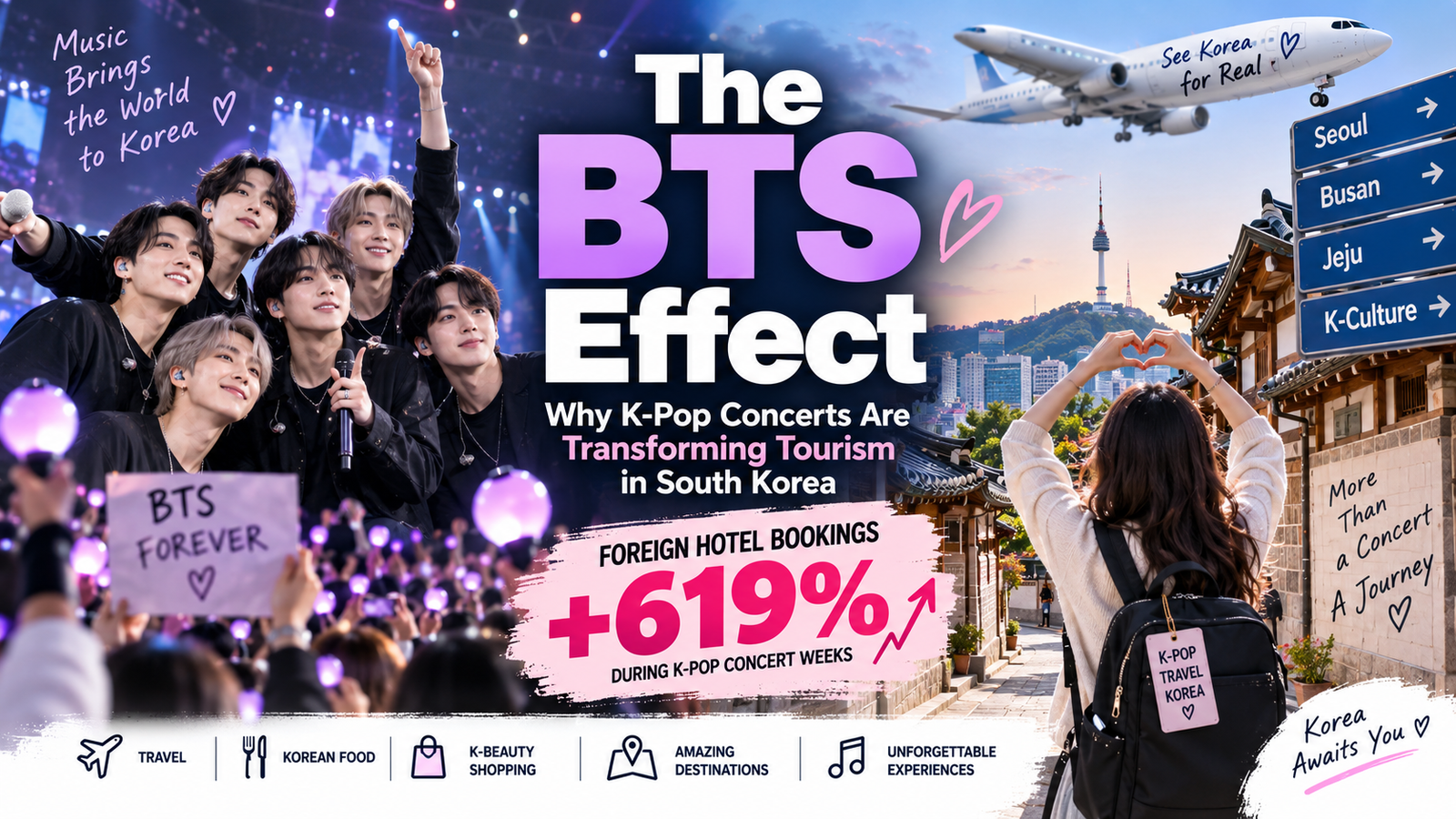
  • The BTS Effect: Why K-Pop Concerts Are Transforming Tourism in South Korea

    The BTS Effect: Why K-Pop Concerts Are Transforming Tourism in South Korea

    For millions of international travelers, a trip to South Korea once began with a familiar checklist:

    Seoul.

    Gyeongbokgung Palace.

    Myeongdong.

    Korean barbecue.

    Maybe Jeju Island or Busan.

    But a new kind of traveler is changing Korean tourism.

    Their trip may begin with something completely different:

    A concert ticket.

    A BTS performance.
    A BLACKPINK concert.
    A Stray Kids show.

    Fans fly thousands of miles to Korea for a few hours of music — but they rarely leave after the concert.

    They stay in hotels.

    They eat Korean food.

    They shop.

    They visit neighborhoods connected to their favorite artists.

    They travel to other cities.

    And increasingly, K-pop is becoming not simply something tourists enjoy while visiting Korea.

    K-pop is becoming the reason they visit Korea in the first place.

    New tourism data shows just how powerful this phenomenon has become.

    According to an analysis by the Korea Tourism Organization, accommodation bookings by foreign visitors surged 619.2% during weeks featuring concerts by three major K-pop acts compared with non-concert weeks in the dataset.

    And BTS provides perhaps the clearest example yet of what happens when global fandom turns into actual travel.

    Welcome to the new era of K-pop tourism in South Korea.


    The BTS Effect Is Bigger Than a Concert

    When BTS returned to the stage in South Korea in 2026, thousands of international ARMYs traveled to the country.

    But Korea’s Ministry of Culture, Sports and Tourism wanted to know something beyond concert attendance:

    What did those fans do after they arrived?

    Together with the Korea Culture & Tourism Institute and Korea Tourism Organization, the ministry surveyed concertgoers and analyzed mobile-network and credit-card data surrounding BTS performances in Seoul and Goyang.

    The results were remarkable.

    Foreign visitors who attended BTS’s March 21 Gwanghwamun performance stayed in South Korea for an average of:

    8.7 days

    and spent approximately:

    KRW 3.53 million per person.

    By comparison, the average international visitor during the first quarter of 2026 stayed 6.1 days and spent approximately KRW 2.45 million.

    In other words, BTS concert visitors stayed about 2.6 days longer and spent roughly KRW 1.08 million more per person than the average international tourist.

    That changes the way we should think about a K-pop concert.

    It is not simply a three-hour entertainment event.

    For international fans, it can become the anchor around which an entire Korean vacation is built.


    73.6% Came to Korea Primarily Because of BTS

    There is an even more important number.

    Among foreign visitors surveyed around BTS’s Gwanghwamun performance:

    73.6% said the BTS event was their primary reason for visiting South Korea.

    Another 17.4% were already visiting Korea for another purpose and added the event to their trip.

    Think about what that means.

    Without the concert, many of those international visitors might not have booked:

    a flight to Korea,

    a hotel room,

    airport transportation,

    restaurant meals,

    shopping trips,

    or visits to Korean attractions.

    The concert created the trip.

    This is why the phrase “BTS Effect” is more than fan language.

    It increasingly describes a measurable tourism phenomenon.


    BTS Fans Didn’t Just Attend the Concert and Go Home

    The Goyang concerts provide an even clearer picture.

    International fans attending BTS’s Goyang shows stayed in Korea for an average of 7.4 days and spent approximately KRW 2.91 million per person.

    And they traveled well beyond the stadium.

    Visitors connected their concert trips with places such as:

    Yongsan

    Myeongdong

    Dongdaemun Design Plaza (DDP)

    and the National Museum of Modern and Contemporary Art.

    These destinations were linked to the broader “BTS THE CITY Seoul” experience surrounding the performances.

    This is exactly why K-pop matters so much to tourism.

    A concert may last several hours.

    But the trip surrounding it can last more than a week.


    One BTS Concert Area Saw Foreign Spending Jump 38-Fold

    Perhaps the most dramatic evidence comes from the neighborhood surrounding the Goyang concert venue.

    The Korea Tourism Organization compared mobile and card data around Daehwa-dong, where the concerts took place, with the same period a year earlier.

    During the three BTS concert days, foreign visitors increased from 1,397 to 48,581.

    That’s approximately:

    35 times more foreign visitors.

    Foreign card spending in the area increased from approximately KRW 8.9 million to KRW 337.8 million.

    That’s roughly:

    38 times more spending.

    These numbers show why cities around the world compete aggressively to host major concerts.

    The economic impact does not stop at the ticket booth.

    It reaches:

    hotels,

    restaurants,

    cafés,

    convenience stores,

    taxis,

    subways,

    shopping centers,

    tourist attractions

    and local businesses.


    Then Came an Even Bigger Number: 619%

    BTS is not an isolated case.

    A newer Korea Tourism Organization analysis examined accommodation behavior surrounding major events.

    The results suggest that the concert-tourism effect extends across K-pop.

    During weeks featuring concerts by BTS, BLACKPINK and Stray Kids in the analyzed data, accommodation bookings increased dramatically.

    Domestic bookings rose around 99.4%.

    But bookings by foreign visitors increased by approximately:

    619%

    compared with non-concert periods in the analysis.

    That number deserves attention.

    Fans are not merely streaming Korean music from Los Angeles, Tokyo, Paris, Bangkok or London.

    Increasingly, they are getting on airplanes.


    K-Pop Has Changed the Meaning of a “Tourist Attraction”

    Traditionally, tourism promotion centered around physical landmarks.

    For Korea, that meant places such as:

    Gyeongbokgung Palace,

    Bukchon Hanok Village,

    N Seoul Tower,

    Jeju Island,

    or Haeundae Beach.

    Those places remain important.

    But younger international travelers increasingly build trips around something less traditional.

    They want to visit places connected to Korean culture they already love.

    A café visited by an idol.

    A music-video filming location.

    A neighborhood featured in Korean entertainment.

    A pop-up store.

    A concert venue.

    A K-pop agency district.

    A restaurant associated with an artist.

    A beauty store selling products used by Korean celebrities.

    The tourist attraction is no longer always a monument.

    Sometimes the attraction is a connection to a story, artist or fandom.


    Why K-Pop Fans Often Stay Longer

    Traditional sightseeing trips can be surprisingly short.

    A visitor might spend three or four days checking off famous attractions and then leave.

    Fandom tourism works differently.

    Imagine flying to Seoul for a Saturday concert.

    You may arrive several days early because international travel is expensive and you don’t want to risk missing the event.

    Then you discover that your favorite group has:

    a pop-up event,

    a merchandise store,

    a themed café,

    a photo exhibition,

    or related attractions elsewhere in the city.

    After the concert, you might add another few days for Korean food, shopping and sightseeing.

    Suddenly, a concert weekend becomes:

    a seven- or eight-day Korea vacation.

    The BTS data shows exactly this pattern.


    Where Do K-Pop Fans Go in Korea Beyond the Concert?

    This is where K-pop tourism becomes particularly interesting for first-time visitors.

    You don’t have to spend your entire vacation searching for idol-related locations.

    The best K-pop trip combines fandom with Korea itself.

    Here are several places that fit naturally into that itinerary.

    1. Hongdae

    Hongdae is one of Seoul’s most energetic neighborhoods.

    Street performances, cafés, fashion, nightlife and music culture make it especially popular with younger travelers.

    For a K-pop fan visiting Korea for the first time, Hongdae is one of the easiest places to experience contemporary Seoul.


    2. Myeongdong

    Myeongdong remains one of the most convenient areas for international visitors.

    You can combine:

    K-beauty shopping,

    Korean street food,

    restaurants,

    fashion

    and easy transportation.

    BTS concert visitors were also observed traveling to Myeongdong during their wider Korea itinerary.


    3. Yongsan

    Yongsan has become increasingly relevant to K-pop travelers.

    The area combines major transportation connections, shopping and proximity to entertainment-related destinations.

    It also appeared among locations visited by international BTS concertgoers.


    4. Dongdaemun Design Plaza

    DDP is one of Seoul’s most recognizable modern landmarks.

    It frequently hosts exhibitions, pop-ups, fashion events and cultural programs.

    Its late-night surroundings also make it easy to combine sightseeing with shopping and food.


    5. Seongsu

    If you want to understand modern Korean pop culture beyond music, visit Seongsu.

    The neighborhood has become known for:

    brand pop-ups,

    fashion,

    cafés,

    beauty launches

    and collaborations involving celebrities and entertainment brands.

    It represents another important part of contemporary Korean youth culture.


    6. The Han River

    Not everything needs to be a paid attraction.

    One of the simplest Seoul experiences is spending an evening along the Han River.

    Buy convenience-store food, order Korean fried chicken, sit by the river and watch Seoul slow down after sunset.

    For international visitors who first discovered Korea through highly produced music videos and dramas, ordinary experiences like this often become some of the most memorable moments of the trip.


    And K-Pop Tourism Is Moving Beyond Seoul

    This may ultimately be the most important change.

    Historically, international tourism to Korea has been heavily concentrated in Seoul.

    But recent tourism data shows foreign travelers are increasingly exploring other regions.

    The share of international visitors staying outside the greater Seoul region rose from 39.5% to 43%, according to the recent tourism analysis.

    Growth was particularly notable in destinations including:

    Busan

    Jeju

    Andong

    and Gyeongju.

    K-pop can accelerate that trend.

    If a major concert takes place outside central Seoul, thousands of international fans suddenly need:

    accommodation,

    transportation,

    food,

    shopping

    and things to do nearby.

    A concert can therefore become a gateway to regional Korea.


    Busan May Be the Perfect Example

    For many international visitors, Busan is already Korea’s obvious second destination after Seoul.

    It offers something completely different:

    beaches,

    seafood,

    traditional markets,

    mountains,

    coastal temples,

    night views

    and a more relaxed atmosphere.

    K-pop events can give travelers the initial reason to visit.

    But once they arrive, places such as:

    Haeundae,

    Gwangalli,

    Jagalchi Market,

    Gamcheon Culture Village

    and Haedong Yonggungsa Temple

    turn a concert trip into a broader Korean travel experience.

    This is the real tourism value of K-pop.

    Music gets people onto the plane.

    Korea gives them reasons to stay.


    K-Pop Is Also Selling Korean Food

    There is another powerful effect that tourism statistics alone don’t fully capture.

    Fans often arrive in Korea already familiar with Korean food.

    They have seen idols eating:

    tteokbokki,

    ramyeon,

    samgyeopsal,

    fried chicken,

    gimbap,

    kimchi jjigae

    and Korean convenience-store food.

    So when they finally visit Korea, eating those foods can feel like participating in the culture they have followed from abroad.

    This is one reason K-pop tourism connects naturally with food tourism.

    A fan who travels to Korea for BTS may return home remembering the concert.

    But they may also remember:

    their first Korean barbecue dinner,

    late-night fried chicken,

    tteokbokki from a street stall,

    or convenience-store ramyeon eaten beside the Han River.

    That emotional connection is extremely powerful.


    K-Pop Also Leads Travelers Into K-Beauty

    The same phenomenon occurs with Korean beauty.

    K-pop fans are constantly exposed to:

    Korean skincare,

    makeup,

    fashion,

    hairstyles

    and beauty trends.

    Once they arrive in Korea, stores in Myeongdong, Hongdae, Gangnam and Seongsu become part of the tourism experience.

    This is why the economic value of Korean popular culture extends far beyond music sales.

    One song can eventually influence spending on:

    travel,

    hotels,

    restaurants,

    beauty,

    fashion,

    transportation

    and entertainment.

    That is the larger K-Culture economy.


    K-Pop Tourism Is Different From Ordinary Celebrity Tourism

    Celebrity tourism is not new.

    People have always traveled to see musicians.

    But K-pop has several characteristics that make the effect unusually powerful.

    First, K-pop fandoms are highly organized internationally.

    Fans communicate through social media and online communities across national borders.

    When a concert is announced, information about:

    tickets,

    flights,

    hotels,

    transportation,

    restaurants

    and fan events

    can spread globally within hours.

    Second, K-pop provides a constant stream of content between concerts.

    Music videos, livestreams, variety shows, social media, documentaries and fan platforms create continuous engagement.

    For many international fans, Korea does not feel like a completely unfamiliar country by the time they arrive.

    They have already been experiencing parts of Korean culture digitally for years.

    The physical trip becomes the final step of a relationship that began online.


    From “Korean Wave” to “Travel to Korea”

    For years, people talked about the Korean Wave — Hallyu — primarily in terms of exports.

    Korean music was exported.

    Korean dramas were exported.

    Korean movies were exported.

    Korean beauty products were exported.

    But something more interesting is now happening.

    Instead of Korean culture only traveling overseas, overseas consumers are traveling to Korea.

    That represents a major change.

    A Spotify stream generates one type of economic value.

    A tourist who flies to Korea and stays for eight days generates something completely different.

    They may buy:

    airfare,

    accommodation,

    concert tickets,

    food,

    transportation,

    cosmetics,

    fashion,

    souvenirs

    and additional travel experiences.

    The BTS tourism data makes this difference visible.


    What This Means for Someone Planning a Korea Trip

    If you are considering traveling to Korea for a K-pop concert, there is one piece of advice worth remembering:

    Don’t make the concert your entire trip.

    Make it the beginning.

    If your concert is in Seoul or Goyang, consider spending several days exploring Seoul before or after the event.

    Then add another destination.

    For example:

    Days 1–4: Seoul
    Day 5: K-pop concert
    Days 6–7: Seoul neighborhoods and shopping
    Days 8–9: Busan or Gyeongju

    Even a shorter trip can combine K-pop with Korean food, history and everyday culture.

    And that is often where the best memories happen.


    The BTS Effect May Be Showing Us the Future of Korean Tourism

    The most interesting thing about the BTS tourism data isn’t simply that BTS is popular.

    We already knew that.

    What matters is what fans do because of that popularity.

    They cross borders.

    They stay longer.

    They spend more.

    They explore neighborhoods.

    They eat Korean food.

    They shop for Korean products.

    And increasingly, they travel beyond Seoul.

    Government data showed foreign visitors around BTS’s Goyang concert increased about 35-fold, while their card spending increased about 38-fold compared with the same period a year earlier.

    More recent tourism data found foreign accommodation bookings surging roughly 619% during selected major K-pop concert weeks.

    Those aren’t streaming numbers.

    They represent people physically moving around Korea.


    Final Thoughts: They Come for BTS — But They Discover Korea

    Perhaps the simplest way to understand K-pop tourism is this:

    Fans may buy the plane ticket because of BTS.

    But BTS isn’t necessarily what they remember most about every day of the trip.

    They may remember eating grilled pork with friends in Seoul.

    Getting lost on the subway.

    Walking along the Han River at night.

    Buying skincare in Myeongdong.

    Discovering a tiny restaurant they had never seen on TikTok.

    Taking the KTX to Busan.

    Seeing the Korean coastline for the first time.

    That is where K-pop’s tourism power becomes much larger than music.

    K-pop gives millions of people a reason to become curious about Korea.

    And once they arrive, Korea itself becomes the experience.

    That may be the real BTS Effect — not simply selling more concert tickets, but turning global music fans into travelers who want to experience the country behind the music.


    Official & Useful Korea Travel Resources

    For official travel planning, destinations, festivals and practical information, visit VisitKorea — Korea Tourism Organization.

    The Korean government’s analysis of BTS concert tourism is also available directly from the Ministry of Culture, Sports and Tourism.


    K-Beauty Shopping

    If your Korea trip includes K-beauty — or you want to shop Korean skincare and cosmetics from overseas — explore OLIVE YOUNG Global.

    Shop K-Beauty at OLIVE YOUNG Global

    If you purchase through the link above, the site operator may receive a commission at no additional cost to you.