Four Hands Two Sonatas

  • Who Shot Jeong-yo in Four Hands? The Opening Shooting Scene Explained

    Who Shot Jeong-yo in Four Hands? The Opening Shooting Scene Explained

    Updated through Episode 3. This article will be updated as new clues are revealed.

    Warning: Spoilers for Four Hands, Two Sonatas.

    If you started watching Four Hands, Two Sonatas expecting a beautiful coming-of-age drama about two young pianists, the opening scene probably made you wonder whether you had clicked on the wrong K-drama.

    A piano competition.

    Blood on the keys.

    Choi Jeong-yo in danger.

    A gunshot.

    And Jeong-yo falling into the water.

    Then the story takes us back to a much younger Kang Pi-o and Choi Jeong-yo, before their friendship, rivalry and musical lives have reached that terrifying moment.

    It immediately creates one of the biggest mysteries in Four Hands:

    Who shot Jeong-yo?

    The most important answer right now is:

    We don’t know yet.

    And that is exactly why the opening scene matters.

    The drama has shown us a possible future before explaining how these two young pianists could ever arrive there. Early reviews have similarly identified the violent flash-forward as one of the central mysteries hanging over the story.

    So rather than pretending we already know the shooter, let’s separate what Four Hands has actually shown us from what we can only speculate about.


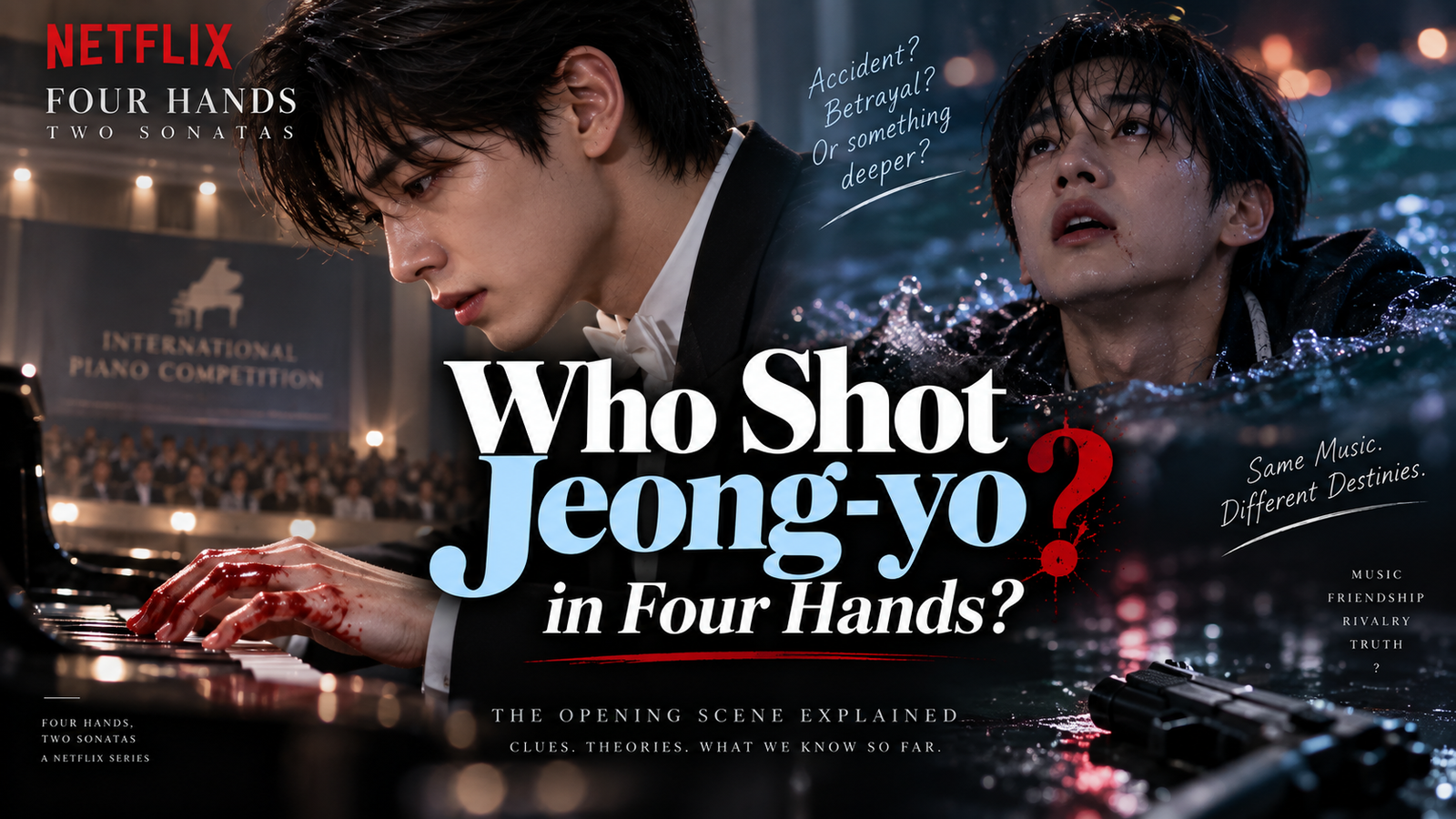
    What Happens in the Four Hands Opening Scene?

    The drama begins far away from the warm school friendship that follows.

    Pi-o is playing piano at a major competition.

    But something is terribly wrong.

    His fingers are bloodied as he continues playing.

    Meanwhile, Jeong-yo is caught in a violent situation elsewhere.

    A gun goes off.

    Jeong-yo is hit and falls into the water.

    The contrast is shocking.

    One friend is playing music while the other appears to be fighting for his life.

    A review of Episodes 1 and 2 describes the opening in essentially these terms: Pi-o plays with bloodied fingers while Jeong-yo is shot and falls into water.

    But the drama doesn’t immediately tell us who shot him or how the two boys reached this point.

    Instead, it takes us backward.

    And suddenly we meet two young musicians whose relationship looks very different.


    Why Show Jeong-yo Being Shot Before We Even Know Him?

    This may be the more interesting question.

    The opening doesn’t simply create suspense.

    It changes how we watch everything that follows.

    Netflix officially describes Pi-o and Jeong-yo as two contrasting pianists whose lives become intertwined through friendship, rivalry and growth. Pi-o has followed a disciplined path toward perfection, while Jeong-yo comes from a turbulent childhood and possesses a much rawer natural talent.

    When we watch them begin to understand each other, however, we already know something they don’t.

    Something terrible is coming.

    That knowledge changes even their happiest scenes.

    When they play together, we remember the opening.

    When they become closer, we remember the opening.

    When rivalry begins to appear, we wonder whether it somehow leads to the opening.

    The drama has effectively given the audience the destination while hiding the road.


    The Biggest Question Isn’t Only “Who Shot Jeong-yo?”

    There are actually several mysteries packed into that opening.

    Who shoots Jeong-yo?

    But also:

    Why is Jeong-yo in that situation?

    Why is Pi-o somewhere else playing piano?

    Why are Pi-o’s fingers bleeding?

    Does Pi-o know Jeong-yo is in danger?

    How much time has passed since their school days?

    And perhaps most importantly:

    What happens between these two friends before we return to this moment?

    That last question may ultimately matter more than the identity of the shooter.


    Does Jeong-yo Die in Four Hands?

    This is another question viewers are likely to ask after watching the opening.

    At this stage:

    Jeong-yo’s death has not been confirmed.

    We see an extremely dangerous situation and a fall into the water.

    But showing a character apparently facing death is not the same as confirming that character’s death.

    Until the drama explicitly reveals what happens afterward, it would be misleading to say that Jeong-yo dies.

    So for now:

    Shot? Yes.

    Falls into the water? Yes.

    Confirmed dead? No.

    That distinction is important.


    Is Pi-o Connected to Jeong-yo’s Shooting?

    This is where we have to be particularly careful.

    The editing deliberately connects the two men.

    Jeong-yo is in danger while Pi-o is performing.

    Pi-o’s bloody fingers make his own scene disturbing as well.

    But parallel editing does not prove that Pi-o caused what happened to Jeong-yo.

    There is currently no reason to turn a visual connection into a factual accusation.

    What we can say is that the drama clearly wants us to ask why these two events are happening at the same time.

    And because the series is built around their friendship and rivalry, the answer will almost certainly tell us something important about how their relationship develops.


    Could Their Rivalry Become That Dark?

    At first glance, that’s an obvious theory.

    Pi-o and Jeong-yo are both extraordinary pianists.

    One has spent years being shaped toward perfection.

    The other possesses an instinctive musical gift capable of disrupting that world.

    Netflix itself describes them as characters who repeatedly clash and challenge each other, pushing one another toward new artistic heights.

    So when the opening shows blood and violence, viewers naturally wonder:

    Does their rivalry eventually destroy their friendship?

    Maybe.

    But again, the drama hasn’t established that.

    And based on the episodes we’ve seen so far, reducing their relationship to simple hatred would miss much of what makes Four Hands interesting.

    Their relationship contains competition, but it also contains admiration.

    They challenge each other precisely because each recognizes something extraordinary in the other.

    That makes the eventual journey toward the shooting scene much harder to predict.


    The Opening Makes Every Happy Scene Feel Different

    This is one of the smartest things about the storytelling so far.

    Without the flash-forward, we could simply enjoy the story of two young pianists becoming friends.

    But we can’t completely do that.

    We have already seen the blood.

    We have already heard the gunshot.

    We have already seen Jeong-yo fall.

    So when Pi-o and Jeong-yo laugh together, practice together or begin understanding each other through music, there is an uncomfortable thought sitting underneath the scene:

    How does this become that?

    One early review made the same observation: the flash-forward places tension underneath the drama because viewers know that a darker moment is waiting somewhere ahead.

    That’s an effective narrative trick.

    The drama isn’t only making us care about their friendship.

    It is making us afraid of losing it.


    Pi-o’s Bloody Fingers May Be Just as Important as the Gunshot

    It’s easy to focus entirely on Jeong-yo because a gunshot is obviously more dramatic.

    But look at Pi-o.

    Why is he playing with injured, bloody fingers?

    For a pianist, hands aren’t simply another part of the body.

    They are connected to identity, career and expression.

    And Pi-o keeps playing.

    That image raises its own questions.

    Did something happen before he went on stage?

    Is he forcing himself through an injury?

    Does his condition have any connection to what is happening to Jeong-yo?

    Or are the two scenes connected primarily symbolically rather than literally?

    We don’t know yet.

    But the drama chose to place those images beside each other.

    That makes Pi-o’s hands another clue worth watching.


    Music and Violence Are Deliberately Colliding

    This may ultimately be the most important thing about the opening.

    Everything else about Four Hands teaches us to associate these characters with music.

    Jeong-yo hears music almost everywhere. An official preview even depicts ordinary school noises transforming into music in his mind, emphasizing his instinctive relationship with sound.

    Pi-o has spent his life pursuing perfection at the piano.

    Then the opening takes the thing that defines them—

    music—

    and places it beside blood, fear and violence.

    That contrast feels deliberate.

    The piano may eventually become more than the thing that brings them together.

    It may also become connected to ambition, sacrifice and pain.


    What We Know So Far

    As of Episode 3, here’s the safest way to understand the mystery:

    Confirmed: Jeong-yo is shown being shot and falling into water in the flash-forward.

    Confirmed: Pi-o is shown performing piano with bloodied fingers.

    Confirmed: The main story then moves back to an earlier period in their lives.

    Not confirmed: Who shot Jeong-yo.

    Not confirmed: Why Jeong-yo was shot.

    Not confirmed: Whether Jeong-yo dies.

    Not confirmed: Whether Pi-o has any direct connection to the shooting.

    Not confirmed: What caused Pi-o’s injured fingers.

    That’s where the mystery stands.

    Anything beyond that is currently a theory.


    My Theory: The Shooter May Not Be the Real Mystery

    I suspect the drama wants us to focus on the obvious question:

    “Who pulled the trigger?”

    But I don’t think that will necessarily be the most important revelation.

    Four Hands is fundamentally being presented as a story about two young musicians whose lives become intertwined through friendship, rivalry and growth.

    That suggests the emotional mystery may be bigger than the crime mystery.

    The question may eventually become:

    What happened to Pi-o and Jeong-yo between the day they became friends and the day one was bleeding at a piano while the other was bleeding in the water?

    Who fired the gun will give us one answer.

    How their friendship reached that moment may give us the real story.


    Why the Opening Scene Works So Well

    We already know where the road appears to lead.

    But we don’t know how they get there.

    That means every new friendship becomes a clue.

    Every rivalry becomes a clue.

    Every family conflict becomes a clue.

    Every decision involving their careers becomes a clue.

    Even the music may become a clue.

    The opening turns what initially appears to be a youth music drama into something with an underlying mystery.

    And that’s why the scene stays in your mind even when the story returns to classrooms, competitions and piano practice.


    So Who Shot Jeong-yo?

    For now, the only accurate answer is:

    Four Hands hasn’t revealed it yet.

    And we shouldn’t invent an answer before the drama gives us one.

    What we do know is that the shooting isn’t a random scene added simply for shock.

    The drama deliberately shows us Jeong-yo’s violent future alongside Pi-o’s bloodied performance before asking us to watch their relationship develop from the beginning.

    That makes the real mystery bigger than:

    Who shot Jeong-yo?

    It becomes:

    What happened to these two boys?

    And every episode brings us a little closer to finding out.


    Four Hands Shooting Scene FAQ

    Who shot Choi Jeong-yo in Four Hands?

    As of Episode 3, the identity of the shooter has not been revealed.

    Does Jeong-yo die?

    His death has not been confirmed. The opening shows him being shot and falling into water, but viewers have not yet been shown a definitive outcome.

    Why are Pi-o’s fingers bleeding?

    That has not yet been fully explained. The drama deliberately juxtaposes Pi-o’s bloodied piano performance with Jeong-yo’s violent situation.

    Is Pi-o responsible for Jeong-yo being shot?

    There is currently no confirmed evidence that Pi-o is responsible. The editing connects their situations, but that should not be mistaken for proof.

    When will the shooting scene be explained?

    The series has 12 episodes, but there is currently no confirmed episode in which the full circumstances of the flash-forward will be revealed. The article should therefore be updated as new episodes provide clues. The 12-episode format is reflected in current series listings and discussion information.
  • Is Four Hands a BL? Or Is Their Friendship So Deep It Looks Like Love?

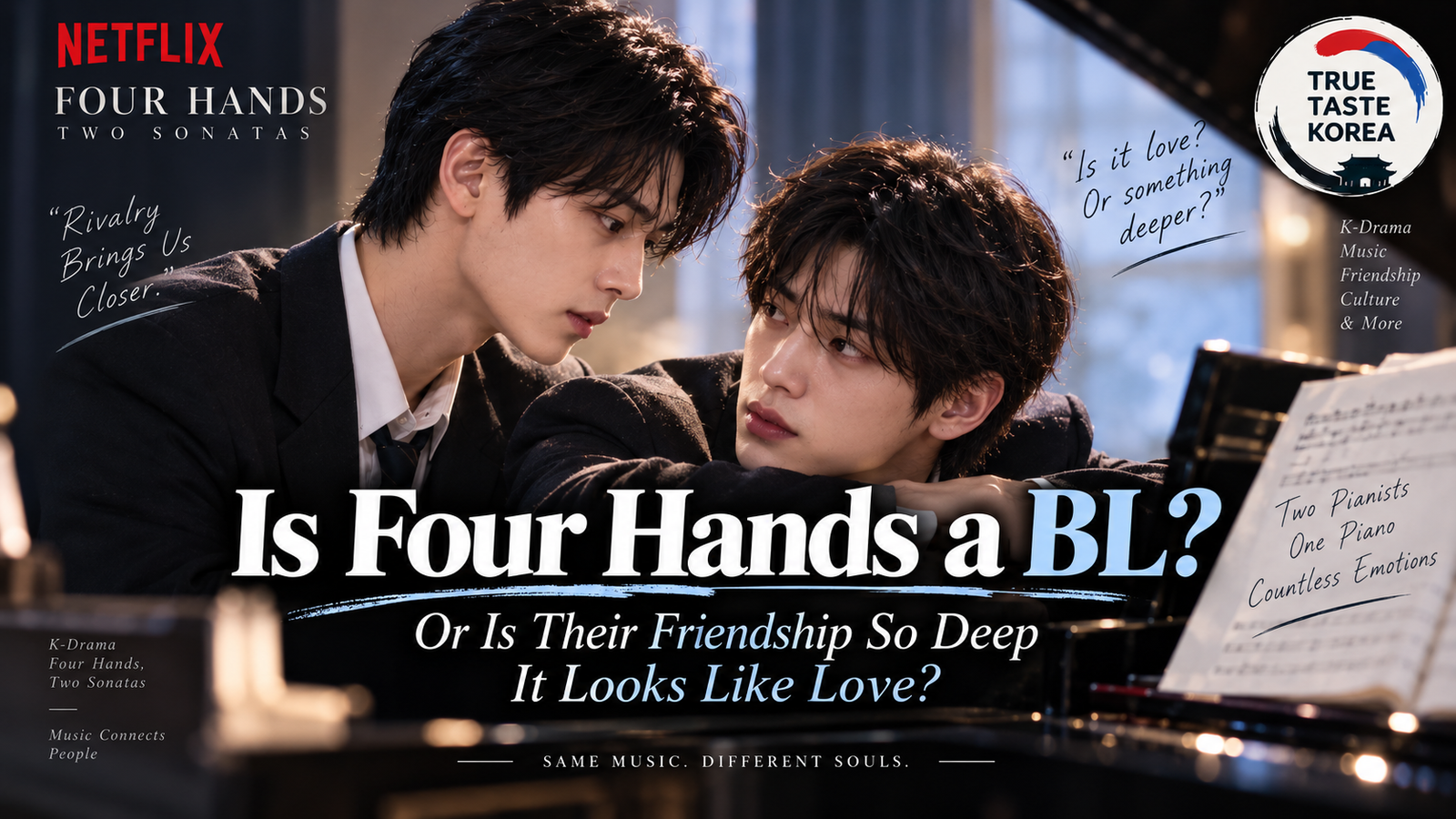
    Is Four Hands a BL? Or Is Their Friendship So Deep It Looks Like Love?

    Spoiler note: This article discusses the relationship between Kang Pi-o and Choi Jeong-yo through Episode 3 of Four Hands, Two Sonatas.

    If you’ve started watching Netflix’s Korean drama Four Hands, Two Sonatas, you may already have wondered:

    Is Four Hands a BL?

    It’s an understandable question.

    Song Kang’s Kang Pi-o and Lee Jun-young’s Choi Jeong-yo quickly develop an unusually intense connection. They compete, admire each other’s talent, play together, hurt each other, and seem capable of understanding parts of one another that other people cannot.

    But as of Episode 3, the answer is straightforward:

    No, Four Hands, Two Sonatas is not officially presented as a BL drama.

    Netflix describes the story around Pi-o and Jeong-yo in terms of friendship, rivalry and growth, while Korean promotional material describes their evolving relationship as friendship intertwined with musical competition.

    But after watching the first three episodes in Korea, I think there is a more interesting question than simply asking whether Four Hands is BL.

    Why can a friendship this deep sometimes look like love?

    And perhaps that confusion tells us something important about friendship itself.


    Is Four Hands, Two Sonatas Actually a BL?

    First, let’s separate official information from viewer interpretation.

    Four Hands, Two Sonatas has not been officially introduced as a Boys’ Love series.

    Netflix’s own description centers on two young pianists whose lives become intertwined through their passion for music as they navigate friendship, rivalry and personal growth.

    Korean promotional coverage similarly describes the drama as following the friendship, love, rivalry and growth of young people who meet at an arts high school and eventually become professional pianists.

    Most importantly, the relationship between Pi-o and Jeong-yo is repeatedly described as a friendship.

    So if you’re asking:

    “Are Kang Pi-o and Choi Jeong-yo officially a romantic couple?”

    At this point in the story, the answer is no.

    But that doesn’t make the question foolish.

    In fact, I think the reason viewers ask it is one of the most interesting things about the drama.


    Why Does Four Hands Sometimes Feel Like a BL?

    Pi-o and Jeong-yo aren’t ordinary classmates.

    Music immediately gives them a connection that other people struggle to enter.

    They are competitors.

    They are partners.

    They admire each other.

    They threaten each other.

    And increasingly, they become emotionally important to each other.

    The official teasers themselves emphasized how the two move from perfectly matched piano partners toward fierce rivals, with constant comparison beginning to damage their friendship.

    That produces emotional scenes we often associate with romance.

    There is admiration.

    There is jealousy.

    There is disappointment.

    There is dependence.

    There is the fear of losing someone.

    And there is pain when the other person begins to pull away.

    Put those emotions between two attractive young male leads with strong screen chemistry, and it’s not surprising that some viewers interpret the relationship through a romantic lens.

    But there is another possible interpretation.

    Maybe friendship can simply be that intense.


    Perhaps True Friendship and Love Have More in Common Than We Admit

    Watching Episode 3 made me think about this.

    We tend to describe friendship as though it should be easy.

    You meet someone.

    You like each other.

    You spend time together.

    You become friends.

    But truly deep friendship isn’t necessarily simple at all.

    It requires trust.

    Understanding.

    Compromise.

    Forgiveness.

    Sometimes sacrifice.

    And sometimes jealousy.

    You can be hurt because someone you care about doesn’t understand you.

    You can fear losing a friend.

    You can resent their success while simultaneously wanting them to succeed.

    You can desperately want their recognition.

    None of those emotions belongs exclusively to romantic love.

    Friendship can hurt precisely because friendship can matter so much.

    That’s why I think Pi-o and Jeong-yo’s relationship is more interesting if we don’t immediately force it into a romantic category.


    Pi-o and Jeong-yo Need Something From Each Other

    The two young pianists are fundamentally different.

    Pi-o has been shaped by discipline, relentless practice and enormous expectations.

    Jeong-yo arrives from a completely different life and approaches music with a raw, instinctive quality.

    Official character material deliberately emphasizes this contrast: Pi-o’s playing is described as precise and delicate, while Jeong-yo commands attention with explosive energy.

    That means their attraction to each other isn’t necessarily romantic.

    It can also be artistic.

    Each sees something in the other that he himself lacks.

    Pi-o encounters a pianist who challenges his understanding of talent.

    Jeong-yo encounters someone whose world and musical discipline are completely different from his own.

    They don’t simply want to defeat each other.

    They change each other.

    And that’s much more dangerous emotionally than ordinary competition.


    The Piano Makes Their Friendship Even More Intimate

    Even the title of the drama helps explain their relationship.

    Four hands is a piano term referring to two people playing one piano together.

    Think about what that requires.

    Two people sit beside each other.

    They play the same instrument.

    They must listen to one another.

    They must control timing together.

    One cannot simply ignore the other and perform independently.

    The drama even depicts the two naturally dividing responsibilities while performing together—one dealing with the pedals and the other with the sheet music—as their coordination develops.

    That makes four-hands piano an almost perfect metaphor for their relationship.

    Two individuals.

    One piano.

    Neither disappears into the other.

    Yet neither can create the performance alone.

    That’s friendship.

    And it’s also exactly why their relationship can feel unusually intimate on screen.


    Friendship Becomes Harder When Your Best Friend Is Also Your Rival

    Then Four Hands adds another complication.

    Imagine that the person who understands you best is also the person capable of taking away the thing you value most.

    That’s Pi-o and Jeong-yo.

    They share music.

    But music is also where they compete.

    The closer they become, the more dangerous comparison becomes.

    The drama’s promotional material explicitly foreshadowed this: outside comparisons begin putting pressure on their relationship until their previously warm friendship starts to fracture.

    That creates a painful contradiction.

    You want your friend to succeed.

    But what if his success makes you feel like a failure?

    You admire his talent.

    But what if everyone begins comparing his talent with yours?

    You want to remain beside him.

    But what if being beside him constantly reminds you of your own insecurity?

    Those aren’t specifically BL emotions.

    They’re painfully human emotions.


    Episode 3 Makes the Friendship Even More Complicated

    By Episode 3, the drama begins pushing that tension into the open.

    The relationship between Pi-o and Jeong-yo is no longer simply the warm story of two gifted students discovering that they enjoy playing together.

    Their competition and emotional frustrations begin colliding.

    Official previews for Episode 3 even showed their conflict escalating into a physical fight, with the surrounding students having to separate them.

    But what interests me isn’t simply that they fight.

    It’s why fighting with this particular person matters so much.

    Indifference doesn’t normally produce this kind of pain.

    We are most easily hurt by people whose opinions matter to us.

    And that may be one reason the relationship feels so emotionally charged.


    Is It Bromance, Then?

    “Bromance” is probably closer to the way many international viewers will describe Pi-o and Jeong-yo’s relationship at this stage.

    But even that word can sometimes make deep male friendship sound like a joke.

    Four Hands seems more serious about it.

    These aren’t simply two guys exchanging funny jokes and becoming buddies.

    Their friendship becomes tied to:

    identity, talent, ambition, insecurity and self-worth.

    The other person becomes a mirror.

    Pi-o sees himself differently because Jeong-yo exists.

    Jeong-yo’s understanding of himself also changes because Pi-o exists.

    That is a powerful relationship regardless of whether romance is involved.


    Why Are Viewers Asking “Is Four Hands a BL?”

    There is another important reason this question matters.

    People are actually searching for it.

    English-language sites have already begun publishing articles specifically answering “Is Four Hands, Two Sonatas a BL?”, which suggests that the ambiguity viewers perceive isn’t limited to one audience.

    And I can understand why.

    If viewers see two male characters:

    • intensely focused on one another,
    • emotionally affected by one another,
    • jealous or hurt because of one another,
    • sharing an intimate artistic connection,
    • and becoming central to each other’s lives,

    modern audiences may naturally ask whether romance is coming.

    But perhaps Four Hands offers another possibility.


    Maybe We Underestimate Friendship

    This is what I find most interesting about the BL question.

    Perhaps the confusion isn’t only about Four Hands.

    Maybe it also says something about how we think about friendship.

    Why do we sometimes find it difficult to believe that two people can love each other deeply without that love being romantic?

    Friendship is also a form of love.

    A different form, certainly.

    But genuine friendship can demand enormous emotional investment.

    A real friend can change the direction of your life.

    A friend can recognize something inside you before you recognize it yourself.

    A friend’s success can inspire you.

    It can also make you jealous.

    A friend’s rejection can hurt.

    And losing a friendship can sometimes hurt as much as losing a romantic relationship.

    Perhaps true friendship is sometimes confused with romance because we underestimate how powerful friendship can actually be.


    Two Pianists, One Piano — And a Difficult Friendship

    That’s why the title Four Hands, Two Sonatas increasingly feels meaningful to me beyond its musical definition.

    Pi-o and Jeong-yo are different people.

    Different personalities.

    Different backgrounds.

    Different pianists.

    They cannot become one person.

    Nor should they.

    But for four-hands piano to work, they must somehow learn to occupy the same musical space.

    Maybe friendship works the same way.

    You don’t become identical.

    You don’t surrender your own identity.

    You learn when to lead.

    When to listen.

    When to give space.

    When to follow.

    And sometimes you get the timing wrong.


    So, Is Four Hands a BL?

    Based on the series’ official presentation and the story through Episode 3: no, Four Hands, Two Sonatas is not officially a BL drama.

    Netflix presents Pi-o and Jeong-yo’s central relationship through friendship, rivalry and growth rather than a confirmed romance.

    But simply answering “no” misses what makes the question interesting.

    Because Four Hands is showing us a relationship powerful enough that some viewers may mistake its emotional intensity for romantic love.

    And perhaps that is part of what makes the story moving.

    True friendship can be difficult.

    It can involve jealousy.

    It can involve sacrifice.

    It can hurt.

    And it can transform your life.

    So maybe the most interesting question Four Hands asks isn’t:

    Are Pi-o and Jeong-yo in love?

    Maybe it’s:

    Why do we sometimes struggle to believe that friendship alone can be this intense?

    And as the drama continues, that may become one of the most interesting relationships to watch.


    FAQ

    Is Four Hands, Two Sonatas a BL drama?

    No. As of Episode 3, the series is not officially presented as a Boys’ Love drama. Netflix describes the central story around friendship, rivalry and growth.

    Are Kang Pi-o and Choi Jeong-yo a couple?

    As of Episode 3, they have not been established as a romantic couple. Their relationship is presented as an intense friendship and musical rivalry.

    Why do people think Four Hands is BL?

    The two male leads share an unusually intense emotional and musical bond. Their admiration, rivalry, jealousy, dependence and strong chemistry can make some viewers interpret their relationship romantically.

    What does “Four Hands” mean?

    In piano music, four hands refers to two pianists playing the same piano together.

    Is Four Hands about romance or friendship?

    The broader drama includes friendship, love, rivalry and growth, but the central Pi-o/Jeong-yo relationship is currently officially framed around friendship and rivalry.

  • Four Hands Taught Me Why Great Pianists Never Sound the Same

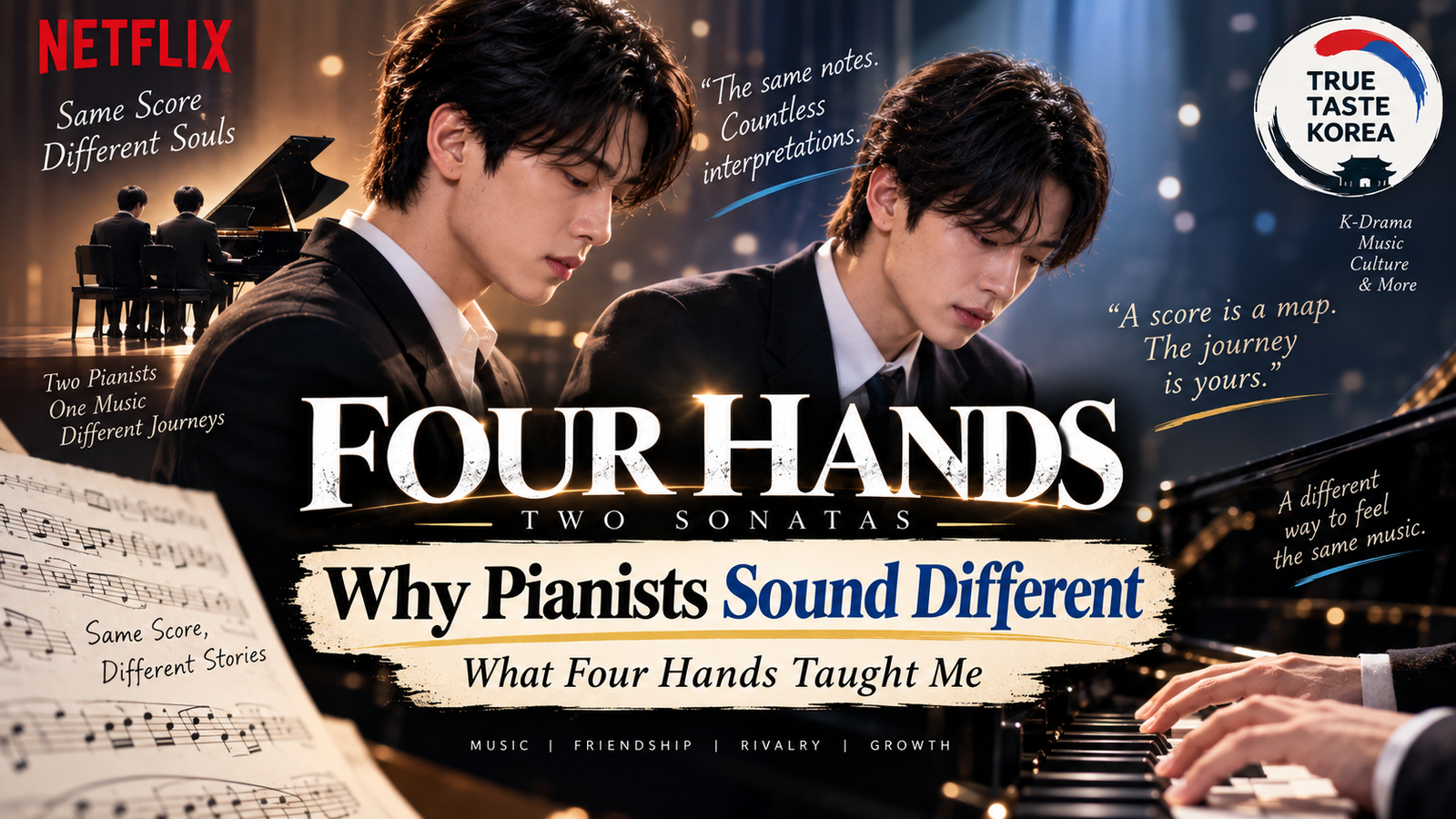
    Four Hands Taught Me Why Great Pianists Never Sound the Same

    Before watching Four Hands, Two Sonatas, I had a very simple idea of what a great pianist was.

    I thought pianists were, in a sense, highly sophisticated machines.

    The composer writes the music. The notes are printed on the score. The pianist reads those notes and plays them as accurately as possible.

    So I assumed that if two world-class pianists played the same piece correctly, their performances should sound more or less the same.

    Four Hands made me realize how wrong that idea was.

    And I suspect I am not the only non-musician who thought this way.

    The drama taught me something surprisingly profound about classical music:

    A musical score is not the music itself. It is more like a map.

    The map may be the same.

    But every great pianist takes a different journey through it.


    I Thought Playing Piano Was About Following the Score

    For someone without professional musical training, the logic seems obvious.

    A score tells the pianist which notes to play.

    It contains rhythm, tempo markings, dynamics and instructions from the composer.

    So what is left for the pianist to decide?

    A great deal, as it turns out.

    That realization is one of the most fascinating ideas presented in Four Hands.

    The drama repeatedly shows that musical ability cannot be measured simply by asking:

    “Did he play the correct notes?”

    A pianist can play every note correctly and still produce a performance that feels completely different from another pianist playing exactly the same score.

    That was something I had never really understood before watching the drama.


    The Score Is a Map, Not a Set of GPS Instructions

    The best way I can describe what Four Hands taught me is this:

    Imagine giving two travelers the same map.

    The starting point is identical.

    The destination is identical.

    The roads printed on the map are identical.

    But that does not mean their journeys will be identical.

    One person may move quickly through one section and slow down somewhere else.

    Another may stop and notice something the first traveler barely saw.

    One may see several landmarks as part of a single landscape.

    Another may focus on each landmark individually.

    The map hasn’t changed.

    Their interpretation of the journey has.

    A musical score can work in a similar way.

    And this is where Four Hands begins to explain why a truly exceptional pianist is not simply someone capable of following instructions.


    The Same Notes Can Become Different Music

    One of the ideas that fascinated me most in the drama was how differently notes can be grouped and expressed.

    A pianist doesn’t necessarily experience music as:

    note → note → note → note.

    Several notes can be understood and expressed as one musical phrase — one larger emotional unit.

    Another pianist may take a similar passage and give individual notes greater separation.

    Neither necessarily needs to change the written notes.

    What changes is how those notes are understood and communicated.

    This was a revelation to me.

    It means that the pianist isn’t merely asking:

    “Which note comes next?”

    The pianist is also asking:

    “What does this entire passage mean?”

    That is a completely different way of understanding performance.


    Tempo Is Not Just About Playing Fast or Slow

    Four Hands also made me notice something else I had previously overlooked.

    Speed itself can be expressive.

    To an ordinary listener, tempo might seem like another instruction:

    Play this piece at this speed.

    But a performance breathes.

    A pianist may push forward through one phrase, create tension, then allow another passage more space.

    Even subtle differences in timing can change how the listener experiences the music.

    A phrase can feel impatient.

    Another can feel hesitant.

    Another can sound confident.

    Another can sound almost as though it is asking a question.

    The notes themselves haven’t necessarily changed.

    The interpretation has.


    Why Choi Jeong-yo’s Talent Matters So Much

    This is also why I think the drama’s portrayal of Choi Jeong-yo, played by Lee Jun-young, is particularly interesting.

    It would have been easy for the writers simply to tell us:

    “Jeong-yo is a genius.”

    Many dramas do exactly that.

    They introduce a gifted character, have everyone around him repeatedly call him a genius, and expect the audience to accept it.

    Four Hands attempts something more interesting.

    It gradually gives the viewer a language for understanding why his musical ability is special.

    His talent isn’t meaningful simply because he can press difficult keys quickly or reproduce complicated music without making mistakes.

    What matters is how he understands the music.

    And as other characters begin to recognize something unusual in his interpretation, the audience begins learning how to recognize it too.

    That distinction is important.


    The Audience Learns Along With the Characters

    This may be one of the smartest aspects of Four Hands.

    At the beginning, many viewers probably listen to piano much like I did.

    We hear a difficult performance and think:

    “Wow. He can play really fast.”

    Or:

    “He didn’t make any mistakes. He must be brilliant.”

    But the drama gradually gives us other things to listen for.

    Why did he slow down there?

    Why did those notes feel like one large phrase?

    Why did the other pianist separate them?

    Why did one interpretation feel restrained while another felt emotional?

    Why can two performances of the same composition leave completely different impressions?

    Suddenly, the viewer isn’t merely watching characters talk about classical music.

    The viewer is learning how to listen.

    That is what surprised me most.


    Pi-o and Jeong-yo Don’t Just Compete — They Hear Music Differently

    This also changes how I see the relationship between Kang Pi-o and Choi Jeong-yo.

    On the surface, Four Hands can look like the familiar story of two geniuses competing to determine who is better.

    But if music can have countless interpretations, the question “Who is better?” becomes much more complicated.

    Pi-o and Jeong-yo don’t simply have different levels of skill.

    They have different experiences.

    Different personalities.

    Different emotions.

    Different lives.

    And all of those things can influence how a musician understands what is written on the page.

    That makes their rivalry much more interesting.

    They aren’t simply racing along the same road to see who reaches the finish line first.

    They may be reading the same map and seeing completely different landscapes.


    Why Can Great Pianists Sound Different Playing the Same Piece?

    This is the question Four Hands ultimately made me ask.

    If the score is identical, where does the difference come from?

    There are many elements of musical interpretation, including:

    Tempo — how quickly the music moves and how that pace changes.

    Phrasing — how individual notes are shaped into larger musical ideas.

    Dynamics — how softly or powerfully different passages are expressed.

    Articulation — whether notes feel connected, separated, sharp, delicate or flowing.

    Pedaling — how sounds are sustained and blended.

    Timing — tiny variations in when notes and phrases arrive.

    And beyond all of these technical concepts is something much harder to measure:

    the musician’s interpretation.

    Two pianists can look at the same score and understand its emotional meaning differently.

    That is why great performers can make familiar compositions feel new.


    The Composer Writes the Music — But the Pianist Gives It a Voice

    This changed another assumption I had.

    I used to think almost all of the creativity belonged to the composer.

    The composer creates.

    The pianist reproduces.

    Now I understand that relationship differently.

    The composer certainly creates the work.

    But a written score cannot physically make sound.

    Someone must transform those symbols into an experience that another human being can hear.

    That requires choices.

    And those choices are part of interpretation.

    A great pianist therefore occupies a fascinating position.

    The pianist must respect what the composer wrote without becoming merely a machine reproducing instructions.

    Too little interpretation, and the music can feel lifeless.

    Too much disregard for the score, and the performer may lose what the composer intended.

    The art exists somewhere between those two extremes.


    Now I Understand Why People Compare Different Recordings

    Before Four Hands, I never completely understood why classical music lovers might own or listen to several recordings of the same composition.

    If it is the same Beethoven sonata, why listen to five pianists play it?

    Shouldn’t one excellent recording be enough?

    Now the answer seems obvious.

    Because they aren’t really the same performance.

    The notes may come from the same score, but the experience can be completely different.

    One pianist may make a passage sound intimate.

    Another may make it monumental.

    One interpretation might emphasize tension.

    Another might reveal sadness.

    Another might find beauty somewhere I never noticed before.

    That means listening to different pianists isn’t simply hearing the same music repeatedly.

    It can be like hearing different interpretations of the same story.


    Four Hands Made Classical Music Easier to Understand

    I think this may be one reason Four Hands has connected so strongly with viewers in Korea.

    You don’t need to be a pianist to understand competition.

    You don’t need to study classical music to understand insecurity, friendship, pride, jealousy or the desire to be recognized.

    The drama uses those emotions to bring the viewer inside a world that might otherwise feel intimidating.

    And somewhere along the way, viewers like me begin learning about music almost without realizing it.

    I started watching a drama about talented young pianists.

    I ended up changing the way I think about piano performance itself.


    A Score Is Only a Map

    If I had to reduce what Four Hands taught me to one idea, it would be this:

    A score is a map.

    The composer draws the map.

    The notes establish the landscape.

    But the performer still has to travel through it.

    One pianist may rush toward something another approaches carefully.

    One may connect several notes into a single thought.

    Another may reveal the individual pieces hidden inside that thought.

    One may find sorrow where another finds hope.

    The map remains the same.

    The journey does not.

    And perhaps that is why we still need great performers even when the music they play was written hundreds of years ago.

    They aren’t simply repeating old notes.

    They are showing us another way to travel through them.


    Four Hands and Piano Interpretation FAQ

    Why do pianists sound different when playing the same piece?

    Because a musical score leaves room for interpretation. Pianists can differ in phrasing, timing, dynamics, articulation, pedaling and their overall understanding of the composition.

    Do classical pianists have to follow the score exactly?

    The written score provides the essential musical structure and the composer’s instructions, but interpretation remains a fundamental part of performance. The goal isn’t simply to reproduce notes mechanically.

    What does phrasing mean in piano playing?

    Phrasing is one way musicians organize individual notes into larger musical ideas. Rather than hearing every note as an isolated event, a pianist can shape groups of notes into something resembling a musical sentence.

    Why is Choi Jeong-yo considered talented in Four Hands?

    The drama portrays Jeong-yo’s ability as going beyond technical accuracy. An important part of his musical identity is the way he understands and interprets what he plays.

    What does the title Four Hands mean?

    In piano music, four hands generally refers to two pianists playing together on one piano. In the drama, the idea also works beautifully as a metaphor for two very different musicians learning to share the same musical world.

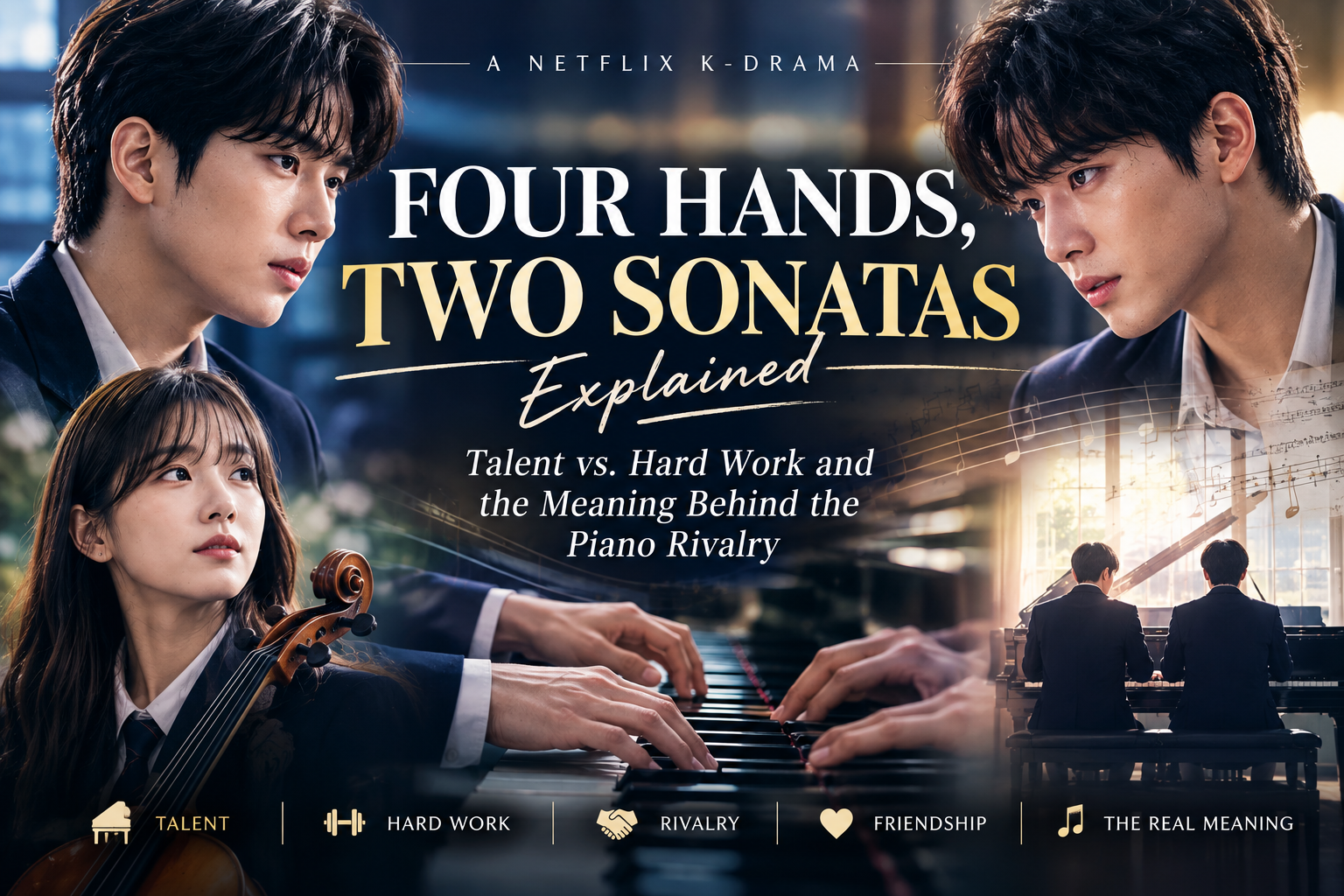
  • Four Hands, Two Sonatas Explained: Talent vs. Hard Work and the Meaning Behind the Piano Rivalry

    Four Hands, Two Sonatas Explained: Talent vs. Hard Work and the Meaning Behind the Piano Rivalry

    When I first wrote about Four Hands, Two Sonatas, I focused on a simple question:

    Why could this Korean drama connect with international viewers?

    But after watching the story more closely, I realized that there is another, much more interesting question.

    What is Four Hands, Two Sonatas actually trying to say?

    On the surface, it is a coming-of-age drama about two gifted young pianists at an elite Korean arts high school.

    Look deeper, however, and the drama becomes a story about something almost everyone has experienced:

    What happens when someone who has worked his entire life to become the best suddenly meets someone who seems to possess naturally what he has spent years trying to perfect?

    That is the conflict between Kang Pi-o, played by Song Kang, and Choi Jeong-yo, played by Lee Jun-young.

    One has discipline, education, technique and an environment built around music.

    The other has lived a far more difficult life and has been forced away from the piano, yet possesses an instinctive musical talent that cannot easily be taught.

    One represents perfection.

    The other represents freedom.

    And somewhere between them lies the real meaning of Four Hands, Two Sonatas.

    This is not simply a drama about deciding which pianist is better.

    It is a story about why neither of them may be complete without the other.

    Two Geniuses — But Two Completely Different Kinds of Genius

    One of the smartest decisions in Four Hands, Two Sonatas is that it does not create a simple relationship between a genius and an ordinary rival.

    Both young men are gifted.

    That makes their conflict much more interesting.

    Kang Pi-o has been walking toward musical excellence for most of his life.

    Choi Jeong-yo, meanwhile, possesses extraordinary talent but has spent much of his life unable—or unwilling—to pursue it.

    Netflix describes Pi-o as an elite pianist who has followed a steady path toward perfection, while Jeong-yo is portrayed as a late-blooming, raw and free-spirited talent whose difficult childhood interrupted his musical journey.

    That difference creates the central question of the drama:

    What exactly makes a great musician?

    Is it thousands of hours of disciplined practice?

    Is it perfect technique?

    Is it natural talent?

    Is it emotion?

    Or does true greatness require all of them?

    Pi-o and Jeong-yo appear to represent different answers.

    But I don’t think the drama ultimately wants us to choose only one.


    Kang Pi-o: The Genius Who Has Spent His Life Proving Himself

    At first glance, Kang Pi-o seems to have everything.

    He comes from an influential musical family.

    He receives elite training.

    He excels academically.

    He wins competitions.

    His piano technique is exceptional.

    He is exactly the kind of student people imagine when they hear the words “Korean elite education.”

    Yet Pi-o may actually be one of the least free characters in the story.

    Why?

    Because almost everything he does carries an invisible question:

    “Am I good enough?”

    Song Kang himself described piano as both Pi-o’s way of communicating with the world and something through which he constantly has to prove himself.

    That distinction matters.

    For some people, music is freedom.

    For Pi-o, music has also become judgment.

    Every performance can become a test.

    Every competition produces another ranking.

    Every mistake becomes evidence that perfection has not yet been reached.

    And every success simply creates the expectation that he must succeed again.


    The Problem With Being Number One

    Being first sounds like the safest position.

    In reality, it can be the most frightening.

    If you are second, you can chase first place.

    If you are first, there is only one direction you can fall.

    Pi-o has built much of his identity around excellence.

    That means Jeong-yo’s arrival threatens more than his position at school.

    It threatens Pi-o’s understanding of himself.

    Imagine spending years practicing, sacrificing and refining every detail of your technique.

    Then someone enters your world who has not followed the same path.

    His technique may be less polished.

    His education may be incomplete.

    Yet when he plays, people stop and listen.

    How would that feel?

    This is where Four Hands, Two Sonatas becomes more than a school rivalry drama.

    Jeong-yo represents a question Pi-o cannot solve simply by practicing longer.


    The Grandfather Behind Pi-o’s Perfectionism

    Pi-o’s pressure does not come only from school.

    It is deeply connected to his family.

    His grandfather, Kang Seung-woon, is a world-renowned conductor and an uncompromising perfectionist.

    Official character material describes him as someone who demands absolute excellence even from his own family. His attitude leaves Pi-o longing for his recognition.

    This helps explain something important about Pi-o.

    His obsession with becoming better is not merely ambition.

    Part of it is emotional.

    Winning becomes connected to recognition.

    Technique becomes connected to approval.

    Music becomes connected to love.

    That is a dangerous combination.

    Because if your value depends on being exceptional, what happens when another exceptional person appears?

    Jeong-yo doesn’t simply challenge Pi-o musically.

    He touches the deepest insecurity Pi-o has carried for years.


    Choi Jeong-yo: The Genius Who Was Forced Away From His Gift

    Jeong-yo’s story is almost the reverse.

    If Pi-o grew up surrounded by music, Jeong-yo grew up surrounded by problems that made music difficult to pursue.

    According to Lee Jun-young’s character interview, Jeong-yo lost his mother at a young age and had to care for his alcoholic father, becoming the family’s breadwinner while still young.

    He loved the piano, but reality forced him to keep his dream at a distance.

    This creates a very different relationship with music.

    For Pi-o, piano can feel like an obligation.

    For Jeong-yo, piano is something he has lost.

    That difference is enormous.

    Pi-o sometimes needs freedom from the piano.

    Jeong-yo needs the freedom to return to it.


    Why “Freedom” Is the Perfect Word for Jeong-yo

    Lee Jun-young chose one word to describe Jeong-yo:

    Freedom.

    He explained that Jeong-yo does not naturally want to live inside a predetermined mold.

    That personality is reflected in his music.

    Jeong-yo has not been shaped by the same institutional system as Pi-o.

    He therefore lacks some of Pi-o’s polish—but he also lacks some of his restraints.

    He can play from instinct.

    From emotion.

    From memory.

    From pain.

    And perhaps that is precisely why Pi-o finds him so disturbing.

    Jeong-yo represents something Pi-o cannot easily acquire through another thousand hours of practice:

    freedom of expression.


    Talent vs. Hard Work Is Actually the Wrong Question

    Many viewers will naturally ask:

    Who is the real genius—Pi-o or Jeong-yo?

    But I think that question misses the point.

    Pi-o is talented too.

    Jeong-yo must work too.

    The drama isn’t really saying:

    One succeeds through effort while the other succeeds through talent.

    The more interesting contrast is this:

    Pi-o has learned how to control music.

    Jeong-yo has learned how to feel it.

    Pi-o needs some of Jeong-yo’s freedom.

    Jeong-yo needs some of Pi-o’s discipline.

    And that is why their rivalry is necessary.

    Each man possesses something the other lacks.


    Jeong-yo Is Not Simply Pi-o’s Enemy

    This is where I think Four Hands, Two Sonatas becomes particularly interesting.

    In an ordinary rivalry story, Jeong-yo would exist to defeat Pi-o.

    But here, his greater role may be to change Pi-o.

    And Pi-o may ultimately do the same for him.

    Jeong-yo forces Pi-o to hear music differently.

    Pi-o forces Jeong-yo to confront the talent and dream he tried to abandon.

    They threaten each other.

    But they also awaken each other.

    That is a much more interesting relationship than simply asking who wins a competition.


    Why the Title “Four Hands” Is the Key to Understanding the Drama

    The title practically tells us what the drama is about.

    In piano terminology, four hands means two pianists playing one piano together.

    Two people.

    One instrument.

    Four hands.

    But think about what that requires.

    You cannot simply play whatever you want.

    You have to listen to the other person.

    You have to understand their timing.

    You have to control your own ego.

    Sometimes you lead.

    Sometimes you follow.

    Sometimes you must create space for the other musician.

    The goal is no longer:

    “I must sound better than you.”

    The goal becomes:

    “We must create one piece of music together.”

    That is why the title is so clever.


    From Competition to Cooperation

    Director Park Hyun-suk explained that the title relates to the journey of two friends moving together toward musical completion.

    That changes how we should view the rivalry.

    The rivalry isn’t necessarily the destination.

    It is the beginning.

    At first, the two musicians compare themselves.

    Who is better?

    Who has more talent?

    Who deserves recognition?

    But four-hands performance demands an entirely different question:

    Can I understand the person sitting beside me?

    And perhaps that is the deeper coming-of-age story.

    Growing up means discovering that life isn’t always a solo performance.


    Two Sonatas May Also Describe Two Lives

    The English title adds another interesting phrase:

    Two Sonatas.

    I read this less literally and more symbolically.

    Pi-o and Jeong-yo are like two separate musical compositions.

    Each has his own rhythm.

    His own history.

    His own pain.

    His own tempo.

    Their lives do not begin in the same place.

    Yet the drama gradually places those two lives beside each other.

    Four hands.

    Two sonatas.

    One piano.

    It is a beautiful metaphor for friendship.

    You don’t need to become the same person to create harmony with someone else.


    Hong Jae-in Is More Important Than a Typical Love-Triangle Character

    Hong Jae-in, played by Jang Gyuri, could easily have been written simply as the woman positioned between two talented men.

    But her musical identity makes her much more interesting.

    Jae-in is not a pianist.

    She is a violist.

    And official character material confirms something particularly important:

    She has perfect pitch.

    She can accurately distinguish individual notes by ear and is among the first people capable of recognizing the extraordinary talent of both Pi-o and Jeong-yo.

    That makes her role symbolically interesting.

    Pi-o and Jeong-yo are busy competing.

    Jae-in is listening.


    Jae-in Represents the Listener

    Music doesn’t exist only between performer and instrument.

    It also exists between performer and listener.

    Jae-in can hear something in both young men that they may not yet fully understand about themselves.

    She knows Pi-o’s excellence.

    But she can also immediately recognize Jeong-yo’s unusual talent.

    In that sense, she becomes a third perspective on their rivalry.

    Pi-o asks:

    “Am I better?”

    Jeong-yo may ask:

    “Do I even belong in this world?”

    Jae-in can hear that both questions are incomplete.

    Both musicians have something worth hearing.

    Jang Gyuri has described music as essentially Jae-in’s entire life and said that her character sees music as both a dream and a source of comfort.

    That makes her much more than a romantic device.

    She is part of the drama’s argument about what music means.


    The Adults Are Creating the Competition Too

    Another layer becomes visible when we look beyond the three young characters.

    The rivalry doesn’t exist in isolation.

    Adults surround them.

    Parents.

    Grandparents.

    Teachers.

    School administrators.

    People who recognize talent—and people who want to shape it.

    Pi-o’s mother has devoted herself to supporting her son’s career, but official character descriptions indicate that Jeong-yo’s appearance creates anxiety because she wants Pi-o to remain the best.

    Meanwhile, school chairwoman Yoon Sun-joo recognizes Jeong-yo’s potential and supports him, although her motives are not entirely simple.

    And pianist Do Hyun-soo becomes a teacher to both young men.

    His task is fascinating:

    Not to make them identical, but to help two opposite musicians strengthen their weaknesses and discover their own musical identities.

    That may be one of the drama’s most important ideas.

    A good teacher does not manufacture copies.

    A good teacher helps different talents become themselves.


    Four Hands Is Also a Story About Korean Competition

    Watching this drama in Korea, I find another layer difficult to ignore.

    Competition is deeply familiar in Korean society.

    Students compete for universities.

    Workers compete for jobs.

    Athletes compete for limited professional positions.

    Artists compete for auditions and recognition.

    And when someone grows up inside a highly competitive system, success can easily become part of personal identity.

    Pi-o fits naturally into that world.

    He has learned to win.

    But the drama asks a more uncomfortable question:

    What happens after you become number one?

    Does being first automatically make you fulfilled?

    Can someone technically perfect still feel incomplete?

    Those questions extend far beyond piano.


    Why Classical Music Works So Well for This Story

    Classical music might initially seem like a difficult subject for a mainstream K-drama.

    But it is actually ideal.

    There are no lyrics telling us exactly what to feel.

    The same composition can sound different depending on who performs it.

    Jang Gyuri made a similar observation while preparing for her role: because classical music has no lyrics, its expression can change according to the performer’s condition and emotional state. She compared that quality to acting.

    That observation could almost describe the entire drama.

    Pi-o and Jeong-yo can look at the same sheet music.

    The notes are identical.

    But the music is not.

    Because the person playing those notes is different.


    The Actors Had to Learn the Language of Their Characters

    Another reason the musical scenes matter is that the actors did significant preparation.

    Song Kang said he began piano lessons months before filming.

    Lee Jun-young, who did not already play piano, said he memorized entire pieces and relied on detailed direction while preparing his performance scenes.

    Jang Gyuri practiced viola, listened extensively to classical music and attended performances to develop her musical sensitivity.

    That matters because hands are difficult to fake in a music drama.

    A viewer may not be a professional pianist, but awkward movement can immediately break the illusion.

    The actors weren’t simply learning dialogue.

    They had to learn enough of their characters’ physical language to make us believe that music had shaped their lives.


    Pi-o and Jeong-yo Are More Similar Than They First Appear

    This may ultimately be the most important point.

    They look like opposites.

    Rich and poor.

    Structured and free.

    Polished and raw.

    Disciplined and instinctive.

    But underneath those differences, they share something.

    Both have been hurt by circumstances they did not choose.

    Pi-o carries the burden of expectation and approval.

    Jeong-yo carries the burden of hardship and responsibility.

    Pi-o has had access to the piano but struggles to become emotionally free.

    Jeong-yo has emotional freedom in his playing but has struggled to gain access to the life of a pianist.

    Each is trapped in a different way.

    That is why they can eventually understand each other.


    The Rival You Hate May Be the Person You Need Most

    This is perhaps the most universal idea in Four Hands, Two Sonatas.

    Sometimes the person who irritates us most is the person exposing something we lack.

    Pi-o looks at Jeong-yo and sees freedom.

    Jeong-yo looks at Pi-o and sees the life of a musician he might have had.

    That can produce jealousy.

    Anger.

    Competition.

    But it can also produce growth.

    A weak rival merely tries to defeat you.

    A great rival changes you.

    And the best rival may eventually become the person capable of playing beside you.


    So Who Is the Real Genius?

    If you came here looking for my answer, here it is:

    Both of them.

    But neither represents complete musical genius alone.

    Pi-o shows us the power of discipline, technique and relentless work.

    Jeong-yo shows us the power of instinct, emotion and freedom.

    The interesting question isn’t:

    Pi-o vs. Jeong-yo — who wins?

    It is:

    What happens when each begins learning what the other already knows?

    That is the story I want to keep watching.


    The Deeper Meaning of Four Hands, Two Sonatas

    For me, the title can ultimately be reduced to one idea:

    You can become excellent alone. But some forms of greatness require another person.

    Pi-o has spent his life becoming a brilliant soloist.

    Jeong-yo has survived by relying heavily on himself.

    Neither is naturally prepared to surrender space to someone else.

    Yet four hands cannot work without trust.

    You have to listen.

    You have to adjust.

    You have to share the keyboard.

    You have to accept that the final music belongs neither entirely to you nor entirely to the person beside you.

    It belongs to both.

    And perhaps that is why a drama about classical piano can become a drama about growing up.

    Because adulthood also requires learning that the world is not a solo performance.

    Sometimes the person sitting next to you isn’t there to take your place.

    Sometimes that person is there to help you play something you could never play alone.

    That, more than the competitions or rankings, may be the real meaning of Four Hands, Two Sonatas.


    Read My First Four Hands, Two Sonatas Review

    If you’re new to the drama, start with my first article, where I explain the story, introduce the main characters, and discuss why I believe Four Hands, Two Sonatas could connect strongly with international K-drama viewers.

    👉 Four Hands, Two Sonatas: Why This K-Drama Could Be a Global Hit


    Official & Further Reading

    For more information about the drama and its cast, these sources offer useful background:

    Netflix – Four Hands, Two Sonatas
    Watch the series and find official information about the drama on Netflix.

    Song Kang on Playing Kang Pi-o
    Read more about Song Kang’s interpretation of Pi-o and why he chose the music-centered drama.

    Lee Jun-young on Playing Choi Jeong-yo
    Learn more about Jeong-yo’s difficult childhood, relationship with the piano, and Lee Jun-young’s approach to the character.


  • 『Four Hands, Two Sonatas』は面白い?ソン・ガン×イ・ジュニョン、音楽で描く新しい韓国ドラマ

    『Four Hands, Two Sonatas』は面白い?ソン・ガン×イ・ジュニョン、音楽で描く新しい韓国ドラマ

    世界でヒットする韓国ドラマといえば、何を思い浮かべるでしょうか。

    ゾンビ、復讐、犯罪、サバイバル、そして次の展開が気になって止められなくなる強烈なストーリー。

    もちろん、それこそがKドラマの大きな魅力の一つです。

    しかし、Netflixの韓国ドラマ**『Four Hands, Two Sonatas(フォーハンズ)』**は少し違います。

    物語の中心にあるのは銃でも復讐でもありません。

    一台のピアノと、二人の若いピアニストです。

    私は韓国でこのドラマを実際に見始めましたが、最初に感じたのは「音楽と青春を描いた作品なのに、思った以上に面白い」ということでした。

    友情、競争、才能、努力、嫉妬、プレッシャー、そして成長。

    静かなクラシック音楽の世界を舞台にしながら、人間同士がぶつかるドラマとして十分な力があります。

    だから私は、この作品が韓国だけではなく海外の視聴者にも届く可能性があると思っています。

    『Four Hands, Two Sonatas』とは?

    『Four Hands, Two Sonatas』の舞台は、才能ある若者たちが集まる韓国の名門芸術高校です。

    物語の中心となるのは、二人のピアノ専攻生。

    **カン・ピオ(ソン・ガン)とチェ・ジョンヨ(イ・ジュニョン)**です。

    二人とも音楽的な才能を持っています。

    しかし、その才能の形も、生きてきた環境も、ピアノに向き合う方法もまったく違います。

    そして、その違いこそがこのドラマを面白くしています。

    「Four Hands」というタイトルの意味

    この作品を見る前に知っておくと面白い言葉があります。

    それが**Four Hands(フォーハンズ)**です。

    ピアノの世界では、一台のピアノを二人の演奏者が一緒に弾くスタイルを「four hands」と呼びます。

    二人で一台のピアノ。

    つまり四本の手で、一つの音楽を完成させます。

    このタイトルは単なる音楽用語ではありません。

    性格も環境も演奏スタイルも異なる二人が、競い合い、衝突し、やがて互いから何かを学んでいく。

    一人では完成できなかった音楽を、二人だからこそ完成させていく。

    そこに、このタイトルの象徴的な意味があります。

    ソン・ガン ― 完璧を求めて育ったピアニスト

    ソン・ガンが演じるカン・ピオは、恵まれた音楽一家で育ったエリートです。

    才能があります。

    しかし、彼を作っているのは才能だけではありません。

    幼い頃から体系的な教育を受け、長時間の練習を重ね、常に最高を求めてきました。

    彼の音楽は正確で、洗練され、完成度が高い。

    一方で、**「完璧でなければならない」**というプレッシャーも彼を支配しています。

    優秀だから楽なのではありません。

    優秀であり続けなければならないから苦しいのです。

    この部分がカン・ピオという人物を単純な「天才キャラクター」にしない理由だと思います。

    イ・ジュニョン ― 型にはまらない天性の才能

    そのカン・ピオの世界に突然入ってくるのが、イ・ジュニョン演じるチェ・ジョンヨです。

    ジョンヨはピオとはまったく違います。

    恵まれた環境で体系的な音楽教育を受けてきた人物ではありません。

    難しい環境の中で生きてきたため、ピアノから離れざるを得なかった時間もあります。

    しかし、彼には強烈な天性の音楽的才能があります。

    ピオが練習と規律によって磨き上げられたピアニストなら、ジョンヨは感覚と本能で音楽を表現するタイプです。

    一人は努力と完成度。

    もう一人は本能と自由。

    だから二人が出会った瞬間から、単なる友人にはなれません。

    互いが互いにとって刺激であり、同時に脅威になります。

    この関係が『Four Hands, Two Sonatas』の最大の魅力です。

    チャン・ギュリ ― 二人の音楽を理解するもう一人の存在

    そして二人の間には、**ホン・ジェイン(チャン・ギュリ)**がいます。

    여기서 중요한 점이 하나 있습니다.

    彼女はピアノ専攻ではありません。

    ヴィオラ専攻の学生です。

    ジェインはピオの幼なじみで、明るいエネルギーを持ちながら、音楽を聴き分ける鋭い感覚を持っています。

    そのため、タイプのまったく異なるピオとジョンヨ、それぞれが持つ才能を感じ取ることができます。

    チャン・ギュリはK-POPグループfromis_9のメンバーとして知られ、その後女優として活動してきました。

    二人の天才ピアニストだけでは単純なライバル物語になりかねないところに、ジェインという人物が加わることで、友情と青春の物語にもう一つの感情の軸が生まれています。

    韓国の「芸術高校」という舞台も面白い

    海外の視聴者にとって興味深いポイントがもう一つあります。

    それが韓国の芸術高校です。

    K-POPや韓国ドラマが好きな人なら、「韓国の若いアーティストたちは、どのような環境で才能を磨いているのだろう?」と考えたことがあるかもしれません。

    このドラマでは、一般的な韓国高校とは少し違う世界を見ることができます。

    ピアノ、ヴィオラなど、それぞれの分野で才能を認められた学生たち。

    彼らにとって学校生活は、勉強だけではありません。

    才能そのものが評価され、比較され、競争になります。

    才能があることは祝福ですが、同時にプレッシャーでもあります。

    その特殊な環境が青春ドラマとして非常に面白い舞台になっています。

    世界的にヒットしたKドラマとは少し違う

    近年、世界で大きな成功を収めた韓国作品には強烈なジャンル作品が数多くありました。

    犯罪、復讐、ゾンビ、サバイバル、暴力、社会的不平等。

    そうした作品は「次に何が起きるのか」という強い刺激で視聴者を引きつけます。

    『Four Hands, Two Sonatas』は、その方向とは少し違います。

    このドラマが描く戦いは、生き残るための戦いではありません。

    自分の才能と向き合うための戦いです。

    「自分より才能のある人間に出会ったらどうするのか?」

    「努力は天性の才能に勝てるのか?」

    「競争相手と友人になることはできるのか?」

    「音楽は完璧な技術なのか、それとも感情なのか?」

    こうした問いが物語の中に自然に入っています。

    だから刺激的な犯罪ドラマとは違うのに、続きを見たくなります。

    海外の視聴者にも届くと思う理由

    音楽には翻訳が必要ありません。

    韓国語が分からなくても、ピアノの演奏から緊張や喜び、嫉妬、憧れを感じることができます。

    そしてライバル関係も世界共通です。

    学校であれ、スポーツであれ、音楽であれ、自分より優れた誰かに出会った経験を持つ人は多いでしょう。

    その人を嫌いになることもある。

    羨ましく思うこともある。

    しかし、その存在によって自分自身が成長することもあります。

    『Four Hands, Two Sonatas』が描いているのは、まさにその感情です。

    韓国の芸術高校という非常に韓国的な舞台でありながら、そこで描かれる感情は国境を越えて理解できます。

    『Sweet Home』から『Four Hands』へ ― ソン・ガンの新しい顔

    海外のNetflix視聴者にとって、ソン・ガンはすでに馴染みのある俳優でしょう。

    特に**『Sweet Home -俺と世界の絶望-』**で彼を知った人は多いはずです。

    怪物と生存を描いた『Sweet Home』と、クラシック音楽を中心にした『Four Hands, Two Sonatas』。

    二つの作品は驚くほど違います。

    だからこそ今回の役は面白い。

    激しいアクションではなく、ピアニストとしての繊細さ、競争心、プレッシャーを表現するソン・ガンを見ることができます。

    『おつかれさま』から『Four Hands』へ ― イ・ジュニョンにも注目

    イ・ジュニョンもNetflixを通じて海外で存在感を高めてきた俳優です。

    特に**『おつかれさま(When Life Gives You Tangerines)』や『弱いヒーロー Class 2』**で彼を見た視聴者なら、今回の役にも注目してほしいと思います。

    『Four Hands, Two Sonatas』では、整えられたエリートとは正反対の、自由で本能的な音楽的才能を持つ青年を演じます。

    ソン・ガンとの対照的なキャラクター設定が、二人の関係をより魅力的にしています。

    『Four Hands, Two Sonatas』は見る価値がある?

    私の答えはYesです。

    特にこんな人にはおすすめします。

    • 『Sweet Home』とは違うソン・ガンを見たい人
    • イ・ジュニョンの新しい演技を見たい人
    • 音楽やピアノが好きな人
    • 韓国の青春ドラマが好きな人
    • ライバルから友情へ変化していく物語が好きな人
    • 激しい復讐劇とは違うKドラマを探している人

    私自身、韓国でこの作品を見始めて、「これは海外の人にも紹介したい」と感じました。

    派手な怪物も、生死をかけたゲームもありません。

    代わりにあるのは、一台のピアノ、四本の手、そしてまだ完成していない若者たちの人生です。

    それこそが『Four Hands, Two Sonatas』の魅力なのかもしれません。


    『Four Hands, Two Sonatas』をもっと知りたい方へ

    作品を見たい方、キャストやストーリーについてさらに知りたい方は、以下の公式・英語情報も参考にしてください。

    Netflix – Four Hands, Two Sonatas
    Netflix公式ページで作品情報と配信状況を確認できます。

    Netflix Official – Four Hands, Two Sonatas
    Netflixによる作品紹介やストーリー、キャスト情報を確認できます。

    Soompi – Four Hands, Two Sonatas Cast & Characters
    ソン・ガン、イ・ジュニョン、チャン・ギュリと主要キャラクターについて詳しく紹介されています。


    韓国ドラマが好きなら、K-Beautyもチェック 🇰🇷

    韓国ドラマや韓国文化が好きなら、韓国で人気のスキンケアやメイクアイテムもチェックしてみませんか?

    OLIVE YOUNG Globalでは、韓国スキンケア、フェイスマスク、メイク用品など、さまざまなK-Beautyアイテムを海外から購入できます。

    👉 OLIVE YOUNG GlobalでK-Beautyをチェック

    ※上のCTAテキストにあなたのOLIVE YOUNG Globalアフィリエイトリンクを設定してください。


    True Taste Korea

    韓国に住んでいるからこそ伝えられるK-Drama、K-Food、K-Culture、そして韓国旅行のリアルな魅力を世界へ。

  • Four Hands, Two Sonatas: Why This K-Drama Could Be a Global Hit

    Four Hands, Two Sonatas: Why This K-Drama Could Be a Global Hit

    K-dramas have conquered global audiences with zombies, revenge, crime, survival games and high-stakes thrillers.

    But what if one of Korea’s next internationally loved dramas begins with something much simpler?

    Two young pianists sitting at one piano.

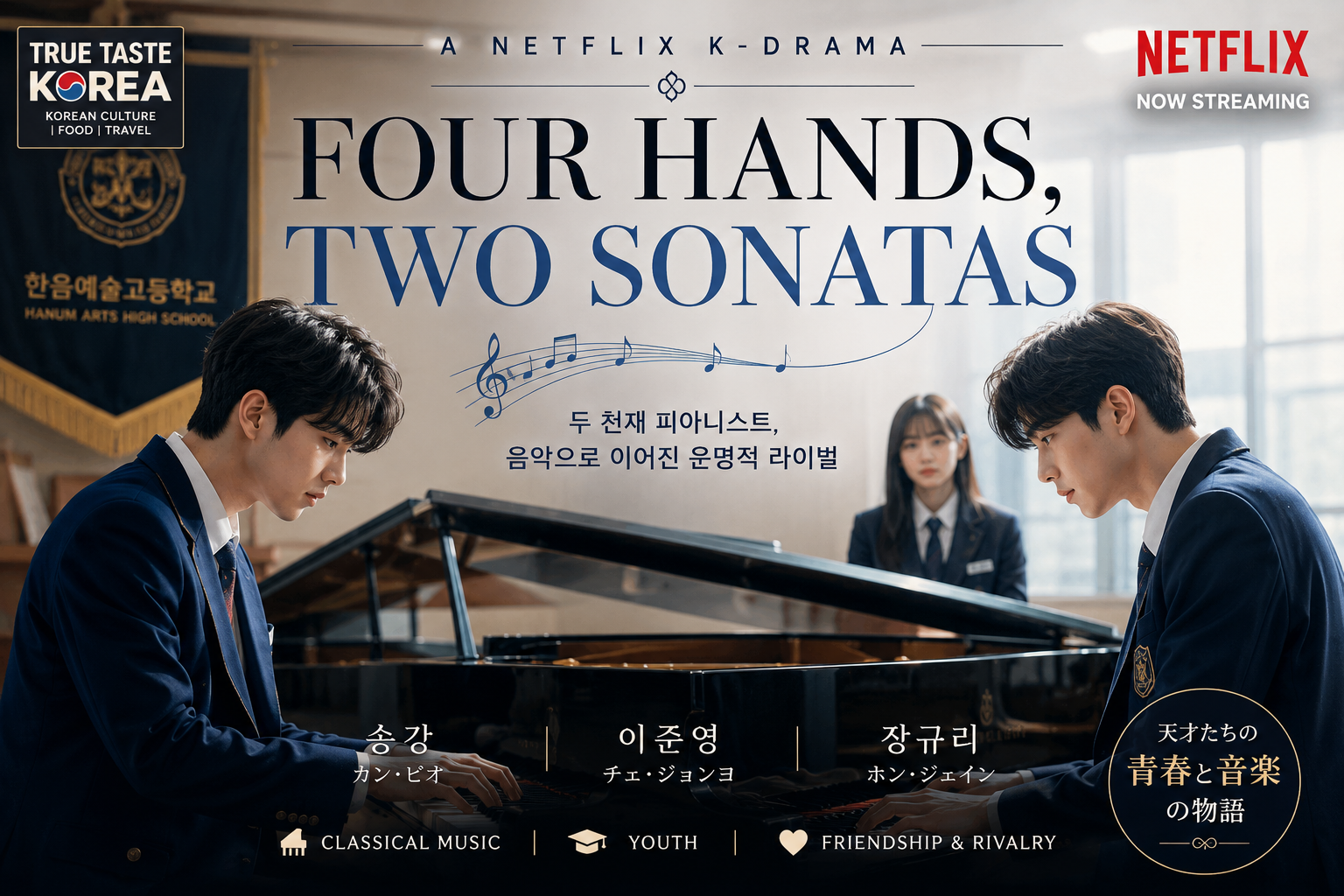
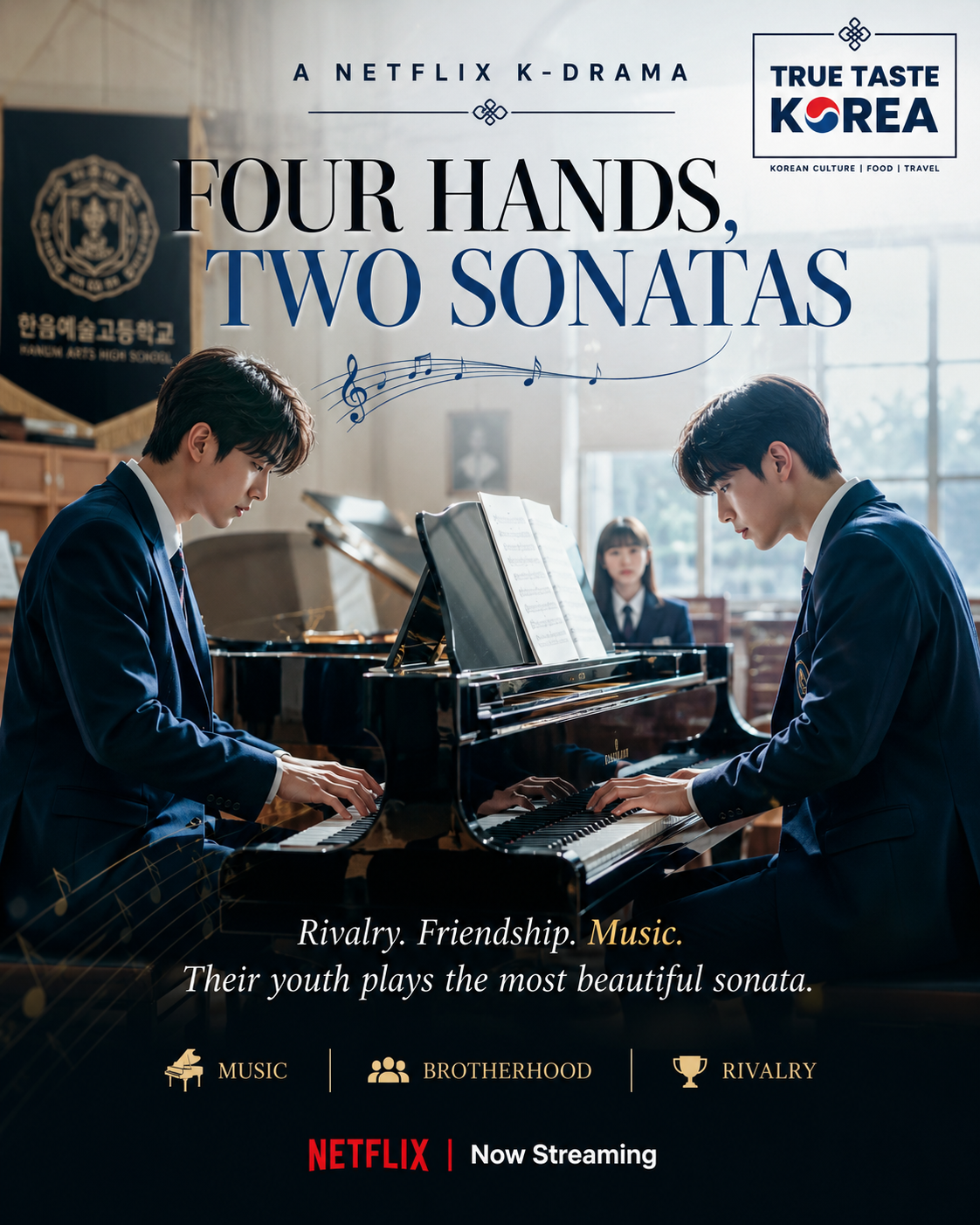
    Netflix’s Four Hands, Two Sonatas is a coming-of-age music drama starring Song Kang, Lee Jun-young and Jang Gyu-ri. Set at an elite Korean arts high school, it follows young musicians whose friendship, rivalry and lives become intertwined through music.

    I started watching the drama in Korea, and what surprised me was how entertaining it is without depending on the extreme violence or constant shock twists often associated with globally successful Korean series.

    At its heart, this is a story about talent, discipline, friendship, rivalry and growing up.

    And that may be exactly what makes Four Hands, Two Sonatas worth watching.

    What Is Four Hands, Two Sonatas About?

    The story centers on two young pianists who come from almost opposite worlds.

    Kang Pi-o, played by Song Kang, has been raised on the path of an elite pianist.

    He is disciplined, technically accomplished and accustomed to striving for perfection. Behind that polished exterior, however, lies enormous pressure and anxiety.

    Then he encounters Choi Jeong-yo, played by Lee Jun-young.

    Jeong-yo comes from a much more difficult background. His personality and music are freer, rawer and more instinctive.

    He does not simply represent another talented pianist.

    He represents a completely different way of understanding music.

    The two meet at an elite arts high school, and what begins as a collision between two contrasting musicians gradually develops into something more complicated: competition, friendship and mutual growth.

    This contrast is one of the most interesting parts of the drama.

    One pursues perfection through discipline.
    The other seems to find music through instinct and emotion.

    Neither is presented simply as the “right” kind of musician.

    Instead, each begins to discover something missing in himself through the other.

    What Does “Four Hands” Mean?

    The title itself contains one of the drama’s most important ideas.

    In piano terminology, “four hands” refers to two pianists playing one piano together.

    Two people.

    One instrument.

    Four hands.

    It is a beautifully appropriate metaphor for Kang Pi-o and Choi Jeong-yo.

    Their personalities, backgrounds and approaches to music are very different. Yet when two musicians sit at the same piano, neither can simply play without considering the other.

    They must listen.

    They must adjust.

    They must understand the other person’s timing.

    And eventually, they must create one piece of music together.

    That makes “Four Hands” more than a musical term. It becomes a symbol of the relationship at the center of the drama.

    Song Kang: The Pianist Raised for Perfection

    International K-drama viewers will immediately recognize Song Kang.

    He has already built a large global audience through Netflix titles including Sweet Home and Love Alarm.

    In Four Hands, Two Sonatas, he plays Kang Pi-o, a pianist who seems to have everything needed for success.

    Talent. Training. Discipline. Opportunity.

    He has spent his life moving toward musical perfection.

    But perfection comes with a price.

    Pi-o’s character allows the drama to ask an interesting question:

    What happens when someone who has been trained to play perfectly meets someone who makes music feel alive in a completely different way?

    That person is Choi Jeong-yo.

    Lee Jun-young: The Free-Spirited Natural Talent

    Lee Jun-young may also be familiar to Netflix viewers.

    He appeared in the internationally successful Korean series When Life Gives You Tangerines as Park Yeong-beom and has appeared in other Netflix productions including Weak Hero Class 2.

    His character Choi Jeong-yo provides a striking contrast to Pi-o.

    Jeong-yo has experienced a difficult childhood and does not come from Pi-o’s privileged musical environment.

    Yet his piano has something that cannot easily be taught.

    Freedom.

    Emotion.

    Instinct.

    There is something unpredictable about the way he approaches both music and life.

    Putting these two characters together creates the drama’s central tension:

    Natural expression vs. disciplined perfection.

    But Four Hands, Two Sonatas does something more interesting than simply asking which pianist is better.

    It asks what happens when they begin learning from each other.

    Jang Gyu-ri and the Third Side of Their Friendship

    The third important young musician is Hong Jae-in, played by Jang Gyu-ri.

    Jang Gyu-ri originally became known as a member of K-pop group fromis_9 before establishing herself as an actress.

    Jae-in is a viola major and a longtime friend of Pi-o.

    At school, she also becomes connected with Jeong-yo, forming the third side of the relationship among these young musicians.

    Her role matters because the drama is not simply structured around two men fighting to determine who is the superior pianist.

    Their school years involve friendship, affection, competition and the complicated emotions of young people discovering both music and themselves.

    The arts high school becomes more than a backdrop.

    It is the place where their identities begin to form.

    A Korean Arts High School Is a Fascinating Setting

    For international viewers, the setting itself may also be interesting.

    The characters attend an elite Korean arts high school filled with exceptionally talented young musicians.

    Instead of ordinary teenagers worrying only about grades and college entrance exams, these students are already living in a highly competitive artistic world.

    Practice rooms become battlegrounds.

    Auditions and performances matter enormously.

    Friendship can easily turn into competition.

    And a classmate may also be the person standing between you and your dream.

    Yet these are still teenagers.

    They experience jealousy, insecurity, friendship, attraction and fear just like everyone else.

    That combination gives the drama much of its emotional energy.

    Why Four Hands Feels Different From Many Global K-Drama Hits

    Some of the Korean dramas that became enormous international hits were built around very intense concepts.

    Survival.

    Zombies.

    Murder.

    Revenge.

    Violence.

    These genres have produced some extraordinary Korean television.

    But Four Hands, Two Sonatas takes another route.

    Its weapons are pianos.

    Its battlefield is the practice room.

    And much of its tension comes from two talented young people trying to understand music, themselves and each other.

    That might sound quieter.

    It doesn’t mean the drama is boring.

    As someone watching the series in Korea, that has been my biggest surprise.

    I expected a beautiful music drama.

    I did not necessarily expect it to be this entertaining.

    The differences between the characters constantly create tension, and their growing friendship makes you want to know what happens next.

    The music is not simply decoration added to the story.

    Music is the conflict.

    And music is also how these characters communicate when words are not enough.

    Why It Could Connect With International Viewers

    There is another reason I think Four Hands, Two Sonatas has international potential.

    You do not need to understand Korean society to understand what these characters want.

    One young man wants to escape the pressure of perfection.

    Another wants his talent to overcome the circumstances into which he was born.

    Both want to make music.

    Both want recognition.

    And both discover that the person who threatens them most may also be the person who helps them grow.

    Those emotions cross borders easily.

    Classical music also gives the drama an unusually universal language.

    A viewer in Seoul, New York, Paris or Tokyo may not speak the same language.

    But everyone can hear the difference between two people playing the same piano.

    From Sweet Home and When Life Gives You Tangerines to Four Hands

    The casting also gives the drama an immediate bridge to international Netflix viewers.

    Song Kang is strongly associated with Netflix through Sweet Home, Love Alarm and other internationally distributed Korean dramas.

    Lee Jun-young has recently reached another large international audience through When Life Gives You Tangerines and Weak Hero Class 2.

    Now the two actors are placed opposite each other as pianists.

    That makes Four Hands, Two Sonatas especially interesting for viewers who discovered Korean actors through Netflix but have never watched a Korean classical-music drama.

    Is Four Hands, Two Sonatas Worth Watching?

    For me, yes.

    But not because it tries to reproduce the formula of another successful K-drama.

    It does almost the opposite.

    Instead of asking who will survive, it asks who these young musicians will become.

    Instead of guns or monsters, there is a piano.

    Instead of defeating an enemy, two rivals may have to learn how to sit beside each other.

    That is why the title feels increasingly meaningful as you watch.

    Two pianists.
    One piano.
    Four hands.
    Two completely different lives.

    And perhaps the most beautiful music begins when neither one plays alone.

    For international viewers looking for a Korean drama built around music, youth, friendship and rivalry rather than violence, Four Hands, Two Sonatas may be one of 2026’s K-dramas worth discovering.


    Where to Watch Four Hands, Two Sonatas

    Four Hands, Two Sonatas premiered on August 29, 2026 and is available internationally through Netflix.

    Official Netflix page:
    Four Hands, Two Sonatas on Netflix


    True Taste Korea watches Korean culture from inside Korea — from food and travel to the dramas, music and everyday experiences that help explain why Korean culture connects with audiences around the world.

    Official & Further Reading

    Want to learn more about Four Hands, Two Sonatas? Here are a few useful official and English-language sources:

    • Watch Four Hands, Two Sonatas on Netflix
      Visit the official Netflix page to watch the series and check availability in your region.
    • Netflix Official Introduction – Four Hands, Two Sonatas
      Read Netflix’s official introduction to the drama, including its story, characters, and the musical rivalry at the heart of the series.
    • Four Hands, Two Sonatas – Cast and Character Guide
      Learn more about Song Kang, Lee Jun-young, Jang Gyu-ri, and the friendship that develops among the young musicians at their elite arts high school.

    Links

    Netflix: https://www.netflix.com/title/82682404

    Netflix Official Introduction: https://about.netflix.com/en/news/four-hands-two-sonatas-teaser

    Soompi Cast & Character Guide: https://www.soompi.com/article/1859522wpp/song-kang-lee-jun-young-and-jang-gyuri-form-a-special-bond-through-music-in-new-drama-four-hands-two-sonatas

    Discover K-Beauty Favorites from Korea 🇰🇷
    Love K-dramas and Korean culture? Discover trending Korean skincare, makeup, face masks, and more at OLIVE YOUNG Global.

    Shop K-Beauty at OLIVE YOUNG Global