Four Hands Explained

  • Could Jeong-yo Really Disappear for 10 Years in Korea? The Four Hands Mystery Explained

    Spoiler warning: This article discusses major events from Episodes 5 and 6 of Four Hands, Two Sonatas.

    One of the biggest surprises in Four Hands, Two Sonatas is not simply that Jeong-yo returns.

    It is that he appears to have been gone for 10 years.

    For viewers, that immediately creates a practical question:

    Could an adult really disappear for 10 years in modern South Korea without his family finding him?

    At first, it sounds almost impossible. Korea is highly connected, smartphones are everywhere, CCTV cameras are common, and official records exist for almost every part of modern life.

    But the answer is more complicated than it seems.

    And surprisingly, a current debate in South Korea about missing adults helps explain why.

    Why Jeong-yo’s 10-Year Disappearance Feels So Strange

    Episode 6 caused exactly this reaction among international viewers.

    After Jeong-yo’s long absence, some viewers questioned how nobody — including investigators — could locate him for an entire decade.

    That leads to several mysteries at once:

    • Was Jeong-yo deliberately hiding?
    • Did someone powerful help him?
    • Did his family actually have the legal ability to track him?
    • And if he was an adult who left voluntarily, could police simply tell his family where he was?

    Those are very different questions.

    The important distinction is this:

    Being missing is not always the same as being in danger.

    Can Korean Police Track Any Missing Adult?

    Not automatically.

    This point is especially interesting because South Korea is debating the issue right now.

    In September 2026, Korean police announced plans to seek stronger legal authority to track the locations of adults reported missing.

    Why would they need new authority?

    Because under the current system, police can face restrictions on tracking an adult’s mobile-device location when there is no evidence suggesting that a crime has occurred.

    That means investigators cannot necessarily treat every adult who stops contacting his family as a kidnapping or criminal disappearance.

    This makes Jeong-yo’s situation more plausible than it first appears.

    If an adult intentionally leaves, remains alive, avoids contact and there is no clear evidence of a crime, the situation becomes very different from the disappearance of a child or a person believed to be in immediate danger.

    But Wouldn’t His Family Just Ask the Police Where He Is?

    This is where privacy becomes important.

    An adult does not lose all privacy rights simply because his family wants to find him.

    Korean police publicly state that personal information and private matters learned during police work must be protected.

    There have also been real debates in Korea over how much information police can publicly disclose when adults go missing.

    So even if authorities obtain information about an adult, that does not automatically mean every detail can simply be handed to relatives or released publicly.

    In other words:

    “The police can investigate” and “the family has a right to know exactly where an adult is” are not necessarily the same thing.

    Korea Actually Has a Current Missing-Adult Problem

    This makes the timing of Four Hands, Two Sonatas surprisingly interesting.

    In early September 2026, Korean police said they would push for legal changes allowing them to better confirm or track the locations of missing adults.

    The announcement followed public criticism surrounding a missing-person case in Jeju.

    Police acknowledged that under the current framework, investigators can be restricted from tracking the mobile locations of missing adults unless there are indications of a crime.

    So the strange question raised by a K-drama —

    “How can an adult disappear in such a connected country?”

    — is also a real policy question being discussed in Korea today.

    Does That Mean Jeong-yo Could Easily Hide for 10 Years?

    Not exactly.

    Ten years is still an extraordinarily long time.

    Living a normal public life for a decade while leaving absolutely no trace would be difficult.

    Banking, employment, housing, phones, transportation, medical treatment and digital activity can all create records.

    That is why Four Hands still appears to be hiding another piece of the puzzle.

    The more interesting question may not be:

    “How did nobody find Jeong-yo?”

    It may be:

    “Who made it possible for Jeong-yo not to be found?”

    That distinction matters.

    Was Someone Protecting Jeong-yo?

    Episode 6 naturally encourages this theory.

    International viewers are already asking who might have supported Jeong-yo during those missing years and why he suddenly decided to return.

    But this is where we should separate what the drama has confirmed from fan speculation.

    At this stage, the existence and identity of a secret supporter should not be treated as established fact unless the series explicitly confirms it.

    Still, from a storytelling perspective, ten years is long enough that Jeong-yo probably needed some combination of money, housing, professional connections or assistance if he intended to remain outside Pi-o’s reach.

    And his return as a conductor makes the mystery even bigger.

    He did not simply survive for 10 years.

    He built another life.

    Could Jeong-yo Have Asked Police to Keep His Location Secret?

    This depends heavily on the circumstances.

    If someone is hiding because of threats, stalking, domestic violence or another genuine safety risk, South Korea has protection systems for victims.

    Police can provide measures such as temporary accommodation, increased patrols, personal protection and connections to specialized protection facilities when appropriate.

    That is very different, however, from saying that any healthy adult can simply ask the government to “erase” him.

    There is no magic disappearance button.

    A person attempting to stay away from family would still have to manage the practical realities of everyday life.

    So Is the Drama’s 10-Year Disappearance Realistic?

    Partly.

    The idea that an adult can voluntarily cut contact with family is realistic.

    The idea that relatives do not automatically gain unlimited access to that adult’s private location is also realistic.

    And current Korean debate shows that police powers involving missing adults have genuine legal limitations.

    But disappearing almost completely for 10 years, while developing a new professional life and apparently avoiding people actively searching for you, is much harder to explain.

    That is precisely why the storyline works.

    The legal reality gives Jeong-yo enough room to disappear.

    But the extraordinary length of his disappearance suggests that Four Hands, Two Sonatas still owes viewers another answer.

    The Bigger Mystery Isn’t Where Jeong-yo Was

    For me, Episode 6 changes the central question.

    At first, we ask:

    Where was Jeong-yo for 10 years?

    But perhaps the better questions are:

    Why did he refuse to return?

    Who knew where he was?

    How did he support himself?

    Why did he choose conducting instead of returning as the pianist everyone remembered?

    And most importantly:

    Why has he decided to come back now?

    That is where the real mystery of Four Hands, Two Sonatas may be hiding.


    Quick Answer

    Can an adult voluntarily disappear in South Korea?
    Yes. An adult can cut contact with family, and family members do not automatically have unlimited rights to that person’s location.

    Can police automatically track the phone of every missing adult?
    Not necessarily. South Korea is currently discussing stronger legal authority for missing-adult location tracking.

    Could someone realistically remain completely hidden for 10 years?
    It would be difficult, particularly while living an active professional life.

    Does this prove someone helped Jeong-yo?
    No. That remains a theory unless the drama confirms it.

    So is the Four Hands storyline impossible?
    No — but the 10-year gap is unusual enough that the drama probably has more to reveal.
  • Why Does Bi-o Hate Jeong-yo in Four Hands? The Real Reason Behind Their Rivalry

    Why is Kang Bi-o so obsessed with Choi Jeong-yo in Four Hands?

    On the surface, the answer seems obvious.

    They are rivals.

    Bi-o is the disciplined elite pianist who has spent years perfecting his technique.

    Jeong-yo is the instinctive genius who seems capable of producing extraordinary music almost naturally.

    One has worked relentlessly.

    The other appears to possess something that cannot simply be learned.

    That alone would be enough to create rivalry.

    But Bi-o’s feelings toward Jeong-yo go much deeper than jealousy between two talented pianists.

    Jeong-yo represents the one thing Bi-o desperately wants but cannot earn through practice: recognition from his grandfather, Kang Seung-woon.

    That is why defeating Jeong-yo becomes so important to him.

    Bi-o is not simply trying to become the better pianist.

    He is trying to prove that he deserves to be chosen.

    Bi-o Has Everything Except the Recognition He Wants Most

    Bi-o appears to have many of the advantages associated with an elite young musician.

    He has received serious training.

    He understands competition.

    He has discipline.

    He has ambition.

    And he belongs to a family deeply connected to classical music.

    But there is one problem.

    The person whose recognition matters most to him is not easily impressed.

    His grandfather, Kang Seung-woon, is not simply a family elder.

    He is a renowned conductor and a musical authority.

    That changes the meaning of their relationship.

    When Bi-o looks at his grandfather, he does not only see someone who should love him as family.

    He sees the person whose judgment can confirm whether his entire life of training has been worthwhile.

    Bi-o wants to hear:

    You are exceptional.

    And more importantly:

    I choose you.

    Then Jeong-yo appears.

    Jeong-yo Has What Bi-o Cannot Practice For

    Jeong-yo is dangerous to Bi-o because his talent seems fundamentally different.

    Bi-o’s strength comes from structure.

    Jeong-yo’s strength comes from instinct.

    Bi-o has learned how music should be played.

    Jeong-yo seems able to ask what else the music could become.

    This distinction matters.

    If Bi-o were competing against another technically excellent pianist, he could respond in the way he understands best.

    Practice harder.

    Improve his technique.

    Correct his weaknesses.

    Become more precise.

    But how do you practice your way into someone else’s instinct?

    How do you defeat a person who hears something you do not?

    That is what makes Jeong-yo terrifying to Bi-o.

    Jeong-yo does not simply challenge his skill.

    He challenges Bi-o’s belief that enough effort can guarantee victory.

    The Grandfather’s Choice Changes Everything

    The rivalry becomes much more personal when Kang Seung-woon chooses Jeong-yo for an important musical opportunity.

    This is the turning point.

    If an unrelated conductor had chosen Jeong-yo, Bi-o would still have been hurt.

    But this decision comes from his grandfather.

    That transforms professional rejection into emotional rejection.

    From Seung-woon’s perspective, the decision may have been entirely musical.

    If he believed Jeong-yo was the right person, choosing Bi-o simply because he was his grandson would have been favoritism.

    But Bi-o does not experience the decision as an abstract question of fairness.

    He experiences it as:

    Grandfather looked at both of us—and chose him.

    That is a completely different wound.

    Bi-o Is Not Really Fighting Jeong-yo

    This may be the key to understanding Bi-o.

    Bi-o believes he is competing with Jeong-yo.

    But psychologically, he may actually be fighting his grandfather’s judgment.

    Every time Jeong-yo receives praise, Bi-o hears:

    “You are not enough.”

    Every time Seung-woon recognizes Jeong-yo’s musical instinct, Bi-o feels his own years of effort becoming less valuable.

    Every time Jeong-yo succeeds, the same question returns:

    Why him and not me?

    That is why simply becoming successful may not satisfy Bi-o.

    He needs to defeat Jeong-yo specifically.

    Because if he defeats Jeong-yo, he can finally challenge the judgment that wounded him.

    He can prove:

    Grandfather was wrong.

    Does Bi-o Actually Hate Jeong-yo?

    This is where the word “hate” becomes complicated.

    Bi-o certainly resents Jeong-yo.

    He is jealous of him.

    He is threatened by him.

    He becomes increasingly obsessed with competing against him.

    But Jeong-yo himself may not be the true source of Bi-o’s anger.

    Jeong-yo did not create Bi-o’s need for approval.

    He did not force Seung-woon to choose him.

    And he did not decide that his own talent should become the standard against which Bi-o measures himself.

    In many ways, Jeong-yo simply exists.

    That may be exactly what makes the situation worse.

    If Jeong-yo were deliberately cruel or manipulative, Bi-o could easily justify hating him.

    But natural talent is not an attack.

    Jeong-yo does not need to intentionally hurt Bi-o.

    His existence alone is enough to remind Bi-o of what he fears he lacks.

    Talent vs Hard Work Is Only the Surface

    It would be easy to describe Four Hands as a familiar story about talent versus hard work.

    Jeong-yo is the genius.

    Bi-o is the disciplined competitor.

    But the drama becomes much more interesting if we look beneath that structure.

    Bi-o is not suffering because hard work is meaningless.

    His hard work has clearly made him an exceptional musician.

    The problem is that he has attached his self-worth to comparison.

    It is no longer enough for Bi-o to become great.

    He needs to be greater than Jeong-yo.

    And once success depends on another person losing, there is no easy way to feel satisfied.

    Even if Bi-o wins one competition, Jeong-yo still exists.

    Even if Bi-o receives applause, he can still wonder whether his grandfather secretly believes Jeong-yo is more gifted.

    The rivalry therefore becomes impossible to finish.

    Seung-woon Seems to Understand the Danger

    This makes Kang Seung-woon’s warning about the relationship between Bi-o and Jeong-yo especially important.

    He tells Bi-o, in effect, to think about who will become completely devastated if the rivalry continues.

    That is a remarkable warning.

    Seung-woon appears to understand something Bi-o does not.

    The greatest danger is not losing to Jeong-yo.

    The greatest danger is allowing Jeong-yo to become the measure of Bi-o’s entire identity.

    Because once that happens, Jeong-yo controls Bi-o without even trying.

    If Jeong-yo succeeds, Bi-o suffers.

    If Jeong-yo receives praise, Bi-o suffers.

    If Jeong-yo is chosen, Bi-o suffers.

    Bi-o’s happiness becomes dependent on what happens to someone else.

    That is why Seung-woon’s warning may ultimately have very little to do with a piano competition.

    It may be a warning about self-destruction.

    But Seung-woon Also Helped Create the Problem

    There is an uncomfortable contradiction here.

    Seung-woon may understand that Bi-o’s obsession is dangerous.

    But he is also one of the people whose judgment gave that obsession so much power.

    Bi-o desperately wants his grandfather’s approval.

    Seung-woon knows this.

    Yet his approach appears to remain harsh and uncompromising.

    Musically, that may be understandable.

    A conductor should not lower artistic standards simply to protect his grandson’s feelings.

    But a grandfather has responsibilities that a conductor does not.

    This is where Four Hands becomes more complicated than a simple rivalry story.

    Perhaps Seung-woon was right to choose Jeong-yo.

    But being right about music does not automatically mean he handled Bi-o correctly as family.

    The decision may have been fair while the aftermath was emotionally disastrous.

    Those two things can both be true.

    What Bi-o Really Wanted Was Not First Place

    This may explain why Bi-o’s obsession cannot be solved simply by winning.

    Suppose Bi-o becomes No. 1.

    Would that heal him?

    Probably not.

    Because first place was never the deepest goal.

    Recognition was.

    Bi-o wants someone he respects—especially his grandfather—to look at him and say that all the effort mattered.

    That he is worthy.

    That he is special.

    That he was not second choice.

    Without that emotional resolution, trophies cannot solve the problem.

    Bi-o could stand on the highest stage in the world and still wonder:

    Would Grandfather have chosen Jeong-yo if he were here?

    That is the tragedy of his rivalry.

    Jeong-yo’s Disappearance Does Not Give Bi-o the Victory He Wanted

    Then the story becomes even crueler.

    Jeong-yo disappears.

    Later, we learn that his right arm has been seriously injured and that his path as a pianist has been destroyed.

    In one sense, Bi-o’s greatest rival is gone.

    But this does not necessarily free Bi-o.

    It may do the opposite.

    Because Bi-o never truly defeated Jeong-yo.

    There is no final performance that proves Bi-o was better.

    There is no clean victory.

    The competition simply stops.

    And that leaves Bi-o with a question he can never answer.

    Could I actually have beaten him?

    For someone as competitive as Bi-o, that uncertainty may be worse than defeat.

    Jeong-yo Returns in the One Way Bi-o Never Expected

    This is why Jeong-yo’s return as a conductor is potentially devastating.

    Bi-o may have spent years imagining Jeong-yo as the pianist he needed to defeat.

    But Jeong-yo returns outside that competition.

    He is no longer sitting at the other side of the piano.

    He is standing in front of musicians.

    That changes the relationship completely.

    Bi-o can no longer simply prove himself by playing better than Jeong-yo.

    The old contest may no longer exist.

    And perhaps that is exactly what Bi-o needs.

    For the first time, he may be forced to see Jeong-yo not as an opponent to defeat, but as another musician whose life was also damaged by the past.

    The Cruel Irony of Bi-o and Jeong-yo

    The greatest irony may be that both young men are victims of the same rivalry.

    Bi-o suffers because he believes Jeong-yo has everything he wants.

    Natural talent.

    Recognition.

    Freedom in music.

    Jeong-yo, meanwhile, eventually loses the very thing Bi-o envies most: his ability to continue his life as a pianist.

    Bi-o spends years wanting Jeong-yo’s position.

    Jeong-yo loses that position entirely.

    Neither of them truly wins.

    That may be why the title Four Hands matters so much.

    Four-hands piano requires two players to share the same instrument.

    They have to listen to each other.

    They have to make space for each other.

    Neither performer can simply dominate the entire keyboard.

    Yet Bi-o and Jeong-yo are pushed toward exactly the opposite relationship.

    Instead of playing together, they are taught—directly or indirectly—to measure themselves against each other.

    The tragedy is not that one is talented and the other works hard.

    The tragedy is that two gifted musicians become incapable of seeing each other without competition standing between them.

    Bi-o’s Real Battle May Still Be Ahead

    Bi-o’s final opponent may not be Jeong-yo.

    It may be himself.

    Can he play music without needing to prove that he is better than someone else?

    Can he accept his grandfather’s recognition without depending on it?

    Can he look at Jeong-yo without seeing his own inadequacy?

    And most importantly, can he understand that another person’s talent does not diminish his own?

    If Bi-o cannot answer those questions, defeating Jeong-yo would never have saved him.

    There would always be another rival.

    Another competition.

    Another musician receiving applause.

    Another reason to feel threatened.

    That is why Seung-woon’s warning feels increasingly important.

    The person who becomes completely devastated may not be the person who loses the competition.

    It may be the person who can no longer imagine himself without it.

    Final Thoughts

    So why does Bi-o hate Jeong-yo so much?

    Because Jeong-yo represents far more than a rival pianist.

    He represents Bi-o’s fear that hard work may not be enough.

    He represents the grandfather’s recognition Bi-o desperately wants.

    He represents natural talent Bi-o cannot simply acquire through more practice.

    And most painfully, he represents the moment Bi-o feels that his grandfather looked at two young musicians and chose someone else.

    That is why Bi-o cannot simply ignore him.

    But the deeper tragedy of Four Hands may be that Jeong-yo was never truly Bi-o’s enemy.

    Bi-o’s real enemy is the belief that he can only prove his own worth by defeating someone else.

    And if Kang Seung-woon already understood where that obsession would lead, then his warning about someone becoming completely devastated may be far more important than it first appeared.

    The next question is therefore unavoidable:

    When Seung-woon warned that one of them would end up completely destroyed, was he talking about Bi-o all along?

  • Why Does Pio Play Until His Fingers Bleed in Four Hands, Two Sonatas?

    One of the most unforgettable images in Four Hands, Two Sonatas appears almost immediately.

    Kang Pio sits at a piano during the Prague competition.

    His finger is injured.

    Blood begins to spread across the keys.

    And he keeps playing.

    At the same time, Choi Jeong-yo — the rival who was supposed to compete against him — is caught in a terrifying situation away from the competition.

    At first, the scene looks like an intense opening designed to make viewers ask what happened between these two pianists.

    But after learning more about Pio and Jeong-yo, the bloody piano begins to mean something much more painful.

    Pio is not simply trying to win a competition.

    He is trying to prove that everything he has sacrificed for the piano has been worth it.

    What Happens at the Prague Competition?

    The drama’s opening establishes a disturbing contrast.

    Pio is performing at an international piano competition despite an injured finger.

    He continues playing as blood appears on the keys.

    Jeong-yo, meanwhile, is unable to arrive normally at the competition because he has been abducted and becomes involved in a violent incident.

    Pio ultimately wins.

    On paper, that should be one of the greatest moments of his young life.

    He entered an international competition.

    He endured physical pain.

    He completed his performance.

    And he won.

    But Four Hands, Two Sonatas does not present the victory as simple triumph.

    That is the important part.

    Pio Wanted Jeong-yo There

    To understand the emotional meaning of Prague, we need to understand what Jeong-yo represents to Pio.

    Pio does not simply want Jeong-yo to disappear.

    That would make their relationship much easier.

    Pio wants to know who is better.

    He wants a real answer.

    Jeong-yo’s talent threatens him, but that threat is also what makes defeating Jeong-yo meaningful.

    Winning against weaker competition cannot give Pio what he is searching for.

    He needs to stand on the same stage as the person whose talent frightens him most.

    That changes the meaning of Prague.

    Pio wants to beat Jeong-yo — but he does not want to win because Jeong-yo is absent.

    So What Does Pio Actually Win?

    This may be one of the cruelest questions in the drama.

    Pio wins the competition.

    But the person he truly wanted to compete against is not there.

    That creates a strange kind of victory.

    He receives the result.

    But he does not receive the answer.

    The trophy can prove that Pio won the competition.

    It cannot prove that he defeated Jeong-yo.

    For someone already obsessed with questions of talent and recognition, that difference is enormous.

    Why the Blood on the Piano Matters

    The blood is visually dramatic, but it also works as a powerful symbol.

    Pio has spent years being taught that the piano is where his value will be measured.

    So when his body tells him to stop, he continues.

    The message is almost frighteningly simple:

    Winning matters more than pain.

    For many ambitious people, this feeling will be familiar.

    At first, you work hard because you want something.

    Then you sacrifice more because you are getting closer.

    Eventually, you have invested so much time, effort and identity into the goal that stopping becomes almost impossible.

    You are no longer asking:

    “Do I still want this?”

    You begin asking:

    “How can I stop after everything I have already sacrificed?”

    Pio’s bleeding fingers make that psychological trap visible.

    Pio Is Not Untalented

    This is essential to understanding him.

    Pio’s tragedy is not that he has no talent.

    He is an elite pianist.

    He has trained at a high level and is capable of winning major competitions.

    Against ordinary musicians, Pio might easily be considered extraordinary.

    Then he meets Jeong-yo.

    And suddenly being extraordinary may no longer feel extraordinary enough.

    That is one of the cruelest experiences for any high achiever.

    You can spend years becoming exceptional only to meet someone who makes your greatest strength feel ordinary.

    Hard Work Meets Natural Talent

    This is one of the central tensions of Four Hands, Two Sonatas.

    Pio represents discipline, structure, expectation and relentless effort.

    Jeong-yo represents a more instinctive relationship with music.

    That does not mean Jeong-yo never works hard or Pio lacks natural talent.

    The drama is more complicated than that.

    But from Pio’s perspective, Jeong-yo possesses something that cannot simply be acquired by practicing another thousand hours.

    That realization is terrifying.

    Because if effort cannot guarantee superiority, what exactly has Pio been sacrificing himself for?

    Why Pio Cannot Simply Give Up

    From the outside, the solution looks easy.

    If competing with Jeong-yo causes Pio so much pain, why not stop comparing himself?

    Real life rarely works that way.

    The closer someone gets to a goal, the harder it can become to walk away.

    Pio has already invested years in becoming a pianist.

    His family has built expectations around his talent.

    His identity has been shaped by competition.

    And he has experienced enough success to believe that perhaps one more sacrifice will finally give him what he wants.

    That is why the blood matters.

    Pio is not someone who has failed completely.

    He is someone who has succeeded enough to believe that the next victory might finally make him feel complete.

    But Recognition Is Different From Winning

    Pio’s problem becomes even deeper because winning is not the only thing he wants.

    He wants recognition.

    Especially from the people whose judgment matters most to him.

    A trophy can be displayed.

    A competition result can be recorded.

    But recognition cannot be forced.

    Someone either looks at you and sees what you desperately want them to see — or they do not.

    That is why another victory may never completely satisfy Pio.

    If the person whose approval he wants still sees something greater in Jeong-yo, Pio can win competitions and still feel as if he has lost.

    Jeong-yo Is Both the Wound and the Answer

    This is what makes their relationship so compelling.

    Jeong-yo causes Pio to question his talent.

    But Jeong-yo is also one of the people who can reconnect Pio with music.

    Pio watches him.

    Listens to him.

    Learns from him.

    Fears him.

    Needs him.

    And wants to defeat him.

    Those emotions should contradict each other.

    Instead, they exist at the same time.

    That is why reducing Pio’s feelings to simple jealousy misses much of the story.

    Jeong-yo is not merely Pio’s rival.

    He is the person through whom Pio is trying to understand his own worth.

    The Cruel Irony of Prague

    That brings us back to the opening.

    Pio gives everything.

    His fingers bleed.

    He finishes the performance.

    He wins.

    Yet the one person whose presence could make that victory answer Pio’s deepest question never reaches the stage.

    The result therefore becomes almost cruel.

    Pio gets exactly what ambitious people are told to want:

    first place.

    And it still may not be enough.

    That is why the bloody keys are more than an image of determination.

    They may represent the moment when ambition stops serving a person and the person begins serving ambition.

    Why This Scene Feels So Real

    Most viewers will never compete in an international piano competition.

    But many people understand the emotion.

    Someone studies for years for an exam.

    Someone spends everything trying to build a business.

    Someone sacrifices relationships for a career.

    Someone keeps telling themselves:

    “Just a little more.”

    Then another person appears who seems to reach the same destination faster or more naturally.

    That is when ambition becomes complicated.

    Do you accept your limits?

    Do you work harder?

    Do you walk away?

    Or do you keep playing until your fingers bleed?

    There is no easy answer.

    And perhaps that is exactly why Pio is so difficult to judge.

    Final Thought

    Pio’s bloody fingers should not simply be read as proof that he works harder than everyone else.

    They reveal something darker.

    He has reached a point where stopping feels more painful than continuing.

    And Prague gives him the cruelest possible reward.

    He wins.

    But Jeong-yo is not there.

    So the competition gives Pio a trophy without answering the question that brought him there.

    Was he truly better?

    Was all the sacrifice worth it?

    And did the person whose recognition he wanted finally recognize him?

    That is why one of the most important images in Four Hands, Two Sonatas may not be the trophy Pio receives.

    It is the blood he leaves on the piano.

    Because sometimes the most dangerous moment in ambition is not when we fail.

    It is when we win — and discover that winning still does not give us what we were really looking for.

  • Why Did B-o Ask Jeong-yo to Enter the Same Competition in Four Hands?

    ⚠️ Spoiler Warning: This article discusses major events and character motivations in Four Hands, Two Sonatas.

    One of the strangest decisions B-o makes in Four Hands, Two Sonatas is also one of the most revealing.

    B-o already knows how extraordinary Jeong-yo is.

    He has heard him play. He has watched the way Jeong-yo approaches music. And perhaps more importantly, B-o understands Jeong-yo’s talent better than almost anyone else does.

    So why would B-o deliberately ask Jeong-yo to enter the same piano competition?

    Wouldn’t it be safer to compete without him?

    Probably.

    But winning safely isn’t what B-o really wants.

    B-o Is Not Simply Jealous of Jeong-yo

    It would be easy to interpret their relationship as a familiar rivalry.

    B-o is the hardworking elite pianist.

    Jeong-yo is the instinctive genius.

    The genius appears, the hardworking student becomes jealous, and eventually they collide.

    But B-o’s feelings are more complicated than that.

    He doesn’t suffer because he thinks Jeong-yo is overrated.

    He suffers because he knows Jeong-yo is the real thing.

    That’s an important difference.

    B-o has spent years training himself to recognize good music. His experience allows him to understand exactly what makes Jeong-yo different.

    In other words, the better B-o understands music, the more painful Jeong-yo becomes.

    B-o Has Spent His Life Becoming the Perfect Competition Pianist

    B-o’s identity has been built around achievement.

    Practice.

    Competitions.

    Technique.

    Evaluation.

    Winning.

    He knows how to produce the kind of polished performance expected from an elite pianist.

    And yet the drama gives him a devastating question:

    Why doesn’t his music have a soul?

    That question strikes directly at everything B-o has built.

    Because technical excellence can be measured.

    Competition results can be measured.

    Hours of practice can be counted.

    But the ability to make another person stop and listen?

    That is much harder to quantify.

    And Jeong-yo seems to possess it naturally.

    His Grandfather Makes the Fear Worse

    B-o’s insecurity becomes much more serious when his grandfather chooses Jeong-yo instead of him.

    For B-o, this isn’t simply another pianist winning an opportunity.

    The judgment comes from the person whose recognition has mattered to him for years.

    The painful question underneath B-o’s reaction is essentially:

    “Why Jeong-yo instead of me?”

    And the answer B-o fears is not that he practiced less.

    It’s that there may be something Jeong-yo possesses that practice alone cannot create.

    That is a far more frightening possibility for someone who has built his entire life around becoming excellent.

    Then Why Invite Jeong-yo Into the Competition?

    This is where B-o’s decision becomes fascinating.

    If B-o simply wanted another trophy, the logical choice would be obvious:

    Keep Jeong-yo away.

    Instead, he does the opposite.

    He brings the person he fears most onto the same battlefield.

    Why?

    Because defeating everyone except Jeong-yo would not answer B-o’s real question.

    Suppose B-o enters the competition and wins while Jeong-yo never participates.

    He gets the trophy.

    But the doubt remains:

    “What would have happened if Jeong-yo had been there?”

    For B-o, that uncertainty may be worse than losing.

    So he creates the confrontation himself.

    B-o Wants Proof, Not Just Victory

    What B-o really seems to want is proof.

    Not necessarily proof that Jeong-yo is ordinary.

    Deep down, he already knows Jeong-yo isn’t.

    Instead, B-o wants to prove something about himself:

    “Jeong-yo may be a genius, but that doesn’t mean I am inferior.”

    That distinction matters.

    B-o’s battle is not simply about destroying Jeong-yo.

    It is about protecting his own sense of worth.

    A victory over weaker competitors cannot give him that reassurance.

    Only standing beside Jeong-yo under comparable conditions can.

    The Same Piece Makes the Competition Even Crueler

    The drama makes the rivalry more interesting by placing both pianists against the same musical challenge.

    That removes many excuses.

    Same composition.

    Same notes.

    Similar competitive conditions.

    Yet potentially completely different music.

    This gets to the heart of what Four Hands seems interested in exploring.

    A musical score tells a pianist what notes to play.

    It does not completely determine what those notes will become in the hands of a particular performer.

    B-o has spent years perfecting execution.

    Jeong-yo appears able to discover something intensely personal inside the music.

    When both are asked to approach the same piece differently, the competition stops being only about technique.

    It becomes a test of interpretation and individuality.

    And B-o Knows This Is Dangerous

    That’s what makes his decision almost self-destructive.

    B-o isn’t unknowingly walking into danger.

    He understands the danger and walks toward it anyway.

    His grandfather has already warned him about what this rivalry could do to him.

    And B-o himself has enough musical intelligence to recognize Jeong-yo’s gift.

    Yet he still asks Jeong-yo to compete.

    It’s almost as if B-o would rather receive a painful answer than continue living with the question.

    That makes him a much more interesting character than a conventional jealous rival.

    The Tragedy of B-o Is That He Is Actually Very Good

    There is another reason B-o’s story hurts.

    B-o isn’t mediocre.

    If he were an untalented pianist who simply resented someone better than him, his conflict would be much simpler.

    But B-o is accomplished.

    Disciplined.

    Technically strong.

    And knowledgeable enough to understand exceptional musicianship when he encounters it.

    That may be precisely why Jeong-yo affects him so deeply.

    Someone who knows little about piano might simply hear two excellent performers.

    B-o can hear the difference.

    His own ability allows him to recognize the thing he fears he cannot become.

    Jeong-yo May Not Be B-o’s Real Opponent

    This leads to the deeper conflict behind their competition.

    B-o believes he needs to defeat Jeong-yo.

    But Jeong-yo may not actually be the person B-o is fighting.

    For years, B-o appears to have connected his value as a pianist with recognition — especially recognition from his grandfather.

    Win.

    Be chosen.

    Be praised.

    Prove that all the work mattered.

    Then Jeong-yo arrives and disrupts that system.

    If B-o can play beautifully without being chosen, what does being chosen actually mean?

    If Jeong-yo can make compelling music without following B-o’s path, what were all those competitions supposed to prove?

    Those questions are much harder to defeat than another pianist.

    B-o Put His Greatest Fear on the Stage Himself

    That’s ultimately why the competition matters so much.

    B-o doesn’t wait for Jeong-yo to challenge him.

    He challenges Jeong-yo.

    He takes the person who represents his greatest insecurity and deliberately puts him on the same stage.

    On the surface, B-o is saying:

    “Let’s see who is better.”

    But underneath that challenge is a much more vulnerable question:

    “If you really are a genius… does that mean everything I’ve spent my life becoming has less value?”

    And that may be the real reason B-o needs Jeong-yo in the competition.

    Winning without him cannot answer the question.

    Only facing him can.

    The cruelest possibility, however, is that even beating Jeong-yo might not solve B-o’s problem.

    Because ultimately, B-o’s greatest opponent may not be Jeong-yo at all.

    It may be his lifelong need to prove his worth through someone else’s recognition.

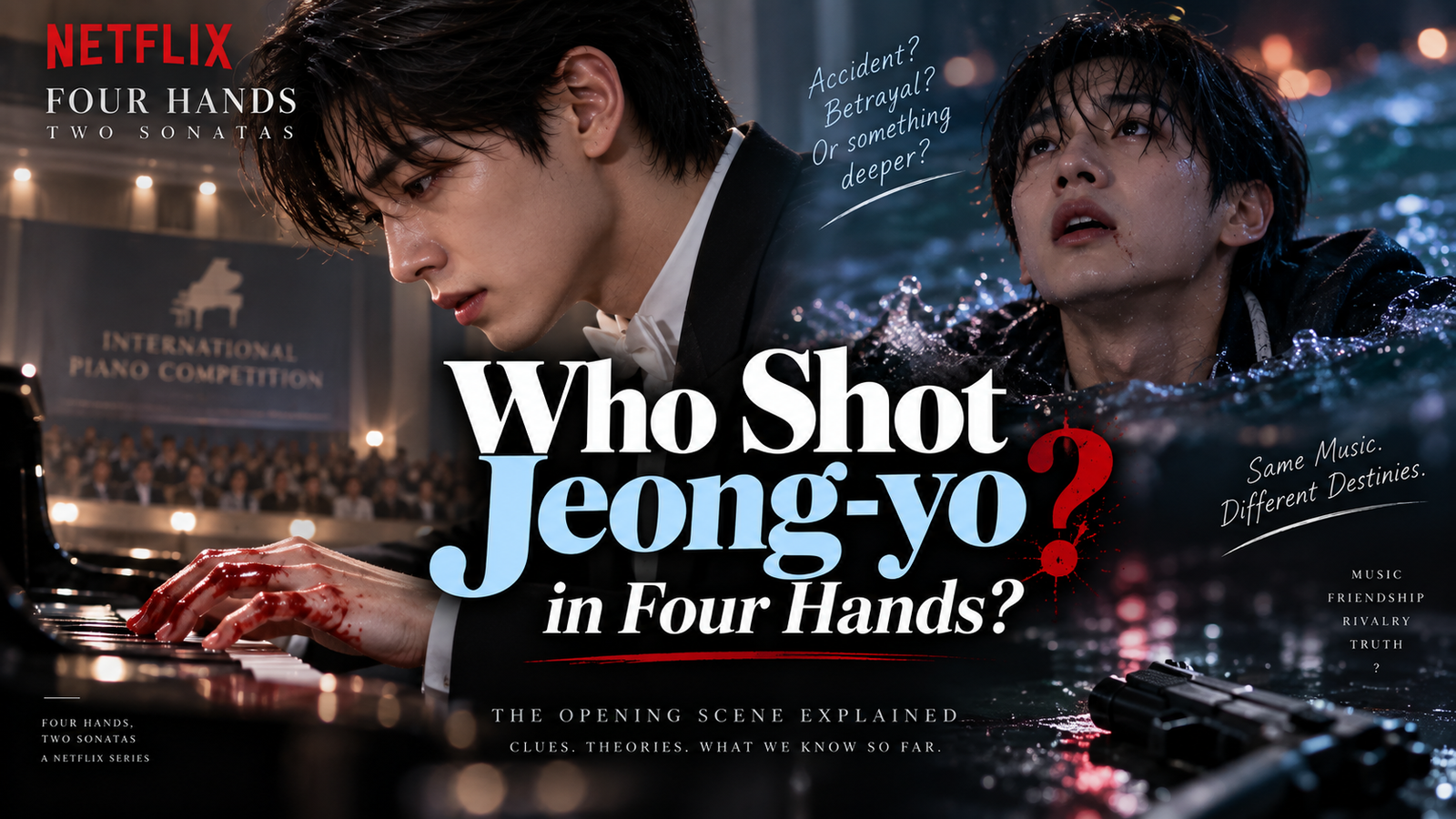
  • Who Shot Jeong-yo in Four Hands? The Opening Shooting Scene Explained

    Who Shot Jeong-yo in Four Hands? The Opening Shooting Scene Explained

    Updated through Episode 3. This article will be updated as new clues are revealed.

    Warning: Spoilers for Four Hands, Two Sonatas.

    If you started watching Four Hands, Two Sonatas expecting a beautiful coming-of-age drama about two young pianists, the opening scene probably made you wonder whether you had clicked on the wrong K-drama.

    A piano competition.

    Blood on the keys.

    Choi Jeong-yo in danger.

    A gunshot.

    And Jeong-yo falling into the water.

    Then the story takes us back to a much younger Kang Pi-o and Choi Jeong-yo, before their friendship, rivalry and musical lives have reached that terrifying moment.

    It immediately creates one of the biggest mysteries in Four Hands:

    Who shot Jeong-yo?

    The most important answer right now is:

    We don’t know yet.

    And that is exactly why the opening scene matters.

    The drama has shown us a possible future before explaining how these two young pianists could ever arrive there. Early reviews have similarly identified the violent flash-forward as one of the central mysteries hanging over the story.

    So rather than pretending we already know the shooter, let’s separate what Four Hands has actually shown us from what we can only speculate about.


    What Happens in the Four Hands Opening Scene?

    The drama begins far away from the warm school friendship that follows.

    Pi-o is playing piano at a major competition.

    But something is terribly wrong.

    His fingers are bloodied as he continues playing.

    Meanwhile, Jeong-yo is caught in a violent situation elsewhere.

    A gun goes off.

    Jeong-yo is hit and falls into the water.

    The contrast is shocking.

    One friend is playing music while the other appears to be fighting for his life.

    A review of Episodes 1 and 2 describes the opening in essentially these terms: Pi-o plays with bloodied fingers while Jeong-yo is shot and falls into water.

    But the drama doesn’t immediately tell us who shot him or how the two boys reached this point.

    Instead, it takes us backward.

    And suddenly we meet two young musicians whose relationship looks very different.


    Why Show Jeong-yo Being Shot Before We Even Know Him?

    This may be the more interesting question.

    The opening doesn’t simply create suspense.

    It changes how we watch everything that follows.

    Netflix officially describes Pi-o and Jeong-yo as two contrasting pianists whose lives become intertwined through friendship, rivalry and growth. Pi-o has followed a disciplined path toward perfection, while Jeong-yo comes from a turbulent childhood and possesses a much rawer natural talent.

    When we watch them begin to understand each other, however, we already know something they don’t.

    Something terrible is coming.

    That knowledge changes even their happiest scenes.

    When they play together, we remember the opening.

    When they become closer, we remember the opening.

    When rivalry begins to appear, we wonder whether it somehow leads to the opening.

    The drama has effectively given the audience the destination while hiding the road.


    The Biggest Question Isn’t Only “Who Shot Jeong-yo?”

    There are actually several mysteries packed into that opening.

    Who shoots Jeong-yo?

    But also:

    Why is Jeong-yo in that situation?

    Why is Pi-o somewhere else playing piano?

    Why are Pi-o’s fingers bleeding?

    Does Pi-o know Jeong-yo is in danger?

    How much time has passed since their school days?

    And perhaps most importantly:

    What happens between these two friends before we return to this moment?

    That last question may ultimately matter more than the identity of the shooter.


    Does Jeong-yo Die in Four Hands?

    This is another question viewers are likely to ask after watching the opening.

    At this stage:

    Jeong-yo’s death has not been confirmed.

    We see an extremely dangerous situation and a fall into the water.

    But showing a character apparently facing death is not the same as confirming that character’s death.

    Until the drama explicitly reveals what happens afterward, it would be misleading to say that Jeong-yo dies.

    So for now:

    Shot? Yes.

    Falls into the water? Yes.

    Confirmed dead? No.

    That distinction is important.


    Is Pi-o Connected to Jeong-yo’s Shooting?

    This is where we have to be particularly careful.

    The editing deliberately connects the two men.

    Jeong-yo is in danger while Pi-o is performing.

    Pi-o’s bloody fingers make his own scene disturbing as well.

    But parallel editing does not prove that Pi-o caused what happened to Jeong-yo.

    There is currently no reason to turn a visual connection into a factual accusation.

    What we can say is that the drama clearly wants us to ask why these two events are happening at the same time.

    And because the series is built around their friendship and rivalry, the answer will almost certainly tell us something important about how their relationship develops.


    Could Their Rivalry Become That Dark?

    At first glance, that’s an obvious theory.

    Pi-o and Jeong-yo are both extraordinary pianists.

    One has spent years being shaped toward perfection.

    The other possesses an instinctive musical gift capable of disrupting that world.

    Netflix itself describes them as characters who repeatedly clash and challenge each other, pushing one another toward new artistic heights.

    So when the opening shows blood and violence, viewers naturally wonder:

    Does their rivalry eventually destroy their friendship?

    Maybe.

    But again, the drama hasn’t established that.

    And based on the episodes we’ve seen so far, reducing their relationship to simple hatred would miss much of what makes Four Hands interesting.

    Their relationship contains competition, but it also contains admiration.

    They challenge each other precisely because each recognizes something extraordinary in the other.

    That makes the eventual journey toward the shooting scene much harder to predict.


    The Opening Makes Every Happy Scene Feel Different

    This is one of the smartest things about the storytelling so far.

    Without the flash-forward, we could simply enjoy the story of two young pianists becoming friends.

    But we can’t completely do that.

    We have already seen the blood.

    We have already heard the gunshot.

    We have already seen Jeong-yo fall.

    So when Pi-o and Jeong-yo laugh together, practice together or begin understanding each other through music, there is an uncomfortable thought sitting underneath the scene:

    How does this become that?

    One early review made the same observation: the flash-forward places tension underneath the drama because viewers know that a darker moment is waiting somewhere ahead.

    That’s an effective narrative trick.

    The drama isn’t only making us care about their friendship.

    It is making us afraid of losing it.


    Pi-o’s Bloody Fingers May Be Just as Important as the Gunshot

    It’s easy to focus entirely on Jeong-yo because a gunshot is obviously more dramatic.

    But look at Pi-o.

    Why is he playing with injured, bloody fingers?

    For a pianist, hands aren’t simply another part of the body.

    They are connected to identity, career and expression.

    And Pi-o keeps playing.

    That image raises its own questions.

    Did something happen before he went on stage?

    Is he forcing himself through an injury?

    Does his condition have any connection to what is happening to Jeong-yo?

    Or are the two scenes connected primarily symbolically rather than literally?

    We don’t know yet.

    But the drama chose to place those images beside each other.

    That makes Pi-o’s hands another clue worth watching.


    Music and Violence Are Deliberately Colliding

    This may ultimately be the most important thing about the opening.

    Everything else about Four Hands teaches us to associate these characters with music.

    Jeong-yo hears music almost everywhere. An official preview even depicts ordinary school noises transforming into music in his mind, emphasizing his instinctive relationship with sound.

    Pi-o has spent his life pursuing perfection at the piano.

    Then the opening takes the thing that defines them—

    music—

    and places it beside blood, fear and violence.

    That contrast feels deliberate.

    The piano may eventually become more than the thing that brings them together.

    It may also become connected to ambition, sacrifice and pain.


    What We Know So Far

    As of Episode 3, here’s the safest way to understand the mystery:

    Confirmed: Jeong-yo is shown being shot and falling into water in the flash-forward.

    Confirmed: Pi-o is shown performing piano with bloodied fingers.

    Confirmed: The main story then moves back to an earlier period in their lives.

    Not confirmed: Who shot Jeong-yo.

    Not confirmed: Why Jeong-yo was shot.

    Not confirmed: Whether Jeong-yo dies.

    Not confirmed: Whether Pi-o has any direct connection to the shooting.

    Not confirmed: What caused Pi-o’s injured fingers.

    That’s where the mystery stands.

    Anything beyond that is currently a theory.


    My Theory: The Shooter May Not Be the Real Mystery

    I suspect the drama wants us to focus on the obvious question:

    “Who pulled the trigger?”

    But I don’t think that will necessarily be the most important revelation.

    Four Hands is fundamentally being presented as a story about two young musicians whose lives become intertwined through friendship, rivalry and growth.

    That suggests the emotional mystery may be bigger than the crime mystery.

    The question may eventually become:

    What happened to Pi-o and Jeong-yo between the day they became friends and the day one was bleeding at a piano while the other was bleeding in the water?

    Who fired the gun will give us one answer.

    How their friendship reached that moment may give us the real story.


    Why the Opening Scene Works So Well

    We already know where the road appears to lead.

    But we don’t know how they get there.

    That means every new friendship becomes a clue.

    Every rivalry becomes a clue.

    Every family conflict becomes a clue.

    Every decision involving their careers becomes a clue.

    Even the music may become a clue.

    The opening turns what initially appears to be a youth music drama into something with an underlying mystery.

    And that’s why the scene stays in your mind even when the story returns to classrooms, competitions and piano practice.


    So Who Shot Jeong-yo?

    For now, the only accurate answer is:

    Four Hands hasn’t revealed it yet.

    And we shouldn’t invent an answer before the drama gives us one.

    What we do know is that the shooting isn’t a random scene added simply for shock.

    The drama deliberately shows us Jeong-yo’s violent future alongside Pi-o’s bloodied performance before asking us to watch their relationship develop from the beginning.

    That makes the real mystery bigger than:

    Who shot Jeong-yo?

    It becomes:

    What happened to these two boys?

    And every episode brings us a little closer to finding out.


    Four Hands Shooting Scene FAQ

    Who shot Choi Jeong-yo in Four Hands?

    As of Episode 3, the identity of the shooter has not been revealed.

    Does Jeong-yo die?

    His death has not been confirmed. The opening shows him being shot and falling into water, but viewers have not yet been shown a definitive outcome.

    Why are Pi-o’s fingers bleeding?

    That has not yet been fully explained. The drama deliberately juxtaposes Pi-o’s bloodied piano performance with Jeong-yo’s violent situation.

    Is Pi-o responsible for Jeong-yo being shot?

    There is currently no confirmed evidence that Pi-o is responsible. The editing connects their situations, but that should not be mistaken for proof.

    When will the shooting scene be explained?

    The series has 12 episodes, but there is currently no confirmed episode in which the full circumstances of the flash-forward will be revealed. The article should therefore be updated as new episodes provide clues. The 12-episode format is reflected in current series listings and discussion information.