TTK Original — Beyond the Headlines
1. A Witness Nobody Wants to Believe
Most crime thrillers begin with a question: Who committed the crime?
Blind (2011), directed by Ahn Sang-hoon, introduces a more complicated question before the investigation can even begin: What happens when the person who knows something important is someone society does not consider a reliable witness?
Min Soo-ah, played by Kim Ha-neul, is a former police academy student who lost her eyesight in a tragic accident. One rainy night, she experiences a suspicious incident involving a vehicle and reports what she believes happened.
But the police initially struggle to accept her account.
The problem is not simply that Soo-ah cannot see. It is that the people listening to her have already decided what a credible witness should look like.
Her testimony does not fit their expectations.
The film builds its central conflict around this contradiction. A person who cannot visually identify everything at the scene may nevertheless possess important information through sound, movement, touch, memory, and spatial awareness.
The investigation gradually reveals that the ability to witness an event cannot be reduced to the ability to see it.
This is what makes Blind more interesting than a conventional serial-killer thriller.
Its mystery concerns not only the identity of a criminal, but also the social assumptions that determine whose version of reality is taken seriously.
2. Soo-ah: A Police Cadet Whose Future Was Taken Away
Soo-ah’s past is essential to understanding her character.
Before losing her eyesight, she was a promising police academy student. Her accident not only changed her physical abilities but also destroyed the professional future she had been preparing for.
This loss creates two layers of conflict.
The first is practical. She must learn to navigate a world that has been designed primarily around sight.
The second is psychological. She has to confront the disappearance of an identity that once gave her direction.
Soo-ah was not simply someone who wanted to become a police officer. Her training had taught her to observe, analyze, remember, and respond to danger.
After the accident, those abilities do not disappear completely. Some must be adapted to a different way of experiencing the world.
This distinction matters.
Her competence does not come from blindness magically giving her extraordinary powers. It comes from the combination of previous training, accumulated experience, careful attention, and the ability to interpret information through other senses.
The film’s most interesting idea is that losing one ability does not necessarily erase every skill developed before that loss.
Soo-ah’s former identity as a police cadet remains part of the person she has become.
3. The Difference Between Seeing and Witnessing
One of the film’s strongest narrative decisions is to introduce two witnesses whose accounts initially contradict each other.
Soo-ah describes what she experienced through sound and other sensory information. Kwon Gi-seob, played by Yoo Seung-ho, claims to have witnessed the incident visually.
The audience is therefore placed in an unusual position.
Which witness should be trusted?
Ordinarily, people tend to assume that someone who saw an event with their own eyes possesses the most reliable information.
But eyewitness testimony is not automatically accurate.
A person may see only part of an incident. Their attention may be distracted. Darkness, distance, speed, fear, and unexpected movement can all influence what they remember.
Soo-ah’s testimony is limited in one way, but Gi-seob’s is not necessarily complete simply because he has eyesight.
The film uses this conflict to challenge the assumption that visual observation is equivalent to objective truth.
It also introduces an important distinction between witnessing and interpreting.
Two people can experience the same event and remember different details. The task of an investigation is not to select the witness who appears more convincing, but to examine how each piece of information fits the available evidence.
This is where Blind moves beyond its basic premise and becomes a story about the reliability of human perception.
4. The Police Station: When Authority Mistakes Appearance for Credibility
The police response to Soo-ah exposes one of the film’s most important social criticisms.
Her testimony is initially treated with skepticism because she is blind.
This reaction reveals how easily institutional authority can reproduce everyday prejudice.
The police are supposed to investigate evidence without allowing irrelevant assumptions to determine the outcome. Yet Soo-ah’s physical condition becomes a reason to question her credibility before her information has been properly examined.
The problem is not that investigators should accept every witness statement without verification.
They should not.
The problem is that a witness’s disability should not automatically disqualify their testimony.
A responsible investigation would examine what the witness could hear, where they were positioned, what physical information they could detect, and whether their account is consistent with other evidence.
Soo-ah’s experience illustrates the danger of confusing a person’s limitations with the limits of their knowledge.
The film’s criticism also extends beyond individual prejudice.
Institutions often rely on familiar procedures and assumptions because they are convenient. When someone does not fit the expected model, the institution may treat that person as a complication rather than an information source.
Soo-ah’s struggle is therefore not simply against a criminal.
She must also overcome the assumptions of the people who are supposed to help her.
5. Sound as Evidence: How the Film Reconstructs an Invisible World
The sound design is central to the identity of Blind.
For a sighted audience, visual information usually dominates the experience of a thriller. We follow characters through their movements, observe the location of danger, and identify objects through the camera.
But the film repeatedly asks viewers to consider what information might remain available when visual observation is limited.
A vehicle approaching from behind, a change in engine noise, the movement of an object, a person’s footsteps, or the sound of a door can all become meaningful clues.
These details do not automatically reveal the entire truth.
They provide fragments that must be interpreted.
That process is important because it prevents the film’s central concept from becoming a simplistic claim that hearing is always superior to sight.
Soo-ah’s advantage is not that sound gives her perfect knowledge. Her strength lies in the way she pays attention to information that other people may overlook.
The film also encourages viewers to listen more carefully.
When the usual visual hierarchy is disturbed, ordinary sounds become more noticeable. A seemingly insignificant noise can create suspense because the audience is unsure what it means.
This is one of the film’s most effective cinematic strategies.
Instead of merely telling viewers that Soo-ah experiences the world differently, the film attempts to make them participate in that difference.
6. The Rainy Taxi Ride: An Ordinary Journey Becomes a Crime Scene
The suspicious taxi ride is the event that sets the investigation in motion.
It is an effective opening because the danger does not initially appear as a dramatic confrontation.
Soo-ah enters a vehicle expecting ordinary transportation. Gradually, however, small details begin to suggest that something is wrong.
The driver behaves suspiciously, and an unusual incident makes her question what has happened outside the vehicle.
The sequence works because the audience is placed in a position similar to Soo-ah’s.
We cannot immediately confirm everything she suspects. We must consider the sounds, movements, and limited information available to her.
This creates uncertainty without relying entirely on visual shock.
The taxi also represents an important problem in everyday life.
Passengers generally place a degree of trust in drivers. They assume that the person controlling the vehicle understands the destination and has no intention of harming them.
For Soo-ah, that ordinary trust becomes dangerous.
The vehicle is enclosed, movement is controlled by another person, and the passenger has limited ability to determine what is happening outside.
The film transforms a familiar urban experience into a psychological trap.
Its effectiveness comes from making an ordinary situation feel unsafe before the audience fully understands why.
7. Gi-seob: The Second Witness Who Challenges Soo-ah’s Account
Gi-seob initially appears to be an inconvenience to Soo-ah’s investigation.
He claims to have witnessed the incident, but his account differs from hers. Their disagreement creates another obstacle in a case that is already difficult to prove.
However, the relationship between these two characters becomes one of the film’s most important elements.
Soo-ah possesses experience, discipline, and an ability to analyze information through senses other than sight.
Gi-seob has visual access to the incident, but he is young, impulsive, and not particularly interested in becoming involved in a dangerous investigation.
Neither character possesses everything required to understand the case.
Their cooperation becomes possible when they recognize that their different experiences can complement one another.
This is an important alternative to the familiar action-film structure in which one exceptional hero solves every problem alone.
Soo-ah needs information that Gi-seob can provide. Gi-seob needs the judgment and persistence that Soo-ah brings to the investigation.
Their relationship develops through disagreement rather than instant trust.
The film suggests that reliable knowledge is often produced through cooperation between people who do not experience the world in exactly the same way.
8. Technology and the Subway Sequence: A Camera That Becomes a Lifeline
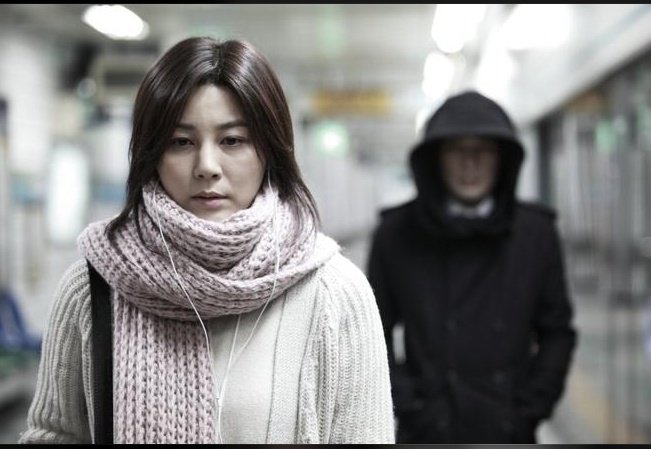
The subway sequence is among the film’s most memorable scenes.
It combines a public transportation environment, an approaching threat, a mobile phone, and the need to communicate information quickly.
The use of video communication is particularly significant.
A camera normally functions as a tool for recording or displaying visual information. In this scene, however, the phone becomes a way for another person to help Soo-ah understand her immediate surroundings.
Gi-seob can observe what is happening and guide her through the phone.
The technology creates a temporary connection between two different ways of experiencing the same environment.
This is an interesting reversal.
Soo-ah’s inability to see makes the camera seem essential, but the camera alone cannot solve the problem. It needs someone who understands what Soo-ah is experiencing and can communicate useful information clearly.
Technology becomes effective because of human cooperation.
The scene also demonstrates how the meaning of a familiar device can change depending on the situation.
A smartphone is usually associated with entertainment, communication, or personal convenience. Here, it becomes an emergency navigation tool.
The suspense comes from the fact that communication is not instantaneous in a psychological sense. Information must be seen, interpreted, explained, and acted upon before the danger reaches Soo-ah.
The sequence remains one of the clearest examples of the film translating its central theme into physical action.
9. Seul-gi: The Guide Dog Is More Than an Emotional Symbol
Soo-ah’s guide dog, Seul-gi, has an important place in the film.
A guide dog is not simply a companion that provides comfort. It performs a practical role in helping a visually impaired person navigate their surroundings.
The relationship between a handler and a guide dog depends on training, communication, consistency, and trust.
This is why Seul-gi’s presence matters beyond the emotional dimension of the story.
The dog represents a form of independence that is made possible through cooperation between two living beings.
Soo-ah is not helpless without Seul-gi, but the dog’s assistance expands the ways in which she can move through the world.
The film also uses the relationship to reveal a more vulnerable side of Soo-ah.
Her connection with Seul-gi is based on daily dependence and mutual trust rather than social judgment.
The tragedy involving the dog later in the film is especially painful because it attacks one of the few relationships that provide Soo-ah with a sense of safety.
However, it is important not to reduce guide dogs to sentimental devices whose only purpose is to make an audience cry.
Their real-world role is practical and highly trained.
The emotional impact of Seul-gi’s presence is strongest when viewers recognize that the dog represents both companionship and an essential part of Soo-ah’s everyday independence.
10. The Killer: A Predator Who Exploits the Vulnerability of Others
The antagonist, played by Yang Young-jo, represents a form of violence that is particularly frightening because it is calculated.
He does not simply create danger through sudden aggression. He exploits the vulnerabilities of people who have limited ability to protect themselves.
The criminal’s pursuit of witnesses reveals another important aspect of the story.
The investigation is no longer just about identifying what happened. It becomes a struggle to prevent the people who know something from being silenced.
This changes the meaning of being a witness.
A witness is often imagined as someone who observes an event and later provides information to the authorities.
But in a dangerous criminal investigation, being a witness can make someone a target.
Soo-ah and Gi-seob discover that knowledge carries risks when the person responsible for a crime is willing to eliminate anyone who can expose the truth.
The antagonist also creates a disturbing contrast with Soo-ah.
She uses her attention and intelligence to understand the world around her. He uses his ability to observe other people’s weaknesses to control and threaten them.
The difference is not simply between sight and blindness.
It is between two different uses of human awareness.
One seeks to understand and protect. The other seeks to exploit and dominate.
11. The Camera’s Perspective: Making the Audience Experience Limited Vision
A thriller about a blind protagonist faces a difficult cinematic problem.
Film is a visual medium. The audience normally receives information through images, camera movement, and editing.
How can a filmmaker communicate the experience of a character who cannot rely on sight in the same way?
Blind attempts to answer this through subjective framing, changes in sound emphasis, and sequences in which visual information is incomplete or deliberately confusing.
The purpose is not necessarily to reproduce blindness accurately in every technical detail.
Rather, the film uses cinematic language to create uncertainty about what is happening and how much information the protagonist can access.
This approach is especially useful during moments of danger.
The audience may see the environment but still lack the information needed to understand the threat. At other moments, the sound design becomes more important than the image.
This creates a useful distinction between seeing something and understanding it.
A person may be looking directly at an event without recognizing its significance. Another person may receive less visual information but notice details that change the interpretation of the situation.
The film’s strongest sequences emerge from this tension.
Its weakness is that the subjective representation of blindness can occasionally become a conventional suspense device.
The audience should remember that Soo-ah is an individual character with particular abilities and experiences, not a universal representation of every blind person’s daily life.
12. The Film’s Strengths and Weaknesses: An Effective Thriller With Uneven Development
Blind has several clear strengths.
Kim Ha-neul’s performance gives Soo-ah an emotional foundation. She must communicate intelligence, frustration, fear, determination, and vulnerability without relying on ordinary visual interaction.
Her portrayal is central to the film’s success.
The central concept is also effective. The conflict between two witnesses with different forms of perception provides a distinctive foundation for a crime thriller.
The subway sequence demonstrates how technology and cooperation can be integrated into suspense rather than used as simple plot decoration.
The film also received significant recognition in South Korea. Kim Ha-neul won major acting awards for her performance, and the film attracted more than two million admissions domestically.
Nevertheless, the film is not without problems.
Some sections shift between thriller, comedy, and melodrama in ways that can interrupt the tension. The supporting characters do not always receive enough development, and the antagonist sometimes feels closer to a familiar thriller villain than a fully explored human being.
The police investigation also relies on certain dramatic conveniences.
These weaknesses do not erase the film’s distinctive premise, but they limit how consistently it develops that premise.
A strong concept is not automatically a complete story.
The film is most successful when it explores Soo-ah’s perception and the relationship between different witnesses. It is less distinctive when it returns to familiar serial-killer conventions.
13. Beyond the Thriller: What the Film Says About Disability and Social Recognition
The deeper social question in Blind concerns the way society evaluates people whose abilities do not match conventional expectations.
Soo-ah’s testimony is initially doubted because she cannot see.
This reflects a broader tendency to define people by what they are assumed to lack rather than by what they can actually contribute.
The same problem appears in workplaces, public institutions, education, and everyday social interactions.
People with disabilities may be excluded from opportunities not because they lack the necessary knowledge or judgment, but because systems are designed around assumptions that do not account for different ways of functioning.
The film does not provide a complete account of disability rights or accessibility. Its primary objective is to create a suspenseful crime story.
However, its central conflict allows viewers to recognize a meaningful social contradiction.
Soo-ah is treated as an unreliable witness before her information is properly evaluated. Yet her observations eventually become essential to understanding the case.
This does not mean that every person with a disability possesses extraordinary abilities.
That would simply replace one stereotype with another.
The more important point is that a person’s disability should not determine the credibility of their knowledge before the evidence has been examined.
The film’s most valuable social message is therefore not that blind people can be heroes too.
It is that society should stop assuming that one particular way of experiencing the world is the only reliable way to understand it.
14. The Final Question: How Much Truth Do We Miss Because We Refuse to Listen?
The ending of Blind brings Soo-ah’s struggle to its most dangerous point.
Her ability to survive depends not only on her own determination but also on the information and assistance available to her.
The story ultimately returns to the relationship between perception, trust, and cooperation.
Soo-ah cannot rely on sight to navigate every situation. Gi-seob cannot solve the case simply by looking at the evidence. The police cannot complete their work by relying on institutional authority alone.
Each person has limitations.
The truth emerges only when different kinds of information are brought together and examined.
This is the film’s most meaningful idea.
We often assume that the person who sees the most must understand the most. But perception is not the same as knowledge, and knowledge is not the same as wisdom.
A witness can overlook something obvious. An investigator can dismiss an important clue. An institution can fail because it trusts its assumptions more than the evidence.
Soo-ah’s story challenges that hierarchy.
Her blindness does not make her automatically wiser, but it exposes how narrow the definition of reliable perception can become when society depends too heavily on appearances.
The title Blind therefore carries a meaning beyond physical vision.
Sometimes the people who cannot see are not the ones who misunderstand the truth.
Sometimes the real blindness belongs to those who refuse to listen.
TTK Final Perspective
Blind is remembered as a suspenseful Korean thriller, but its most interesting achievement is the way it challenges the relationship between physical perception and social credibility.
Soo-ah’s journey is not about proving that blindness gives someone extraordinary powers. It is about demonstrating that human knowledge can come from different forms of experience, and that those experiences deserve to be examined rather than dismissed.
The film has familiar thriller conventions and some uneven character development. Yet its central premise remains powerful.
In a world where people are often judged by what they appear to lack, Blind asks viewers to reconsider what it actually means to see.
Perhaps the greatest form of blindness is not the inability to perceive an image.
It is the refusal to recognize the truth when it comes from someone we have already decided not to believe.
TTK Original — Beyond the Headlines