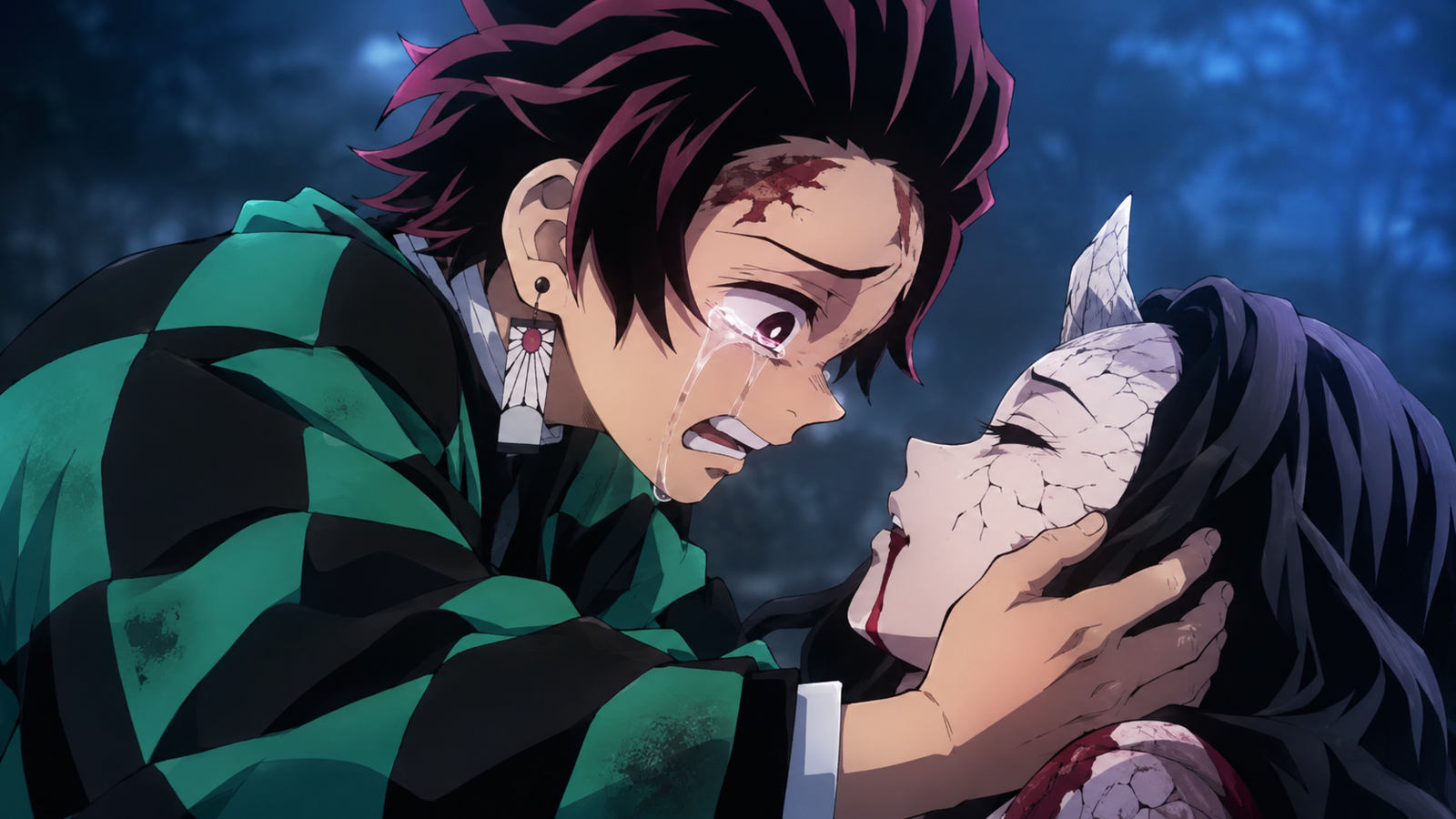
Demon Slayer appears to have a straightforward premise. Demons prey on humans, the Demon Slayer Corps hunts them, and Tanjiro Kamado fights to protect the innocent while searching for a way to turn his sister Nezuko back into a human.
But something unusual happens throughout the story.
Just when viewers are ready to celebrate a demon’s defeat, the series often reveals the life that demon once lived. A monster who seemed cruel and terrifying suddenly becomes someone who suffered, lost, or desperately wanted something that was never within reach.
The audience is left with an uncomfortable emotional contradiction: the demon deserved to be stopped, but its death can still feel tragic.
That contradiction is one of the most important reasons Demon Slayer connects with audiences beyond its spectacular battles.
1. A Story That Asks Us to Hate Its Villains—and Then Understand Them
Most action stories establish a clear emotional division between heroes and villains.
The audience identifies with the hero, fears the enemy, and eventually experiences satisfaction when the villain is defeated.
Demon Slayer follows this structure, but repeatedly interrupts it.
After a demon loses a battle, the story may return to its human past. We discover the relationships it once had, the suffering it experienced, and the decisions that led it toward becoming a demon.
This does not erase its crimes.
Instead, it changes the emotional meaning of its defeat. The audience can recognize that a demon must be stopped while also recognizing that something deeply human was lost along the way.
The series does not ask viewers to excuse every villain. It asks them to look beyond the monster’s final appearance.
2. Tanjiro Is Different Because He Does Not Confuse Understanding With Forgiveness
Tanjiro’s defining characteristic is not simply his determination or fighting ability.
It is his capacity to recognize suffering even when it belongs to an enemy.
He understands that demons have committed terrible acts. He does not abandon his responsibility to protect people. Yet he often senses the tragedy behind the violence.
This distinction is essential.
Understanding why someone became cruel does not mean accepting what that person has done. Compassion does not require surrendering moral judgment.
Tanjiro embodies both positions at once. He can fight decisively and still feel sorrow for the defeated demon.
That emotional balance gives the protagonist a different kind of strength. His humanity survives even in a world designed to destroy it.
3. The Demons Are Not Born as the Monsters We Meet
One of the series’ most effective storytelling choices is its repeated return to the demons’ human identities.
Their transformations are not presented as identical experiences. Some are driven by desperation, some by manipulation, and others by desires that gradually consume their remaining humanity.
Their individual histories reveal different relationships with fear, loneliness, jealousy, power, and loss.
This approach creates an important distinction between the act of becoming a demon and the circumstances surrounding it.
A demon’s past may explain its transformation, but explanation is not the same as justification.
That is why these stories can be emotionally powerful without making the victims’ suffering disappear.
4. Akaza Shows How a Tragic Past Can Complicate a Terrible Villain
Akaza is one of the clearest examples of this contradiction.
As an Upper Rank demon, he is terrifying. His strength, fighting instincts, and obsession with power make him an extraordinary threat.
Yet his human past reveals a very different person.
Before becoming a demon, he was Hakuji, a young man whose life was shaped by poverty, desperation, and devastating personal losses. His relationship with Keizo and Koyuki gave him a glimpse of a life that might have been peaceful.
That possibility was destroyed.
His transformation into a demon does not make his later violence acceptable. But it reveals how much was lost before he became the enemy Tanjiro and the others had to confront.
Akaza’s story is tragic precisely because the person he once was and the monster he became cannot be separated completely.
5. Daki and Gyutaro Reveal the Cruelty of a World Before the Demon Transformation
The story of Daki and Gyutaro offers another perspective.
Their human lives were shaped by extreme poverty, social rejection, and violence. They grew up in an environment where their existence was treated as disposable.
Their relationship as siblings became their strongest source of attachment.
Even after becoming demons, that bond remained central to their identities.
Their story does not suggest that their victims’ lives mattered less. Rather, it shows how a brutal environment can create people who eventually reproduce the brutality they experienced.
Their final moments are particularly significant because the conflict is no longer only about defeating two powerful enemies.
It is also about the relationship between two siblings who have almost nothing left except each other.
6. Doma Represents the Limits of Sympathy
Not every demon receives the same emotional treatment.
Doma is an important contrast to characters such as Akaza.
His apparent kindness and cheerful manner conceal a disturbing absence of genuine emotional connection. He does not simply become cruel because of one tragic event that viewers can easily understand.
His character challenges the assumption that every villain must have a heartbreaking explanation.
Sometimes, the most unsettling possibility is that a person can cause terrible suffering without experiencing the emotions that others take for granted.
This contrast matters because it prevents the series from reducing every demon to the same formula.
Some demons invite sympathy. Others reveal the frightening distance between human appearance and human feeling.
7. Kokushibo Shows What Happens When Ambition Becomes an Identity
Kokushibo’s tragedy is rooted in comparison and envy.
Once known as Michikatsu Tsugikuni, he lived in the shadow of his younger twin brother, Yoriichi.
Yoriichi possessed extraordinary natural talent, and Michikatsu’s inability to accept the difference between them gradually shaped his choices.
His desire to overcome human limitations eventually became more important than the life he already had.
Kokushibo is compelling because his downfall is not simply caused by external cruelty.
It is also the result of an internal obsession.
He wanted to become greater, but the pursuit of greatness consumed the very identity he was trying to protect.
His story asks a difficult question: when does the desire to become better stop being ambition and become self-destruction?
8. Muzan Is the Important Exception to the Sympathy Formula
Muzan Kibutsuji stands apart from many of the demons whose pasts invite compassion.
He is the origin of the demon threat and represents a form of selfishness that extends far beyond ordinary survival.
His desire to overcome death and escape vulnerability shapes his treatment of others. People become tools, obstacles, or disposable resources.
Unlike demons whose stories reveal a painful human history, Muzan’s character is built around his refusal to accept limits.
He wants immortality without responsibility and power without accountability.
This makes him an important counterpoint to Tanjiro.
Tanjiro’s strength comes partly from acknowledging the suffering of others. Muzan’s power comes from treating other lives as insignificant.
Their conflict is therefore more than a battle between a demon slayer and the strongest demon. It is a clash between two radically different ways of understanding life.
9. Nezuko Makes the Story’s Moral Question Personal
Tanjiro’s compassion toward demons would be less meaningful if his own family had not been destroyed by one.
Nezuko’s transformation places the central contradiction directly inside his family.
She is a demon, but she is also his sister.
Her existence challenges the assumption that every demon has completely lost its humanity.
The story does not treat Nezuko as proof that all demons can be trusted. Instead, she becomes an extraordinary case that forces Tanjiro to keep searching for the possibility of humanity even in a transformed being.
Her relationship with Tanjiro gives the larger conflict an emotional foundation.
The question is no longer simply whether demons deserve to die.
It becomes a more personal question: what remains of someone after the world has changed them beyond recognition?
10. Why the Demon Slayer Corps Cannot Simply Forgive Every Demon
Compassion has limits in a world where innocent people are constantly being killed.
The Demon Slayer Corps exists because demons are a genuine danger. Every hesitation can mean another victim.
This is where Demon Slayer avoids turning empathy into an easy moral solution.
Tanjiro can feel sorrow for a demon, but he cannot allow that sorrow to prevent him from protecting others.
The distinction is important because the series gives equal emotional weight to the victims and the defeated enemies.
A tragic past does not restore the lives a demon has taken.
The story’s emotional complexity comes from refusing to make either side disappear.
11. The Final Moments of a Demon Often Reveal More Than the Battle
The battles in Demon Slayer are visually spectacular, but their emotional conclusions frequently happen after the fighting stops.
A demon’s final memories can reveal the person it once was. A forgotten relationship may return. A long-buried regret may become visible.
These scenes change how the audience remembers the battle.
The victory is still necessary, but it is no longer emotionally simple.
This structure also gives individual demons a sense of narrative closure. Their lives are not defined exclusively by their final acts of violence.
The series uses the moment of defeat to reveal the distance between who they were and who they became.
12. Why Reddit Fans Debate the Story’s Emotional Depth
Discussions among Demon Slayer fans often reveal two different ways of evaluating the series.
Many viewers appreciate the tragic histories of the demons, particularly when those histories deepen the emotional impact of a fight.
Others argue that the storytelling can become predictable: a powerful demon is defeated, and the audience then receives a tragic flashback explaining its past.
This criticism is worth taking seriously.
When the same structure appears repeatedly, viewers may begin anticipating the emotional reveal before it happens. For some, this reduces the surprise and makes the formula feel familiar.
But the repetition also serves a thematic purpose.
The series keeps returning to the same question because the answer is never exactly the same. Akaza, Daki and Gyutaro, Kokushibo, and Doma represent different relationships with suffering and humanity.
The strength of the storytelling lies not in making every demon sympathetic, but in showing that evil can emerge from very different circumstances.
13. The Real Difference Between Tanjiro and the Demons Is What They Do With Their Pain
Tanjiro and many demons share something important: both have experienced devastating loss.
The difference is how they respond to it.
Tanjiro’s suffering does not make him indifferent to other people. Instead, it strengthens his determination to protect them.
Some demons respond to their pain by seeking power, revenge, or control. Their suffering becomes a reason to impose suffering on others.
This contrast is the deeper moral structure of the series.
Pain alone does not determine whether someone becomes compassionate or cruel. What matters is what a person chooses to do with that pain.
That is why Tanjiro’s kindness is not weakness. It is a decision he continues to make even when the world gives him every reason to become bitter.
14. The Most Terrifying Thing About Demon Slayer Is How Easily Humanity Can Be Lost
At first glance, Demon Slayer is a story about humans fighting monsters.
But its most memorable emotional moments suggest something more complicated.
The demons are frightening because of what they do. Their human pasts are tragic because of what they have lost. And the contrast between those two realities forces viewers to confront an uncomfortable truth.
Humanity is not guaranteed by appearance, memory, or even the history someone once had.
It is reflected in how people treat others.
The series does not ask us to excuse the demons. It asks us to recognize the human stories behind some of them without forgetting the people they harmed.
That is what makes its emotional conflicts more interesting than a simple battle between good and evil.
The real tragedy is not merely that humans become demons.
It is that suffering can become something people pass on to others.
And perhaps the greatest victory in Demon Slayer is not simply defeating monsters, but refusing to let hatred turn the people fighting them into monsters themselves.
Final Thought
Demon Slayer makes its audience do something unusual: mourn the enemy without forgetting why the enemy had to be defeated.
Its demons are not all innocent victims, and their tragic pasts do not erase their crimes. But their stories reveal how easily pain, fear, and obsession can destroy the humanity that once existed beneath the surface.
Tanjiro’s greatest strength may therefore be something no sword technique can measure.
He can see the monster, recognize the person who once existed, and still choose to protect the living.