Classical Piano

  • The Real-Life Jeong-yo? 5 Yunchan Lim Performances Every Four Hands Fan Should Hear

    If Jeong-yo from Netflix’s Four Hands, Two Sonatas were a real pianist, who would he resemble?

    For Korean viewers, one name is difficult to ignore:

    Yunchan Lim.

    To be clear, there is no confirmed evidence that Jeong-yo was officially based on Lim.

    But the comparison is fascinating.

    Both represent a particular image of musical genius: not simply someone who can play difficult notes faster than everyone else, but someone who seems to hear something different inside the music.

    And Yunchan Lim’s real story can sometimes sound almost as unlikely as a K-drama.

    Is Jeong-yo Based on Yunchan Lim?

    As far as publicly confirmed information goes, we should not say that he is.

    There is an important difference between:

    “Jeong-yo was modeled after Yunchan Lim”

    and

    “Yunchan Lim is a real pianist who reminds us of Jeong-yo.”

    The second is the interesting question.

    Jeong-yo is portrayed as a pianist whose greatest weapon is not simply technique.

    It is his instinctive relationship with music.

    He interprets.

    He surprises.

    And other musicians do not always seem to understand where his musical decisions come from.

    That is where the comparison with Yunchan Lim becomes interesting.

    Yunchan Lim Did Not Come From a Famous Musical Family

    Lim was born in Siheung, South Korea, in 2004.

    His parents were not professional musicians.

    He began learning piano at around seven years old after becoming interested in music as a child.

    That detail matters.

    When we watch fictional prodigies, we often imagine a child raised from birth inside an elite musical dynasty.

    Lim’s story was different.

    He started relatively normally before his extraordinary ability became increasingly apparent.

    He later studied at the Music Academy of the Seoul Arts Center and eventually entered Korea National University of Arts, where pianist and teacher Minsoo Sohn became a major influence on his development.

    So the romantic version — “an unknown child walks into a neighborhood piano school and suddenly becomes a world champion” — would be an exaggeration.

    But the underlying story is still remarkable:

    an ordinary Korean child with no famous musical parents developed into one of the most talked-about young pianists in the world.

    What Makes Yunchan Lim Feel Like Jeong-yo?

    Technique alone is not the answer.

    There are many pianists with astonishing technique.

    What made Lim’s rise particularly fascinating was how often attention focused on his interpretation.

    When he won the 2022 Van Cliburn International Piano Competition at only 18, he became the youngest gold medalist in the competition’s history.

    But audiences did not become obsessed with him simply because he was young.

    They responded to the way he played.

    His performances could feel intensely controlled one moment and almost dangerous the next.

    That is also what makes Jeong-yo interesting in Four Hands.

    A technically perfect pianist is impressive.

    A pianist who makes you wonder,

    “Why did he play it that way?”

    is much harder to forget.

    1. Rachmaninoff — Piano Concerto No. 3

    If you watch only one Yunchan Lim performance after Four Hands, start here.

    His performance of Rachmaninoff’s Piano Concerto No. 3 at the 2022 Van Cliburn Competition became one of the defining performances of his breakthrough.

    This is an enormous piece technically.

    But don’t watch only his hands.

    Watch how the music develops.

    There are moments of restraint, enormous climaxes and sudden changes in emotional weight.

    For a Four Hands viewer, this may be the easiest performance through which to understand the difference between:

    “He can play incredibly well.”

    and

    “He seems to understand the music differently.”

    That second feeling is very Jeong-yo.

    2. Liszt — Transcendental Études

    Next, listen to Lim playing Liszt’s 12 Transcendental Études.

    Even the name tells you what kind of music this is.

    These works are among the great technical challenges of the piano repertoire.

    But again, speed is not the most interesting part.

    The 12 études have different characters, colors and emotional landscapes.

    Playing the notes is one challenge.

    Making twelve technically brutal pieces feel like twelve different musical worlds is another.

    This is perhaps the performance I would recommend most strongly to viewers fascinated by Jeong-yo’s “genius” side.

    Because true virtuosity becomes much more interesting when technique stops being the destination and becomes merely a tool.

    3. Beethoven — Piano Concerto No. 3

    Now listen to something different.

    Lim’s Beethoven shows why describing him only as an explosive young virtuoso misses part of his appeal.

    Beethoven demands structure.

    The pianist cannot simply overwhelm the listener with speed or emotion.

    The architecture of the music has to make sense.

    Listen to how Lim handles phrasing, tension and silence.

    For Four Hands fans, this is useful because it reveals something important about real pianists:

    genius is not always loud.

    Sometimes it is knowing exactly how much not to play.

    4. Mozart — Piano Concerto No. 22

    Mozart provides another test.

    A pianist cannot hide behind sheer power here.

    The music needs clarity, balance, conversation and personality.

    This is where you can listen for the lighter side of Lim’s musicianship.

    If Rachmaninoff shows the scale of his talent and Liszt shows his virtuosity, Mozart helps reveal his musical instincts.

    It is also a good reminder that a great pianist is not simply someone capable of playing the hardest music.

    The harder skill can be making something apparently simple sound alive.

    5. Chopin — Études, Op. 10

    And then there is Chopin.

    Lim’s recording of Chopin’s Études Op. 10 became particularly significant in his international career, earning major critical recognition.

    These pieces combine technique with poetry in a way that makes them perfect for understanding why Lim’s playing attracts so much attention.

    Listen beyond the difficulty.

    Listen for character.

    One étude can feel intimate, another restless, another almost overwhelming.

    That ability to give individual identity to familiar music is exactly why the comparison with Jeong-yo becomes interesting.

    Jeong-yo vs. Yunchan Lim: Where the Comparison Works

    There are some striking similarities in the image they project.

    Jeong-yo in Four HandsYunchan Lim in real life
    Extraordinary musical instinctInternationally praised young pianist
    Known for interpretation, not only techniqueFrequently praised for musical depth and interpretation
    Makes other musicians curious about his choicesPerformances generated major international attention
    Young Korean piano prodigyYoungest-ever Van Cliburn gold medalist
    Fictional dramatic careerReal professional concert career

    But there is one enormous difference.

    Jeong-yo is a fictional character.

    His life can be designed around rivalry, disappearance, family secrets and dramatic twists.

    Lim is a real musician whose career has developed through years of training, teachers, competitions and professional performance.

    We should enjoy the similarities without turning fiction into biography.

    Was Yunchan Lim Really an Unknown Piano-School Genius?

    This needs a little clarification because it makes a great story — perhaps too great.

    Lim did begin piano at around seven and did not come from a professional musical family.

    But he did not remain an anonymous neighborhood student until suddenly appearing at the Van Cliburn Competition.

    His talent was recognized much earlier.

    He received specialized musical education, entered Korea’s elite training system and studied seriously with Minsoo Sohn.

    By the time the world discovered him in Texas in 2022, years of training had already taken place.

    So perhaps the more interesting question is not:

    “How did an unknown boy suddenly become a genius?”

    It is:

    “How did an ordinary beginning develop into something extraordinary?”

    Why Does Korea Keep Producing World-Class Pianists?

    Yunchan Lim is not an isolated case.

    South Korea has produced internationally recognized classical musicians including pianists Cho Seong-jin and Lim, along with many successful competitors and performers.

    There are several possible reasons.

    Korea has a highly developed private music-education culture, specialized arts schools, strong competition among students and families willing to invest enormous time in education.

    But education alone cannot manufacture a Yunchan Lim.

    Thousands of students practice.

    Very few become internationally distinctive artists.

    Training can develop technique.

    The mystery is what happens when exceptional training meets an exceptional musical mind.

    And that is exactly the question Four Hands, Two Sonatas dramatizes through Jeong-yo.

    If You Love Jeong-yo, Start With These Two

    You don’t need to become a classical-music expert.

    If Four Hands made you curious about piano, just start with two performances:

    For drama and overwhelming emotion:
    Yunchan Lim — Rachmaninoff Piano Concerto No. 3

    For pure pianist-to-pianist fascination:
    Yunchan Lim — Liszt’s Transcendental Études

    Then close your eyes for a few minutes.

    Forget the competition.

    Forget how old the pianist is.

    Forget whether the piece is supposed to be difficult.

    Just listen.

    You may understand why people sometimes use the word “genius” not for someone who plays more notes —

    but for someone who makes familiar notes sound as though they have just been discovered.

    And if Jeong-yo from Four Hands, Two Sonatas has made you curious enough to listen to a real Korean pianist for the first time, perhaps the drama has already done something worthwhile.
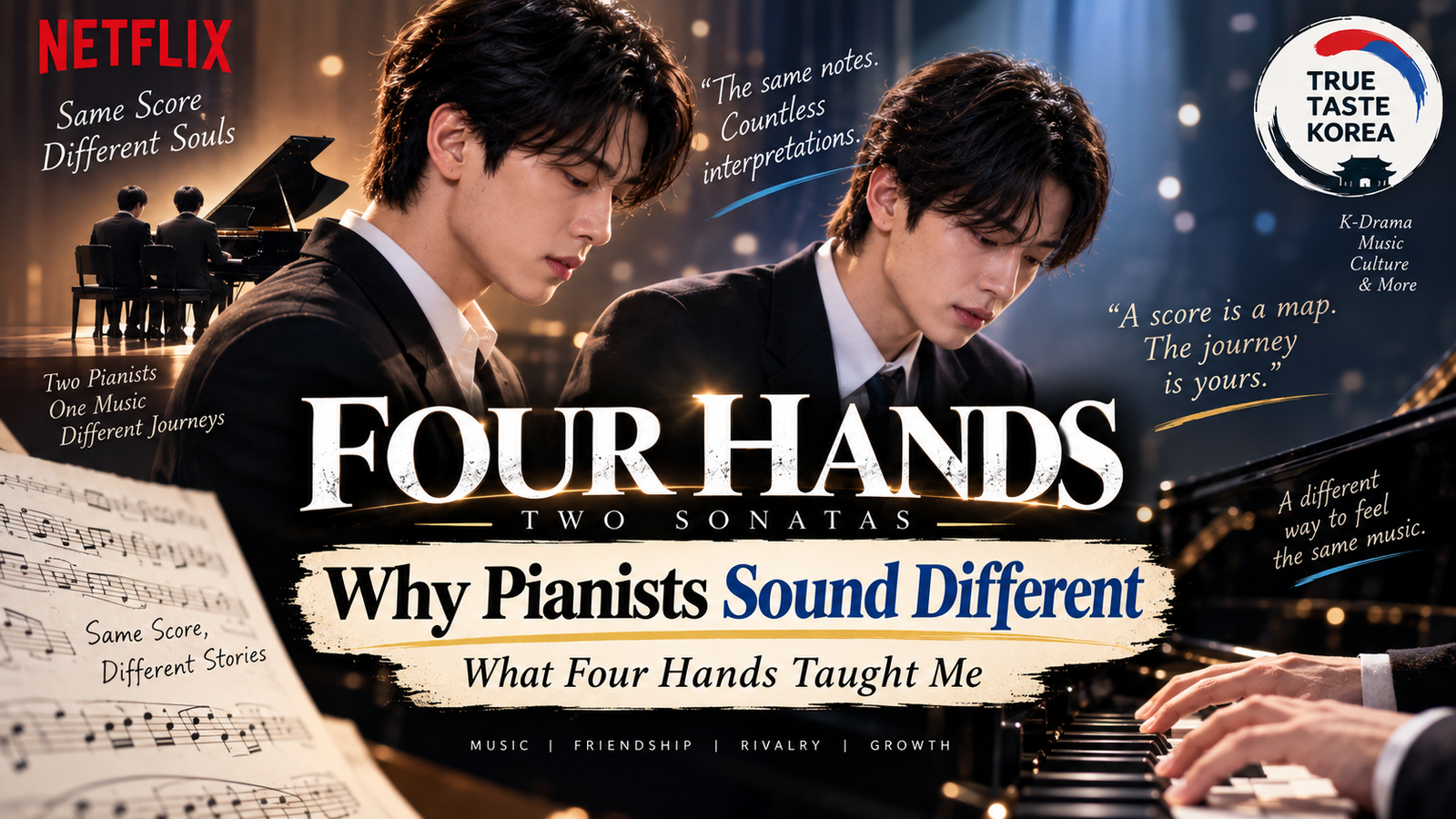
  • Four Hands Taught Me Why Great Pianists Never Sound the Same

    Four Hands Taught Me Why Great Pianists Never Sound the Same

    Before watching Four Hands, Two Sonatas, I had a very simple idea of what a great pianist was.

    I thought pianists were, in a sense, highly sophisticated machines.

    The composer writes the music. The notes are printed on the score. The pianist reads those notes and plays them as accurately as possible.

    So I assumed that if two world-class pianists played the same piece correctly, their performances should sound more or less the same.

    Four Hands made me realize how wrong that idea was.

    And I suspect I am not the only non-musician who thought this way.

    The drama taught me something surprisingly profound about classical music:

    A musical score is not the music itself. It is more like a map.

    The map may be the same.

    But every great pianist takes a different journey through it.


    I Thought Playing Piano Was About Following the Score

    For someone without professional musical training, the logic seems obvious.

    A score tells the pianist which notes to play.

    It contains rhythm, tempo markings, dynamics and instructions from the composer.

    So what is left for the pianist to decide?

    A great deal, as it turns out.

    That realization is one of the most fascinating ideas presented in Four Hands.

    The drama repeatedly shows that musical ability cannot be measured simply by asking:

    “Did he play the correct notes?”

    A pianist can play every note correctly and still produce a performance that feels completely different from another pianist playing exactly the same score.

    That was something I had never really understood before watching the drama.


    The Score Is a Map, Not a Set of GPS Instructions

    The best way I can describe what Four Hands taught me is this:

    Imagine giving two travelers the same map.

    The starting point is identical.

    The destination is identical.

    The roads printed on the map are identical.

    But that does not mean their journeys will be identical.

    One person may move quickly through one section and slow down somewhere else.

    Another may stop and notice something the first traveler barely saw.

    One may see several landmarks as part of a single landscape.

    Another may focus on each landmark individually.

    The map hasn’t changed.

    Their interpretation of the journey has.

    A musical score can work in a similar way.

    And this is where Four Hands begins to explain why a truly exceptional pianist is not simply someone capable of following instructions.


    The Same Notes Can Become Different Music

    One of the ideas that fascinated me most in the drama was how differently notes can be grouped and expressed.

    A pianist doesn’t necessarily experience music as:

    note → note → note → note.

    Several notes can be understood and expressed as one musical phrase — one larger emotional unit.

    Another pianist may take a similar passage and give individual notes greater separation.

    Neither necessarily needs to change the written notes.

    What changes is how those notes are understood and communicated.

    This was a revelation to me.

    It means that the pianist isn’t merely asking:

    “Which note comes next?”

    The pianist is also asking:

    “What does this entire passage mean?”

    That is a completely different way of understanding performance.


    Tempo Is Not Just About Playing Fast or Slow

    Four Hands also made me notice something else I had previously overlooked.

    Speed itself can be expressive.

    To an ordinary listener, tempo might seem like another instruction:

    Play this piece at this speed.

    But a performance breathes.

    A pianist may push forward through one phrase, create tension, then allow another passage more space.

    Even subtle differences in timing can change how the listener experiences the music.

    A phrase can feel impatient.

    Another can feel hesitant.

    Another can sound confident.

    Another can sound almost as though it is asking a question.

    The notes themselves haven’t necessarily changed.

    The interpretation has.


    Why Choi Jeong-yo’s Talent Matters So Much

    This is also why I think the drama’s portrayal of Choi Jeong-yo, played by Lee Jun-young, is particularly interesting.

    It would have been easy for the writers simply to tell us:

    “Jeong-yo is a genius.”

    Many dramas do exactly that.

    They introduce a gifted character, have everyone around him repeatedly call him a genius, and expect the audience to accept it.

    Four Hands attempts something more interesting.

    It gradually gives the viewer a language for understanding why his musical ability is special.

    His talent isn’t meaningful simply because he can press difficult keys quickly or reproduce complicated music without making mistakes.

    What matters is how he understands the music.

    And as other characters begin to recognize something unusual in his interpretation, the audience begins learning how to recognize it too.

    That distinction is important.


    The Audience Learns Along With the Characters

    This may be one of the smartest aspects of Four Hands.

    At the beginning, many viewers probably listen to piano much like I did.

    We hear a difficult performance and think:

    “Wow. He can play really fast.”

    Or:

    “He didn’t make any mistakes. He must be brilliant.”

    But the drama gradually gives us other things to listen for.

    Why did he slow down there?

    Why did those notes feel like one large phrase?

    Why did the other pianist separate them?

    Why did one interpretation feel restrained while another felt emotional?

    Why can two performances of the same composition leave completely different impressions?

    Suddenly, the viewer isn’t merely watching characters talk about classical music.

    The viewer is learning how to listen.

    That is what surprised me most.


    Pi-o and Jeong-yo Don’t Just Compete — They Hear Music Differently

    This also changes how I see the relationship between Kang Pi-o and Choi Jeong-yo.

    On the surface, Four Hands can look like the familiar story of two geniuses competing to determine who is better.

    But if music can have countless interpretations, the question “Who is better?” becomes much more complicated.

    Pi-o and Jeong-yo don’t simply have different levels of skill.

    They have different experiences.

    Different personalities.

    Different emotions.

    Different lives.

    And all of those things can influence how a musician understands what is written on the page.

    That makes their rivalry much more interesting.

    They aren’t simply racing along the same road to see who reaches the finish line first.

    They may be reading the same map and seeing completely different landscapes.


    Why Can Great Pianists Sound Different Playing the Same Piece?

    This is the question Four Hands ultimately made me ask.

    If the score is identical, where does the difference come from?

    There are many elements of musical interpretation, including:

    Tempo — how quickly the music moves and how that pace changes.

    Phrasing — how individual notes are shaped into larger musical ideas.

    Dynamics — how softly or powerfully different passages are expressed.

    Articulation — whether notes feel connected, separated, sharp, delicate or flowing.

    Pedaling — how sounds are sustained and blended.

    Timing — tiny variations in when notes and phrases arrive.

    And beyond all of these technical concepts is something much harder to measure:

    the musician’s interpretation.

    Two pianists can look at the same score and understand its emotional meaning differently.

    That is why great performers can make familiar compositions feel new.


    The Composer Writes the Music — But the Pianist Gives It a Voice

    This changed another assumption I had.

    I used to think almost all of the creativity belonged to the composer.

    The composer creates.

    The pianist reproduces.

    Now I understand that relationship differently.

    The composer certainly creates the work.

    But a written score cannot physically make sound.

    Someone must transform those symbols into an experience that another human being can hear.

    That requires choices.

    And those choices are part of interpretation.

    A great pianist therefore occupies a fascinating position.

    The pianist must respect what the composer wrote without becoming merely a machine reproducing instructions.

    Too little interpretation, and the music can feel lifeless.

    Too much disregard for the score, and the performer may lose what the composer intended.

    The art exists somewhere between those two extremes.


    Now I Understand Why People Compare Different Recordings

    Before Four Hands, I never completely understood why classical music lovers might own or listen to several recordings of the same composition.

    If it is the same Beethoven sonata, why listen to five pianists play it?

    Shouldn’t one excellent recording be enough?

    Now the answer seems obvious.

    Because they aren’t really the same performance.

    The notes may come from the same score, but the experience can be completely different.

    One pianist may make a passage sound intimate.

    Another may make it monumental.

    One interpretation might emphasize tension.

    Another might reveal sadness.

    Another might find beauty somewhere I never noticed before.

    That means listening to different pianists isn’t simply hearing the same music repeatedly.

    It can be like hearing different interpretations of the same story.


    Four Hands Made Classical Music Easier to Understand

    I think this may be one reason Four Hands has connected so strongly with viewers in Korea.

    You don’t need to be a pianist to understand competition.

    You don’t need to study classical music to understand insecurity, friendship, pride, jealousy or the desire to be recognized.

    The drama uses those emotions to bring the viewer inside a world that might otherwise feel intimidating.

    And somewhere along the way, viewers like me begin learning about music almost without realizing it.

    I started watching a drama about talented young pianists.

    I ended up changing the way I think about piano performance itself.


    A Score Is Only a Map

    If I had to reduce what Four Hands taught me to one idea, it would be this:

    A score is a map.

    The composer draws the map.

    The notes establish the landscape.

    But the performer still has to travel through it.

    One pianist may rush toward something another approaches carefully.

    One may connect several notes into a single thought.

    Another may reveal the individual pieces hidden inside that thought.

    One may find sorrow where another finds hope.

    The map remains the same.

    The journey does not.

    And perhaps that is why we still need great performers even when the music they play was written hundreds of years ago.

    They aren’t simply repeating old notes.

    They are showing us another way to travel through them.


    Four Hands and Piano Interpretation FAQ

    Why do pianists sound different when playing the same piece?

    Because a musical score leaves room for interpretation. Pianists can differ in phrasing, timing, dynamics, articulation, pedaling and their overall understanding of the composition.

    Do classical pianists have to follow the score exactly?

    The written score provides the essential musical structure and the composer’s instructions, but interpretation remains a fundamental part of performance. The goal isn’t simply to reproduce notes mechanically.

    What does phrasing mean in piano playing?

    Phrasing is one way musicians organize individual notes into larger musical ideas. Rather than hearing every note as an isolated event, a pianist can shape groups of notes into something resembling a musical sentence.

    Why is Choi Jeong-yo considered talented in Four Hands?

    The drama portrays Jeong-yo’s ability as going beyond technical accuracy. An important part of his musical identity is the way he understands and interprets what he plays.

    What does the title Four Hands mean?

    In piano music, four hands generally refers to two pianists playing together on one piano. In the drama, the idea also works beautifully as a metaphor for two very different musicians learning to share the same musical world.