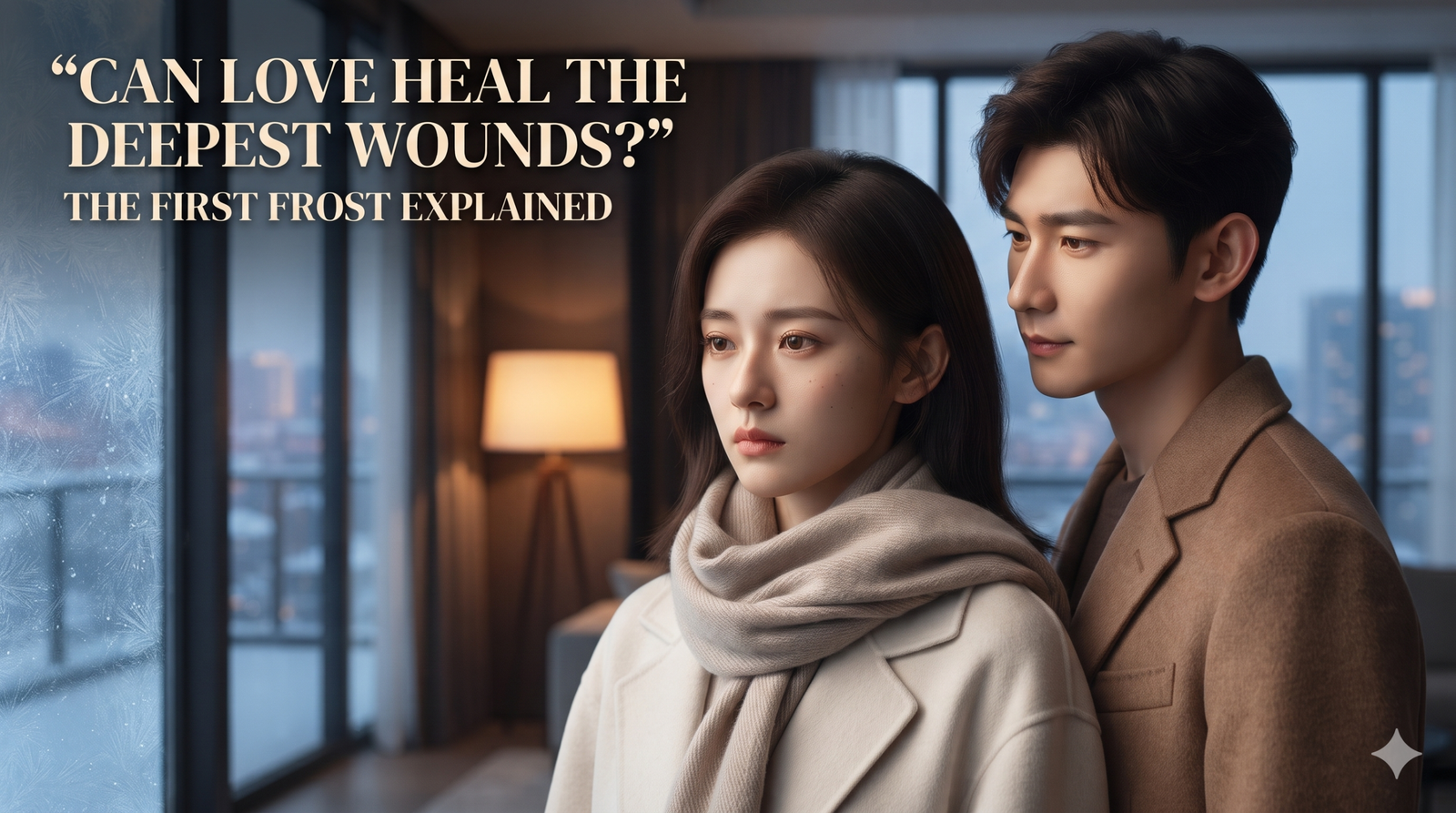
The First Frost is not simply a romance about two people who find each other again. It is a story about what happens when someone who has learned to fear the world finally encounters a person who makes trust feel possible.
Spoiler Warning: This analysis discusses major character developments, traumatic events, and the ending of the series.
Introduction: A Love Story That Begins With an Unhealed Past
At first glance, The First Frost appears to follow a familiar romantic formula.
Two former classmates meet again years after their relationship ended. Their circumstances bring them into close contact, old feelings gradually return, and the distance between them begins to disappear.
But Wen Yifan and Sang Yan’s reunion is not simply a second chance at first love.
For Wen Yifan, the past is not a collection of pleasant memories interrupted by a misunderstanding. It is something that has shaped the way she moves through the world.
She has experienced harassment, the violation of personal boundaries, family betrayal, and the devastating experience of not being adequately protected by the adults who should have protected her. These experiences have affected her ability to trust others and to imagine a future in which she can feel safe.
Sang Yan, meanwhile, has carried his feelings for her across years of separation. When they meet again, he discovers that the girl he remembers has become someone who struggles to accept even the simplest expressions of care.
This creates the central tension of the drama.
Sang Yan wants to get close to her. Wen Yifan wants to remain safe. The more he tries to understand her, the more she struggles with the possibility that allowing someone into her life might expose her to another kind of pain.
The question is not simply whether they still love each other.
It is whether love can exist without becoming another demand placed on someone who has already spent years trying to survive.
That is what makes The First Frost more interesting than an ordinary reunion romance.
1. Wen Yifan’s Deepest Wound Is Not Only What Happened to Her
One of the most important decisions in the drama is that Wen Yifan’s emotional difficulties are not presented as the result of a single unfortunate incident.
Her past contains multiple layers of harm.
She experiences threatening and inappropriate behavior from men, but the damage is intensified by the responses of the people around her. Instead of consistently receiving protection and understanding, she encounters situations in which her experiences are minimized, misunderstood, or turned against her.
This distinction matters.
There is a difference between being hurt by an individual and discovering that the people who should protect you may not stand beside you when you need them most.
For Wen Yifan, the failure of family protection becomes part of the wound itself.
Her father’s death marks a major turning point. The family environment that follows does not provide the security she needs. The adults who should recognize her vulnerability instead contribute to an atmosphere in which she has to endure more than she should ever have been expected to endure.
The result is not merely sadness.
It is a gradual loss of confidence in the idea that other people will protect her.
This helps explain why Wen Yifan often responds to danger by withdrawing, remaining silent, or trying to disappear from a situation rather than immediately confronting it.
From the outside, such behavior can look passive.
But the drama invites viewers to consider another interpretation: when a person repeatedly discovers that speaking up does not guarantee protection, silence can become a survival strategy.
That does not mean silence is always healthy or that avoidance solves the underlying problem. It means that behavior must be understood in the context of what produced it.
Wen Yifan’s character is therefore not simply a shy woman who needs a romantic partner to become confident.
She is someone whose understanding of safety has been damaged by repeated experiences in which other people failed to respect or protect her.
2. Why Family Betrayal Can Be More Complicated Than an Enemy’s Cruelty
The drama’s most uncomfortable subject may not be the behavior of the men who threaten Wen Yifan.
It is the behavior of the family members who fail to protect her.
An openly hostile person is easier to identify. Their actions can be condemned, and the victim can understand that the danger comes from outside.
Family betrayal creates a more complicated emotional conflict.
Children are generally taught that family is where they should expect protection. They are encouraged to believe that parents will stand beside them, that relatives can be trusted, and that home is a place where they can return when the outside world becomes difficult.
When those expectations collapse, the damage can reach beyond one relationship.
The person may begin questioning their own judgment. They may wonder whether they are asking for too much, whether their discomfort is justified, or whether speaking about what happened will create even greater problems.
This is especially significant when a victim is blamed or made to feel responsible for another person’s behavior.
Instead of receiving reassurance that the wrongdoing was not their fault, they may learn to monitor their own appearance, speech, movements, and interactions in an attempt to prevent future harm.
That is a devastating reversal of responsibility.
The person who caused the harm should be accountable. Yet the victim begins carrying the burden of preventing it.
In Wen Yifan’s story, the family environment helps explain why she struggles to believe that someone will stand beside her without demanding something in return.
This is why her relationship with Sang Yan cannot be understood only through romantic chemistry.
She is not simply deciding whether she likes him.
She is confronting a much larger question: can another person become close to her without eventually becoming another source of danger?
3. Sang Yan’s Love Is Important, but Love Is Not a Cure
Sang Yan is presented as someone who has never completely let go of Wen Yifan.
His affection is persistent. He remembers their past, notices changes in her behavior, and gradually discovers that the distance between them is connected to experiences he did not fully understand.
His patience becomes one of the drama’s strongest romantic elements.
But there is an important distinction between loving someone and understanding what that person needs.
At first, Sang Yan knows that Wen Yifan has kept him at a distance. He does not immediately understand the full history behind that distance.
As he learns more, his feelings begin to take on a different meaning.
He is no longer simply trying to recover a lost romance. He is beginning to understand why the woman he loves has difficulty accepting affection.
This is where the drama’s romantic premise becomes more psychologically interesting.
A person who has experienced repeated boundary violations may not automatically interpret attention as kindness. Even sincere affection can feel overwhelming when trust has been damaged.
The important question is therefore not how intensely Sang Yan loves her.
It is whether he can respect the limits she establishes, even when those limits are painful for him.
His devotion is meaningful when it creates room for Wen Yifan to make her own decisions. It becomes less meaningful if it is interpreted as permission to override those decisions simply because he believes he knows what is best for her.
This distinction deserves attention because romantic dramas sometimes confuse persistence with respect.
The two are not the same.
Persistence can be admirable when it means remaining emotionally available without demanding an immediate response. It becomes problematic when it ignores another person’s wishes.
Sang Yan’s strongest contribution is not that he can magically remove Wen Yifan’s suffering.
It is that he gradually becomes someone with whom she can experience a different kind of relationship: one in which she is not automatically blamed, dismissed, or treated as responsible for someone else’s behavior.
He does not erase her past.
He helps create the possibility of a future that does not have to repeat it.
4. The Difference Between Being Rescued and Being Given the Space to Recover
One of the most important questions viewers can ask about The First Frost is whether Wen Yifan is truly becoming stronger or whether the story relies too heavily on Sang Yan to protect her.
This is also one of the areas where the drama invites debate.
There are moments in which Sang Yan intervenes when she is threatened. His willingness to stand beside her is emotionally satisfying, especially after viewers have witnessed how frequently she has been left without adequate protection.
But a story about recovery becomes less convincing if the person who has suffered is allowed no meaningful role in determining what happens next.
There is a difference between rescue and recovery.
Rescue addresses an immediate danger.
Recovery involves rebuilding the ability to make decisions, establish boundaries, seek help, and participate in life without being defined entirely by what happened in the past.
A romantic partner can contribute to that process, but cannot complete it on someone else’s behalf.
This distinction is essential to understanding Wen Yifan.
If Sang Yan defeats every threat, solves every problem, and makes every difficult decision, then Wen Yifan’s life remains organized around someone else’s actions.
She may be safer, but she has not necessarily regained control.
The more meaningful moments are those in which she begins to recognize that her needs matter, that she has the right to refuse, and that she does not have to accept mistreatment simply to preserve a relationship.
Her recovery must include her own choices.
This is why her confrontation with her family and her eventual decision to establish distance from the people who failed to protect her are so significant.
She is not simply moving from one family to another.
She is beginning to define what kind of relationships she is willing to accept.
5. The Hong Kong Arc: Escape, Self-Protection, or a Missed Opportunity for Growth?
The Hong Kong storyline is one of the more debated parts of the series.
After the relationship has developed, Wen Yifan leaves again, creating another separation between the two leads.
For some viewers, this development is frustrating. It can feel as though the drama is repeating an emotional obstacle that should already have been resolved.
Others see the separation as an attempt to show that understanding one’s past does not automatically remove the fear associated with it.
Both interpretations deserve consideration.
From Wen Yifan’s perspective, leaving can be understood as an attempt to regain control when the past becomes threatening again. She has learned to protect herself by withdrawing, and the return of danger brings that familiar response back to the surface.
However, the dramatic execution raises a legitimate question.
Does the separation demonstrate meaningful character development, or does it temporarily reverse the progress she has made?
A story about recovery needs to show that progress is not always linear. People can make meaningful changes and still experience fear, hesitation, and setbacks.
But a setback should reveal something new about the character.
It should not simply repeat the same emotional pattern to prolong the romance.
The Hong Kong arc is most interesting when viewed as a test of whether Wen Yifan can move from avoidance toward conscious decision-making.
Leaving may protect her in the immediate moment, but it cannot by itself resolve the deeper problem.
She must eventually decide what she wants, what she fears, and whether she can face the past without surrendering control of her future.
The arc also gives Sang Yan an opportunity to understand how much of Wen Yifan’s life he never knew during their years apart.
That perspective is valuable.
However, the story could have made Wen Yifan’s independent decision-making even more central. This is one reason some viewers have questioned the adaptation’s treatment of her character.
6. Why the Original Novel Debate Matters
The First Frost is adapted from the web novel by Zhu Yi, the author also associated with Hidden Love.
The drama’s relationship with its source material became a subject of discussion among viewers, particularly concerning how Wen Yifan’s agency is portrayed.
Some adaptation comparisons have argued that the drama makes her more avoidant and places her in more situations where other characters intervene on her behalf.
The Hong Kong storyline has also been discussed as a significant change from the novel.
These differences matter because they affect the meaning of the heroine’s development.
In a story about a woman whose ability to protect herself has been undermined, the way she responds to danger is not a minor character detail.
It determines whether the narrative treats her as an active participant in her own recovery or primarily as someone who must be protected.
A drama adaptation has the freedom to change its source material. It can add scenes, expand supporting characters, or restructure the emotional progression.
But those changes should ideally strengthen the central theme.
If the original story is about a woman learning to trust herself and others, then every major adaptation decision should be examined through that question.
Does the change deepen our understanding of her?
Does it reveal a new aspect of her relationship with Sang Yan?
Does it give her more agency, or does it make her increasingly dependent on external intervention?
The debate around The First Frost is therefore not merely a disagreement between fans of a novel and fans of a television series.
It is a discussion about what a recovery story should look like.
7. The Supporting Characters Show What a Healthy Home Can Mean
One of the most meaningful contrasts in the series is between Wen Yifan’s family background and the environment she encounters through Sang Yan.
The Sang family offers a different experience of belonging.
For someone who has learned that family relationships can involve neglect, pressure, and betrayal, witnessing a household where affection is expressed more openly can be deeply significant.
But the important point is not that another family can simply replace everything she has lost.
It is that relationships do not all have to follow the same pattern.
Wen Yifan can experience care without having to earn it through silence. She can become part of a social environment where her presence is welcomed rather than treated as a burden.
Her friendship with Zhong Siqiao also matters.
A romantic relationship should not become the only source of emotional support in a person’s life. Friendship, community, and ordinary daily interactions can also help restore a sense of connection.
The drama becomes richer when we recognize that Wen Yifan’s world is gradually expanding beyond the relationship with Sang Yan.
She is not simply being transferred from a painful family environment into a romantic one.
She is discovering that different kinds of relationships are possible.
That is a more sustainable form of hope.
8. Sang Yan Also Has to Grow Beyond the Idea of Waiting Forever
It would be easy to analyze The First Frost entirely through Wen Yifan’s suffering.
But Sang Yan is also a character who needs to be understood beyond his role as the devoted romantic lead.
His feelings have lasted for years. He has carried memories, regrets, and expectations about a relationship that never developed as he hoped.
That devotion is moving, but it also raises a question.
Can someone love another person for a long time without turning that love into an expectation?
Waiting can be an expression of affection. But if the person waiting begins to believe that the other individual owes them a relationship because of the years they have invested, affection can become pressure.
Sang Yan’s growth matters because he must understand that Wen Yifan’s return cannot be demanded as a reward for his patience.
She has to choose him freely.
This is what separates mature affection from emotional entitlement.
His love becomes more meaningful when he recognizes that the person he remembers from high school is not simply waiting to resume the relationship where they left off.
She has lived through experiences he did not share. She has developed fears and defenses that he cannot fully understand from the outside.
He must get to know the person she has become, not merely recover the girl he once loved.
In that sense, their reunion is not a return to the past.
It is the beginning of a different relationship between two adults.
9. The Ending: A Proposal Is Not the Same as a Perfect Recovery
The series ends on a hopeful note, bringing Sang Yan and Wen Yifan back together and culminating in a proposal at their former school.
The setting is meaningful.
Their school represents the period when their relationship first began, but the proposal is not simply an attempt to return to their youth.
They are no longer the same people.
The years apart have changed their understanding of affection, responsibility, and what it means to remain connected to another person.
The school setting therefore works as a symbolic meeting point between memory and the future.
It allows them to acknowledge where their relationship began while choosing what they want it to become.
There is also something important about the fact that the ending does not need to show a perfect solution to every problem.
A happy romantic ending does not mean that all psychological wounds disappear.
Wen Yifan’s past remains part of her history. The effects of what happened to her cannot be erased by a proposal or a declaration of love.
What changes is her relationship with the future.
She is no longer required to define every possibility through the expectation of being hurt again.
She can make a decision based on what she wants, rather than only on what she fears.
That is a more meaningful interpretation of the ending than simply saying that love conquers everything.
Love can provide support. It can create trust. It can make a person feel less alone.
But it cannot undo the past, replace accountability, or guarantee that life will never become difficult again.
The ending is hopeful because the characters have the possibility of building something different, not because the world has suddenly become free of pain.
10. What Does The First Frost Really Say About Love?
The title itself suggests the beginning of a cold period, a moment when warmth becomes difficult to find.
The story’s emotional structure reflects that idea.
Wen Yifan has spent years protecting herself by limiting how much of her inner life she allows others to see. Sang Yan represents the possibility of warmth, but warmth alone is not enough.
If someone is afraid of being hurt, simply telling them that they are loved does not automatically make them feel safe.
Trust must be built through repeated experiences.
A person must discover that their boundaries will be respected, that their feelings will be taken seriously, and that they do not have to become someone else to deserve affection.
This is where the drama’s central message becomes more universal.
Many people carry experiences they do not openly discuss. Some hide behind humor, others become excessively independent, and some withdraw whenever a relationship begins to feel emotionally demanding.
From the outside, these behaviors can be misunderstood.
A person may appear distant when they are actually afraid. They may seem indifferent when they are trying not to become vulnerable. They may reject help because accepting it feels more frightening than continuing to struggle alone.
The drama encourages viewers to look beyond the visible behavior and consider the history behind it.
But it also reminds us that understanding someone’s pain does not mean ignoring the boundaries or needs of the people around them.
Healthy love requires consideration in both directions.
Wen Yifan deserves patience and respect. Sang Yan also deserves a relationship in which his feelings matter.
The goal is not for one person to sacrifice everything while the other receives unconditional care.
It is for two people to build a relationship in which neither has to disappear.
Conclusion: Love Cannot Rewrite the Past, but It Can Change What Comes Next
The First Frost is at its most powerful when it moves beyond the familiar idea of two people finding their way back to each other.
Wen Yifan’s story is about the consequences of being hurt by people who should have protected her. Her struggle is not simply a fear of romance. It is a struggle to believe that trust, safety, and genuine affection can exist without hidden conditions.
Sang Yan’s role is important, but his love is not a magical cure.
His greatest contribution is the possibility of a relationship in which Wen Yifan does not have to earn basic respect, hide her feelings, or accept blame for someone else’s wrongdoing.
At the same time, her recovery must remain her own journey. She must be able to make choices, establish boundaries, and decide what kind of future she wants.
That is why the drama’s ending matters.
It is not a declaration that love has erased everything that happened. It is a statement that the past does not have to control every decision that follows.
Perhaps the deepest message of The First Frost is not that the right person can heal every wound.
It is that genuine love should never demand that someone pretend they were never wounded in the first place.
Love cannot give Wen Yifan back the years she lost. But it can help her believe that the years ahead still belong to her.

