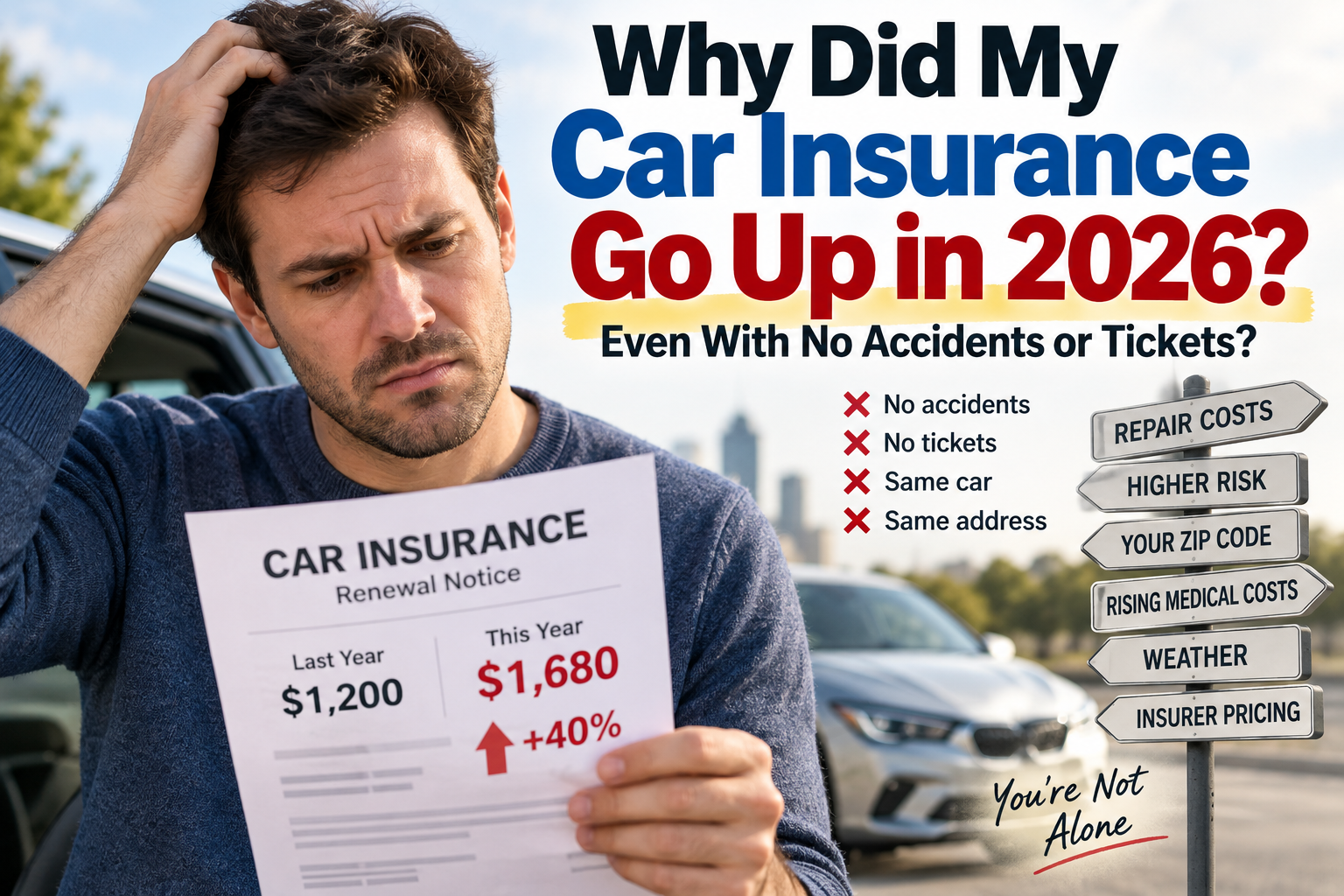
You haven’t had an accident.
You haven’t gotten a speeding ticket.
You haven’t added a new car.
You haven’t moved.
Maybe you’ve even been with the same insurance company for years.
Then your renewal notice arrives.
And somehow, your car insurance costs more.
So you ask the obvious question:
Why did my car insurance go up in 2026 when I did nothing wrong?
You’re not asking the wrong question.
But here’s where things get strange.
According to the latest available U.S. Bureau of Labor Statistics data, the national motor vehicle insurance index was actually 4.5% lower in July 2026 than a year earlier.
So if car insurance prices are falling nationally…
why did YOUR premium go up?
That’s the real question.
And the answer reveals something most drivers don’t realize about how auto insurance actually works.
Your Driving Record Is Only One Part of Your Insurance Price
Many drivers think car insurance works like this:
Good driver = lower price.
Bad driver = higher price.
That’s partly true.
Accidents, tickets and claims can absolutely affect what you pay.
But your driving history is only one piece of a much larger calculation.
Insurers may also consider factors such as:
- where you live
- the vehicle you drive
- how expensive that vehicle is to repair
- local accident and theft patterns
- your annual mileage
- other drivers on the policy
- coverage levels and deductibles
- state insurance rules
- your age and driving experience
- insurance history
- credit-based insurance information where permitted
- the insurer’s own claims experience and pricing model
That’s why two people with perfectly clean driving records can receive dramatically different quotes.
And it’s why your premium can rise even when you personally did nothing wrong.
Reason No. 1: Cars Are Becoming More Expensive to Repair
This may be one of the biggest pieces of the puzzle.
Modern cars are essentially computers on wheels.
A bumper isn’t always just a piece of plastic anymore.
It may contain:
cameras,
radar,
parking sensors,
driver-assistance technology,
and other electronics.
A relatively minor collision can require not only replacing damaged parts but recalibrating sophisticated safety systems.
And the latest BLS numbers show that these costs are still rising.
In July 2026, motor vehicle maintenance and repair prices were 6.6% higher than a year earlier.
Maintenance and servicing were up 7.3%, while motor vehicle repair was up 6.2%.
That matters to your insurer.
Because insurance isn’t only pricing the probability that you’ll crash.
It’s also pricing:
how expensive the crash could be.
“But I Didn’t Crash My Car. Why Should I Pay More?”
This is where insurance becomes frustrating.
You aren’t buying a personal savings account.
You’re participating in a risk pool.
Imagine thousands of drivers insured by the same company in your area.
Even if you don’t crash, the insurer may experience:
more expensive repairs,
more severe claims,
higher medical costs,
more theft,
more weather-related damage,
or higher liability payouts.
Those costs can influence future rates.
So the question insurance companies are trying to answer isn’t simply:
“Did this driver have an accident last year?”
It’s closer to:
“How much risk does this policy represent going forward?”
Those are very different questions.
Reason No. 2: Your ZIP Code Can Matter More Than You Think
You can be an excellent driver and still live in an expensive place to insure.
Why?
Because location affects risk.
Your area may have:
higher accident frequency,
more vehicle theft,
more vandalism,
more uninsured drivers,
more expensive repair shops,
severe hail,
flooding,
or other weather risks.
Move only a relatively short distance and insurance quotes can sometimes change.
Your driving ability didn’t suddenly become worse.
The risk surrounding the vehicle changed.
Reason No. 3: The Car You Drive Matters Even If It’s Getting Older
Here’s another question drivers often ask:
“My car is older and worth less. Why isn’t my insurance getting cheaper?”
Because the value of your own car is only part of the policy.
Auto insurance can include several different types of protection, including collision, comprehensive, bodily injury liability, property damage liability, medical-related coverage and uninsured-motorist coverage, depending on the policy and state. BLS includes these major coverage categories when measuring motor vehicle insurance prices.
Suppose you’re driving an old $5,000 car.
You hit a $70,000 SUV.
Or someone is seriously injured.
The fact that your own vehicle is cheap doesn’t make those potential liability costs cheap.
That’s why:
“My car isn’t worth much anymore”
doesn’t necessarily mean:
“My insurance should be cheap.”
Reason No. 4: Insurance Is About Other People’s Cars Too
Look around an American parking lot today.
Pickup trucks can cost tens of thousands of dollars.
SUVs can be extremely expensive.
Luxury vehicles can cost $80,000, $100,000 or much more.
And even ordinary vehicles increasingly contain expensive electronics.
Your liability insurance isn’t simply protecting your car.
It’s protecting you financially if you’re responsible for damaging someone else’s property or injuring someone else.
That means rising vehicle and repair costs across the entire road system can matter.
You don’t have to own an expensive vehicle to be exposed to expensive vehicles.
Reason No. 5: Medical Costs Can Make Accidents More Expensive
The expensive part of a serious crash isn’t always the car.
It can be the people.
An accident may involve:
ambulance services,
emergency treatment,
hospitalization,
surgery,
rehabilitation,
lost income,
and liability claims.
BLS reported hospital service prices were 5.2% higher year over year in July 2026.
That doesn’t translate directly into the same percentage increase in your car insurance.
But it illustrates a broader problem:
the financial consequences of serious accidents can be extremely expensive.
Reason No. 6: Weather Can Raise Auto Insurance Risk Too
Homeowners aren’t the only people affected by extreme weather.
Cars get damaged by:
hail,
floods,
falling trees,
wildfires,
hurricanes,
and severe storms.
One hailstorm can damage thousands of vehicles in a single metropolitan area.
One flood can destroy entire parking lots full of cars.
That’s why comprehensive insurance risk can change even for someone with a spotless driving record.
You didn’t cause the storm.
But your vehicle was still exposed to the risk.
Then Why Does the Government Say Car Insurance Prices Are Falling?
Now we get to the most interesting part.
The latest BLS data show U.S. motor vehicle insurance prices down 4.5% year over year in July 2026.
That sounds contradictory.
But it isn’t.
The BLS Consumer Price Index measures changes across a large national sample.
It does not mean every driver’s individual premium fell 4.5%.
Your insurance renewal is personal.
It depends on your insurer, state, location, vehicle, coverage, household and risk profile.
Think about home prices.
If the national median home price falls, that doesn’t mean every house in every city became cheaper.
Insurance works the same way.
A national trend and your individual bill can move in opposite directions.
And there’s another important piece of context.
One year earlier, in August 2025, motor vehicle insurance prices were still 4.7% higher than the previous year, according to BLS.
So 2026’s national decline comes after years in which many drivers experienced substantial increases.
A decline in the rate index doesn’t magically erase the higher price level many households reached during previous increases.
This Is the Difference Between “Prices Falling” and “Prices Returning to Normal”
Imagine your insurance premium looked like this:
2022: $1,200
2023: $1,350
2024: $1,550
2025: $1,800
Then prices stabilize or even decline somewhat.
That doesn’t necessarily mean you’re going back to $1,200.
This distinction matters throughout the economy.
Inflation slowing doesn’t mean prices return to where they started.
And an insurance index falling doesn’t guarantee your renewal notice will suddenly look cheap.
Reason No. 7: Your Insurer May Simply Price You Differently Now
Insurance companies don’t all calculate risk the same way.
One insurer may desperately want customers like you.
Another may be trying to reduce its exposure in your state, ZIP code or vehicle category.
One company’s quote might be $1,500.
Another might be $2,300.
A third might be $3,000.
Same driver.
Same car.
Same address.
Different insurer.
This is one reason staying loyal to the same insurance company indefinitely doesn’t automatically guarantee the best price.
“I’ve Been With My Insurance Company for 15 Years. Shouldn’t That Make It Cheaper?”
Maybe.
But don’t assume loyalty always produces the lowest rate.
Insurance pricing changes continuously.
Your company may offer discounts for tenure or multiple policies.
But competitors may use completely different pricing models.
That’s why one of the most important things you can do after a large renewal increase is simple:
Get competing quotes.
You’re not required to accept your renewal price without checking the market.
Reason No. 8: Adding a Teen Driver Can Be Extremely Expensive
Parents often experience one of the biggest insurance shocks when a teenager starts driving.
Why?
Because insurers price risk partly based on driving experience and historical claims patterns.
A newly licensed driver has very little driving history.
That uncertainty can be expensive.
So when parents say:
“I added my teenager and my insurance exploded.”
the increase isn’t necessarily about the family’s previous claims.
It’s about the new risk being added to the policy.
This is another example of why:
“I haven’t had an accident”
doesn’t tell the whole insurance story.
Reason No. 9: Credit Can Affect Insurance Prices in Some States
This surprises many drivers.
Depending on the state, insurers may use credit-based insurance scores or related information when determining premiums.
These aren’t necessarily identical to the credit score a lender uses to approve a mortgage or credit card.
And state rules vary.
Some states restrict or prohibit the practice.
But where it is permitted, changes in credit-related information can potentially affect insurance pricing even when your driving record hasn’t changed.
If your premium jumps unexpectedly, it’s worth asking your insurer exactly which factors contributed to the change.
Reason No. 10: Coverage Changes Can Hide Inside the Renewal
Don’t assume this year’s policy is identical to last year’s policy.
Check it.
Look at:
liability limits,
collision coverage,
comprehensive coverage,
deductibles,
uninsured motorist coverage,
rental coverage,
roadside assistance,
and other optional protections.
A change in coverage can change the price.
So when comparing your old bill with your new one, compare the policy, not just the premium.
Why Does My Friend Pay Less Than Me?
This question drives people crazy.
Your friend:
drives a newer car,
lives nearby,
and maybe even has a worse driving record.
Yet somehow pays less.
There may be dozens of differences.
Different insurer.
Different ZIP code.
Different mileage.
Different deductibles.
Different liability limits.
Different discounts.
Different household drivers.
Different insurance history.
Different credit-related factors where allowed.
Different vehicle safety and repair characteristics.
Without comparing the complete policies, the two premiums aren’t necessarily comparable.
Should You Drop Full Coverage on an Older Car?
Sometimes this question is worth asking.
If your vehicle has relatively little market value, paying a large amount for collision and comprehensive coverage may eventually stop making financial sense.
But don’t confuse dropping optional physical-damage coverage with dropping legally required or financially important liability protection.
Before changing coverage, ask:
How much is the car worth?
How much am I paying for collision and comprehensive?
What is my deductible?
Could I afford to replace the car myself tomorrow?
If losing the car would create a financial crisis, dropping coverage purely to save a small amount could backfire.
Should You Raise Your Deductible?
A higher deductible can sometimes lower your premium.
For example, moving from a $500 deductible to $1,000 means you’re accepting more of the initial loss yourself.
The insurer takes less risk.
The premium may fall.
But don’t choose a deductible you couldn’t afford tomorrow.
The purpose of insurance is to prevent a financial disaster.
Saving a few dollars each month isn’t useful if a claim suddenly requires cash you don’t have.
What Should You Do If Your Car Insurance Suddenly Goes Up?
Don’t immediately cancel the policy.
First, investigate.
1. Compare the old and new policy
Make sure the coverage hasn’t changed.
2. Ask the insurer why
Call and ask:
“What factors caused my renewal premium to increase?”
Don’t settle for “rates went up.”
Ask specifically.
3. Check for discounts
Ask about:
safe-driver discounts,
low-mileage programs,
multi-car discounts,
home-and-auto bundling,
automatic payment,
defensive-driving programs,
and other available discounts.
4. Get several quotes
This may be the most important step.
Don’t assume your existing insurer remains the cheapest.
5. Compare identical coverage
A cheaper quote with much lower liability limits isn’t necessarily a better deal.
6. Review your deductible
If you have enough emergency savings, a higher deductible may reduce premiums.
7. Check your annual mileage
If you drive much less than you used to, tell your insurer.
8. Review optional coverage on older vehicles
Some coverage may no longer make economic sense.
Don’t Make This Mistake When Shopping for Insurance
Suppose your current policy costs $2,000.
Another company offers $1,450.
Fantastic?
Maybe.
Then you discover the cheaper policy has:
lower liability limits,
a much higher deductible,
no rental coverage,
and weaker protection.
That’s not necessarily a $550 savings.
You may simply be buying less insurance.
When shopping, compare equivalent coverage as closely as possible.
Could Car Insurance Become Cheaper Again?
Possibly.
And the July 2026 BLS data suggest that national insurance price pressure has already eased substantially compared with earlier periods.
Competition among insurers can help.
Safer vehicles can reduce some kinds of accidents.
Improved anti-theft technology can reduce certain losses.
Claims trends can improve.
And insurers can adjust prices as conditions change.
But there’s a competing force.
Cars continue becoming technologically sophisticated and expensive to repair.
The latest BLS data show vehicle maintenance and repair costs still rising significantly even while the motor vehicle insurance index is falling.
That’s why the future probably won’t be as simple as:
“Insurance inflation is over, so everyone’s bill goes down.”
The Most Important Question Isn’t “Did I Have an Accident?”
This is the mistake many drivers make.
They open their renewal notice and think:
I didn’t crash.
I didn’t get a ticket.
I didn’t file a claim.
So why did my price change?
Because insurers aren’t only looking backward.
They’re estimating future risk.
Your driving history matters.
But so do the cost of cars around you, repair bills, medical expenses, your location, weather exposure, your vehicle, other drivers on the policy and the insurer’s own pricing strategy.
That’s why a perfect driving record doesn’t freeze your premium forever.
Bottom Line
So why did your car insurance go up in 2026 even though you had no accidents or tickets?
Because your driving record isn’t the only thing your insurance company is pricing.
Your premium reflects a much larger risk environment.
Vehicle repairs are expensive.
Modern cars contain costly technology.
Medical treatment can be expensive.
Your ZIP code matters.
Weather matters.
Your vehicle matters.
Other drivers on your policy matter.
And your insurance company can change how it evaluates all of those risks.
Here’s the strange part:
The latest national data show motor vehicle insurance prices 4.5% lower year over year in July 2026, while vehicle maintenance and repair costs were 6.6% higher.
So both of these statements can be true at the same time:
Car insurance prices can be falling nationally.
And:
Your personal car insurance bill can still be going up.
That’s the answer many frustrated drivers are looking for.
And if your renewal suddenly jumped, perhaps the most useful question isn’t:
“What did I do wrong?”
It’s:
“What changed in the risk my insurer is charging me for—and can another insurer price that risk differently?”
This article is for general informational purposes only and is not insurance, legal or financial advice. Insurance rules, rating factors and available coverage vary by state and insurer.