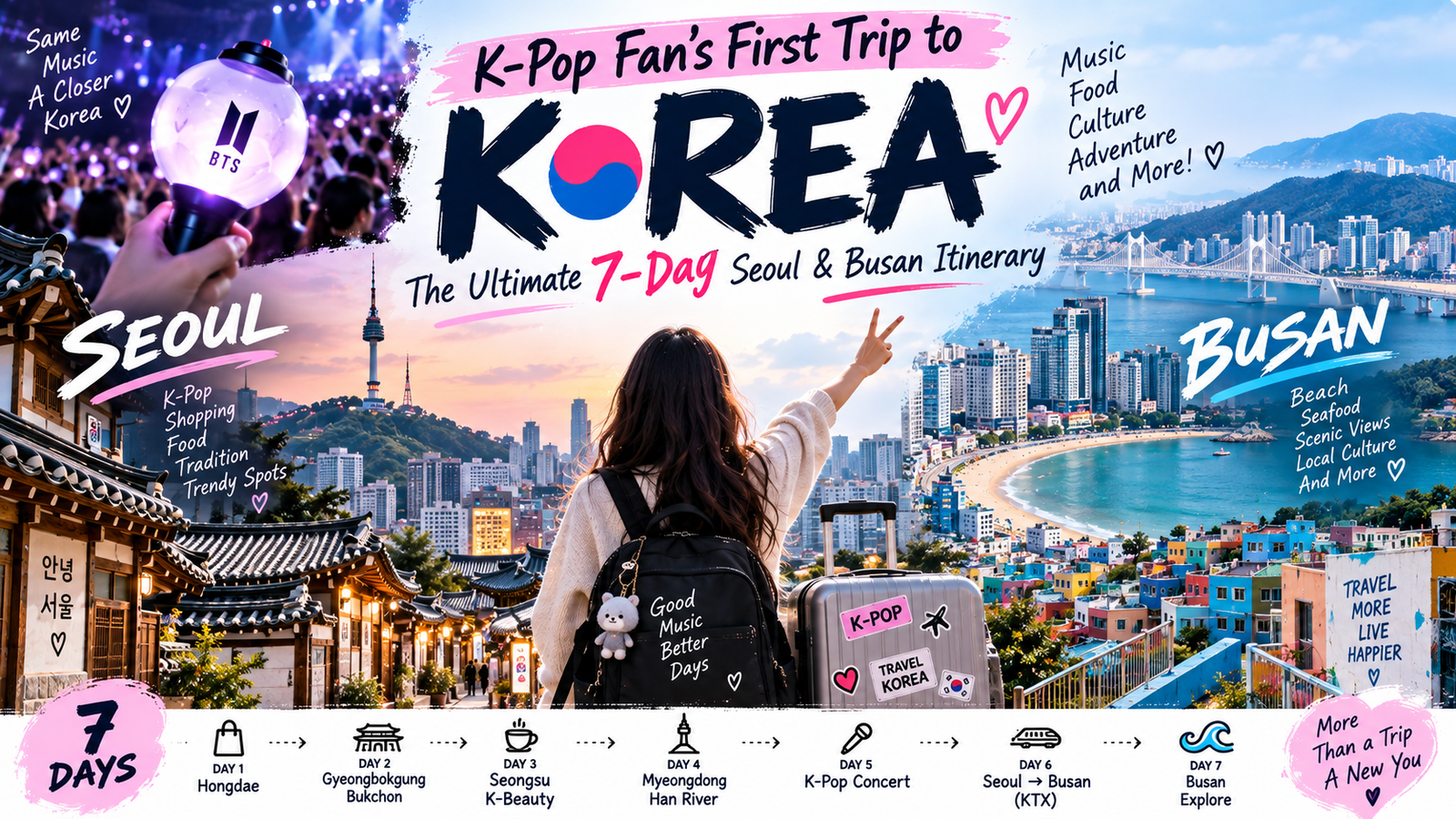
For many first-time visitors, traveling to South Korea has traditionally meant one place above all:
Seoul.
Gyeongbokgung Palace, Myeongdong, Hongdae, Gangnam and the Han River still deserve their place on a first Korea itinerary.
But something is changing.
More international travelers are beginning to look beyond Seoul.
Some are heading south to Busan, where a major coastal city offers beaches, seafood, nightlife and urban energy.
Others are beginning to discover a very different Korea along the country’s western and southwestern coast — a landscape of tidal flats, islands, fishing villages, spectacular sunsets and some of Korea’s most interesting seafood.
If Busan represents Korea’s energetic seaside city life, the west coast offers something quieter.
And perhaps more unexpected.
Busan Is No Longer Just a Side Trip from Seoul
The numbers coming from Busan are remarkable.
From January through July 2026, approximately 2.93 million international visitors traveled to Busan, according to the city.
That was a 46.1% increase compared with the same period a year earlier.
Busan also reported that roughly one in four international visitors to Korea visited the city during that period.
Even more interesting is what happened to travelers arriving through Gimhae International Airport.
During the first half of 2026, about 98% of foreign arrivals through the airport stayed in Busan or the surrounding southeastern region rather than immediately moving toward the Seoul metropolitan area.
That suggests an important shift.
For some travelers, Busan is becoming a destination in its own right rather than simply an extra stop after Seoul.
But There Is Another Side of Coastal Korea
Busan is relatively easy for international visitors to understand.
It has skyscrapers, famous beaches, huge seafood markets and excellent public transportation.
Korea’s west coast is different.
This is not necessarily where you go for a checklist of famous attractions.
You go there to slow down.
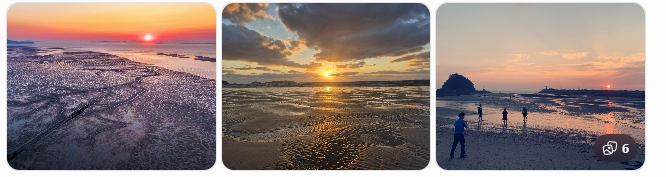
Much of Korea’s western coastline faces the Yellow Sea, where dramatic tides expose enormous tidal flats known in Korean as getbol (갯벌).
At low tide, the sea can appear to retreat far into the distance.
What remains is a vast landscape of mud, shallow water and tiny marine creatures.
Then the tide returns and the landscape changes again.
For someone who has only seen Seoul’s dense streets and high-rise buildings, it can feel like discovering another country.
Korea’s Tidal Flats Are a UNESCO World Heritage Site
These mudflats are not simply empty stretches of mud.
They are among Korea’s most valuable natural ecosystems.
UNESCO’s Getbol, Korean Tidal Flats World Heritage property includes tidal-flat ecosystems along Korea’s western, southwestern and southern coasts.
Originally inscribed in 2021, the World Heritage property was expanded in 2026.
UNESCO records thousands of plant and animal species in these coastal wetlands, which also provide vital habitats for migratory birds.
Places including Seocheon, Gochang and Shinan are part of this extraordinary coastal ecosystem.
But for travelers, there is another reason getbol is fascinating:
You don’t always have to admire it from a distance.
You can actually walk into it.
Don’t Just Look at the Mudflat — Step Into It
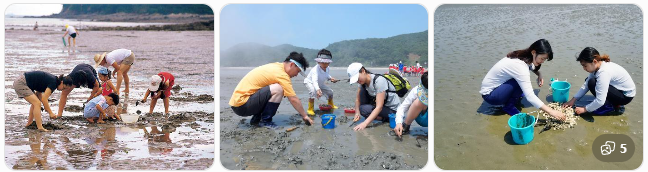
One of the most memorable west-coast experiences is a Korean tidal-flat activity.
Put on rubber boots, walk onto the mudflat at low tide and you may be able to dig for clams and discover small creatures living beneath the surface.
For Korean families, experiences like these have long been a familiar form of coastal recreation.
For an international traveler, however, it can feel completely different from conventional sightseeing.
You are not looking at Korea through a bus window.
You are standing ankle-deep in it.
And after seeing where shellfish actually live, the seafood you eat later that day suddenly has a story behind it.
Yes, Koreans Even Turn Mud Into a Festival
If the idea of getting covered in mud sounds fun rather than frightening, there is one west-coast destination you should know:
Boryeong.
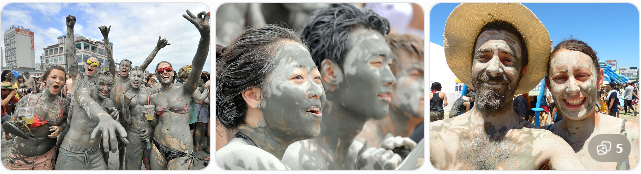
The Boryeong Mud Festival has become one of Korea’s best-known international summer festivals.
Visitors slide through mud, play in mud zones, paint themselves with mud and participate in mud beauty-care experiences.
It is one of those rare travel experiences where getting completely dirty is the entire point.
There is an important distinction, however.
The organized mud used for festival and beauty experiences should not be confused with simply scooping random mud from a natural tidal flat and applying it to your skin.
If you want the famous Korean “mud on your face” photo, an organized mud experience such as Boryeong is the better choice.
Then Comes the Best Part: Eating
For me, this is where Korea’s west coast becomes especially interesting.
The tidal flats are not separate from Korean food culture.
They helped create it.
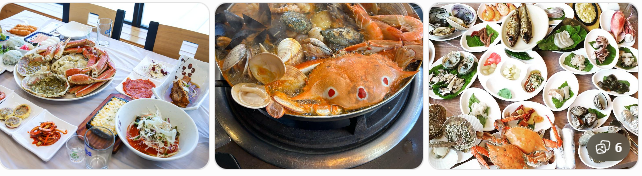
Depending on where you travel and the season, western coastal regions are famous for foods involving clams, oysters, shrimp, blue crab, octopus and other seafood.
In some coastal areas, the experience can become a complete journey:
Walk across the tidal flat. Experience the fishing village. See where seafood comes from. Watch the sunset. Then eat local seafood nearby.
That is very different from ordering seafood in the middle of Seoul.
The food becomes connected to the landscape.
The West Coast Sunset Is Different
There is another reason Koreans travel west.
Sunset.
Because the western coast faces the Yellow Sea, there are countless places where the sun appears to fall directly toward the ocean.
But it is not only the sunset itself.
The combination of shallow water, exposed tidal flats, small islands and fishing boats can create incredibly quiet and almost poetic landscapes.
At low tide, pools of water left across the mudflat can reflect the evening sky.
Fishing villages slowly turn into silhouettes.
The sky changes from gold to orange and finally deep red.
Busan can be exciting.
The west coast can be emotional.
[IMAGE: Dramatic red-orange sunset reflected across a Korean tidal flat]
And the Food Changes as You Travel
Another mistake visitors sometimes make is thinking of “Korean food” as one cuisine that tastes roughly the same everywhere.
Travel outside Seoul and that idea quickly disappears.
Coastal food changes according to geography, season and what local fishermen bring ashore.
Different areas of Korea’s western and southwestern coast have their own relationships with shellfish, crab, shrimp, octopus, oysters, fermented seafood and countless local dishes.
This is one of the reasons I believe food is one of the best ways to travel through Korea.
Don’t only ask:
“What Korean food should I eat?”
Ask:
“What do people eat here?”
That one question can completely change your trip.
Busan or the West Coast?
You don’t necessarily have to choose.
They offer two very different versions of coastal Korea.
Choose Busan if you want a major city, famous beaches, nightlife, markets and excellent seafood with the convenience of an urban destination.
Explore the west coast if you want tidal flats, fishing villages, islands, sunsets, seafood experiences and a slower journey through Korea.
And if you have enough time?
Experience both.
The Korea Beyond Seoul Is Much Bigger Than Most Visitors Realize
Seoul is extraordinary.
But Seoul is not Korea.
The country changes remarkably quickly once you leave the capital.
Travel south and you can find the energy of Busan.
Travel west and the cityscape gives way to tidal flats, fishing villages and sunsets.
Go farther along the southwestern coast and you encounter islands, wetlands and regional food cultures that many international visitors still know very little about.
Perhaps the next stage of Korean tourism will not be about discovering another neighborhood in Seoul.
It will be about discovering another Korea outside Seoul.
And sometimes, the best way to discover it is simple:
Take off your city shoes.
Put on a pair of rubber boots.
Walk onto the tidal flat.
Watch the sun go down.
And then find out what the fishermen caught that day.
Maybe BLACKPINK, Stray Kids, SEVENTEEN, aespa, IVE or another artist you’ve followed from thousands of miles away.
The concert may last only a few hours.
But if you are flying all the way to South Korea, don’t make the concert your entire trip.
Make it the beginning.
K-pop fans are increasingly traveling to Korea not only to see their favorite artists, but to experience the country behind the music.
And for a first visit, there is one itinerary I recommend more than almost any other:
5 Days in Seoul + 2 Days in Busan
Seven days is long enough to experience modern Seoul, traditional Korea, K-pop culture, Korean food, K-beauty and the country’s most famous coastal city — without turning your vacation into an exhausting race between tourist attractions.
This itinerary is designed especially for a first-time international visitor to South Korea who loves K-pop.
You don’t need to spend seven days visiting idol-related locations.
Instead, we’ll use K-pop as the doorway and experience the Korea that exists beyond the concert.
Why 7 Days Is a Great First Korea Trip
You can technically visit Seoul in three or four days.
But if you are flying from North America, Europe or another long-distance destination, that can feel painfully short.
Seven days gives you time for:
K-pop
Korean food
K-beauty
traditional Korea
modern Seoul
shopping
the Han River
and
Busan
without changing hotels every night.
There is another advantage.
If your main reason for visiting Korea is a concert, arriving several days early gives you protection against flight delays.
Never schedule an international arrival only hours before a concert you spent months trying to attend.
For this itinerary, I would ideally place the concert around Day 4 or Day 5.
Before You Arrive: The Three Things You Need
Before discussing the itinerary, prepare three things.
1. A Transportation Card
Seoul’s subway and bus network makes traveling around the city relatively easy.
A rechargeable transportation card can be used across much of Korea’s public transit system.
You’ll use public transportation constantly, so this should be one of the first things you organize after arriving.
2. Korean Map Apps
One surprise for many international travelers is that Google Maps is not always the best navigation option in South Korea.
Install at least one Korean navigation app before your trip.
Naver Map and KakaoMap are widely used for navigating Korean cities.
Save your hotel and important destinations in advance.
This will make your first day considerably easier.
3. Comfortable Shoes
This sounds trivial.
It isn’t.
You are going to walk.
A lot.
Subway stations can be large, neighborhoods are best explored on foot, and several attractions involve hills or long walking routes.
Your fashionable concert shoes and your sightseeing shoes do not necessarily need to be the same pair.
Your feet will thank you by Day 5.
DAY 1 — Arrive in Seoul, Hongdae and Your First Korean Night
Don’t plan too much for your first day.
After immigration, baggage collection and transportation from the airport, you may already be tired.
Check into your hotel, take a short break and begin with one of Seoul’s easiest neighborhoods for younger international visitors.
Hongdae
Hongdae is an excellent introduction to modern Seoul.
The neighborhood is filled with:
cafés,
restaurants,
fashion shops,
street performers,
music,
beauty stores
and nightlife.
If K-pop was your introduction to Korea, Hongdae will probably feel surprisingly familiar and completely new at the same time.
Don’t spend your first evening checking boxes on a sightseeing list.
Walk.
Explore.
Eat.
Watch the city.
What Should You Eat on Your First Night?
For your first Korean meal, keep it fun.
Try:
samgyeopsal — Korean grilled pork belly
or
Korean fried chicken
If you are traveling with friends, Korean barbecue is particularly good because eating together around the grill is part of the experience.
And if you still have energy afterward?
Find a Korean convenience store.
Buy a drink and some snacks.
Congratulations.
Your Korea trip has officially started.
DAY 2 — Traditional Korea: Gyeongbokgung, Bukchon and Insadong
Yesterday was modern Korea.
Today, go backwards in time.
Start at:
Gyeongbokgung Palace
Built during the Joseon Dynasty, Gyeongbokgung is one of Seoul’s most important historical landmarks.
If this is your first visit to Korea, don’t skip it simply because it appears on every tourist itinerary.
There is a reason it does.
The contrast between the palace architecture and modern Seoul surrounding it is one of the city’s defining experiences.
Many visitors also rent hanbok, traditional Korean clothing, near the palace.
If that interests you, allow extra time.
Walk Toward Bukchon
After the palace, explore the traditional streets around Bukchon Hanok Village.
But remember something important:
Bukchon is not a theme park.
People actually live there.
Keep your voice down, respect restricted areas and avoid blocking residential entrances while taking photographs.
That small amount of consideration makes tourism better for everyone.
Lunch: Try a Traditional Korean Meal
This is a good day to move beyond the most internationally famous Korean foods.
Consider:
bibimbap
bulgogi
mandu
samgyetang
or a Korean set meal with multiple side dishes.
One of the best parts of traveling in Korea is discovering that Korean food is much larger than barbecue and kimchi.
Finish the Day in Insadong
Insadong is an easy continuation from the palace area.
You’ll find:
traditional crafts,
tea houses,
souvenirs,
galleries
and smaller streets worth exploring.
If Day 1 showed you the Korea of K-pop, Day 2 shows you part of the cultural foundation underneath modern Korea.
DAY 3 — Seongsu, K-Beauty and Contemporary Seoul
Today is about the Korea that is changing right now.
Head to:
Seongsu
Seongsu has become one of Seoul’s most interesting neighborhoods for fashion, beauty, cafés and pop-up culture.
This is particularly relevant for K-pop fans.
K-pop does not exist separately from Korean:
fashion,
beauty,
design,
brands
and youth culture.
They constantly influence one another.
And Seongsu is one of the easiest places to see those worlds overlap.
Don’t Overplan Seongsu
This is important because pop-ups change constantly.
A store that everyone was posting about three months ago may already be gone.
Instead of building your entire itinerary around one old viral TikTok, check what events and pop-ups are operating shortly before your trip.
Then spend time simply exploring the neighborhood.
Sometimes the most interesting place will be something that did not exist when you booked your flight.
K-Beauty Shopping
If you’ve wanted to try Korean skincare or makeup, today is a good day.
But don’t feel that you need to buy everything immediately.
Korean beauty stores are everywhere in Seoul.
Compare products.
Check what actually suits your skin.
And remember that a giant shopping bag becomes much less exciting after carrying it around for six hours.
DAY 4 — Myeongdong, Namsan and the Han River
Start with one of Korea’s most famous shopping districts.
Myeongdong
Myeongdong is touristy.
And that’s perfectly fine.
For a first-time visitor, it is convenient.
You can find:
K-beauty,
fashion,
restaurants,
cafés,
street food,
currency exchange
and easy transportation.
It is also a good place to buy gifts for people back home.
Try Korean Street Food
Depending on what is available, look for foods such as:
tteokbokki
hotteok
eomuk
dakgangjeong
and various grilled snacks.
Don’t worry about eating every famous Korean dish in one afternoon.
You have seven days.
N Seoul Tower and Namsan
From Myeongdong, you can continue toward Namsan.
Whether you actually go to the top of N Seoul Tower is up to you.
The more important experience is seeing Seoul from above and understanding just how enormous the city really is.
Evening: Do Something Very Korean — Nothing
After several busy days, slow down.
Go to the:
Han River
Buy food.
Get a drink.
Sit.
Talk.
Watch bicycles pass.
Look at Seoul’s skyline.
If you’ve watched Korean dramas, variety shows or idol content, you’ve probably seen people spending time beside the Han River.
It may not sound as exciting as a palace or concert.
But ordinary experiences are often what travelers remember most.
DAY 5 — K-Pop Day and Concert Night
This is the day you came for.
But don’t ruin it by exhausting yourself beforehand.
Keep the daytime schedule light.
Sleep a little longer.
Eat properly.
Charge your phone.
Check your ticket.
Check the venue’s official rules.
Check transportation.
Check prohibited items.
And most importantly:
Follow the organizer’s official instructions rather than random social-media posts.
Concert procedures can change.
What to Do Before a K-Pop Concert
If official merchandise is being sold, queues can be long.
There may also be:
fan events,
pop-up stores,
photo zones,
special cafés,
album events
or citywide promotions.
Plan those around your concert rather than trying to squeeze them into the final hour.
If the venue is outside central Seoul — for example, Goyang or Incheon — allow significantly more transportation time than the map initially seems to suggest.
Thousands of other people may be traveling to the same place.
The Most Important Concert Tip: Plan the Trip Home
Everyone plans how to reach the concert.
Fewer people think carefully about what happens when tens of thousands of fans leave simultaneously.
Before entering the venue, know:
your subway route,
the last train time,
alternative routes,
taxi possibilities,
and where you will meet friends if your phones stop working.
Your concert ends when you are safely back at your hotel.
Not when the encore ends.
DAY 6 — Take the KTX to Busan
Now we change cities.
And this is where your first Korea trip becomes much more interesting.
Take the KTX high-speed train from Seoul to Busan.
The journey is roughly 2.5 to 3 hours depending on the service.
For many international visitors, the train ride itself becomes part of the experience.
You leave the enormous capital behind and begin seeing a different side of Korea.
First Stop in Busan: The Sea
Seoul is one of the world’s great metropolitan cities.
Busan feels different almost immediately.
It is Korea’s largest port city, surrounded by mountains and the sea.
For a short first visit, I would focus on a few major areas rather than trying to see everything.
Haeundae Beach
Haeundae is one of Korea’s most famous beaches.
Walk along the coast, explore nearby restaurants and enjoy the slower atmosphere.
If your Seoul days have been packed with subway transfers and shopping streets, the contrast feels wonderful.
Gwangalli at Night
If you can choose only one Busan night view, Gwangalli is hard to beat.
The illuminated Gwangan Bridge stretches across the water in front of you.
Find somewhere to eat nearby or simply walk along the beach.
This is one of those moments when you’ll realize:
Korea is much more than Seoul.
What to Eat in Busan
Busan has its own strong food identity.
Depending on your preferences, consider trying:
dwaeji gukbap — pork soup with rice
milmyeon — wheat noodles
eomuk — Busan-style fish cake
and, if you enjoy seafood, visit one of the city’s seafood districts.
This is exactly why adding Busan to a K-pop trip is worthwhile.
The music may be the same.
But the Korea around you has changed.
DAY 7 — Gamcheon, Jagalchi and Goodbye to Korea
Your final day should combine one more memorable neighborhood with food and a little shopping.
Start with:
Gamcheon Culture Village
Gamcheon is famous for its colorful hillside houses and narrow streets.
It has become one of Busan’s most recognizable destinations.
Take your time.
The neighborhood is hilly.
Again: comfortable shoes.
Jagalchi Market
Then experience another side of Busan at Jagalchi Market, one of Korea’s best-known seafood markets.
Even if you don’t eat seafood, the area around the market offers an interesting look at Busan’s identity as a port city.
Nearby streets are also good for exploring traditional markets and local food.
One Last Korean Meal
Your final meal does not need to be expensive.
In fact, one of the joys of Korea is that memorable meals can come from very ordinary places.
A small gukbap restaurant.
A noodle shop.
A gimbap restaurant.
A market stall.
A neighborhood barbecue restaurant.
By Day 7, you’ll probably already have your own opinion about which Korean food deserves one final meal.
That’s when you know you’ve actually traveled.
The Complete 7-Day Korea Itinerary
Here is the entire route in one place:
Day
Destination
Main Experience
Day 1
Hongdae
Arrival, modern Seoul, Korean food
Day 2
Gyeongbokgung–Bukchon–Insadong
Traditional Korean culture
Day 3
Seongsu
K-pop culture, cafés, K-beauty, pop-ups
Day 4
Myeongdong–Namsan–Han River
Shopping, street food, Seoul lifestyle
Day 5
Concert Day
K-pop concert and fan experiences
Day 6
Seoul → Busan
KTX, Haeundae, Gwangalli
Day 7
Busan
Gamcheon, Jagalchi, local food
Where Should a First-Time Visitor Stay in Seoul?
For this particular itinerary, three areas stand out.
Hongdae
Best if you want:
youthful atmosphere,
nightlife,
cafés,
easy airport access
and lots of restaurants.
Excellent for younger travelers and K-pop fans.
Myeongdong
Best if you want:
central location,
shopping,
K-beauty,
tourist convenience
and relatively easy access to major attractions.
For a first visit to Korea, Myeongdong is difficult to beat for convenience.
Seoul Station Area
Best if you plan to take the KTX to Busan and value transportation convenience.
It is not necessarily the neighborhood I would choose purely for atmosphere, but it makes moving around Korea easier.
How Much Money Should You Budget?
There is no single answer because Korea can accommodate very different travel styles.
Your biggest expenses are likely to be:
international airfare,
hotel,
concert ticket,
and shopping.
Public transportation and everyday Korean food can be relatively affordable compared with many major global cities.
A budget traveler can use:
guesthouses,
subways,
local restaurants
and convenience stores.
A higher-budget traveler can easily spend much more on:
hotels,
fine dining,
beauty treatments,
taxis,
shopping
and premium concert experiences.
The important thing is to separate your concert budget from your daily travel budget.
K-pop merchandise has a mysterious ability to make carefully planned budgets disappear.
Should You Visit Only K-Pop Locations?
I wouldn’t.
And I’m saying that in a guide specifically written for K-pop fans.
If BTS, BLACKPINK, Stray Kids or another artist made you curious about Korea, that’s wonderful.
Visit the places connected to them.
Go to the concert.
Buy the album.
Take the photos.
But don’t leave Korea having experienced only your fandom.
Spend one day learning about Korean history.
Eat food you’ve never seen your favorite idol eat.
Visit a neighborhood you discovered by accident.
Talk to people.
Take the train to another city.
Sit beside the Han River without doing anything.
Let K-pop bring you to Korea.
Then let Korea surprise you.
Why This Trip Is Bigger Than K-Pop
Recent tourism data shows that K-pop concerts can have a remarkable effect on international travel to Korea.
Foreign accommodation bookings during selected major K-pop concert weeks rose dramatically compared with non-concert periods, while government research around BTS performances found international concertgoers staying longer and spending more than the average foreign visitor.
That’s the phenomenon I explored in our previous article:
The BTS Effect: Why K-Pop Concerts Are Transforming Tourism in South Korea
But statistics only tell half the story.
The other half begins when the fan walks out of the stadium.
What happens next?
They eat tteokbokki.
They discover Seongsu.
They walk beside the Han River.
They shop in Myeongdong.
They ride the KTX.
They see Busan.
And suddenly the concert they flew across the world to attend becomes only one chapter of a much bigger memory.
A Few Mistakes First-Time Korea Travelers Should Avoid
Don’t schedule your flight too close to the concert.
Don’t rely entirely on one navigation app without preparing alternatives.
Don’t carry your passport, wallet and every valuable item carelessly in one place.
Don’t try to visit ten Seoul neighborhoods in one day.
Don’t assume every viral restaurant is worth waiting two hours for.
Don’t forget that residential areas such as parts of Bukchon require respectful behavior.
And don’t spend your entire vacation looking through your phone camera.
You traveled a long way.
Look at Korea with your own eyes too.
What If You Have More Than 7 Days?
Excellent.
Then I would not add more Seoul.
I would add more Korea.
With 9–10 days, consider:
Seoul → Gyeongju → Busan
Gyeongju offers a completely different experience from both Seoul and Busan.
It was the capital of the ancient Silla kingdom and is filled with archaeological and historical sites.
With 10–12 days, you could consider adding Jeju Island.
That gives you four dramatically different versions of Korea:
Seoul — modern metropolis
Gyeongju — history
Busan — coastal city
Jeju — nature
That’s a far richer introduction to Korea than spending the entire trip in one city.
Final Thoughts: Come for the Concert, Stay for Korea
Maybe your journey starts with a notification.
“World Tour Announced.”
Then comes the ticket battle.
The flight search.
The hotel reservation.
The countdown.
Finally, you arrive in Korea.
And for one night, thousands of people inside a stadium sing the same songs together.
That may be the reason you came.
But years later, you might remember something else just as clearly.
The smell of Korean barbecue on your first night.
The rooflines of Gyeongbokgung.
A random café in Seongsu.
Convenience-store ramyeon beside the Han River.
The KTX pulling out of Seoul Station.
The lights of Gwangan Bridge reflecting on the sea.
That is the wonderful thing about traveling because of music.
K-pop may give you the ticket to Korea.
But Korea gives you the journey.
So if you’re traveling thousands of miles for a concert, don’t simply attend the show and fly home.
For rail schedules and KTX reservations, use KORAIL. Because schedules, fares, concert rules, pop-ups and opening hours can change, verify these details shortly before traveling.
K-Beauty Shopping
If you want to explore Korean skincare, cosmetics and beauty products before or after your trip, you can browse OLIVE YOUNG Global.