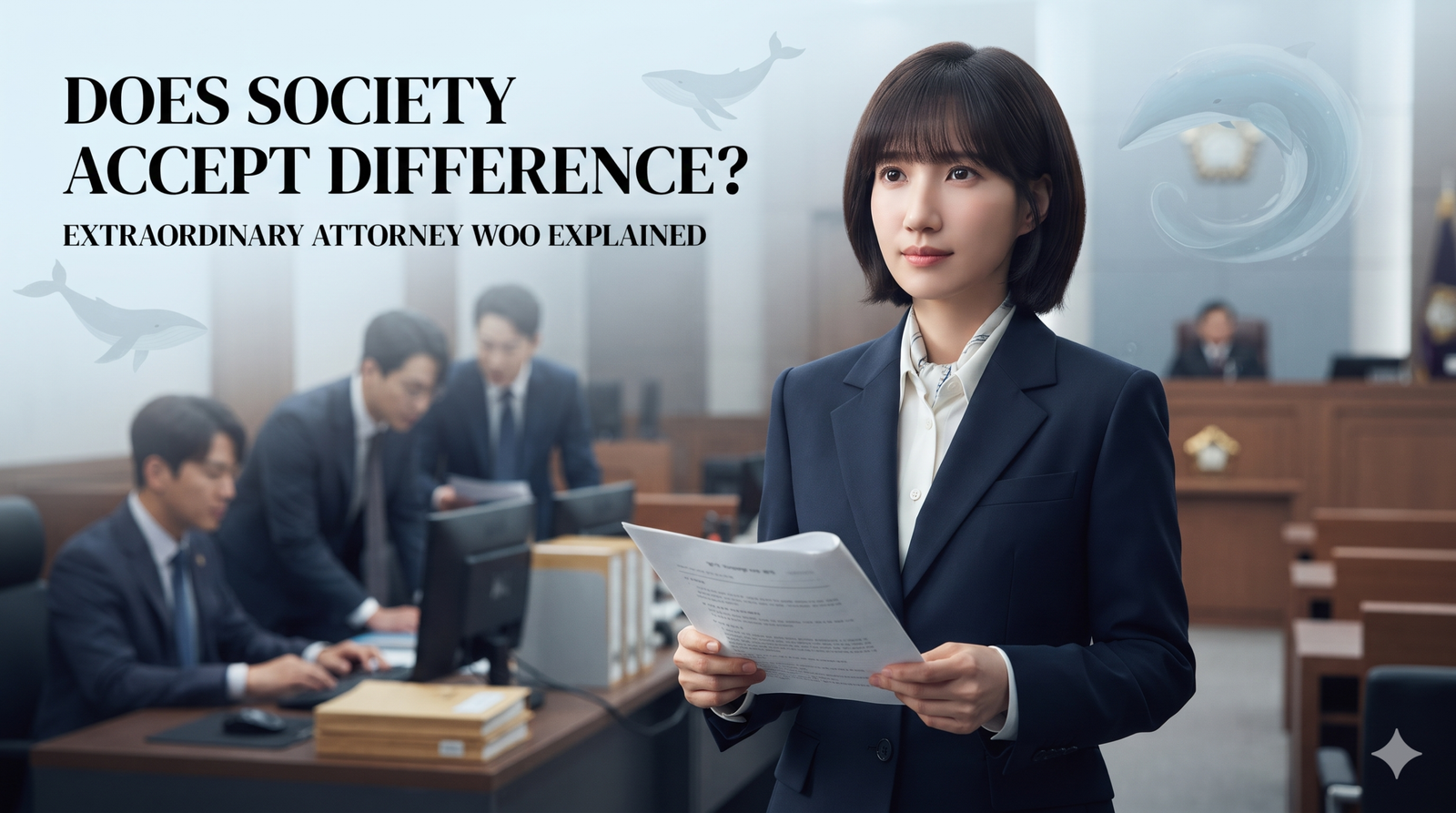
An in-depth analysis of autism, workplace inclusion, social expectations, and the meaning of being different.
Spoiler Warning: This article discusses major character developments and courtroom cases from the Netflix series Extraordinary Attorney Woo.
What if a person could become one of the most talented lawyers in the country but still struggle with something as ordinary as entering a crowded room, understanding an unspoken social rule, or navigating a conversation with a stranger?
That is the contradiction at the center of Extraordinary Attorney Woo.
Woo Young-woo is an intelligent young lawyer on the autism spectrum. She possesses an extraordinary memory, an intense interest in law, and an unusual ability to recognize patterns that other people may overlook. Yet the same world that admires her legal abilities does not always know how to respond to her differences.
At first, the series appears to be a warm story about a gifted lawyer overcoming prejudice. But a more difficult question emerges as the episodes unfold.
Does society truly accept people who are different, or does it accept them only when their differences produce something exceptional?
This question matters because Young-woo’s intelligence gives her opportunities that many people on the autism spectrum may never receive. Her success challenges prejudice, but it also creates an uncomfortable standard: what happens to people whose abilities are ordinary, whose support needs are greater, or whose differences are less easily celebrated?
The series is most interesting when viewed through this contradiction.
It is a story about one woman’s professional journey, but it is also an examination of how workplaces, families, friendships, and legal institutions decide whose differences they are willing to accommodate.
1. Woo Young-woo: A Brilliant Lawyer Who Does Not Fit the Expected Pattern
Woo Young-woo enters Hanbada Law Firm with an unusual combination of strengths and challenges.
She has an extraordinary memory and an intense interest in legal knowledge. She can recall complicated information and identify connections that other people might overlook.
Her thinking often follows a different route from that of her colleagues.
The cases she encounters can trigger unexpected connections, and she sometimes approaches a legal problem by examining details that initially seem unrelated.
Yet her professional ability does not remove the everyday challenges she faces.
Social communication can be difficult. Certain sounds, environments, and physical interactions can overwhelm her. She may interpret language literally or find it difficult to understand expectations that other people consider obvious.
This contrast is important.
The series does not present intelligence as a magical solution to every difficulty. Young-woo can be an excellent lawyer and still need understanding, patience, and practical support.
However, the drama also creates a tension in its portrayal.
Her extraordinary legal talent is a major reason she receives an opportunity at a prestigious law firm. That raises a question the audience should not ignore:
Would the same workplace have opened its doors to someone on the autism spectrum who did not possess exceptional academic achievements?
Young-woo challenges the assumption that autistic people cannot become successful professionals. But her story also exposes how easily society can replace one stereotype with another: the idea that a person with a disability must be extraordinary to deserve acceptance.
2. The Genius Problem: Why Being Exceptional Can Become Another Burden
One of the most important ways to understand Extraordinary Attorney Woo is to examine the relationship between disability and exceptional ability.
Young-woo is not simply a lawyer who happens to be autistic. Her extraordinary memory and unusual legal insights are central to the way the story develops.
This makes the drama entertaining and gives its courtroom stories a distinctive structure.
But it also creates a representational problem.
Autism is a spectrum. Autistic people have different strengths, communication styles, sensory experiences, support needs, and life circumstances.
There is no single personality or ability profile that represents everyone.
Young-woo’s experience therefore cannot be treated as a universal picture of autism.
The concern is not that a character like Young-woo should never be portrayed. Her story deserves to exist. The concern is what happens when an exceptional character becomes the most visible example of an entire group.
Imagine a workplace that watches Young-woo succeed and concludes that autistic employees should be welcomed because they might possess unusual talents.
That sounds positive, but it still makes acceptance conditional.
What about someone who needs more time to complete a task? Someone who cannot tolerate a noisy office? Someone who has no special academic ability but is capable of performing meaningful work with appropriate support?
Their dignity should not depend on whether they can impress an employer.
This is where the title of the drama becomes an important part of its deeper meaning.
Young-woo is extraordinary, but the right to participate in society should not be reserved for extraordinary people.
3. Hanbada Law Firm: Is It a Realistic Workplace or an Ideal One?
Hanbada is one of the most important settings in the series.
It is not merely the place where Young-woo handles legal cases. It is also the environment in which the drama tests whether professional competence and personal difference can coexist.
Her colleagues do not always understand her behavior immediately.
Some need time to adjust. Some make mistakes. Some recognize that the usual assumptions about communication and workplace conduct do not always apply to Young-woo.
But the firm gradually becomes a place where her abilities can be recognized without requiring her to behave exactly like everyone else.
This is one of the most hopeful elements of the story.
A supportive workplace does not necessarily remove every difficulty. It can instead create conditions in which an employee’s abilities become more visible.
The distinction is important.
If a workplace expects every employee to communicate, concentrate, socialize, and respond in exactly the same way, it may confuse conformity with professionalism.
A person who works differently may be judged as less capable even when the quality of their work is strong.
Hanbada offers an alternative possibility: a workplace can maintain professional standards while recognizing that people may need different ways of meeting them.
However, the firm can also look unusually accommodating compared with many real workplaces.
That gap should not be ignored.
The ideal workplace in the drama is not proof that inclusion is already common. It is better understood as an example of what becomes possible when colleagues and institutions make an effort to understand individual needs.
The more useful question is not whether every office should behave exactly like Hanbada.
It is why ordinary workplaces so often fail to provide even basic understanding and flexibility.
4. Jung Myung-seok: The Difference Between Pity and Professional Respect
Jung Myung-seok is arguably one of the most important characters in Young-woo’s professional development.
As her supervising lawyer, he must decide whether he can trust her with real responsibilities.
His position is complicated because he has professional obligations. He cannot simply ignore mistakes or lower standards because an employee faces additional challenges.
But he also recognizes that Young-woo should not be judged only through the difficulties she experiences.
This creates an important distinction between pity and respect.
Pity looks at a person and focuses on what they cannot do.
Respect looks at the person as a whole, including their abilities, limitations, and right to participate.
Myung-seok gradually learns how to work with Young-woo without treating her as either helpless or perfect.
He can question her decisions while recognizing her talent. He can offer guidance without assuming that she needs to be protected from every challenge.
That is a meaningful form of professional inclusion.
His character also reveals something about leadership.
A good manager does not have to understand every aspect of an employee’s experience immediately. But the manager must be willing to listen, learn, and distinguish genuine performance problems from difficulties created by an inflexible working environment.
Myung-seok is not important simply because he supports Young-woo.
He is important because he demonstrates that professional respect can exist without pretending that differences do not matter.
5. Choi Su-yeon: What Does Genuine Friendship Look Like?
Choi Su-yeon is another essential character because her relationship with Young-woo is not based solely on professional admiration.
Their connection reaches back to their university years.
Su-yeon recognizes Young-woo’s difficulties and sometimes helps her navigate situations that are socially confusing or emotionally uncomfortable.
But she is not simply a permanent assistant.
She has her own ambitions, frustrations, insecurities, and professional challenges.
This makes the friendship more believable.
A relationship built only around one person helping another can become unequal. Genuine friendship requires room for both people to have needs and make mistakes.
Su-yeon also demonstrates that acceptance does not mean agreeing with everything a friend does.
She can disagree with Young-woo, feel frustrated, or struggle with complicated emotions while still caring about her.
That is an important message.
People with disabilities do not need relationships in which others treat them as permanently fragile. They need relationships in which they can be recognized as complete human beings.
Su-yeon’s friendship is meaningful because it includes both care and ordinary human disagreement.
6. Lee Jun-ho: Can Romantic Love Exist Without Turning Someone Into an Object of Protection?
Lee Jun-ho introduces another dimension to the story.
His relationship with Young-woo develops through attraction, affection, and the gradual recognition of each other’s personalities.
At first, his kindness may appear straightforward. But as their relationship becomes more serious, the drama raises a more difficult question.
Can he love Young-woo as an equal partner while recognizing that her experiences and needs may differ from his own?
This is more complicated than simply asking whether he accepts her autism.
Romantic relationships require communication, mutual understanding, and the ability to negotiate differences.
Young-woo has to understand her own feelings and communicate them in ways that work for her. Jun-ho must also learn that caring for someone does not mean deciding what is best for them without listening.
There is a danger in portraying a romantic partner as a heroic protector whose kindness solves every difficulty.
That can unintentionally reduce the disabled character to someone who receives love rather than someone who actively participates in a relationship.
The more meaningful interpretation of their romance is that both people must learn.
Jun-ho does not need to become an expert on autism to love Young-woo. But he does need to respect her independence and understand that their relationship cannot be built entirely around his assumptions.
Their connection suggests that intimacy is not created by eliminating differences.
It is created by learning how to live with them without denying either person’s individuality.
7. Kwon Min-woo: When Competition Becomes a Question of Fairness
Kwon Min-woo introduces a different kind of conflict.
Unlike the characters who are primarily interested in supporting Young-woo, Min-woo often views her through the lens of workplace competition.
He sees her abilities, her unusual circumstances, and the attention she receives from colleagues.
This creates resentment.
His behavior raises a question that appears frequently in discussions about fairness:
Is it unfair when one employee receives different treatment from another?
The answer depends on what kind of difference is involved.
Fairness does not always mean treating everyone identically.
An employee who needs a different communication method or a reasonable adjustment is not necessarily receiving an unfair advantage. The purpose of accommodation is to make meaningful participation possible.
At the same time, workplace concerns about performance, responsibility, and competition should not be dismissed automatically.
The important distinction is between questioning a specific decision and using someone’s disability as a reason to discredit them.
Min-woo often reveals how easily people can interpret another person’s accommodation as favoritism when they do not understand the circumstances behind it.
His character is useful because he represents a form of prejudice that is not always expressed through open hostility.
Sometimes discrimination appears as ordinary professional suspicion.
A person is considered less deserving before their work has even been evaluated fairly.
8. The Courtroom Cases: Why the Law Cannot Be Separated From Human Experience
The courtroom cases are not just entertaining puzzles.
They allow the series to examine how legal principles interact with real people whose circumstances do not fit neatly into established categories.
Some cases involve family conflict. Others involve discrimination, social pressure, responsibility, or the consequences of decisions made under difficult conditions.
The legal arguments may be complicated, but the underlying questions are often accessible.
Who deserves to be believed?
When should personal circumstances affect how responsibility is understood?
Can a legal system treat people equally when their circumstances are fundamentally different?
These questions connect directly to Young-woo’s own experience.
She works within a profession that depends on language, interpretation, evidence, and rules. Yet she often sees details that other people overlook because she approaches problems from a different perspective.
This creates an interesting relationship between her identity and her profession.
She is not simply overcoming her differences to become a lawyer. In some situations, her different way of thinking becomes part of what makes her effective as one.
But the series also reminds us that legal brilliance cannot resolve every social problem.
A courtroom may determine responsibility in a particular case, but it cannot automatically remove prejudice from a workplace, repair a family relationship, or guarantee that a vulnerable person will receive support.
The law can provide an important form of protection.
It cannot replace the everyday work of building a more inclusive society.
9. The Whale Motif: A World That Makes Sense to Young-woo
The whales are among the most recognizable visual elements of Extraordinary Attorney Woo.
They appear in moments when Young-woo makes connections, considers a legal problem, or experiences a sense of excitement.
At one level, the whales represent her intense interest and the distinctive way her mind works.
They also create a visual language that allows the audience to enter her imaginative world.
This is important because the series frequently asks viewers to consider how the world looks from Young-woo’s perspective rather than simply observing her from the outside.
But the whale motif should not be reduced to a symbol of genius.
Her interest is meaningful because it belongs to her. It is part of her personality, not merely a device that makes her useful to the plot.
People often understand someone more easily when they can identify an obvious talent or special interest.
But a person should not have to possess an impressive ability to deserve curiosity and respect.
The whales help viewers recognize Young-woo’s individuality.
The deeper lesson is that people are more than the categories through which society attempts to understand them.
10. The Representation Debate: Is Young-woo a Positive Example or an Unrealistic Standard?
One of the most important conversations surrounding Extraordinary Attorney Woo concerns its portrayal of autism.
Many viewers appreciated seeing an autistic woman as the central character of a major Korean drama.
Some autistic viewers described feeling represented or recognizing aspects of their own experiences in Young-woo.
Others questioned the way the series combines extraordinary intellectual ability with a specific set of autistic traits.
A recurring concern is that viewers might mistakenly conclude that autistic people should resemble Young-woo in order to be accepted.
This criticism deserves serious attention.
Autism is not a single personality type. Some autistic people have exceptional academic abilities. Others do not. Some communicate verbally with ease, while others use different forms of communication. Sensory experiences, support needs, and everyday challenges also vary widely.
A fictional character cannot represent all of these experiences.
There is also a discussion about casting and lived experience. Some viewers would prefer autistic actors to play autistic characters, while others focus on the quality of the performance and the care taken in developing the role.
These discussions are not merely arguments about whether a television performance is good.
They concern who gets to tell stories about a community and how much responsibility entertainment has when representing people whose real lives are often misunderstood.
The series has opened a conversation that many viewers might not otherwise have encountered.
But starting a conversation and representing every experience accurately are two different achievements.
A drama can be valuable while still having limitations.
Recognizing those limitations does not require dismissing the entire work.
11. Does Society Accept Difference Only When It Becomes Exceptional?
This is the question that brings the entire series together.
Young-woo enters a competitive legal profession with an extraordinary ability to remember information and identify legal connections.
Her talent challenges the assumptions of people who underestimate her.
But her success also exposes an uncomfortable condition of social acceptance.
What if she were not a brilliant lawyer?
What if she needed more assistance, worked at a slower pace, or chose a profession that did not attract public admiration?
Would society still recognize her right to participate?
The problem is not that exceptional talent should be ignored. Young-woo deserves recognition for her achievements.
The problem is when achievement becomes the price of dignity.
A society that welcomes only exceptional people with disabilities has not truly embraced difference.
It has simply discovered a way to benefit from certain forms of difference.
This distinction applies far beyond autism.
People are often praised for overcoming disadvantages, but the praise can conceal the systems that made those disadvantages difficult in the first place.
When someone succeeds despite a lack of support, their success may become an excuse for refusing support to others.
The logic becomes dangerous:
If one person managed to succeed, why can’t everyone else?
Extraordinary Attorney Woo is most powerful when it encourages viewers to challenge that assumption.
The goal of inclusion should not be to discover how many people can overcome every barrier through exceptional talent.
It should be to question why those barriers exist and what can be changed so that more people can participate.
12. What Young-woo’s Story Ultimately Teaches Us About Equality
Equality is often described as giving everyone the same opportunity.
But the series suggests that opportunity is more complicated than simply opening the same door.
Two people may enter the same workplace with very different needs.
One may communicate comfortably in a crowded meeting. Another may need written instructions or additional time to process information.
Treating them identically in every circumstance may appear neutral, but it does not necessarily create equal opportunities.
This is why understanding individual differences matters.
Young-woo’s story does not suggest that professional standards should disappear.
She is expected to study, prepare, represent clients, and take responsibility for her work.
But the environment around her also has a responsibility to recognize that people may need different conditions to demonstrate their abilities.
This is not a special privilege.
It is part of building a workplace in which competence can be evaluated more fairly.
The series also reminds viewers that inclusion is not a single act of kindness.
It requires repeated decisions: how colleagues communicate, how managers evaluate performance, how institutions respond to discrimination, and whether people are allowed to participate without hiding every aspect of themselves.
That is a much more demanding idea than simply being nice to someone who is different.
Final Thoughts: A Person Should Not Have to Be Extraordinary to Deserve Acceptance
Extraordinary Attorney Woo succeeds because it gives viewers a protagonist whose way of seeing the world is different from their own.
Young-woo’s legal abilities are impressive, but her story becomes meaningful through the relationships and obstacles that surround those abilities.
Jung Myung-seok demonstrates the importance of professional respect.
Choi Su-yeon shows that friendship can include care without turning into permanent protection.
Lee Jun-ho explores the possibility of love built through mutual understanding.
Kwon Min-woo exposes the way competition can disguise prejudice as a question of fairness.
And the courtroom cases reveal that legal equality is inseparable from the human circumstances behind every dispute.
Yet the most important question remains outside the courtroom.
Would society accept Woo Young-woo if she were not extraordinary?
That is the question viewers should carry beyond the final episode.
A person should not need a remarkable memory, exceptional academic achievements, or a special talent to deserve a meaningful place in society.
Being different should not automatically mean being less capable. And being capable should not be the condition for being treated with dignity.
Young-woo’s story is inspiring not because every autistic person can become an extraordinary lawyer.
It is inspiring because it challenges the assumption that there is only one acceptable way to think, communicate, work, and live.
Perhaps the greatest lesson of Extraordinary Attorney Woo is not that an extraordinary person can overcome an ordinary society.
It is that an ordinary society must learn to make room for people who are different.
The real test of inclusion is not how warmly we welcome exceptional people. It is whether we respect people even when they have nothing extraordinary to prove.