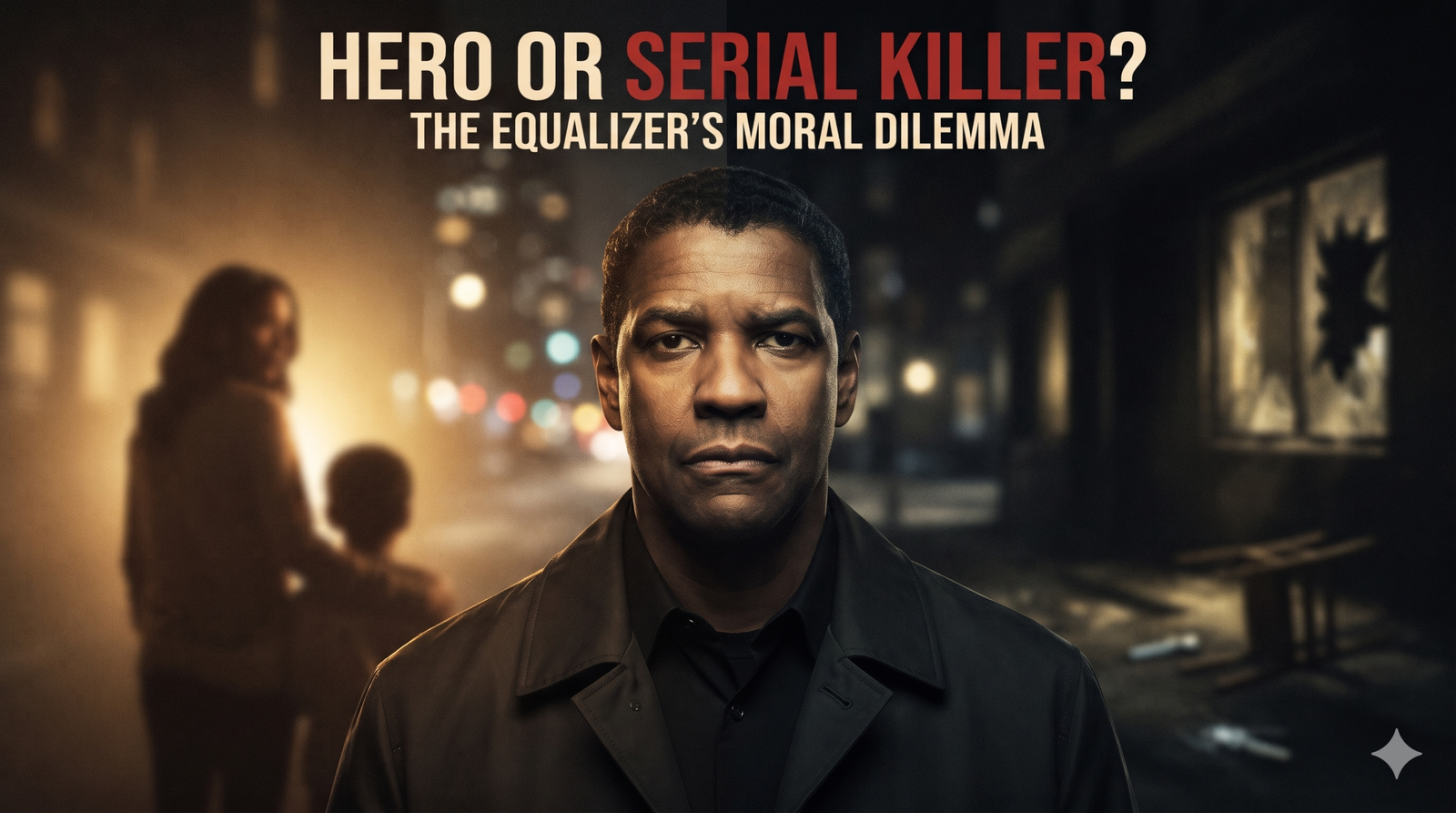
The Equalizer Trilogy Explained: Vigilante Justice, Moral Authority, and Why We Cheer for Robert McCall’s Violence
Spoiler Warning: This article discusses major plot developments and endings from The Equalizer (2014), The Equalizer 2 (2018), and The Equalizer 3 (2023).
Robert McCall kills people.
Not accidentally.
Not always in the heat of an uncontrolled struggle.
He often studies his opponents, anticipates their actions, and eliminates them with extraordinary precision.
Yet audiences rarely experience him as a conventional murderer.
Instead, they cheer.
When he destroys a room full of violent criminals, the scene feels satisfying.
When he punishes people who exploit the vulnerable, the violence can feel like justice.
When he calmly confronts someone who believes himself untouchable, viewers anticipate the moment that criminal discovers his mistake.
But remove the music, the camera angles, and the carefully established villainy of his enemies.
What remains?
A highly trained former government operative who repeatedly decides which people deserve to die.
That description sounds considerably less heroic.
And it leads to the most uncomfortable question in The Equalizer trilogy.
Is Robert McCall a hero because he kills dangerous people—or do we consider his killings acceptable because the movies have already convinced us he is a hero?
The distinction matters.
It reveals how the trilogy constructs its morality, how vigilante justice becomes emotionally attractive, and why Denzel Washington’s Robert McCall remains fascinating even when his behavior becomes increasingly disturbing.
1.What Makes Robert McCall Different From an Ordinary Action Hero?
Most action heroes respond to a threat.
Someone attacks their family.
A criminal organization targets them.
A terrorist plot endangers innocent people.
The hero fights back.
Robert McCall begins in a similar position, but his story develops differently.
In the first Equalizer film, he is a retired government operative living quietly in Boston.
He works at a hardware store.
He helps his coworkers.
He reads books at night.
He befriends Alina, a young woman trapped in an exploitative criminal operation.
When she is brutally beaten, McCall intervenes.
Initially, he offers money to secure her freedom.
The criminals refuse.
He kills them.
At this point, audiences can understand his actions as a response to a specific injustice.
But McCall does not stop after rescuing Alina.
He dismantles a larger criminal network.
He confronts the organization’s leader.
And by the end of the film, he decides to continue helping strangers facing serious threats.
His violence is no longer simply an emergency response.
It becomes part of a chosen mission.
This is the crucial transformation.
McCall stops being a man who occasionally uses violence to protect someone. He becomes a man who deliberately seeks situations in which his capacity for violence may be needed.
That does not automatically make him a villain.
But it changes the moral question.
We are no longer asking whether one desperate act was justified.
We are asking whether an individual should possess the authority to administer lethal punishment repeatedly.
2.Is Robert McCall Technically a Serial Killer?
The phrase “serial killer” is provocative, but it requires care.
In ordinary conversation, people sometimes use it to describe anyone who kills multiple people across separate incidents.
In criminology, however, serial murder has more specific definitions.
The FBI has used a working definition involving the unlawful killing of two or more victims by the same offender in separate events.
That definition does not mean every soldier, police officer, or person who kills repeatedly is automatically a serial murderer.
The circumstances and legality of the killings matter.
McCall is a fictional vigilante whose actions include both immediate confrontations with armed attackers and deliberate killings carried out outside any formal legal process.
Those situations cannot all be classified in the same way.
The films also do not establish that he kills primarily for the psychological gratification commonly associated with popular portrayals of serial killers.
His stated motives center on protection, punishment, and the prevention of further harm.
Therefore, simply declaring McCall a serial killer would obscure the more interesting issue.
He is better understood as a fictional vigilante who repeatedly uses lethal force based on his own moral judgment.
But that description is hardly reassuring.
The disturbing question is not whether McCall fits a criminal-profile label. It is why his personal judgment is enough for the audience to accept deaths that would otherwise demand serious scrutiny.
3.Why Do We Trust McCall to Decide Who Deserves Punishment?
The first film establishes McCall as an exceptionally considerate person.
He encourages Ralphie to improve his health and pursue a better job.
He listens to Alina’s dreams.
He treats ordinary workers with dignity.
These scenes matter because they build moral credibility.
Before viewers witness his most extreme violence, they have already seen him behave compassionately.
We believe he cares about people.
Then the movie introduces criminals who are unmistakably cruel.
They exploit women.
They beat vulnerable people.
They intimidate workers.
They use money and connections to avoid consequences.
The contrast is deliberate.
McCall is patient and generous.
His opponents are predatory and arrogant.
The audience is encouraged to trust him before he acts.
And once that trust has been established, the film rarely requires him to explain why a particular criminal deserves death rather than arrest, imprisonment, or another consequence.
The villains’ cruelty does much of the moral work.
This is a powerful storytelling technique.
It simplifies a difficult ethical problem by placing a highly sympathetic character opposite people who seem beyond redemption.
But it also creates a danger.
We begin to confuse confidence in McCall’s character with proof that every decision he makes is justified.
Those are not the same thing.
A person can have admirable motives and still make morally questionable decisions.
4.The $9,800 Scene: Is McCall Offering Mercy or Claiming Authority?
One of the most revealing scenes in the first film occurs when McCall offers Slavi $9,800 to release Alina.
He enters the room calmly.
He places the money on the table.
He proposes a peaceful resolution.
Slavi refuses.
The confrontation ends in violence.
On the surface, the scene makes McCall appear restrained.
He tried negotiation first.
He gave the criminals an opportunity to stop.
But look more closely.
McCall has appointed himself the person who will determine the consequences of their refusal.
He decides the terms.
He decides when the negotiation is over.
He decides how to respond.
Slavi’s cruelty is real within the story.
Yet McCall’s authority is entirely self-appointed.
This is what makes the scene more complex than a simple demonstration of mercy.
The offer creates a moral boundary.
If Slavi accepts, he may survive.
If he refuses, McCall is prepared to use lethal force.
The audience experiences that boundary as reasonable because Slavi is an obvious villain.
But the underlying structure resembles a private judgment.
McCall becomes investigator, negotiator, judge, and executioner.
He gives Slavi a choice, but McCall alone decides what the refusal will cost.
That is the beginning of the trilogy’s central ethical problem.
5.Does McCall Believe He Is Above the Law?
McCall does not present himself as someone who wants to rule society.
He does not seek political office.
He does not build an organization around personal power.
He does not demand public recognition.
In fact, he often tries to remain invisible.
But his actions repeatedly place him outside legal institutions.
He gathers information.
He identifies wrongdoing.
He decides who is responsible.
He uses force.
And in some cases, he kills.
The trilogy presents legal and institutional systems as unable or unwilling to protect the people he helps.
That failure is essential to the vigilante fantasy.
If every victim could obtain immediate and effective protection through ordinary institutions, McCall’s extraordinary interventions would become harder to justify.
The movies therefore create a world in which justice frequently arrives too late—or does not arrive at all.
McCall fills that gap.
But filling a gap in institutional protection does not automatically grant someone legitimate authority to impose punishment.
The distinction is important.
There is a moral difference between stopping an immediate attack and deliberately killing someone who could potentially be restrained or prosecuted.
The films sometimes blur that distinction for dramatic effect.
McCall’s opponents are so dangerous that viewers are encouraged to believe ordinary legal solutions would never work.
The result is a fantasy of perfect personal judgment.
McCall does not explicitly claim to be above the law. But he repeatedly acts as though his ability to recognize injustice gives him permission to bypass it.
6.What Changes in The Equalizer 2?
The Equalizer 2 expands McCall’s mission.
He is now working as a driver and continuing to help people who are threatened or exploited.
He intervenes in situations involving vulnerable individuals.
But the central conflict becomes deeply personal when his friend and former colleague Susan Plummer is murdered.
McCall investigates her death and discovers a conspiracy involving people connected to his former professional world.
The story becomes a confrontation with individuals who possess training and knowledge similar to his own.
This matters because the second film reduces the distance between hero and villain.
In the first movie, McCall confronts an organized-crime network that exploits civilians.
In the second, he faces former operatives who have turned their skills toward criminal purposes.
They understand the same world he once inhabited.
They possess comparable abilities.
They have also crossed moral boundaries.
The difference between them and McCall is not simply professional training.
It is what they believe their abilities should be used for.
McCall sees himself as protecting people.
His enemies have used their training for personal gain and violence.
But the resemblance raises an uncomfortable question.
What prevents McCall from becoming like the people he hunts?
His answer appears to be his moral code.
He believes he is acting for others rather than himself.
Yet Susan’s murder also gives his campaign a powerful element of personal revenge.
The second film tests whether McCall’s violence remains an act of protection when the person he most wants to punish has hurt someone he loves.
7.Is Revenge Really Different From Justice in The Equalizer 2?
Revenge and justice can produce similar outward actions.
Both may involve identifying a wrongdoer.
Both may involve punishment.
Both can be driven by a desire to prevent future harm.
But they differ in important ways.
Revenge is personal.
It arises from injury, anger, or loss.
Justice, at least as a social ideal, requires standards that apply beyond the feelings of one individual.
It also requires limits.
The person imposing punishment should not be the only person deciding whether the punishment is deserved.
McCall’s confrontation with the people responsible for Susan’s death sits uneasily between these ideas.
His enemies have committed serious crimes.
Stopping them may protect others.
But his emotional investment is unmistakable.
He is not an impartial observer.
He is grieving.
He is angry.
He wants the people responsible to pay.
The film encourages us to see his actions as justified because the villains are guilty and dangerous.
Yet it rarely asks whether McCall’s personal grief might affect his judgment.
That omission is important.
The closer McCall’s mission comes to personal revenge, the harder it becomes to separate his moral code from his emotional needs.
The movie’s dramatic satisfaction depends partly on that ambiguity.
We want him to punish the people who killed Susan.
But wanting punishment is not the same as establishing that every form of punishment is justified.
8.Why Does The Equalizer 3 Make McCall Even More Disturbing?
The third film changes the setting.
McCall travels to Italy and becomes connected to a small coastal community.
He experiences kindness and hospitality.
For perhaps the first time in years, he begins to imagine a life of belonging.
But the local community is threatened by organized crime.
Once again, McCall intervenes.
The structure resembles the first film.
An ordinary community is threatened.
Powerful criminals exploit vulnerable people.
McCall possesses the skills needed to stop them.
But his violence in the third film often feels particularly severe.
The opening sequence presents him amid the aftermath of a bloody confrontation at a Sicilian estate.
Later, his campaign against the Camorra organization includes brutal acts intended not merely to defeat opponents but to terrify those who remain.
This intensifies the moral question.
McCall is not always simply neutralizing an immediate threat.
At times, he uses fear as an instrument.
That is significant because fear is also the mechanism through which the criminals control their victims.
The film presents McCall’s intimidation as justified by its targets.
But the similarity of method remains.
When a hero uses terror to defeat people who rule through terror, does the difference in purpose make the method entirely acceptable?
The trilogy never fully resolves that question.
And perhaps that unresolved tension is one reason McCall remains compelling.
9.Why Do We Enjoy Watching McCall Punish Criminals?
The Equalizer films are carefully constructed to produce a particular emotional experience.
First, they show us people being harmed.
Then they establish that the perpetrators are powerful and difficult to stop.
Finally, McCall arrives.
The audience knows something the criminals do not.
The quiet man they are threatening is far more dangerous than they imagine.
This creates anticipation.
We wait for the moment when the balance of power reverses.
The villains believe they are predators.
Then they discover they are vulnerable.
That reversal can be deeply satisfying.
It offers a fantasy in which cruelty receives immediate consequences.
There are no endless delays.
No corrupt negotiations.
No powerful criminals escaping through connections.
McCall simply acts.
But this emotional satisfaction should not be mistaken for a complete moral argument.
A scene can be satisfying because it fulfills a desire for punishment.
That does not mean the punishment would be justified under every ethical or legal standard.
The films use editing, music, performance, and the characterization of villains to make violence feel deserved.
And they are remarkably effective at it.
The Equalizer does not merely ask whether McCall’s violence is justified. It makes us feel that it is justified before we have time to examine the question.
That is one of the trilogy’s most powerful storytelling mechanisms.
10.Is Robert McCall a Modern Western Gunslinger?
There is a useful comparison between McCall and the heroes of classic Western films.
A mysterious stranger arrives in a community.
The people are being oppressed.
The authorities are weak, corrupt, or absent.
The stranger possesses extraordinary fighting skills.
He confronts the people responsible.
Order is restored.
Then he leaves—or discovers that he cannot fully belong to the peaceful world he has protected.
McCall follows much of this pattern.
He is a modern version of the wandering gunfighter.
His weapons are different.
His setting is contemporary.
His past involves government intelligence rather than frontier warfare.
But the moral structure is familiar.
He possesses a capacity for violence that ordinary people do not.
That capacity makes him valuable when a community faces danger.
Yet it also separates him from the peaceful life he wants.
This is especially visible in The Equalizer 3.
McCall finds a community that offers him friendship and belonging.
But he must confront the violence threatening it.
The film presents his final struggle as a path toward peace.
Still, the old Western question remains.
Can a man whose identity is built around violence ever truly become part of the peaceful world he protects?
McCall is a gunslinger who dreams of being an ordinary neighbor.
That contradiction gives the trilogy much of its emotional power.
11.Why Is McCall’s Kindness Essential to the Violence?
Imagine the same films without McCall’s ordinary acts of compassion.
Remove his friendship with Alina.
Remove his encouragement of Ralphie.
Remove his care for vulnerable strangers.
Remove his attachment to the Italian community in the third film.
What remains?
A highly trained man who repeatedly kills people.
The character would become much harder to admire.
This reveals the importance of his kindness.
It does not merely make him likable.
It provides the moral framework through which viewers interpret his violence.
Because McCall is compassionate toward vulnerable people, we assume his cruelty toward criminals serves a compassionate purpose.
Because he asks for little in return, we assume he is not motivated by selfishness.
Because he avoids public recognition, we assume he does not seek power.
These assumptions may often be reasonable within the fictional world.
But they are still assumptions.
A person can be compassionate in one relationship and dangerous in another.
The existence of kindness does not automatically justify every act of violence.
McCall’s gentleness is what makes his brutality emotionally acceptable to the audience—and that is precisely why the character deserves closer examination.
12.Does McCall Ever Question His Own Judgment?
The trilogy repeatedly shows McCall struggling with his past and his desire for peace.
He is not portrayed as a man entirely free of emotional conflict.
His former career, his wife’s death, his relationships, and the consequences of violence all shape him.
In The Equalizer 3, his physical vulnerability becomes particularly important.
He is injured.
He requires care.
He depends on the kindness of people he has only recently met.
For a character who usually controls every dangerous situation, dependence is a significant change.
He must accept help rather than always providing it.
This creates the possibility of a different kind of life.
A life based on relationships rather than constant intervention.
But the films do not consistently require McCall to examine the legitimacy of his own lethal decisions.
He may question whether he wants to return to violence.
He may question whether he deserves peace.
Those questions are different from asking whether he should possess the authority to decide who dies.
That distinction is crucial.
McCall’s deepest conflict is often whether he can live with being a killer—not whether he has the right to kill.
The trilogy explores the first question far more directly than the second.
13.Did Robert McCall Finally Find Peace in The Equalizer 3?
The ending of the third film suggests that McCall may finally have found a place where he belongs.
After the criminal threat is defeated, the Italian community continues its ordinary life.
McCall is no longer simply an outsider passing through.
He has formed relationships.
He has experienced care.
He has discovered the possibility of remaining somewhere without constantly moving toward another mission.
This is a meaningful development.
In the first film, he constructs an orderly but emotionally isolated life.
In the second, he continues moving through the world while helping others.
In the third, he encounters a community that offers him something beyond the satisfaction of solving problems.
Belonging.
The ending can therefore be interpreted as a form of redemption.
McCall is not redeemed because his past violence disappears.
It cannot disappear.
He is redeemed, in the film’s emotional logic, because he discovers a way to live with other people rather than existing only as their protector.
But there is still an ambiguity.
His peace follows another campaign of extreme violence.
The community is safe because he has eliminated its enemies.
This means the film’s vision of peace remains dependent on his extraordinary ability to destroy threats.
McCall finds a peaceful home, but the trilogy never completely escapes the idea that peace must first be secured through overwhelming violence.
That is the unresolved contradiction beneath its hopeful ending.
14.What Would Happen If Robert McCall Made a Mistake?
This may be the most important question the trilogy rarely confronts.
McCall is exceptionally observant.
He is intelligent.
He is experienced.
He usually identifies the correct enemies.
The films are designed so that his targets are clearly guilty and dangerous.
But imagine a different situation.
What if the evidence were incomplete?
What if someone manipulated him?
What if a person he believed responsible were innocent?
What if his anger affected his judgment?
What if the person he was about to kill could have been safely arrested?
The moral structure of the films depends heavily on McCall’s near-perfect ability to identify wrongdoing.
That is a luxury real systems of justice cannot assume.
Courts require evidence.
Legal processes allow challenges.
Procedures exist partly because even sincere and intelligent people can make mistakes.
McCall’s system contains no comparable safeguards.
His judgment is immediate.
His punishment may be irreversible.
And there is often no one capable of stopping him.
This is the fundamental danger of vigilante justice.
Not that every vigilante necessarily has bad intentions.
But that good intentions do not eliminate the possibility of catastrophic error.
A justice system built around one extraordinary person’s certainty is only as reliable as that person’s next decision.
And no person, however capable, is incapable of error.
15.Is McCall a Hero, an Antihero, or Something More Complicated?
Robert McCall is clearly constructed as a heroic protagonist.
He protects vulnerable people.
He opposes exploitative criminals.
He acts courageously.
He often places himself in danger without seeking money or fame.
These qualities make him admirable within the films’ moral universe.
But he also operates outside ordinary accountability.
He uses lethal force repeatedly.
He makes unilateral decisions about punishment.
And his methods can resemble the intimidation practiced by the criminals he fights.
These qualities complicate the heroic image.
Calling him a villain would ignore the people he saves and the genuine compassion he demonstrates.
Calling him an uncomplicated hero would ignore the moral risks of his methods.
The term antihero captures part of the contradiction, although McCall is more conventionally compassionate than many antiheroes.
Perhaps the most accurate description is a morally idealized vigilante.
The films imagine a person whose judgment is so reliable, whose abilities are so extraordinary, and whose motives are so sympathetic that viewers are willing to accept powers they would hesitate to grant anyone in reality.
That is the fantasy.
And it is also the danger.
16.Final Analysis: The Equalizer’s Real Fantasy Is Not Violence—It Is Perfect Judgment
Is Robert McCall a hero or a serial killer?
Neither label fully captures what makes him interesting.
He is a fictional vigilante whose compassion is genuine and whose violence is often extreme.
He protects people whom powerful criminals have harmed.
But he also assumes the authority to decide when another person’s life should end.
The trilogy encourages us to accept that authority because McCall is almost always right.
He recognizes the guilty.
He protects the innocent.
He anticipates danger.
He rarely misjudges the situation.
And when he acts, the results generally restore order.
But this is the crucial point.
The most unrealistic element of The Equalizer may not be McCall’s fighting ability. It may be the near-perfect reliability of his moral judgment.
A real person could not be trusted with that level of unchecked power.
Not because every person is malicious.
But because every person is fallible.
The films allow us to enjoy a world in which a single extraordinary individual can identify injustice and eliminate it without making a devastating mistake.
That is an appealing fantasy.
Especially when institutions fail and vulnerable people suffer.
Yet it also invites us to overlook the safeguards that make justice different from revenge.
Robert McCall is compelling because he embodies both sides of this contradiction.
He is gentle enough to make us trust him.
Dangerous enough to make criminals fear him.
And certain enough of his own judgment to become something more powerful than either an ordinary hero or an ordinary killer.
The real question is not whether Robert McCall deserves our admiration.
It is whether we would still admire his methods if we could no longer be certain that he was right.
That is the question The Equalizer leaves behind long after its final confrontation.
Frequently Asked Questions
Is Robert McCall a serial killer?
Robert McCall is best described as a fictional vigilante who repeatedly uses lethal force. Whether particular killings would qualify as unlawful homicide depends on their circumstances. Calling him a serial killer without qualification oversimplifies his motives and the legal distinctions involved.
Is Robert McCall a good guy or a bad guy?
The trilogy portrays him as a protector of vulnerable people, but his repeated use of extrajudicial violence raises significant ethical questions.
Why does Robert McCall kill so many people?
McCall believes his specialized abilities can protect people from dangerous criminals. His motives include protection, punishment, and, at times, personal revenge.
Does Robert McCall enjoy killing?
The films do not conclusively establish that he kills for pleasure. However, his emotional composure and increasingly brutal methods invite viewers to question his relationship with violence.
Why is Robert McCall so calm when killing?
His background as a highly trained former operative helps explain his discipline, threat assessment, and ability to act under pressure.
What is Robert McCall’s moral code?
He generally protects vulnerable people, confronts those who exploit them, and often offers opportunities to stop wrongdoing. However, the trilogy does not establish a formal or consistently articulated ethical code governing every lethal decision.
Is The Equalizer 3 the end of Robert McCall’s story?
The third film gives McCall a sense of belonging and an emotionally satisfying conclusion, although that ending does not by itself settle every question about his future.
What is the main message of The Equalizer trilogy?
One interpretation is that extraordinary abilities gain meaning through protecting others. A more critical interpretation is that the films explore the appeal—and the danger—of placing justice in the hands of a single powerful individual.
Related Reading on True Taste Korea
Part 1 — Why Is Robert McCall So Kind—and So Brutal? The Equalizer’s Darkest Paradox Explained
Explore the psychological contradiction behind McCall’s compassion for ordinary people and his ruthless treatment of violent criminals.
Part 2 — The Equalizer Ending Explained: Why Did McCall Turn Home Mart Into a Death Trap?
Discover the symbolism of the hardware-store finale, Teddy’s death, and the moment McCall accepts his violent past.
More Action Movie Analysis
War of the Arrows Ending Explained: Why Did Nam-yi Spare Jushinta Before Killing Him?
Another action film that examines the boundary between violence, protection, and personal responsibility.
Could the Curving Arrow in War of the Arrows Really Work?
Explore the difference between real combat techniques and the extraordinary abilities portrayed in action cinema.
