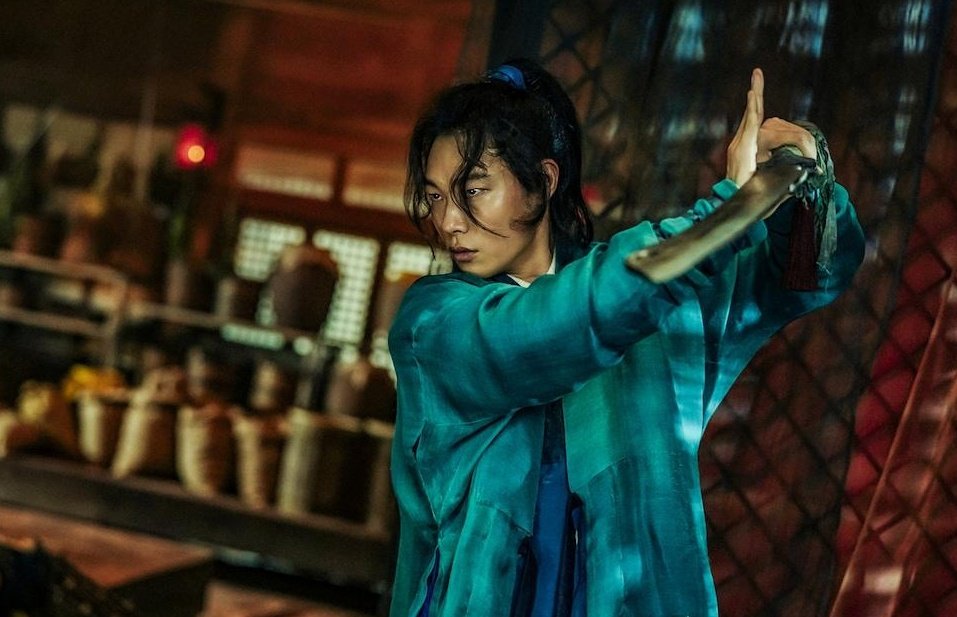
Spoiler Warning: This article discusses major plot developments and the ending of Alienoid: Return to the Future (2024), the second part of the Korean science-fantasy film series.
1. The Second Film Begins Where the First One Left Us
The first Alienoid film introduced an extraordinary world in which alien prisoners, human bodies, futuristic technology, Goryeo-era Taoist magic, and time travel exist within the same story.
But it ended with a revelation that changed everything.
Mureuk, the seemingly carefree Taoist magician, was connected to the Controller, the dangerous alien intelligence that threatened humanity. He had lived without understanding what was inside him or how his forgotten past had shaped his identity.
Alienoid: Return to the Future picks up that unfinished story.
Lee Ahn is still trapped in the past, the future remains in danger, and the people caught between two eras must finally confront the consequences of decisions made long before they understood them.
The second film is not simply about stopping an alien invasion.
It is about discovering whether people can escape a fate that was decided without their permission.
2. Mureuk: The Man Who Was Never Fully Himself
Mureuk initially appears to be an amusing and somewhat unreliable Taoist magician.
He is interested in rewards, money, and the practical advantages of possessing the Divine Blade. His personality seems far removed from the traditional image of a serious hero.
Yet Part 1 had already revealed that something was wrong.
Mureuk’s extraordinary abilities, unexplained memories, and unusual physical resilience were connected to the alien presence inside his body.
Part 2 turns this mystery into an identity crisis.
Mureuk must confront the possibility that some of the things he considers part of himself may have another origin.
This is more disturbing than simply discovering that an alien lives inside his body.
If another consciousness has influenced his memories, abilities, and behavior, how much of his life has actually belonged to him?
3. The Controller: An Enemy Living Inside a Human Life
The Controller is more than a powerful alien antagonist.
It represents the terrifying possibility that one consciousness can occupy another being’s life without permission.
The alien system was originally designed to imprison dangerous criminals inside human hosts. But the Controller’s presence in Mureuk reveals how easily the boundaries between imprisonment, survival, and control can become complicated.
Mureuk is not responsible for the circumstances that placed the Controller inside him.
He did not choose to become a host, and he did not understand the truth when he was growing up.
This distinction matters.
A person should not automatically be defined by something that was forced upon them.
The film’s most interesting identity question is therefore not whether Mureuk is human or alien.
It is whether he can remain himself when another existence has become part of his body.
4. Is Mureuk a Victim, a Threat, or Both?
Mureuk occupies an uncomfortable position.
To those who understand the danger of the Controller, his body represents a potential disaster. To himself, however, he is a person trying to understand an increasingly frightening reality.
This creates a conflict between individual identity and public safety.
If a person carries something dangerous without knowing it, should society treat that person as guilty?
The question becomes even more difficult when the threat is powerful enough to endanger everyone.
Mureuk is both a victim of circumstances and a possible source of danger.
The film does not need to make him completely innocent or completely responsible. Its strongest emotional tension comes from the fact that both descriptions can exist at the same time.
5. Lee Ahn: Freedom Requires More Than Returning Home
Lee Ahn’s mission appears straightforward.
She must recover the Divine Blade, find a way back to the future, and prevent the catastrophe that threatens humanity.
But her journey is more complicated than a simple rescue mission.
She has spent years in an unfamiliar historical period. She has lost the life she was supposed to have, and the people she once depended on are separated from her by time.
Her determination is not merely about returning to 2022.
She wants to protect the people who matter to her and reclaim the future that was taken away.
In Part 1, Lee Ahn began discovering that powerful beings had made decisions about her life without telling her the truth.
In Part 2, she acts on what she has learned.
She no longer waits for others to decide what she should do.
Her freedom becomes something she must actively defend.
6. The Divine Blade: A Key to the Past and the Future
The Divine Blade is one of the most important objects in the entire story.
To the people of Goryeo, it appears to be a mysterious weapon with supernatural power. But its true significance is connected to the advanced technology and time-travel system introduced in the first film.
The blade is not simply a weapon that can defeat an enemy.
It is a means of crossing the boundary between historical periods.
For Lee Ahn, it represents the possibility of returning to her own time. For other characters, it offers power, knowledge, or the opportunity to change their circumstances.
This creates an interesting contrast.
Many characters want the same object, but they do not want the same future.
The Divine Blade reveals that possessing the means to change the world does not necessarily mean understanding what should be changed.
7. Why the Goryeo Characters Matter to the Final Conflict
The Goryeo storyline is not a separate fantasy adventure that exists only to provide comic relief.
The Taoist magicians, bounty hunters, and other historical characters gradually become part of a much larger conflict.
Their understanding of the world is different from that of the modern characters.
What they interpret as ghosts, spirits, or supernatural phenomena is often connected to alien technology and beings from another time.
This difference in knowledge creates misunderstandings, but it also creates unexpected possibilities.
The historical characters are not simply powerless people waiting for modern technology to save them.
They have their own abilities, relationships, and reasons to become involved.
The second film brings these different worlds together to suggest that saving humanity requires more than one kind of knowledge.
8. Min Gae-in: The Ordinary Person Who Gets Pulled Into an Extraordinary Disaster
Min Gae-in offers another important perspective.
Unlike Lee Ahn, Guard, or the Taoist magicians, she is not someone who begins with a clear understanding of the alien system.
She becomes involved after witnessing events that ordinary people cannot easily explain.
Her presence reminds viewers that the consequences of the alien conflict do not belong only to the people who understand it.
Ordinary citizens are the ones who suffer when powerful beings fight over the future of the planet.
This is an important contrast with the characters who possess extraordinary abilities.
The people making decisions may be aliens, advanced machines, or powerful magicians, but the consequences reach people who never asked to participate.
9. The 48-Minute Countdown: When There Is No Time Left for Perfect Decisions
The threat of Haava gives the second film a much more immediate sense of urgency.
The central conflict moves beyond the question of how the characters became connected.
They now have to stop a disaster before time runs out.
The countdown changes the nature of their choices.
There is no opportunity to understand every mystery, resolve every disagreement, or develop a perfect plan.
The characters must act with incomplete information.
This is one of the film’s most effective ideas.
Real crises rarely provide enough time for people to understand everything before making a decision.
The important question is not whether the characters can find a flawless solution.
It is whether they can cooperate despite their differences and accept responsibility for the consequences.
10. Guard and Thunder: The Cost of Protecting Humanity
Guard and Thunder have always represented the system responsible for controlling the alien prisoners.
But their relationship with Lee Ahn makes their role more personal.
Guard is not simply a machine carrying out an assignment. His connection with Lee Ahn has developed into something resembling a family bond.
That relationship complicates his original mission.
Protecting humanity is an enormous responsibility, but protecting one person can become just as meaningful.
The film places these forms of responsibility beside each other.
Guard’s choices are not only about following the rules of the alien prison system. They are also about the people he has come to care about.
Thunder’s role further reinforces the emotional connection between technology and human relationships.
The film repeatedly suggests that the meaning of a being cannot be reduced to the purpose for which it was originally created.
11. The Final Battle: Different Eras Must Finally Work Together
The climax brings together characters from the modern world and the Goryeo period.
Their different abilities and experiences become necessary in the struggle against the alien threat.
The final conflict is therefore not just a battle between humans and aliens.
It is a confrontation between different kinds of power, knowledge, and responsibility.
The modern characters possess advanced technology and knowledge of the alien system. The historical characters bring their own forms of combat, magic, and determination.
Neither side can solve the crisis alone.
This is a meaningful development from Part 1.
The first film introduced two apparently disconnected timelines. The second film reveals why those timelines must eventually become one story.
The future cannot be saved by the future alone.
12. The Ending: Does Mureuk Finally Become His Own Person?
The resolution of Mureuk’s story is central to the emotional meaning of Part 2.
His connection to the Controller initially makes him appear to be someone whose identity has already been compromised.
But the important distinction is between what exists inside him and what he chooses to do.
Mureuk’s identity cannot be reduced to the alien presence that entered his body when he was a child.
His relationships, experiences, decisions, and willingness to stand with others are also part of who he is.
The final confrontation gives this conflict its meaning.
Mureuk is no longer simply an unaware host carrying a dangerous secret. He becomes an active participant in deciding what happens next.
The film’s resolution is not a philosophical explanation of exactly where one consciousness ends and another begins.
Instead, it emphasizes that identity is also revealed through choices.
A person may not control everything that happens to them.
But the response to those circumstances can still belong to them.
13. Why Viewers Were Divided Over Part 2
The second film received mixed reactions, and the reasons are worth examining.
Some viewers appreciated that the sequel finally connected the different timelines and resolved the mysteries introduced in Part 1.
Others enjoyed the action, visual effects, unusual mixture of Korean fantasy traditions and science fiction, and the emotional payoff of the characters’ journeys.
However, the film’s ambitious structure remained a source of criticism.
Some reviewers felt that the story contained too many genres and ideas competing for attention. The large cast, rapid transitions, and complicated mythology could make the narrative difficult to follow.
The contrast between critical reactions is revealing.
Rotten Tomatoes listed a 78% audience score alongside a 69% critics’ score in its displayed ratings, while individual reviews ranged from enthusiastic praise to strong criticism.
The divide is not simply about whether the film is entertaining.
It is also about what viewers expect from a science-fiction story.
Some want a tightly controlled mythology with clear rules. Others are willing to accept narrative chaos in exchange for imagination, spectacle, and originality.
Neither response represents every viewer.
But the disagreement helps explain why Alienoid remains such an unusual entry in Korean genre cinema.
14. Could Mureuk Escape a Fate He Never Chose?
The central question of Alienoid Part 2 is different from the one introduced in the first film.
Part 1 asked whether human beings were ever truly in control of their own destiny.
Part 2 takes that question further.
What happens when someone discovers that an important part of their identity was shaped by something they never chose?
Mureuk did not choose to become connected to the Controller.
Lee Ahn did not choose to have her childhood and future shaped by decisions made by others.
The human hosts did not choose to become prisons for alien criminals.
Even Guard and Thunder began their existence within a system that assigned them a particular purpose.
Yet the story does not end by declaring that everyone is powerless.
The characters make decisions, form relationships, challenge expectations, and accept risks for people beyond themselves.
Perhaps freedom is not the ability to control every circumstance.
Perhaps it is the ability to decide what kind of person to become after those circumstances have already changed your life.
That is what makes Mureuk’s journey more than a story about an alien living inside a human body.
It is a story about whether a person can claim ownership of a life that began with a choice they never made.
Final Thought
Alienoid: Return to the Future completes the two-part story by bringing its scattered timelines, characters, and mysteries into a final confrontation.
Its crowded storytelling and constant shifts in tone will not work for every viewer. But its central question is more emotionally grounded than its enormous science-fiction setting might initially suggest.
Mureuk cannot choose how the Controller entered his life. Lee Ahn cannot undo the decisions that shaped her childhood. The human hosts cannot change the fact that they were used by an alien prison system.
But they can still make choices about what happens next.
The first film asked whether people were ever in control of their destiny.
The second film offers a more hopeful possibility:
Even when we cannot choose what happens to us, we may still have the power to choose who we become.
Continue the story: Read Alienoid Part 1: Were Humans Ever in Control of Their Own Destiny? to understand the origins of Mureuk’s mystery and the world that leads to this conclusion.