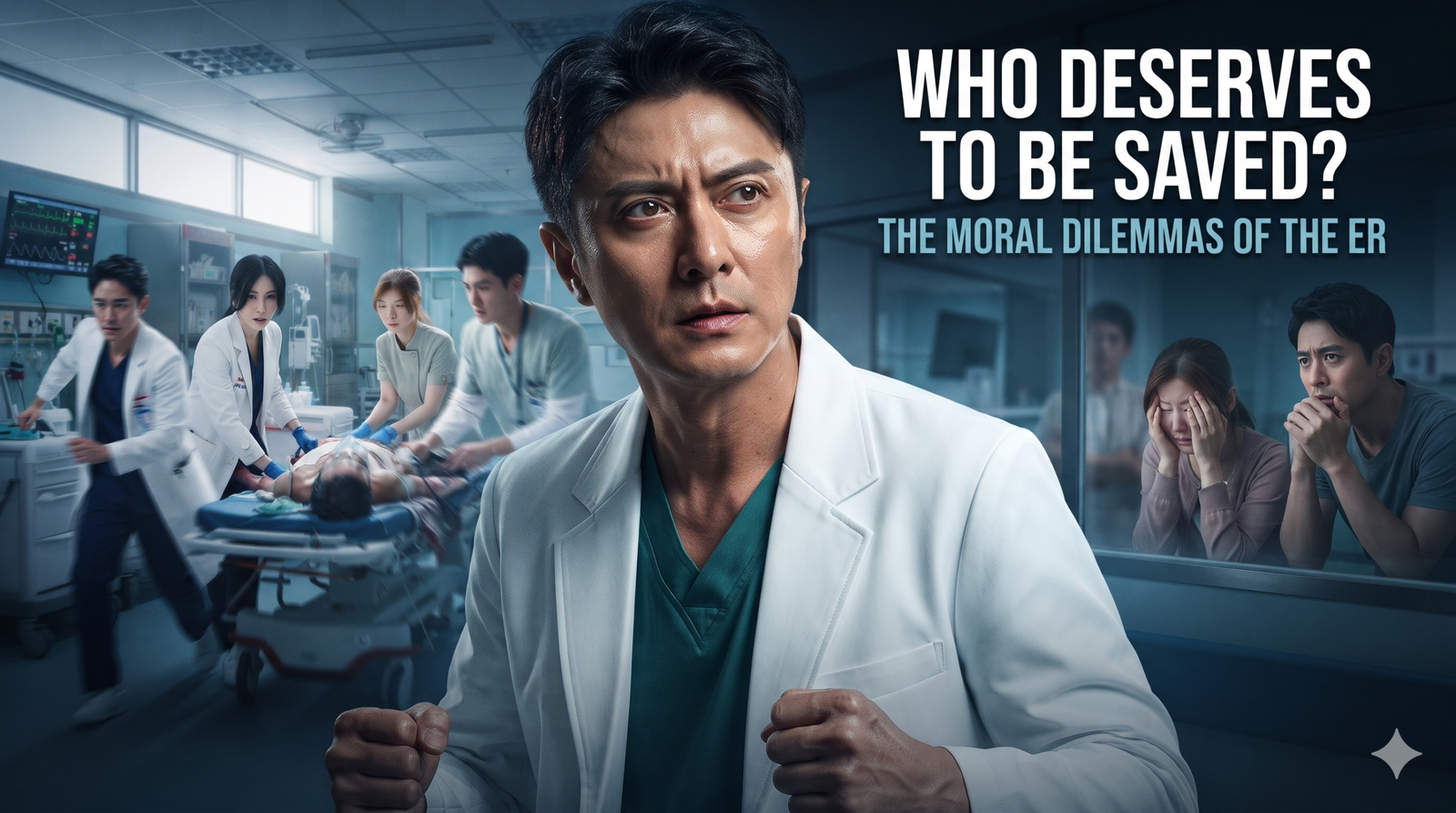
An emergency room is a place where decisions cannot always wait for perfect information.
A doctor may have only minutes to understand a patient’s condition. A wrong decision can change a life, but refusing to make a decision can be just as dangerous.
This is the world of Miracles of the ER, the Taiwanese medical drama on Netflix.
The series follows a group of doctors working in the emergency department of Yang-Da University Hospital. Among them is Lin Geng-ming, an average-performing medical graduate who receives an unexpected opportunity from senior physician Chou Cheng-jun.
Unlike his academically outstanding colleagues, Geng-ming does not begin his career with an impressive record. He must prove that he belongs in an environment where medical knowledge, quick judgment, and emotional control are constantly tested.
However, the most interesting question in this drama is not whether an inexperienced doctor can become a brilliant physician.
It is something more difficult:
What makes someone a good doctor when every decision involves risks, and even the best intentions cannot guarantee a patient’s survival?
Through medical emergencies, financial difficulties, malpractice disputes, and conflicts inside the hospital, Miracles of the ER explores the distance between being medically qualified and being morally responsible.
1. Why Does the Senior Doctor Choose an Average Graduate?
The decision to recruit Lin Geng-ming is one of the drama’s most important starting points.
Geng-ming is not presented as the obvious choice for a demanding emergency department. His academic performance is ordinary compared with his highly accomplished colleagues.
That makes Chou Cheng-jun’s decision unusual.
In a competitive medical environment, academic results are often treated as evidence of ability. High grades suggest discipline, knowledge, and the capacity to understand complex information.
But emergency medicine requires more than the ability to perform well in examinations.
Doctors must communicate with patients, recognize incomplete information, respond to unexpected changes, and accept responsibility when their decisions produce difficult outcomes.
A person can understand medical theory without knowing how to respond emotionally when a patient deteriorates in front of them.
Geng-ming’s recruitment therefore raises an important distinction.
Is the best doctor necessarily the person with the strongest academic record, or is medical excellence a combination of knowledge, judgment, humility, and the ability to learn from failure?
The series does not suggest that medical competence is unimportant. In fact, Geng-ming’s early struggles make the opposite point. Good intentions cannot compensate for a lack of clinical ability.
But academic excellence alone cannot guarantee that someone will become a good physician either.
Chou’s decision can be interpreted as an attempt to introduce a different kind of potential into an established medical environment.
He is not simply choosing a weaker candidate. He may be looking for qualities that traditional evaluations do not measure easily.
2. The Most Dangerous Mistake Is Believing That Good Intentions Are Enough
One of the most uncomfortable aspects of Geng-ming’s early experience is that his desire to help patients does not automatically make him capable of helping them.
He enters the emergency department with enthusiasm, but his lack of experience becomes apparent when he faces real medical situations.
The first episode establishes this problem through a difficult procedure involving a patient. Geng-ming struggles with a basic medical task, and the consequences are serious.
This is important because the drama avoids an overly convenient version of the inexperienced hero.
In many workplace dramas, a new employee’s sincerity and unusual perspective eventually compensate for their lack of experience.
Emergency medicine is less forgiving.
A doctor cannot simply tell a patient that they meant well.
The patient needs an accurate assessment and appropriate treatment.
This creates two responsibilities that must exist together.
First, doctors must continue developing their knowledge and practical skills.
Second, they must remain aware of the human consequences of their mistakes.
A doctor who refuses to acknowledge mistakes cannot improve. But a doctor who repeatedly makes avoidable mistakes cannot rely on personal sincerity as an excuse.
The distinction between intention and competence is one of the strongest themes in the series.
It also makes Geng-ming’s development more meaningful than a conventional story about an underestimated employee proving everyone wrong.
His real challenge is not winning recognition from his colleagues.
It is becoming someone who can safely accept the responsibility that comes with treating another person’s life.
3. A Hospital Does Not Always Reward the Doctor Who Saves the Patient
One of the drama’s most interesting conflicts emerges when medical decisions collide with hospital authority.
Chou Cheng-jun is portrayed as an experienced physician who is willing to take risks when he believes a patient’s condition demands immediate action.
But the hospital does not necessarily view every risky decision in the same way.
A medical procedure may be justified by the urgency of the situation, yet it can still create institutional and professional consequences.
This is where the drama moves beyond the familiar image of a doctor fighting against death.
A hospital is also an organization.
It has administrators, professional hierarchies, financial responsibilities, performance evaluations, and rules designed to reduce risk.
These systems are not automatically bad. Hospitals need procedures because medical decisions affect patients, staff, and public trust.
The problem appears when protecting the organization becomes more important than examining whether a medical decision was right.
A hospital may prefer a decision that is easier to defend administratively rather than one that requires difficult judgment.
That creates a dangerous possibility: doctors may begin choosing actions according to how safely they can explain them later, rather than what the patient needs at that moment.
The drama’s institutional conflicts invite viewers to consider a difficult question.
If a doctor saves a patient’s life but violates an established procedure, should the hospital judge the result, the decision-making process, or both?
There is no simple answer.
A successful outcome does not automatically prove that a risky decision was correct. Equally, an unfavorable outcome does not automatically prove that the doctor acted irresponsibly.
The quality of a medical decision must be examined in the context of what the physician knew, what alternatives were available, and how much time remained.
That complexity makes the hospital’s internal conflicts more than ordinary workplace politics.
4. When Medical Costs Become Another Emergency
The fourth episode introduces a cancer patient who wants to leave the hospital because the financial burden of treatment has become difficult to bear.
This storyline reveals a problem that medical dramas sometimes overlook.
A hospital may have the knowledge and equipment to treat a patient, but access to treatment is not determined by medical technology alone.
It is also affected by money.
For a patient facing a serious illness, the decision to continue treatment may involve more than the possibility of survival.
There may be concerns about family finances, lost income, debt, and the possibility of becoming a burden to relatives.
From the doctor’s perspective, encouraging treatment may appear to be the obvious response.
But from the patient’s perspective, continuing treatment may create another kind of suffering.
This produces a difficult ethical distinction.
Is a doctor responsible only for recommending the medically appropriate treatment, or should the doctor also consider whether the patient can realistically continue receiving it?
The answer cannot be that doctors must personally solve every financial problem.
Medical professionals cannot independently remove every economic barrier in society.
However, recognizing that financial hardship affects medical decisions is part of understanding the patient as a whole person.
The case also challenges the assumption that every patient who refuses or delays treatment has given up.
Sometimes the obstacle is not a lack of hope.
It is the cost of maintaining that hope.
This is one of the drama’s most socially relevant questions because it connects the emergency department to the wider economic conditions in which patients live.
5. Can a Doctor Be Good Without Becoming a Hero?
Medical dramas often celebrate doctors who sacrifice everything for their patients.
They stay beyond their shifts, challenge authority, and make extraordinary decisions when everyone else has lost hope.
Such stories can be emotionally powerful, but they also create an unrealistic expectation.
Doctors are human beings.
They become exhausted. They make mistakes. They have families, financial concerns, personal fears, and limits to their knowledge.
Miracles of the ER gives this human limitation particular importance through its senior medical characters.
He Yu-hua, an experienced emergency physician, faces the emotional consequences of a medical dispute. Her professional identity is challenged by scrutiny and the possibility that others may judge her decisions differently from how she experienced them.
Her situation reveals a painful contradiction.
A doctor is expected to remain calm and confident when patients and families are frightened.
But what happens when the doctor herself begins to question whether she is capable of doing the job?
The white coat may represent professional authority to patients, but it does not remove uncertainty from the person wearing it.
This is why a good doctor should not be defined as someone who never feels afraid or never questions a decision.
A more realistic standard is whether that person continues to examine their actions, accepts responsibility, and seeks to improve.
Professional strength is not the absence of vulnerability.
It is the ability to continue acting responsibly while recognizing that vulnerability exists.
6. The Medical Dispute: Who Has the Right to Judge a Doctor?
The medical dispute involving Yu-hua introduces another important issue.
A patient’s death or deterioration can create enormous pain for family members. They naturally want to understand what happened and whether something could have been done differently.
Doctors, meanwhile, may believe they acted according to the best information available at the time.
These perspectives can exist simultaneously.
A family may experience a tragic outcome as evidence of failure. A physician may see the same event as an unsuccessful result despite a reasonable medical effort.
The difficult part is determining what actually happened.
Medical disputes require more than emotional certainty.
They involve medical records, professional standards, expert assessments, and the details of the circumstances surrounding treatment.
Yet the process can also be deeply personal for the doctor involved.
Being judged after a difficult medical decision is not the same as discussing a mistake in an ordinary workplace.
The doctor may be forced to revisit the moment when a patient was in danger and ask whether another decision could have changed the outcome.
The series uses this conflict to raise a larger question about accountability.
Doctors should not be protected from legitimate criticism simply because their profession is difficult.
But neither should every tragic outcome automatically be treated as proof of negligence.
A fair system must protect patients’ rights while also allowing medical professionals to make necessary decisions without being judged solely by outcomes they cannot completely control.
The difference between accountability and automatic blame is essential.
7. Why the Best Medical Researcher May Not Be the Best Doctor
Another significant conflict in the series involves research, professional reputation, and hospital promotion.
This introduces a different kind of institutional problem.
Medical institutions need research. New treatments and scientific discoveries can improve patient care.
Academic publications can also help doctors develop expertise and contribute to the wider medical community.
But what happens when research achievements become the main measure of professional value?
A physician may be highly productive academically without necessarily being the strongest clinician in an emergency department.
Likewise, a doctor who spends years treating patients may produce fewer publications despite making an important contribution to everyday medical care.
This creates a problem of measurement.
Hospitals need standards for promotion and evaluation, but no single metric can capture every dimension of medical excellence.
If research output becomes the dominant route to professional advancement, doctors may feel pressure to prioritize academic recognition over clinical responsibilities.
That does not mean research is less important.
It means the institution must distinguish between different forms of contribution.
A doctor who discovers a better treatment and a doctor who applies medical knowledge effectively to save patients both serve important purposes.
The drama’s internal power struggles invite viewers to question whether institutional success is always the same as medical success.
A hospital can look impressive on paper while failing to recognize the people who perform its most essential daily work.
8. The Emergency Room Reveals Inequality in Unexpected Ways
The series also introduces patients whose circumstances make their treatment more complicated.
Among them are a frightened teenage girl, a cancer patient facing financial pressure, and a migrant worker whose medical condition raises additional questions.
These stories broaden the meaning of emergency medicine.
A hospital receives people who do not share the same economic resources, family support, social position, or ability to explain their problems.
Some patients can clearly describe their symptoms and demand attention.
Others arrive frightened, isolated, or unable to communicate their needs effectively.
A medical team must recognize that the urgency of a patient’s condition is not always reflected in how confidently that patient speaks.
This is especially important when dealing with vulnerable people.
A teenage patient may be unable to explain a dangerous family situation.
A migrant worker may have reasons to fear authorities or avoid discussing personal circumstances.
A financially struggling patient may conceal how difficult treatment has become.
The emergency department is therefore not simply a place where doctors identify diseases.
It is a place where social inequalities become visible through individual medical cases.
The drama’s wider message is that patients do not enter the hospital as identical medical problems.
They bring their entire lives with them.
9. The Final Test: Can Doctors Keep Their Principles During a Crisis?
The eighth episode places the medical team in the middle of a mass stabbing incident on a city bus.
The emergency department must deal with a sudden influx of injured people, including the perpetrator.
This situation creates a particularly difficult ethical test.
When many injured patients arrive at once, doctors cannot treat everyone in the same way at the same time.
They must assess the severity of injuries, identify who needs immediate intervention, and organize limited medical resources.
This is the reality of triage.
The principle is not that every patient is equally ill or that every patient can receive immediate attention.
It is that medical priority must be determined according to clinical need rather than personal sympathy, anger, or social status.
The arrival of the suspected attacker adds another layer.
A doctor may feel anger toward someone accused of harming others.
But the medical responsibility does not disappear because the patient is morally unpopular.
This is one of the most difficult principles in medicine.
A physician’s duty to provide necessary care cannot depend on whether the patient is liked, respected, or considered deserving.
The final emergency therefore brings the series’ ethical questions together.
Can doctors maintain professional standards when emotions are intense, resources are limited, and the people in front of them have radically different stories?
The answer is not found in heroic speeches.
It is found in the decisions they make under pressure.
10. The Real Miracle Is Not Saving Every Patient
The title Miracles of the ER may initially suggest extraordinary recoveries and dramatic medical victories.
But the series offers a more complicated picture of what a miracle can mean.
Doctors cannot save every patient.
They cannot remove every financial obstacle, prevent every mistake, or repair every weakness in the medical system.
They also cannot guarantee that their decisions will be understood by patients, families, administrators, or the public.
If the standard of a good doctor is the ability to save everyone, then every physician is destined to fail.
A more meaningful standard must consider how doctors respond to the limits of their profession.
Do they continue learning after mistakes?
Do they listen when patients cannot clearly express their needs?
Do they recognize the difference between protecting a hospital and protecting its patients?
Do they accept responsibility without pretending that every tragic outcome has a simple explanation?
And can they continue treating people with dignity even when personal emotions make that difficult?
These questions make the series more interesting than a conventional story about talented doctors competing for recognition.
The medical procedures may create the immediate tension, but the moral choices give the stories their deeper meaning.
Final Verdict: A Good Doctor Is Not Someone Who Never Fails
Miracles of the ER presents an emergency department where medical knowledge, professional ambition, financial pressure, and institutional authority constantly collide.
Its most important question is not whether a doctor can become a hero.
It is whether a doctor can remain responsible when there is no perfect decision.
Geng-ming must learn that compassion without competence is not enough.
Yu-hua must confront the emotional cost of professional judgment.
Chou must navigate the conflict between saving patients and working within an institution.
Their experiences suggest that medicine is not simply the application of scientific knowledge.
It is also a continuous negotiation between what doctors know, what they can do, what patients need, and what the system allows.
The greatest mistake would be to expect doctors to become flawless heroes.
The more important expectation is that they remain honest about their limitations, accountable for their decisions, and willing to keep improving.
A good doctor is not someone who can save every life. A good doctor is someone who never stops taking responsibility for the lives placed in their hands.
That may be the most meaningful miracle an emergency room can offer.