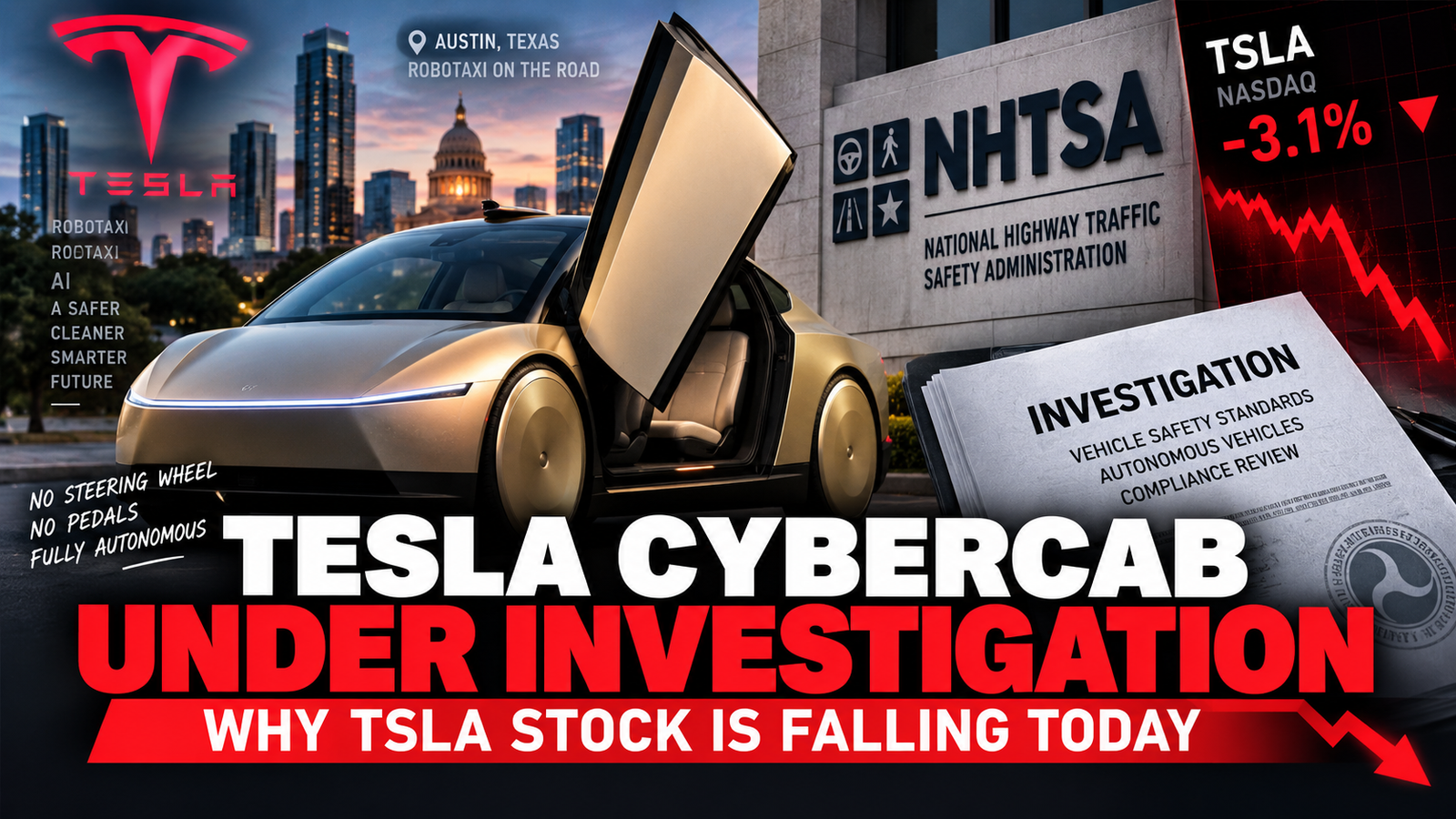
Tesla’s long-awaited Cybercab has finally moved from futuristic concept to real-world robotaxi service.
But just as investors were celebrating the launch, a new problem emerged.
The U.S. National Highway Traffic Safety Administration (NHTSA) has begun scrutinizing Tesla’s Cybercab rollout and its compliance with federal vehicle safety standards.
The news sent Tesla (NASDAQ: TSLA) shares down roughly 3% in premarket trading on September 4, 2026, after the stock had gained about 6% the previous day.
The reason investors are paying attention is simple.
Cybercab is not just another Tesla vehicle.
Cybercab could be one of the most important products in Tesla’s attempt to transform itself from an electric-car company into an autonomous transportation and AI company.
So why is NHTSA looking at Cybercab?
And could the investigation become a serious problem for Tesla stock?
Here is what investors need to know.
What Is Tesla Cybercab?
Cybercab is Tesla’s purpose-built autonomous robotaxi.
Unlike a Model 3 or Model Y, Cybercab was designed from the beginning to operate without a human driver.
That means something immediately stands out when you look inside:
There is no steering wheel.
There are also no traditional accelerator or brake pedals.
Tesla describes Cybercab as a fully autonomous two-passenger vehicle featuring butterfly-style doors, a large central touchscreen and enough cargo space for two standard checked suitcases plus two carry-on bags.
This is a fundamental departure from the traditional automobile.
And that’s exactly why regulators are interested.
Why Is NHTSA Investigating Tesla Cybercab?
The core issue is not simply whether Cybercab can drive itself.
The question is:
Does a vehicle designed without conventional driver controls comply with U.S. federal motor vehicle safety standards?
Reuters reported that NHTSA opened an audit involving roughly 1,000 Tesla Cybercabs, focusing on the company’s safety certification and compliance with federal standards.
Traditional federal safety rules were largely written around vehicles operated by human drivers.
Those vehicles normally have equipment such as:
a steering wheel
brake and accelerator pedals
mirrors
and other driver-oriented controls.
Cybercab challenges that traditional framework because Tesla designed the vehicle specifically for autonomous operation.
NHTSA is examining the technical information and certification process used by Tesla, including how the company determined which Federal Motor Vehicle Safety Standards apply to the Cybercab.
Is Cybercab Being Recalled?
This distinction is extremely important.
No recall has been announced based on the information currently available.
NHTSA’s scrutiny does not automatically mean Cybercab has been declared unsafe.
Nor does it mean the regulator has already determined that Tesla violated federal rules.
The agency is examining the rollout and compliance process.
So headlines saying simply:
“Tesla Cybercab is unsafe”
would go beyond what is currently known.
The accurate description is:
U.S. regulators are evaluating whether Cybercab’s design and certification comply with federal safety requirements.
That investigation could ultimately produce different outcomes depending on what regulators find.
Cybercab Is Already Carrying Passengers in Austin
This isn’t just a prototype sitting on a show floor.
Tesla has started offering Cybercab rides in limited parts of Austin, Texas.
Tesla’s own support page currently confirms that Cybercab rides are available in limited areas of Austin.
Meanwhile, Tesla’s broader Robotaxi service using autonomous vehicles operates in several U.S. cities, including Austin, Dallas, Houston, Miami, Orlando and Tampa.
According to Texas registration information cited by Reuters, there were 420 Tesla autonomous vehicles registered in Texas, including 45 Cybercabs, as of the latest report.
That makes the regulatory question more urgent.
Cybercab is no longer merely a future promise.
It is beginning to interact with real passengers and public roads.
Why Did Tesla Stock Fall Today?
The immediate answer is regulatory uncertainty.
Tesla shares fell around 3% in premarket trading Friday following news of the NHTSA investigation.
But there’s another reason the market reaction matters.
Tesla shares had risen roughly 6% the previous day as investors responded enthusiastically to the Cybercab launch.
So the sequence looked roughly like this:
Cybercab excitement → TSLA +6% → NHTSA scrutiny → TSLA falls about 3% premarket
That illustrates the tension surrounding Tesla right now.
Investors see enormous potential in autonomous transportation.
Regulators see an entirely new class of safety questions.
Why Cybercab Matters So Much to Tesla Stock
Cybercab matters because Tesla’s valuation is increasingly about much more than selling electric cars.
Tesla has been positioning itself around:
autonomous driving
artificial intelligence
Robotaxi
Cybercab
Optimus robots
and other technology businesses.
In its latest quarterly materials, Tesla described Cybercab as the “workhorse” of its Robotaxi fleet and said production had already begun.
That language is important.
Tesla doesn’t see Cybercab as a niche experiment.
It wants the vehicle to become a central part of a much larger autonomous transportation network.
If that vision succeeds, Tesla could potentially earn revenue not only by selling cars but by operating transportation services at scale.
Tesla’s Robotaxi Network Is Already Expanding
Tesla’s official Robotaxi page says autonomous rides are currently offered in:
Austin
Dallas
Houston
Miami
Orlando
and
Tampa.
Tesla also reported in its second-quarter update that it was preparing for additional markets, including Phoenix and Las Vegas, while expanding unsupervised operations in several existing cities.
This expansion is crucial to the Tesla investment thesis.
The company needs to demonstrate that autonomous transportation can work not just in carefully controlled demonstrations but across multiple cities at meaningful scale.
The Biggest Cybercab Question: Can Tesla Scale It?
A few dozen Cybercabs operating in limited areas is one thing.
Operating thousands—or eventually hundreds of thousands—across the United States is something entirely different.
To reach that scale, Tesla needs to solve several problems simultaneously.
1. Regulatory approval
Different states and jurisdictions have different requirements for autonomous vehicles.
2. Safety
Autonomous vehicles need to operate reliably around unpredictable human drivers, pedestrians, cyclists and emergency situations.
3. Manufacturing
Tesla must produce Cybercabs cheaply and in large numbers.
4. Software
The autonomous-driving system needs to work consistently across different roads, weather conditions and cities.
5. Public trust
Even if the technology works, consumers still need to feel comfortable entering a vehicle with no human driver—and no steering wheel.
These are not small challenges.
Why the Missing Steering Wheel Matters
Cybercab’s most futuristic feature may also be its biggest regulatory challenge.
A conventional vehicle assumes that a human can take control.
Cybercab does not.
Tesla says the vehicle uses camera vision and sensors to navigate streets, highways, intersections and parking environments autonomously.
But removing the steering wheel and pedals changes the fundamental safety architecture of a vehicle.
If the autonomous system encounters a situation it cannot resolve, the passenger cannot simply grab the wheel.
That creates questions regulators must address:
What happens during a system failure?
How does the vehicle reach a safe stop?
How can passengers respond during an emergency?
Which existing federal standards apply to a vehicle with no human driver controls?
These questions are central to the regulatory debate surrounding Cybercab.
Cybercab vs. Waymo: Tesla Has a Powerful Rival
Tesla isn’t entering an empty market.
Alphabet-owned Waymo has already established a substantial autonomous ride-hailing presence.
Reuters reported that Waymo had 988 vehicles registered in Texas, compared with Tesla’s 420 autonomous vehicles at the time of the report.
The two companies also use different technological approaches.
Tesla has historically emphasized vision-based autonomous driving and scalable vehicle manufacturing.
Waymo uses a broader suite of sensors and has focused heavily on geofenced autonomous ride-hailing.
For investors, the important question isn’t simply:
“Can Tesla build a self-driving car?”
It is:
“Can Tesla build a robotaxi network faster, cheaper and at greater scale than competitors?”
Cybercab is Tesla’s attempt to answer that question.
Could Cybercab Transform Tesla’s Business Model?
This is the bull case.
Traditional automakers typically make money when they sell a vehicle.
A robotaxi could potentially generate revenue repeatedly.
Instead of selling one car once, Tesla could theoretically use one Cybercab to provide thousands of paid rides over its operating life.
That changes the economics.
A successful autonomous fleet could generate revenue from:
rides
fleet operations
software
AI
and potentially third-party fleet ownership or operation.
Tesla’s Cybercab FAQ even provides a form for parties interested in purchasing individual Cybercabs or fleets for commercial purposes.
If the economics work, this could become a very different business from conventional auto manufacturing.
But Regulation Could Slow Everything Down
This is the bear case.
Tesla can manufacture Cybercabs.
It can improve autonomous-driving software.
It can build Robotaxi apps.
But it cannot unilaterally decide where fully autonomous vehicles may legally operate.
Regulators have significant influence over deployment.
And Cybercab’s unusual design makes the regulatory question particularly important because the vehicle removes traditional human controls.
Reuters reported that regulatory requirements remain a significant constraint on broader deployment, particularly in major markets such as California.
This means Tesla’s autonomous future depends on two races:
the technology race
and
the regulatory race.
Winning only one may not be enough.
Is the NHTSA Investigation Bad for Tesla?
In the short term, yes—it creates uncertainty.
That’s one reason TSLA shares reacted negatively.
But the long-term impact depends entirely on what happens next.
There are several possible scenarios.
Best-case scenario
Regulators review Tesla’s certification and allow deployment to continue with limited changes.
That would remove a major uncertainty surrounding Cybercab.
Middle scenario
Tesla must modify certain systems, documentation or operating procedures before expanding.
That could slow rollout but would not necessarily destroy the Robotaxi strategy.
Worst-case scenario
Regulators identify substantial compliance problems that require major vehicle changes or significantly restrict deployment.
That could delay Cybercab’s expansion and weaken one of the most important growth narratives supporting Tesla’s valuation.
At this point, it is too early to know which scenario will occur.
What Tesla Investors Should Watch Next
For TSLA investors, there are now several key indicators worth following.
1. NHTSA’s next action
Does the agency simply complete its review, or does scrutiny escalate?
2. Number of Cybercabs deployed
The jump from dozens of vehicles to thousands would be a major milestone.
3. New Robotaxi cities
Expansion beyond existing markets would demonstrate scalability.
4. Autonomous miles
Tesla reported approximately 2.4 million cumulative paid Robotaxi miles by June 2026 in its Q2 materials.
Growth in this figure will help show whether real-world usage is accelerating.
5. Safety incidents
Any serious Cybercab incident could dramatically change public perception and regulatory scrutiny.
6. Cybercab economics
Eventually investors need answers about cost per vehicle, utilization, ride pricing and profitability.
Those numbers may matter more than the initial hype.
Tesla Cybercab: Bull Case vs. Bear Case
| Bull Case | Bear Case |
|---|---|
| Purpose-built autonomous vehicle | Regulatory uncertainty |
| No driver labor cost | Safety scrutiny |
| Robotaxi network already expanding | Limited Cybercab deployment today |
| Tesla manufacturing scale | Waymo competition |
| Recurring ride revenue potential | Rules vary by jurisdiction |
| AI/autonomy could justify higher valuation | Autonomous technology still carries execution risk |
This explains why TSLA can move sharply in both directions on Cybercab news.
The upside could be enormous.
But so could the execution risk.
Is Tesla Stock a Buy After the Cybercab Investigation?
A regulatory investigation alone does not answer whether Tesla stock is cheap or expensive.
The much more important question is:
How much of Tesla’s future Robotaxi success is already reflected in TSLA’s valuation?
If Cybercab scales successfully across the U.S. and eventually internationally, Tesla’s business could look dramatically different from today’s automobile company.
But if deployment is repeatedly delayed by regulation, safety issues or technical limitations, investors may have to reduce their expectations for Robotaxi revenue.
That is why Cybercab news can move Tesla shares so quickly.
Investors aren’t simply valuing one new car.
They’re trying to value a potential transportation network.
Why TSLA Stock Is Falling Today: The Simple Answer
Today’s story can be summarized in one chain:
Cybercab launches → investors celebrate → TSLA rises about 6% → NHTSA begins scrutiny → TSLA falls about 3% premarket.
The U.S. regulator is examining roughly 1,000 Cybercabs and Tesla’s compliance with federal safety requirements, particularly because the purpose-built robotaxi lacks conventional controls such as a steering wheel and pedals.
That does not mean Cybercab has failed.
It means one of Tesla’s biggest future businesses has entered the phase where ambitious technology meets real-world regulation.
And that may be the most important part of the story.
Bottom Line
Cybercab could become one of the most important products Tesla has ever built.
If Tesla succeeds, the company could move far beyond the traditional model of manufacturing and selling electric cars.
It could operate a massive autonomous transportation network powered by AI.
But the very feature that makes Cybercab revolutionary—a vehicle designed to operate without a human driver or traditional controls—also creates regulatory questions that ordinary cars don’t face.
For investors, the next major catalyst isn’t simply another Tesla event.
It is whether Cybercab can move from:
dozens of vehicles → thousands → a nationwide fleet.
If that happens, Tesla’s Robotaxi thesis becomes much more tangible.
If regulators significantly slow that expansion, the market may have to reconsider how quickly the autonomous future can arrive.
Cybercab is now on the road. The next battle is scale—and regulation.
This article is for informational purposes only and does not constitute investment advice. Investing in stocks involves risk, including loss of principal.
Official Cybercab Information
Tesla now has official information for passengers explaining Cybercab operation, safety and availability.
Shop K-Beauty at OLIVE YOUNG Global
Interested in Korean skincare, cosmetics and beauty products? Explore K-Beauty products through OLIVE YOUNG Global.
👉 Shop K-Beauty at OLIVE YOUNG Global
If you purchase through the link above, the site operator may receive a commission at no additional cost to you.