Explore Indian movies, Bollywood, Netflix series, entertainment, and culture through ending explanations, character analysis, hidden meanings, fan theories, and the questions viewers are asking.
Spoiler Warning: This article discusses the ending of Shakun Batra’s segment in Netflix’s Lust Stories 3 (2026).
Two people walk into a courthouse holding hands.
Normally, that would look like a romantic reconciliation. But in Lust Stories 3, Sailee and Varun are heading toward the final stage of their divorce.
So what does that last gesture mean? Have they decided to save their marriage, or have they finally learned how to end it?
The answer is more complicated than a simple yes or no.
Did Sailee and Varun Actually Get Back Together?
The film never explicitly confirms that Sailee and Varun cancel their divorce.
In the final sequence, they approach the court together, holding hands. Their relationship is visibly different from the bitter, combative marriage we have watched unravel.
But the scene does not establish that they have chosen to remain husband and wife.
There are two plausible interpretations.
The romantic reading is that they have rediscovered their affection and might be ready to start again.
The more bittersweet reading is that they have finally made peace with separating.
I lean toward the second interpretation.
Their final gesture does not necessarily mean they are choosing marriage. It may mean they are choosing kindness.
Why Were Sailee and Varun Divorcing in the First Place?
When we meet Sailee, played by Radhika Madan, and Varun, played by Ali Fazal, their marriage has deteriorated so badly that divorce seems inevitable.
They cannot discuss ordinary matters without reopening old wounds.
Yet their physical attraction has not disappeared.
In fact, their intimacy becomes particularly intense during the court-mandated waiting period before their divorce.
That contradiction is the central irony of Shakun Batra’s story.
The couple’s problem is not simply that they have stopped desiring each other. It is that desire has become easier than communication.
Physical closeness allows them to escape their arguments temporarily, but it does not resolve the reasons they are separating.
They know how to reach each other physically. They no longer know how to live together.
Was Varun’s Mother the Real Reason Their Marriage Failed?
Family interference is one of the clearest sources of conflict.
Varun’s mother remains deeply involved in his life, while Sailee struggles with the lack of privacy and independence within their marriage.
The issue is not merely whether Varun loves his mother too much.
It is whether he can establish boundaries that allow his marriage to exist as a relationship between two adults.
At one revealing moment, Varun admits that when Sailee wanted to leave, his first concern was not their relationship itself. He worried about what his parents would think.
That admission changes how we understand the marriage.
Varun has spent so much energy protecting the appearance of a successful marriage that he has failed to protect the people inside it.
But blaming his mother alone would oversimplify the story.
Sailee and Varun also struggle to express their needs without accusation, defensiveness or resentment.
Their marriage is damaged by family pressure, but it is sustained in that damaged state by their inability to talk honestly.
Why Does Their Final Conversation Matter More Than Their Physical Chemistry?
Throughout the segment, physical intimacy repeatedly interrupts emotional conflict.
It offers relief without resolution.
Eventually, their conversations begin to change.
Instead of trying to win every argument, Sailee and Varun acknowledge their disappointments and the expectations they brought into their marriage.
This is the real turning point.
Their breakthrough is not that they suddenly become passionate again. Passion was never entirely absent.
Their breakthrough is that they begin listening.
For perhaps the first time in years, they can recognize each other as individuals rather than opponents.
That does not automatically make them compatible.
Sometimes understanding another person helps repair a relationship. Sometimes it helps explain why the relationship should end.
The Meaning of “I Like You” Instead of “I Love You”
One of the most revealing moments comes when the couple discovers that saying they like each other feels more meaningful than declaring their love.
Why would a smaller expression carry greater emotional weight?
Because, in their marriage, love has become entangled with obligation.
It comes with expectations about sacrifice, family, loyalty and what a successful marriage should look like.
Liking someone is different.
It suggests that beneath years of conflict, Sailee and Varun can still appreciate each other without demanding that the other person fulfill an idealized role.
This distinction is crucial to the ending.
Their affection is real.
But affection alone does not answer whether they should remain married.
Why Are Viewers Divided Over the Final Scene?
The disagreement is visible in Reddit discussions of the film.
Some viewers interpret the hand-holding as evidence that Sailee and Varun have reconciled.
Others argue that they are entering the courthouse to complete their divorce peacefully.
Both readings respond to something the film deliberately preserves: emotional intimacy without an explicit declaration of reconciliation.
The final scene gives us a gesture, not a legal outcome.
That ambiguity matters because audiences often expect romantic stories to reward emotional growth with reunion.
But Lust Stories 3 raises a more uncomfortable possibility.
What if emotional growth means accepting that a relationship has ended?
What if two people can still care deeply about each other without being right for each other?
My Interpretation: They Find Closure, Not Necessarily a Second Chance
I believe Sailee and Varun are more likely moving toward an amicable divorce than an uncomplicated reunion.
The strongest clue is not the courthouse itself. It is the emotional transformation that precedes it.
Earlier, they repeatedly confuse physical attraction with the possibility of repairing their marriage.
By the end, they no longer need that confusion.
They can be affectionate without pretending their problems never existed.
Holding hands can therefore represent mutual respect rather than a renewed commitment.
That reading also makes the ending more powerful.
A conventional romance would tell us that love conquers everything.
Shakun Batra’s story suggests something harder: sometimes the kindest thing two people can do is stop hurting each other, even if they still care.
Final Verdict: Did They Stay Together?
There is no definitive on-screen confirmation that Sailee and Varun stay married.
Their hand-holding leaves room for reconciliation, but their honest conversations and the courthouse setting also support the interpretation that they are parting on better terms.
My reading is that they have found closure.
The film’s final question is not simply whether they love each other.
It is whether love, without compatibility and communication, is enough to sustain a marriage.
And Lust Stories 3 is brave enough to leave that answer unresolved.
What do you think? Did Sailee and Varun walk into court to cancel their divorce, or to end their marriage as friends? Share your interpretation in the comments.
Major Spoiler Warning: This article reveals the central twist, the identity of adult Ticket, and the ending of Toxic: A Fairy Tale for Grown-Ups.
Was Ticket really alive throughout Toxic?
For most of the film, the answer appears obvious. Ticket is introduced as Raya’s grown-up son, a man who has returned to confront the father who abandoned him. He attacks Raya’s criminal empire, challenges his authority, and eventually becomes involved in a dangerous conflict surrounding Adam, Raya’s younger son.
The film encourages us to see their relationship as a familiar gangster-movie conflict: a father who built an empire through violence and a son who has returned to destroy it.
Then the ending changes everything.
The adult Ticket is not a living person. He is a manifestation of Raya’s fractured psychological reality.
The real Ticket was Raya and Nadia’s son, but he died when he was still a child. The adult version who narrates much of the film and confronts Raya is part of the father’s imagination, shaped by guilt, grief, and the consequences of his own actions.
This revelation does more than explain why Yash plays two characters. It forces viewers to reconsider the story they have just watched.
Raya was not simply fighting a son who came back for revenge.
He was confronting the part of himself that could never escape what happened to that child.
1. What Really Happened to Ticket in Toxic?
Ticket was the son of Raya and Nadia.
After Raya’s relationship with Nadia deteriorates, their family is destroyed by the same violence that has shaped his life. For much of the film, viewers are encouraged to believe that Ticket survives his childhood and eventually grows into the adult character played by Yash.
The truth is considerably darker.
The tragedy involving Ticket is connected to a car and water. During a confrontation, Raya leaves the vehicle, which eventually goes into the water. He realizes what has happened and attempts to save his son, but he cannot undo the tragedy.
The film leaves important ambiguity around Raya’s precise intention at that moment. It is safer to say that his anger and actions lead to the circumstances of Ticket’s death than to claim that every detail proves a deliberate murder.
What the ending makes clear is that the real Ticket never grows up.
Raya loses his son, but he cannot fully accept that loss. The adult Ticket who later appears in the story becomes a psychological substitute for the child who died.
This distinction is essential:
The child Ticket was real.
His relationship with Raya and Nadia was real.
His death was real.
The adult Ticket who returns to confront Raya is not an independent living person.
The tragedy is not that Ticket never existed.
It is that Raya cannot stop imagining the future his son never had.
2. Who Is the Adult Ticket? The Film’s Biggest Twist Explained
The adult Ticket is best understood as a manifestation of Raya’s guilt and fractured psychological state.
Before the reveal, the film presents two apparently separate men. Raya is the aging gangster who has built a powerful criminal empire, while Ticket is the younger man who wants to destroy everything his father has created.
Their conflict initially looks like a straightforward revenge story.
But the final revelation changes the relationship completely.
Ticket is not an independent enemy with his own separate life. He represents the son Raya lost, the violence that destroyed their relationship, and the guilt that has remained unresolved.
This also explains why Yash plays both characters.
The casting is not merely a way to create a visual resemblance between father and son. It reinforces the psychological connection between them.
The two characters look like separate people because Raya’s mind experiences them that way.
But the real conflict is internal.
Raya is fighting the son he failed to save and the part of himself that refuses to forget.
3. Why Does Raya Imagine That Ticket Survived?
Raya has spent his adult life building power.
He has defeated rivals, expanded his criminal operations, and created a world in which other people are expected to obey him.
Yet none of that power can reverse his personal losses.
His relationship with Nadia ends in tragedy. Ganga, the sister who helped shape his rise, is also lost. His growing empire cannot restore the family he destroyed.
Ticket becomes the most painful reminder of that failure.
The adult version of his son allows Raya’s mind to imagine an alternative reality: the child survived, grew up, and returned to confront his father.
That imagined future is both a form of punishment and an expression of grief.
Raya cannot simply remember Ticket as a dead child. Instead, he experiences him as someone who can still speak, argue, accuse, and demand answers.
This makes the imagined Ticket especially threatening.
Raya can eliminate a rival gangster. He can destroy a business or defeat an opposing organization.
But he cannot defeat a memory that has become part of his own mind.
4. Why Does Ticket Want Revenge but Sometimes Save Raya?
Before the twist, Ticket’s behavior appears contradictory.
He returns to punish the father who supposedly abandoned him and tried to kill him. He attacks Raya’s operations and threatens his family.
Yet he also refuses to kill Raya when he has the opportunity. At certain moments, he even protects him.
Why would a son who supposedly wants revenge behave this way?
The ending offers a psychological explanation.
Ticket is not an independent person following a consistent plan. He is part of Raya’s internal conflict.
One side of Raya wants punishment. Another wants forgiveness. He resents the son who reminds him of his failure, but he also desperately wants that son to remain alive.
These conflicting emotions appear as conversations and confrontations between two characters.
The apparent father-son rivalry is therefore also a struggle between different parts of Raya’s own emotional reality.
This is why Ticket’s actions can seem inconsistent.
He is not simply trying to destroy Raya.
He is expressing the guilt, grief, anger, and longing that Raya cannot reconcile within himself.
5. If Ticket Is Imaginary, Who Has Been Narrating the Film?
This is one of the most important consequences of the ending.
Ticket narrates much of Toxic. At first, viewers accept his voice as that of a real character looking back on his life and his relationship with Raya.
But once adult Ticket is revealed to be part of Raya’s psychological reality, the narration becomes much more complicated.
Ticket is not an independent observer describing events from outside the story.
He is part of the mind through which much of the story has been presented.
This makes him an unreliable narrator.
An unreliable narrator is a storytelling device in which the audience cannot automatically trust the perspective through which events are described.
In Toxic, the revelation raises several questions:
Did every confrontation involving adult Ticket happen as shown?
Were some events distorted by Raya’s memories?
Did Raya attribute his own actions to the imagined Ticket?
How much of the story reflects reality, and how much reflects his psychological collapse?
The film does not provide a separate explanation for every scene.
That uncertainty is important.
The twist is not simply that Ticket was imaginary. It is that viewers may have been experiencing parts of Raya’s world through a perspective that could not be fully trusted.
6. Did Ticket Really Kidnap Adam?
Adam’s kidnapping becomes one of the most disturbing parts of the story after the revelation.
Before the twist, adult Ticket appears to threaten Raya’s younger son. The kidnapping seems to be part of a revenge plan against the father who failed to save him.
But if adult Ticket does not exist independently, who is actually responsible?
The stronger interpretation is that Raya himself is responsible for the actions associated with Ticket.
His mind separates those actions from the identity he recognizes as his own. The imagined son becomes another person through whom his destructive impulses can be expressed.
This changes the meaning of the conflict.
Raya is not simply protecting Adam from an enemy who has returned from the past.
He has become a danger to his own family.
The apparent kidnapping is particularly revealing because it echoes the original tragedy involving Ticket. The father who once failed to save one son now faces the possibility of losing another.
The repetition suggests that Raya’s unresolved guilt is influencing his behavior in the present.
The film turns the father-son conflict into something even darker: a man whose past is beginning to destroy the next generation.
7. Why Does Yash Play Both Raya and Ticket?
Yash’s dual role is central to the film’s storytelling.
At first, the casting creates the visual impression of a father confronting his grown son. Their resemblance is easy to understand as a family connection.
After the reveal, however, the same casting takes on another meaning.
Raya and Ticket are two versions of one psychological conflict.
Raya represents the man who survived, built an empire, and continued living after the death of his child.
Ticket represents the child who never had the opportunity to grow up, along with the guilt that Raya has carried since the tragedy.
The visual similarity is therefore more than a family resemblance.
It reflects the fact that Ticket’s adult identity exists within Raya’s mind.
Yash’s performance allows the film to present the internal conflict as an external confrontation.
Instead of watching Raya argue with his own memories, we see him fight another version of himself.
8. What Does Ticket Symbolize?
Ticket represents several connected ideas.
The child who died: He is the son Raya lost and could never bring back.
Unresolved guilt: He reminds Raya of the consequences of his own actions.
Grief: He represents the future that was taken away before it could happen.
Inherited violence: His imagined revenge reflects the destructive world Raya created.
Conscience: He forces Raya to confront the truth that his power cannot erase.
There is another important layer.
Ticket is not only a symbol of punishment. He is also the son Raya desperately wants to recover.
That is why the imagined relationship remains emotionally complicated.
Raya fears Ticket, fights him, and resents his accusations. Yet he cannot completely let him go.
The adult Ticket represents the impossible wish that the child had survived and grown up.
In this sense, Raya is not merely haunted by the past.
He is haunted by the future he lost.
9. What Happens in the Final Avalanche Scene?
The final avalanche scene brings the psychological conflict to its emotional conclusion.
By this stage, Raya’s world has largely collapsed. His criminal empire, his relationships, and his ability to distinguish his own actions from the imagined Ticket have all been pushed toward destruction.
An avalanche approaches.
Instead of continuing to fight, Raya finally embraces Ticket.
The detail that matters is the form in which Ticket appears.
The final embrace connects Raya with the child he lost, rather than simply presenting a victorious adult son returning to his father.
The scene can be interpreted as Raya finally accepting the loss he has spent years refusing to confront.
For most of the film, he has treated Ticket as an enemy.
At the end, he stops fighting.
The embrace suggests that he is finally acknowledging the child, the tragedy, and his own responsibility.
The avalanche then approaches, and the film cuts to black.
The scene does not offer a conventional victory or a simple resolution. It replaces the expected gangster-movie showdown with a confrontation that is far more personal.
10. Does Raya Die at the End of Toxic?
The film leaves Raya’s final physical fate uncertain.
The climax places him in an extremely dangerous situation. The avalanche approaches as he embraces Ticket, but the film cuts away before showing an unambiguous outcome.
There are interpretations that read the ending as Raya’s death, particularly because the final scene follows the destruction of his criminal world and his apparent surrender to his past.
However, the film does not provide a conventional confirmation of his survival or death in that final image.
It is important to separate two questions:
What happened to Ticket? The real child died, and adult Ticket is part of Raya’s psychological reality.
What happened to Raya? The ending leaves his physical fate unresolved.
The film gives viewers a much clearer answer about Ticket’s identity than about Raya’s ultimate survival.
That difference is deliberate enough to preserve the ambiguity of the final scene.
11. Is Ticket Raya’s Split Personality?
Some viewers may describe Ticket as Raya’s split personality.
That phrase can work as informal shorthand, but it should not be treated as a confirmed medical diagnosis.
The film presents Ticket as a manifestation of Raya’s fractured psychological state. Words such as imagination, hallucination, and unreliable narration help explain the storytelling structure.
However, the movie does not establish a specific psychiatric diagnosis.
There is also a difference between interpreting a fictional character’s behavior and diagnosing a real person.
For understanding the ending, the essential point is simpler:
The adult Ticket exists within Raya’s psychological reality, not as the living adult son the audience initially believed him to be.
This distinction explains the twist without assigning a medical label that the film itself does not confirm.
12. Was Everything in Toxic Just a Dream?
No. That interpretation goes too far.
The revelation does not automatically mean that Raya’s entire life, criminal empire, family relationships, and every event in the film were imaginary.
The film establishes that adult Ticket is not an independent living person and that his narration cannot be trusted as an objective account.
But this does not prove that every event involving other characters was invented.
A more careful interpretation is that the story has been filtered through Raya’s fractured perspective.
Some events may have happened as presented. Others may have been distorted by his memories, guilt, and psychological instability. Certain scenes involving adult Ticket may represent actions or conflicts that Raya experiences internally rather than events involving a separate person.
This is why the ending invites viewers to reconsider the second half of the film rather than simply dismissing the entire story as a dream.
The uncertainty is part of the film’s narrative design.
13. Why Is the Final Embrace More Important Than the Father-Son Fight?
The final embrace changes the emotional meaning of the entire film.
Raya has spent his life building power through violence. He has treated control as the solution to almost every problem.
But he cannot control memory.
He cannot reverse his son’s death.
And he cannot eliminate the guilt that follows him.
When he finally embraces Ticket, the relationship changes from confrontation to acceptance.
The moment does not necessarily mean that Raya has been forgiven. It does not erase the consequences of his actions or restore the family he destroyed.
Instead, it suggests that he has finally stopped running from the truth.
For the first time, he is no longer trying to defeat the image of his son.
He is embracing the child he lost.
That makes the final scene more emotionally significant than a conventional revenge climax.
Frequently Asked Questions
Is Ticket alive in Toxic?
No. The real Ticket died when he was a child. The adult Ticket who confronts Raya is a manifestation of Raya’s fractured psychological reality.
Was Ticket really Raya and Nadia’s son?
Yes. Ticket was a real child and the son of Raya and Nadia. The twist concerns the adult version, not the child’s existence.
Why does Yash play both Raya and Ticket?
The dual role visually reinforces the psychological connection between the two characters. Adult Ticket represents the son Raya lost and the guilt he cannot escape.
Did Ticket really kidnap Adam?
The film presents the kidnapping through the apparent adult Ticket. After the reveal, the stronger interpretation is that Raya himself is responsible for the actions associated with Ticket.
Does Raya die in the avalanche?
The final scene does not clearly confirm his physical fate. The avalanche approaches as he embraces Ticket, and the film cuts to black.
Is Ticket a ghost?
The ending points more strongly toward Ticket being a manifestation of Raya’s imagination and guilt than a literal ghost.
Was the entire film a dream?
No. The twist makes the narration and scenes involving adult Ticket unreliable, but it does not establish that Raya’s entire life and criminal empire were imaginary.
Final Answer: Ticket Was Real, But the Adult Ticket Was Not
The central twist of Toxic is not that Ticket never existed.
He did exist.
He was the son of Raya and Nadia, and his death became one of the defining psychological wounds of Raya’s life.
The adult Ticket who returns to confront his father is a creation of Raya’s fractured mind: a version of the son who never had the chance to grow up.
That explains the contradictions in Ticket’s behavior, the unreliable narration, and the growing sense that Raya is losing control of his own reality.
The final embrace brings the conflict to its emotional conclusion.
For most of the film, Raya appears to be fighting his son.
But the truth is darker.
He has been fighting his own guilt, his own memories, and the consequences of the violence that shaped his life.
The criminal empire he built could defeat rivals and silence enemies. It could not bring back the child he lost.
Major Spoiler Warning: This article reveals the post-credit scene and major plot details of Mirzapur: The Movie (2026).
You stayed until the end of the credits.
Guddu Pandit, Munna Bhaiya, and Bablu Pandit are sitting together in a salon. The atmosphere feels surprisingly relaxed. Guddu and Munna are receiving facials, while Bablu is busy looking at his phone.
Then an ordinary conversation takes a dangerous turn.
Guddu and Munna discover that they are both in love with the same woman.
Sweety.
The mood changes immediately. Their conversation becomes an argument, their rivalry resurfaces, and guns are drawn.
Then gunshots are heard.
The scene ends without showing the consequences.
So who was shot? Was it Guddu? Munna? Did both men fire? Or did neither actually get hit?
The most important detail is that the film does not give us a confirmed answer.
But the scene is not simply a random cliffhanger. It reconnects three familiar characters, brings an old romantic rivalry into a new situation, and gives the next chapter of Mirzapur a conflict that is both personal and potentially explosive.
1. Who Was Shot at the End of Mirzapur: The Movie?
The direct answer is: the film does not confirm who was shot, or even whether anyone was hit.
The post-credit scene shows Guddu and Munna discovering their shared feelings for Sweety. Their confrontation escalates, guns appear, and gunshots bring the sequence to an abrupt end.
However, the audience is not shown a confirmed victim.
There is no clear aftermath establishing that:
Guddu was shot.
Munna was shot.
Both men were injured.
One of them fired first.
Neither man was hit.
The sound of gunfire is not enough to establish who pulled the trigger or what happened afterward.
This distinction is important because many viewers naturally interpret the final sound as confirmation that someone has been shot.
But the scene deliberately withholds that information.
The gunshots are part of the cliffhanger. The identity of the victim remains unknown.
Any explanation claiming that Guddu or Munna definitely dies in this scene goes beyond what the released film shows.
2. What Actually Happens in the Salon Scene?
The scene begins with an unexpectedly casual atmosphere.
Guddu and Munna are sitting together at a salon, receiving facials. Bablu is nearby, occupied with his phone and messaging Golu.
Munna notices Bablu’s activity and begins teasing him about whether he is talking to someone romantically.
The conversation eventually moves toward relationships and the women they are interested in.
Guddu and Munna reveal their feelings, only to discover that they are talking about the same person: Sweety.
That revelation changes everything.
The humor disappears, and the conversation becomes a confrontation between two men who are not accustomed to sharing what they want.
The scene then escalates toward violence.
What makes this moment effective is the contrast between its setting and its outcome.
A salon is normally associated with relaxation, grooming, and ordinary conversation. Here, it becomes the location for a potentially deadly confrontation.
The filmmakers take a familiar everyday setting and turn it into another place where the violent instincts of Mirzapur characters can emerge.
The result is both darkly comic and unsettling.
3. Why Are Guddu and Munna Fighting Over Sweety?
Sweety is not a newly introduced romantic interest.
She already has an important place in the original Mirzapur story.
Guddu and Sweety develop a romantic relationship, while Munna also has feelings for her. His interest is not returned in the same way, but it becomes one of the emotional complications surrounding the two men.
That history makes the post-credit revelation particularly meaningful.
Guddu and Munna are not simply arguing about an unfamiliar woman.
They are confronting a rivalry that viewers already associate with their relationship.
In the original series, Munna’s desire for Sweety and her relationship with Guddu contribute to the tension between the two characters.
The movie returns to an earlier point in the timeline and gives the audience another look at how their personal rivalry develops.
The important detail is that their conflict is not purely political.
In Mirzapur, power is never just about territory, money, or family position. Pride, jealousy, insecurity, and personal relationships can be equally dangerous.
Sweety becomes the immediate trigger for all of these emotions.
The post-credit scene uses a romantic revelation to reopen a rivalry that the main story temporarily puts aside.
4. Why Are Guddu, Munna, and Bablu Alive Together?
The answer is the movie’s position in the franchise timeline.
Mirzapur: The Movie is not a straightforward continuation after Season 3.
According to actress Harshita Gaur, the film is positioned between Episodes 6 and 7 of Season 1. She explained that the movie’s story connects directly with the events surrounding those episodes.
This means the film takes viewers back to an earlier period, before several major events in the television series have occurred. <Cite refs={[“turn155735search1″,”turn155735search6”]}/>
The chronological structure is therefore:
Mirzapur Season 1, Episodes 1–6
Mirzapur: The Movie
Mirzapur Season 1, Episodes 7–9
Mirzapur Season 2
Mirzapur Season 3
This explains why Guddu, Munna, and Bablu can appear together.
Their later fates belong to events that take place after the movie’s timeline.
It also explains why viewers familiar with the television series may experience the film differently from newcomers.
They already know where certain characters are heading, but the movie introduces additional events that help fill in the earlier history.
5. Does the Timeline Prove That Guddu and Munna Survive the Gunshots?
The timeline provides context, but it does not reveal exactly what happens in the salon.
This is an important distinction.
Because the movie takes place before the later events of the television series, viewers know that the characters have established roles in the story that follows.
That makes a permanent death at this point difficult to reconcile with the existing chronology.
But survival in a later episode does not tell us whether a character was injured during an earlier, previously unseen incident.
Several possibilities remain open:
The gunshots may miss both men.
One character may be injured but survive.
The shots may come from a different direction.
The confrontation may end in a way the audience has not yet been shown.
These are possible explanations, not confirmed outcomes.
The timeline limits some interpretations, but it does not identify the shooter or the victim.
The most reliable approach is to separate what the television series establishes from what the movie deliberately leaves unanswered.
6. What Happens in the Main Ending Before the Post-Credit Scene?
The salon confrontation makes more sense when viewed against the events of the main film.
The central conflict revolves around Babban Yadav’s attempt to challenge the Tripathi family’s power.
Babban’s plan puts Kaleen Bhaiya in danger and draws Guddu, Bablu, and Munna into a larger struggle.
Despite their personal differences, the characters find themselves working toward a common objective.
The conflict eventually reaches its climax in Jaisalmer.
Guddu, helped by Bablu’s use of steroids, overpowers Babban and kills him on Kaleen Bhaiya’s orders.
The immediate threat to the Tripathi family is removed, but the film does not end with everything neatly resolved.
Birju later attempts to attack Kaleen Bhaiya at the Tripathi residence. Beena shoots him before he can expose her involvement.
The main story therefore concludes with the Tripathi family’s immediate danger under control.
But the post-credit scene changes the emotional focus.
Instead of another external enemy challenging the family, the film returns to the personal rivalry between Guddu and Munna.
That shift is deliberate.
The main plot shows what happens when the characters cooperate against a common threat.
The post-credit scene asks whether that cooperation can survive their own personal ambitions.
7. Why Does the Post-Credit Scene End With Gunshots?
The scene works because it creates a new conflict without resolving the existing one.
Guddu and Munna have just been involved in a story where they can temporarily put their differences aside.
They have a shared objective, a common enemy, and a reason to cooperate.
But the salon scene reveals how fragile that arrangement really is.
The discovery about Sweety immediately brings their personal rivalry back to the surface.
This creates three important effects.
First, it restores their rivalry.
The audience is reminded that Guddu and Munna are not natural allies. Their cooperation depends on circumstances, not necessarily mutual trust.
Second, it turns a romantic disagreement into a potential power struggle.
Neither character is particularly good at accepting rejection or sharing what he wants. The argument therefore becomes more dangerous than an ordinary disagreement.
Third, it gives the next chapter an immediate dramatic question.
The audience now wants to know what happened after the gunshots.
The filmmakers do not need to introduce a completely new villain to create anticipation. They simply put two familiar characters on opposite sides of a personal conflict.
That is a particularly effective way to build on an established franchise.
8. Was Another Post-Credit Scene Filmed?
Yes, according to reports published after the movie’s release.
Variety India reported on September 7, 2026, that the filmmakers had shot another end-credit sequence but decided not to include it in the theatrical release.
The report said the team believed the scene would have a greater narrative impact in the next chapter.
Hindustan Times also reported the existence of the additional sequence, noting that its characters and contents had not been disclosed. <Cite refs={[“turn155735search0″,”turn155735search3”]}/>
This is an interesting detail because it suggests that the filmmakers were thinking beyond the immediate ending of the first movie.
However, there is a limit to what can responsibly be said.
The unreleased scene has not been publicly described in sufficient detail to establish what happens in it.
We do not know:
Which characters appear.
Whether it directly follows the salon confrontation.
Whether it reveals the shooter.
Whether it introduces another major conflict.
Whether it explains the future of Guddu and Munna.
It is tempting to speculate, but doing so would turn an undisclosed scene into an invented plot summary.
For now, the only reliable conclusion is that additional footage was reportedly held back for the next chapter.
9. Is Mirzapur: The Movie Part 2 Confirmed?
Reports indicate that a second film was already part of the plan.
The September 2026 reporting about the withheld end-credit sequence described the sequel as something the filmmakers had considered before the first film’s box-office performance became known. <Cite refs={[“turn155735search2″,”turn155735search5”]}/>
That makes a continuation more than a random fan theory.
However, it is important to distinguish industry reporting about plans from a fully detailed official production announcement.
A confirmed release date, completed production schedule, or complete sequel storyline should not be assumed without an official announcement.
The first film nevertheless leaves several obvious questions for a continuation:
What happened after Guddu and Munna drew their guns?
Did either man get injured?
How will Sweety’s position affect their rivalry?
Will Bablu remain caught between the two?
What was the purpose of the additional end-credit scene?
The salon confrontation provides a natural starting point for the next story.
10. Does the Movie Change the Original Mirzapur Timeline?
The movie is designed to add to the existing chronology rather than simply replace it.
Its placement between Episodes 6 and 7 of Season 1 gives the filmmakers an opportunity to explore events that happened before the later turning points of the television series.
That approach also allows the audience to revisit familiar characters from a different perspective.
For example, viewers already know that Guddu and Munna’s relationship becomes increasingly destructive.
The movie gives us another glimpse of the tensions that exist before the events that define their later rivalry.
The salon scene is particularly interesting in this context.
It suggests that the emotional conflict between the two men is not limited to their competition for influence within the Tripathi empire.
Their personal desires can create just as much instability.
However, the movie should not automatically be treated as an alternate timeline simply because it adds new situations.
The actress’s explanation of the placement between the two Season 1 episodes supports the interpretation that the film is intended to fit into the established chronology. <Cite refs={[“turn155735search1″,”turn155735search6”]}/>
The more interesting question is how these additional events change our understanding of the original series.
11. The Real Meaning of the Ending: Their Greatest Enemy May Be Each Other
The gunshots are the obvious hook, but the reason behind them is more revealing.
The main film revolves around survival, power, and the Tripathi family’s struggle to maintain control.
The post-credit scene takes that larger conflict and makes it personal.
Guddu and Munna can cooperate when the situation demands it.
But cooperation does not automatically eliminate jealousy, pride, or competition.
This is the contradiction at the center of their relationship.
They may be able to stand together against an outside enemy, but they are still capable of becoming enemies themselves.
Sweety’s name brings that contradiction into focus.
The scene also plays with the audience’s knowledge of the original series. We know how the characters’ relationships develop, but the film gives us a new moment from their shared past.
That makes the final confrontation more than a simple sequel advertisement.
It adds another layer to a rivalry that viewers already understand.
The most dangerous conflict in Mirzapur may not always come from the person trying to take the throne. Sometimes it comes from the person sitting beside you.
Frequently Asked Questions
Who was shot at the end of Mirzapur: The Movie?
The movie does not confirm who was shot or whether anyone was hit. The post-credit scene ends after Guddu and Munna draw guns and gunshots are heard.
Did Guddu shoot Munna?
The released scene does not identify the shooter. There is no confirmed evidence that Guddu shot Munna.
Did Munna shoot Guddu?
That is also unconfirmed. The film does not show a confirmed victim or the immediate aftermath of the gunfire.
Why do Guddu and Munna fight over Sweety?
They discover that they are both in love with Sweety. The revelation turns a casual salon conversation into a confrontation.
Why are Guddu, Munna, and Bablu alive together?
The movie takes place between Episodes 6 and 7 of Season 1, before the later events of the television series.
Is Bablu alive in Mirzapur: The Movie?
Yes. The film takes place earlier in the franchise timeline, before the later events that determine his fate in the television series.
Was a second post-credit scene filmed?
Yes. Variety India and Hindustan Times reported that another end-credit scene was filmed but held back for the next chapter. Its contents have not been revealed.
Is Mirzapur: The Movie Part 2 happening?
Industry reports indicate that a sequel was planned, but an official release date and complete production details should not be assumed without confirmation.
Final Answer: The Gunshots Are Confirmed, but the Victim Is Not
So, who was shot at the end of Mirzapur: The Movie?
The film does not tell us.
Guddu and Munna discover that they both love Sweety. Their conversation turns into an argument, guns are drawn, and gunshots end the post-credit scene.
But the released movie does not identify the shooter or confirm that either man was hit.
The earlier timeline of the television series gives viewers important context, but it does not solve the immediate mystery.
The additional end-credit sequence reportedly held back for the next chapter creates another reason to watch what happens next.
Yet the most important revelation is not about the bullets.
It is about the relationship between Guddu and Munna.
They can cooperate when their interests align. They can fight together when a common enemy threatens them. But the moment personal jealousy enters the picture, their alliance becomes fragile again.
They survived the fight for the Tripathi empire. But can they survive each other?
That is the real question Mirzapur: The Movie leaves hanging after the final gunshots.
And until the next chapter provides an answer, the identity of the person who was shot remains one of the film’s biggest unanswered mysteries.
If you watched Mirzapur Season 2, seeing Munna Bhaiya alive in Mirzapur: The Movie may feel like a major contradiction.
Didn’t Munna die?
Did Divyenndu return as a resurrected character? Did the filmmakers change the original ending? Or is the movie set in a completely different version of the Mirzapur universe?
The answer is much simpler.
Munna Bhaiya is alive in the movie because its story takes place before his death in Season 2.
The film is set between Episodes 6 and 7 of Mirzapur Season 1. It returns to an earlier period in the story, when Munna, Bablu, Sweety, and other familiar characters were still alive.
This is not a resurrection, a dream sequence, or an alternate version of the original series.
It is an untold chapter inserted into the existing timeline.
But understanding exactly where the movie fits also explains why several other characters look different from the versions viewers remember from later seasons.
1. Where Does Mirzapur: The Movie Fit in the Timeline?
This is the most important detail for understanding Munna’s return.
Actress Harshita Gaur, who plays Dimpy Pandit, explained in an interview with The Indian Express that the film introduces a new block of story between Episodes 6 and 7 of Season 1.
She also explained that the movie’s events connect with the other seasons as the story progresses. <Cite refs={[“turn814997search0″,”turn814997search1”]}/>
The chronological order is:
Mirzapur Season 1 — Episodes 1–6
Mirzapur: The Movie
Mirzapur Season 1 — Episodes 7–9
Mirzapur Season 2
Mirzapur Season 3
This placement changes how viewers should understand the movie.
It does not pick up after Season 3 and bring dead characters back to life. Instead, it returns to a period when the original characters were still part of the same unfolding story.
Ali Fazal also advised viewers to watch Season 1 only up to Episode 6 before watching the film, reinforcing the intended viewing order. <Cite refs={[“turn814997search4″,”turn814997search7”]}/>
The movie is therefore best understood as a missing chapter in the original chronology.
2. Did Munna Bhaiya Really Die in Season 2?
Yes.
Munna’s appearance in the movie does not erase what happened to him in Season 2.
His death remains part of the established television storyline.
The easiest way to understand this is to imagine a novel with twenty chapters.
A character dies in Chapter 20. Later, the author publishes a new story that takes place between Chapters 5 and 6.
The character can appear in that new story because the events leading to his death have not happened yet.
That is exactly how Munna’s return works.
Movie Munna is the character from an earlier point in the timeline, not a resurrected version of the character.
This distinction matters because the film is adding to the original story rather than rewriting its ending.
For longtime fans, the experience is unusual: they are watching a character whose future they already know, but whose earlier story still has room to surprise them.
3. Why Did the Filmmakers Bring Munna Back?
Munna is one of the most recognizable characters in the Mirzapur franchise.
His return gives the filmmakers an opportunity to explore the original character dynamics again, particularly the tension between Munna, Guddu, and Kaleen Bhaiya.
In the later seasons, viewers see the consequences of their ambitions and conflicts.
But the movie returns to a time when those relationships have not yet reached their later turning points.
This creates two different kinds of interest.
For existing fans, seeing Munna again brings back the character’s familiar personality, ambitions, and unpredictable behavior.
For newer viewers, the film introduces a story that can be followed without knowing every later event in the television series.
The filmmakers are not simply repeating Season 1. They are exploring an untold story within that period.
Producer Ritesh Sidhwani has described the movie as a new chapter from Season 1, rather than an attempt to compress the three seasons into a single theatrical film. <Cite refs={[“turn814997search9″,”turn814997search8”]}/>
That is why Munna’s return is more than nostalgia.
It allows the franchise to explore what happened in a part of its history that viewers had not previously seen.
4. Why Does Golu Look Different in the Movie?
The timeline also explains why Golu Gupta may feel different from the character viewers remember in the later seasons.
In the television series, Golu undergoes a major transformation.
Loss, violence, revenge, and her experiences in the criminal world gradually change her personality.
By the later seasons, she is far removed from the young woman audiences first encountered.
But the movie takes place much earlier.
She has not yet experienced all the events that shaped her later personality.
Shweta Tripathi Sharma has discussed the challenge of returning to the earlier version of Golu after playing the character through three seasons.
That distinction is important.
The movie is not showing the same character at the end of her journey. It is returning to an earlier stage of her life.
The same principle applies to Munna.
His personality, ambitions, and relationships must be understood in the context of the period in which the film takes place.
The characters are not moving backward emotionally. The story itself is moving backward chronologically.
5. Is Mirzapur: The Movie a Prequel or an Interquel?
Both descriptions can be useful, but one is more precise.
A prequel is a story released after an existing work but set before its main events.
An interquel is a story that takes place between two previously established parts of an existing story.
Mirzapur: The Movie has elements of both.
It takes place before the later seasons, so calling it a prequel is understandable.
However, its exact placement between Episodes 6 and 7 of Season 1 makes interquel a more precise description.
This is not a conventional sequel to Season 3.
It does not simply continue from the latest point in the franchise.
Instead, it inserts a new story into an established timeline.
That is why the movie can bring back Munna, Bablu, and Sweety without changing their later fates.
6. Does the Movie Change the Original Mirzapur Story?
The movie has been presented as an additional story within the established chronology, not as a replacement for the original series.
Harshita Gaur explained that the film’s events connect with the other seasons and help audiences understand how certain developments fit into the wider story. <Cite refs={[“turn814997search0″,”turn814997search1”]}/>
This gives the movie an interesting storytelling opportunity.
It can introduce new events without necessarily changing the major outcomes that viewers already know.
For example, fans already understand the later conflict between Guddu and Munna.
But the movie can show another incident from their earlier relationship, giving viewers additional context for the hostility that develops between them.
The film therefore adds information rather than automatically creating an alternate timeline.
Of course, any new chapter can influence how viewers interpret earlier scenes. That is part of the appeal of returning to a familiar story.
The important distinction is that adding an unseen event is not the same as reversing an established event.
7. Why Are Bablu and Sweety Also Alive?
Munna is not the only character whose appearance requires a timeline explanation.
Bablu Pandit and Sweety Gupta also belong to the earlier period explored by the movie.
Their later fates have not yet occurred at this point in the story.
That is why the film can bring these characters together again.
There is also an important casting detail.
Jitendra Kumar plays Bablu in the movie, replacing Vikrant Massey, who portrayed the character in the original television series.
Harshita Gaur addressed the casting change in her interview with The Indian Express, explaining that Jitendra Kumar had taken over the role. <Cite refs={[“turn814997search0″,”turn814997search3”]}/>
For viewers, this means two things need to be kept separate:
The character is Bablu Pandit, from an earlier point in the story.
The actor portraying him in the movie is different from the original series.
The change in actor does not mean the film has introduced a different timeline.
It is a recasting within the same franchise.
8. How Does the Post-Credit Scene Fit Into Munna’s Return?
The post-credit scene provides another reason why the movie’s earlier timeline matters.
Guddu, Munna, and Bablu are together in a salon.
A seemingly casual conversation turns into a confrontation when Guddu and Munna discover that they are both interested in Sweety.
Their argument escalates, guns are drawn, and the scene ends with gunshots.
The film does not confirm who was shot or whether anyone was hit.
But the scene gives viewers another glimpse of the personal tensions that exist between Guddu and Munna during this earlier period.
It also creates a separate mystery for the next chapter.
The important point is that the salon confrontation belongs to the same earlier timeline as the main movie.
It does not establish that Munna survived Season 2.
For a full breakdown of the unanswered shooting, read our related article:
Although the film was released after the television series had completed three seasons, its story does not continue from the end of Season 3.
This is an important difference between release order and chronological order.
The movie arrived later, but its events take place much earlier.
Think of the franchise as a timeline:
<escape>Season 1 (Episodes 1–6) → The Movie → Season 1 (Episodes 7–9) → Season 2 → Season 3</escape>
The release date tells you when audiences saw the film.
The story placement tells you when its events happened.
Confusing those two things is the main reason Munna’s return seems impossible at first.
Once the timeline is understood, the apparent contradiction disappears.
10. Do You Need to Watch the Series Before the Movie?
Not necessarily.
The filmmakers have indicated that the movie is designed to be understandable even for people who have not watched the entire television series.
However, existing fans will recognize more of the character relationships and references.
If you want to follow the story in chronological order, the best approach is:
Watch Mirzapur Season 1, Episodes 1–6.
Watch Mirzapur: The Movie.
Continue with Season 1, Episodes 7–9.
Watch Seasons 2 and 3.
This order follows the film’s stated position in the story.
It also gives the post-credit scene more context because viewers already understand the history between Guddu, Munna, and Sweety.
For someone who has already watched all three seasons, there is no need to repeat everything before seeing the movie.
The important thing is simply to remember that the film takes place during the first season.
11. Munna Bhaiya’s Timeline: A Quick Guide
Story
Munna’s status
Season 1, Episodes 1–6
Alive
Mirzapur: The Movie
Alive
Season 1, Episodes 7–9
Alive
Season 2
Dies
Season 3
His death remains part of the established story
This timeline is the simplest way to resolve the confusion.
The movie does not reverse the events of Season 2.
It takes viewers back to a point before those events happened.
Frequently Asked Questions
Why is Munna Bhaiya alive in Mirzapur: The Movie?
Because the movie takes place between Episodes 6 and 7 of Season 1, before the events that lead to his death in Season 2.
Did Munna survive Season 2?
His appearance in the movie does not establish that he survived. The film is set earlier in the timeline and does not reverse his Season 2 fate.
Is Mirzapur: The Movie set after Season 3?
No. It is set within the first season’s timeline, between Episodes 6 and 7.
Is Mirzapur: The Movie a prequel?
It can be described as a prequel because its events occur before the later seasons. More precisely, it is an interquel because it takes place between two episodes of Season 1.
Why are Bablu and Sweety also alive in the movie?
They belong to the same earlier timeline. The events that determine their later fates have not yet happened.
Why is Jitendra Kumar playing Bablu instead of Vikrant Massey?
Jitendra Kumar took over the role for the movie. The casting change was discussed by Harshita Gaur in her interview with The Indian Express.
Does the movie create an alternate Mirzapur timeline?
There is no need to assume that. The film has been presented as an additional chapter within the established chronology.
What should I watch before Mirzapur: The Movie?
For chronological viewing, watch Season 1 Episodes 1–6 first, then the movie, followed by Episodes 7–9 and the later seasons.
The Simple Answer: Munna Wasn’t Resurrected
If you came here looking for one straightforward explanation, here it is:
Munna Bhaiya is alive inMirzapur: The Moviebecause the film takes place before his death in Season 2.
The chronological order is:
Season 1 Episodes 1–6 → Mirzapur: The Movie → Season 1 Episodes 7–9 → Season 2 → Season 3.
Munna was not brought back from the dead.
The original ending was not erased.
The filmmakers simply returned to an earlier point in the story to explore an untold chapter.
And that is what makes the movie interesting for longtime fans.
We already know what eventually happens to Munna. But we now have another opportunity to see the character before that fate, alongside people whose lives will later change dramatically.
Sometimes a character does not need to come back from the dead. The story only needs to go back in time.
Most teenagers are still thinking about school, friends and what they want to do after graduation.
Vaibhav Sooryavanshi is already dealing with something very different: the expectations of Indian cricket.
He has played for India’s senior T20I team, won the IPL Orange Cap, helped India win the Under-19 World Cup and become part of an Asian Games gold-medal squad.
He has also experienced something every young international cricketer eventually has to face: being left out.
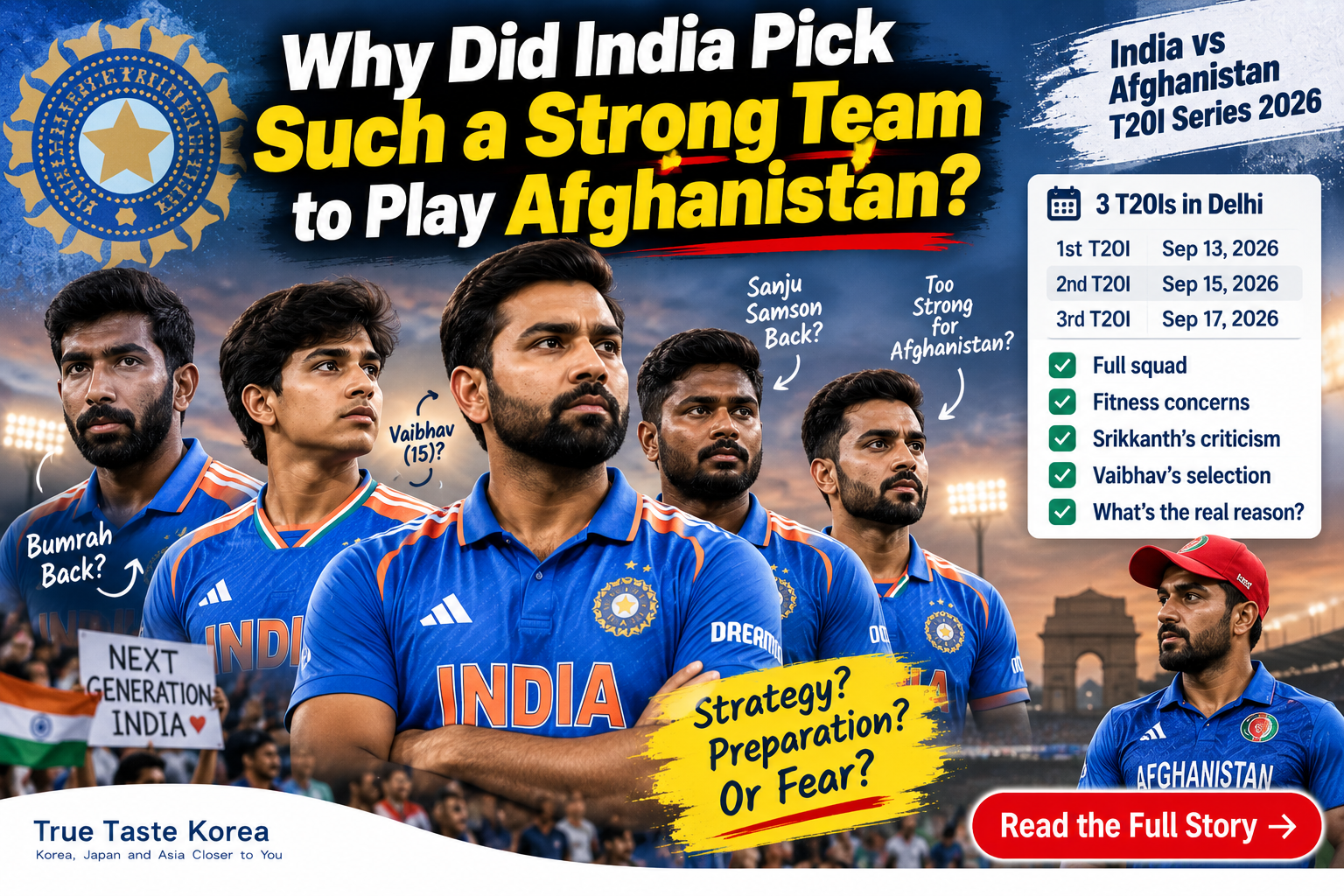
In September 2026, Sooryavanshi was selected for India’s three-match T20I series against Afghanistan. Despite arriving after an outstanding series against Zimbabwe, he did not play a single match.
A few weeks later, he appeared in India’s Asian Games campaign, including the gold-medal final against Pakistan. Against New Zealand, he then helped produce a record-breaking powerplay with Abhishek Sharma.
And now another development has raised the stakes.
The Bihar Cricket Association has appointed the 15-year-old as captain of its senior team for the opening two matches of the Syed Mushtaq Ali Trophy.
That decision has reopened a debate involving one of Indian cricket’s greatest names, Sachin Tendulkar.
So the question is no longer simply whether Sooryavanshi can hit international bowlers.
It is whether Indian cricket is developing him at the right speed.
Is India giving a once-in-a-generation talent the opportunities he needs, or is it placing too much responsibility on a teenager before he has had time to develop?
1. Who Is Vaibhav Sooryavanshi, and Why Is Everyone Talking About Him?
Vaibhav Sooryavanshi was born on March 27, 2011.
At 15, he has already experienced a career progression that most professional cricketers never achieve.
His rise became impossible to ignore during the 2026 Indian Premier League season.
Playing for Rajasthan Royals, he scored 776 runs in 16 innings at a strike rate of more than 237, finishing as the tournament’s leading run-scorer.
His performances were not merely impressive for a teenager. They were extraordinary by the standards of elite T20 cricket.
He followed that achievement with a remarkable Under-19 World Cup campaign, including a match-winning 175 in the final against England.
That combination of explosive batting and consistent high-level performances made his promotion to India’s senior T20I setup almost inevitable.
But his age remains central to the discussion.
A 25-year-old batter who scores heavily in the IPL is usually judged on whether he can reproduce that performance internationally.
A 15-year-old faces a different question.
Can he maintain his development while the expectations surrounding him grow faster than his experience?
2. His IPL Success Created the Opportunity — But International Cricket Is a Different Test
Sooryavanshi’s IPL performances demonstrated that he could attack experienced bowlers and change the direction of a T20 match in a matter of overs.
However, international cricket introduces different challenges.
Opponents have more detailed information about a batter’s strengths and weaknesses. Bowling plans become more specific. Field placements are designed around individual tendencies, and the pressure of representing a national team is different from playing in a franchise competition.
His first three T20I appearances against England in July 2026 illustrated that transition.
He scored 14, 13 and 15 in his first three innings.
Those scores were not disastrous, but they were a reminder that IPL success does not automatically translate into immediate international dominance.
The important question was how he would respond.
And Zimbabwe provided an answer.
3. Zimbabwe Changed the Conversation: 151 Runs in Three T20Is
India’s July T20I series against Zimbabwe became a turning point in Sooryavanshi’s international career.
He scored 151 runs across three matches, finishing as India’s leading run-scorer and winning Player of the Series.
His numbers were striking:
Statistic
Performance
Matches
3
Runs
151
Average
50.33
Strike rate
196.10
Highest score
81
Half-centuries
2
The opening match produced one of the most memorable moments of his young international career.
He scored 50 from just 19 balls, showing the same aggressive approach that had made him a sensation in the IPL.
In the third T20I, he went further, scoring 81 from 49 deliveries.
That innings was particularly important.
The 19-ball fifty demonstrated his ability to attack. The 81 showed that he could remain at the crease longer and construct a substantial innings rather than relying exclusively on a short burst of boundaries.
It was not proof that he had solved every challenge in international cricket.
But it was evidence that he could respond after a difficult introduction to the format.
4. Why Was He Selected for Afghanistan but Never Played?
This is one of the most revealing episodes in his development.
After his Zimbabwe success, Sooryavanshi was named in India’s 15-player squad for the three-match T20I series against Afghanistan in September.
Many fans expected him to receive another opportunity.
Instead, India chose established opening options, including Abhishek Sharma and Sanju Samson.
Sooryavanshi did not appear in the playing XI for any of the three matches.
That decision generated frustration among supporters who believed a player coming off a Player of the Series performance deserved to continue.
But there was another side to the selection decision.
India already had experienced international batters competing for the opening positions. Samson and Abhishek were not simply occupying places that could automatically be given to a promising teenager.
They were established players with their own performances and responsibilities.
After the series, head coach Gautam Gambhir indicated that Sooryavanshi would have to wait for his opportunity.
This episode exposes a fundamental difference between selection and development.
Being named in a national squad does not mean a player is ready to become a regular international starter.
It means the selectors believe he belongs in the wider group.
For Sooryavanshi, the Afghanistan series was therefore an opportunity to experience the senior-team environment, even though he did not get a chance to bat.
5. The Asian Games: A Gold Medal and a Different Kind of Experience
Sooryavanshi’s next major international assignment came at the 2026 Asian Games in Japan.
India’s men’s cricket team faced Pakistan in the gold-medal final on October 3.
India batted first and scored 211 for six.
Sooryavanshi opened the innings and made 15 from nine balls, including two sixes.
It was not a major individual contribution, but it was part of a successful team performance.
India defeated Pakistan by 19 runs to retain the men’s cricket gold medal.
Earlier in the competition, Sooryavanshi had scored 38 from 21 balls against Sri Lanka.
The two innings offered a useful reminder about his role.
He could contribute to a major international tournament without needing to be the leading scorer in every match.
That is an important lesson for a young player surrounded by enormous expectations.
A successful international career is not built entirely on spectacular individual performances. It also requires understanding different match situations and contributing to a team with several other high-quality players.
6. New Zealand Revealed Both His Explosive Ability and His Inconsistency
The October T20I series against New Zealand provided another important test.
In the second T20I at Christchurch, Sooryavanshi scored just four from eight balls.
In the third match at Wellington, however, he produced a very different performance.
Opening alongside Abhishek Sharma, he scored 45 from 19 balls.
The pair added 133 runs for the first wicket in just over seven overs.
Their partnership included 118 runs in the six-over powerplay, setting a new record for the highest powerplay total in men’s T20I cricket.
Abhishek eventually scored 113 from 38 balls, while Sooryavanshi’s contribution helped India build an extraordinary platform for the chase.
But the contrast between his two innings matters.
Four from eight balls.
Then 45 from 19.
This is precisely the kind of inconsistency that needs to be examined rather than ignored.
His ability to score quickly is obvious. The next stage of development is learning how to respond when the conditions, bowling plans or timing do not immediately favour him.
A young batter who can attack from the first ball is valuable.
A young batter who can also recognize when to wait, rotate the strike and rebuild an innings becomes much harder to contain.
7. What Do His Overall T20I Numbers Actually Tell Us?
By early November 2026, Sooryavanshi had played ten T20I matches for India.
His record stood at:
Statistic
Record
Matches
10
Innings
10
Runs
295
Average
29.50
Strike rate
185.53
Highest score
81
Half-centuries
2
A strike rate above 185 is an extraordinary figure.
It suggests that he can change a match quickly and place immediate pressure on opposing bowlers.
But the average of 29.50 provides another part of the picture.
His impact is already significant, but his record is still developing.
Ten innings are not enough to establish a reliable long-term pattern, especially for a player who has faced different opponents, conditions and batting roles.
The numbers show genuine international potential.
They do not yet prove that he has become a consistently dependable international opener.
That distinction is important because a player’s reputation can grow much faster than the evidence needed to evaluate his long-term ability.
8. The Duleep Trophy Asked a Different Question: Can He Bat Against the Red Ball?
Perhaps the most interesting part of Sooryavanshi’s development has taken place outside T20 cricket.
In August 2026, he represented East Zone in the Duleep Trophy semi-final against Central Zone.
He scored 92 from 81 balls.
At 15 years and 157 days, he became the youngest player to score a half-century in Duleep Trophy history, breaking a record that had stood for 57 years.
The previous record belonged to Laxman Singh, who had achieved the milestone at 16 years and 23 days in the 1968–69 competition.
The innings was significant for more than the age record.
Red-ball cricket requires a different set of decisions from T20 cricket.
A batter must manage longer periods at the crease, assess changes in the ball and pitch, and understand when attacking is appropriate.
Sooryavanshi’s 92 demonstrated that he could play a substantial innings in a first-class environment.
However, one innings cannot establish his readiness for Test cricket.
His first-class record was still relatively limited, and he needed more opportunities to demonstrate that he could repeat this performance against different bowling attacks and under different conditions.
The Duleep Trophy innings was an encouraging development, not a final answer.
9. Why Sachin Tendulkar Thinks India Should Slow Down
This is where the discussion becomes much more interesting.
Sooryavanshi was named vice-captain of East Zone for the Duleep Trophy.
He also briefly took over captaincy duties when regular captain Ishan Kishan was unavailable during the semi-final.
For some observers, this was another sign of his extraordinary maturity.
But Sachin Tendulkar offered a different perspective.
During a Reddit question-and-answer session, Tendulkar was asked about the decision to give Sooryavanshi a leadership role at such a young age.
His response was direct:
“I feel it’s too early for him to become a vice-captain in the Duleep Trophy. We have to let him play more matches with the red ball and take one step at a time!”
This is an important comment because Tendulkar is not questioning the teenager’s batting ability.
He is questioning the timing of the additional responsibility.
There is a difference between recognizing exceptional talent and assuming that a young player is ready for every responsibility that comes with it.
Tendulkar’s argument is essentially that Sooryavanshi should first gain more experience in red-ball cricket before being asked to take on leadership duties in that environment.
It is a development-focused argument rather than a criticism of the player’s potential.
10. Why Bihar’s Decision to Make Him Captain Creates a New Debate
On November 6, the Bihar Cricket Association announced that Sooryavanshi would captain the state’s senior team for its first two Syed Mushtaq Ali Trophy matches.
The matches are scheduled against Saurashtra on November 14 and Railways on November 16.
He will then join India’s A squad for the ACC Men’s Asia Cup Rising Stars tournament in Doha, scheduled for November 19–29.
Bihar’s decision creates an interesting contrast with Tendulkar’s advice.
The association believes captaincy can help Sooryavanshi develop as a player and leader.
Tendulkar believes the teenager should first gain more red-ball experience before taking on leadership responsibilities.
These positions are not necessarily contradictory.
They are based on different assessments of what the young cricketer needs at this stage.
The Bihar association is giving him a limited leadership opportunity in the T20 format.
Tendulkar was specifically discussing the vice-captaincy role in a red-ball competition.
The distinction matters.
Leading a state side in two T20 matches is not identical to being responsible for a team in a long first-class competition.
But both decisions raise the same broader question:
How much responsibility should a 15-year-old be given simply because his cricketing ability is far beyond what is normal for his age?
11. Is Captaincy an Opportunity or an Unnecessary Burden?
There are arguments on both sides.
The case for giving him responsibility is straightforward.
Captaincy can teach a young player to think beyond his own batting.
He must understand match situations, communicate with teammates, work with bowlers and make decisions under pressure.
Those experiences can accelerate cricketing maturity.
But there is also a risk.
A teenager who is already dealing with international selection pressure, media attention and expectations may not need every new achievement to come with another responsibility.
There is a difference between allowing a player to develop leadership skills and making leadership another measure by which his performance is judged.
If Bihar wins its opening matches, the appointment may be celebrated as a masterstroke.
If the team loses, the teenager could become the subject of criticism that has very little to do with his batting ability.
That is why the most sensible approach is to treat the captaincy as a learning opportunity, not a test of whether he is already a finished leader.
12. Is Sooryavanshi Ready for Test Cricket?
Sooryavanshi has expressed interest in playing Test cricket and has spoken positively about developing his red-ball game.
That ambition is understandable.
Test cricket remains the most demanding format in terms of concentration, technique and the ability to adapt over long periods.
His Duleep Trophy 92 was a promising sign.
But there is a considerable distance between scoring a first-class half-century and becoming a successful Test batter.
He still needs to demonstrate:
Consistency against high-quality red-ball bowling
The ability to defend for long periods
Patience when scoring opportunities are limited
Adaptability to different pitches and conditions
The ability to recover after technical setbacks
His aggressive approach does not need to disappear.
The challenge is to make sure he has more than one way to succeed.
If he can combine his natural attacking instincts with the ability to construct long innings, his potential will become much more interesting across formats.
13. Could India’s Expectations Become a Problem?
This may be the most important issue of all.
Sooryavanshi is already being compared with some of the greatest names in Indian cricket.
His age makes every achievement seem historic.
But it also makes every failure more visible.
After a big innings, social media can describe him as India’s next superstar.
After a low score, the same platforms can question whether he was promoted too early.
Neither reaction is a particularly useful way to develop a young cricketer.
The danger is that the player begins to be evaluated against expectations that no teenager could reasonably satisfy.
A 15-year-old does not need to become Sachin Tendulkar next season.
He needs to improve his technique, learn from international bowlers, develop physical strength and understand the demands of professional cricket.
The public may want a new superstar immediately.
Indian cricket should want a player who is still improving five years from now.
14. What Should India Do With Vaibhav Sooryavanshi Now?
The answer should not be to protect him from every difficult situation.
That would be just as damaging as rushing him into every possible competition.
He needs exposure to strong bowling attacks and opportunities to learn from experienced teammates.
But those opportunities should be selected carefully.
India should consider three priorities.
First: Give him meaningful opportunities, not just squad selections.
The Afghanistan series showed that being included in a squad without playing does not necessarily advance a player’s development.
If the selectors believe he is ready, he needs a clear role and enough opportunities to learn from actual international matches.
Second: Continue developing his red-ball game.
The Duleep Trophy performance was encouraging, but more first-class cricket is necessary before drawing conclusions about his Test potential.
Third: Avoid making every new responsibility a public test.
Captaincy, media attention and constant comparisons with legends should not become more important than the basic process of improving as a batter.
The goal should be to develop a complete cricketer, not simply to create the next headline.
15. So, Is Vaibhav Sooryavanshi Really Ready for India at 15?
The evidence suggests that he is already capable of competing at senior international level.
His Zimbabwe series demonstrated that he can score heavily against international bowling.
His Asian Games appearances gave him experience in a major tournament environment.
His New Zealand performance showed that he can contribute to an explosive opening partnership against another established international side.
And his Duleep Trophy innings demonstrated that his development is not limited to the shortest format.
But there is a difference between being ready to play international cricket and being ready for every responsibility that comes with it.
He has not yet established the consistency expected of a long-term international opener.
His red-ball development remains a work in progress.
And his captaincy experience is only beginning.
That is not a criticism.
It is a normal part of developing a 15-year-old athlete, even one with extraordinary talent.
The more interesting question is not whether India should use him immediately in every format.
It is whether the Indian cricket system can give him the right opportunities without allowing public expectations to dictate his development.
The Bottom Line: India’s Biggest Challenge Is Not Finding His Talent — It Is Managing It
Vaibhav Sooryavanshi has already achieved things that most professional cricketers can only dream about.
He has dominated the IPL, delivered a major Under-19 World Cup performance, scored heavily in international T20 cricket and broken a long-standing Duleep Trophy record.
He has also experienced being left out of India’s playing XI, even after winning Player of the Series in Zimbabwe.
Now he is preparing to captain Bihar’s senior team for the opening two matches of the Syed Mushtaq Ali Trophy.
The contrast between Sachin Tendulkar’s advice and Bihar’s decision makes his situation particularly interesting.
One emphasizes patience and more red-ball experience.
The other sees leadership responsibility as another opportunity for growth.
Both approaches are trying to develop the same young player.
And perhaps that is the real story.
India does not need to decide today whether Vaibhav Sooryavanshi will become another Tendulkar, another great opener or the face of Indian cricket for the next decade.
It needs to give him the space to become the best version of himself.
At 15, his greatest achievement should not be how much pressure he can survive. It should be how much better he can become.
The talent is already visible.
Now Indian cricket has to get the development right.
India are about to play Afghanistan in a three-match T20I series.
On paper, that doesn’t sound unusual.
But when the BCCI announced India’s squad, one question immediately stood out:
Why is India taking such a strong team against Afghanistan?
Jasprit Bumrah is there.
Shreyas Iyer is captain.
Tilak Varma is vice-captain.
Abhishek Sharma, Sanju Samson, Ishan Kishan, Axar Patel, Varun Chakaravarthy and Arshdeep Singh are all included.
And 15-year-old sensation Vaibhav Sooryavanshi is in the squad too.
Even more surprisingly, four players — Jasprit Bumrah, Nitish Kumar Reddy, Washington Sundar and Harshit Rana — were selected subject to fitness clearance.
That has led to a bigger debate in Indian cricket.
If some important players are still working their way back to full fitness, why risk them in this series?
And why not use Afghanistan to test more young players before the Asian Games?
Here’s what is going on.
When Is India vs Afghanistan T20I Series 2026?
The three matches are scheduled for:
1st T20I — September 13, 2026
2nd T20I — September 15, 2026
3rd T20I — September 17, 2026
All three will be played at the Arun Jaitley Cricket Stadium in Delhi.
There’s an unusual detail here too.
Afghanistan are technically the hosts of the series, even though all three games are being played in India. Afghanistan has used venues in India for home fixtures in the past.
The four players marked with an asterisk are subject to fitness clearance, according to the BCCI.
That’s an extremely experienced T20 squad.
And that’s exactly why the selection has attracted attention.
Why Are People Questioning India’s Team Selection?
One of the strongest criticisms has come from former India captain Krishnamachari Srikkanth.
His basic argument is simple:
Why select such a strong team against Afghanistan when India could use the series to test younger players?
The criticism becomes more interesting because several selected players are not yet guaranteed to be fully fit.
Srikkanth questioned why players such as Washington Sundar were being brought back rather than giving opportunities to other young players.
He also suggested India’s recent poor T20I results may have influenced the selectors’ thinking.
So there are really two competing philosophies here.
Option A
Use Afghanistan as a development series.
Rest major players.
Test youngsters.
Prepare the next generation.
Option B
Stop experimenting.
Play a strong team.
Get India winning again.
Build momentum before the Asian Games.
The selectors appear to be leaning much closer to Option B.
Is India Trying to Get Back to Winning?
This is probably the most important context behind the squad.
India’s recent T20I results have not been good.
Indian Express notes that India came into this selection after unsuccessful tours of Ireland and England, while a second-string Indian side subsequently swept Zimbabwe 3-0.
That changes how the Afghanistan series looks.
If India had been dominating every recent series, selectors might have felt more comfortable resting established players.
Instead, Afghanistan represents an opportunity to:
rebuild confidence
settle combinations
restore winning momentum
and
prepare players for what comes next.
That’s one plausible explanation for why the squad looks stronger than some fans expected.
But Is Afghanistan Really an Easy Opponent?
This is another mistake worth avoiding.
Calling Afghanistan an automatic win in T20 cricket is increasingly dangerous.
Afghanistan have developed into a serious international cricket side, particularly in limited-overs cricket.
So India’s selectors cannot simply assume:
“We’ll send anyone and win.”
And that makes the selection debate more complicated.
There’s a difference between asking:
“Why isn’t India resting everyone?”
and assuming:
“Afghanistan can’t beat India.”
Those are not the same claim.
Then Why Select Players Who Aren’t Fully Cleared for Fitness?
This is probably the most controversial part.
The BCCI didn’t simply announce Bumrah, Washington Sundar, Nitish Kumar Reddy and Harshit Rana as unconditional selections.
It specifically marked all four:
Subject to fitness clearance.
That means being named in the squad does not automatically guarantee participation.
But it still raises the question:
If their fitness needs monitoring, is Afghanistan the right series to bring them back?
Srikkanth’s criticism focuses partly on this issue, particularly with the Asian Games approaching later in September.
From the selectors’ perspective, however, this series can also provide competitive match time before that tournament.
So the exact same fact can support two arguments:
Critics: Don’t risk important players.
Selectors: They need matches before the next major assignment.
Why Is Jasprit Bumrah in the Squad?
Bumrah’s inclusion is particularly eye-catching.
He remains one of India’s most important fast bowlers, and the BCCI has explicitly made his Afghanistan participation dependent on fitness clearance.
There’s another reason his return matters.
Bumrah is also part of India’s squad for the 2026 Asian Games.
So Afghanistan can potentially function as preparation rather than merely an isolated three-match series.
The sequence is:
Afghanistan T20Is: September 13–17
↓
Asian Games cricket later in September
That makes the squad selection easier to understand.
Why Is Vaibhav Sooryavanshi Still in India’s Squad at Just 15?
And now we get to perhaps the most fascinating player in the entire squad.
Vaibhav Sooryavanshi.
He is still only 15.
His selection for India’s senior T20I squads earlier this year made him the youngest player ever selected for the Indian men’s senior team, according to Rajasthan Royals.
His rise has been extraordinary.
His IPL 2026 campaign included:
776 runs in 16 innings
a strike rate of 237.30
72 sixes
and the Orange Cap.
He also produced a 36-ball century during the season.
When he originally received his India call-up, chairman of selectors Ajit Agarkar essentially argued that Sooryavanshi’s performances had made him impossible to ignore.
But his international journey hasn’t been completely smooth.
Reuters reported this week that after a difficult debut series in England, he responded with two half-centuries in Zimbabwe. He has now retained his place for Afghanistan.
That makes this series another important test.
Will Vaibhav Sooryavanshi Actually Play Against Afghanistan?
That’s a much harder question.
India have several players who can occupy the top order.
The squad includes:
Abhishek Sharma
Vaibhav Sooryavanshi
Sanju Samson
Ishan Kishan
among others.
So simply being in the squad does not guarantee Vaibhav a starting position.
This debate isn’t new either.
When Sooryavanshi was waiting for opportunities earlier this year, Indian cricket fans were already arguing over whether a 15-year-old should be pushed immediately or allowed more time to develop.
One Reddit discussion about his dismissal attracted more than 1,000 upvotes, with commenters debating whether he had been promoted to the senior level too early.
Another discussion about whether India should put him into the ODI setup drew more than 600 upvotes, showing just how much attention his development is generating.
So Vaibhav himself is becoming a search topic independent of the Afghanistan series.
Is Sanju Samson Back?
Yes.
Sanju Samson has returned to the squad as one of India’s two designated wicketkeepers, alongside Ishan Kishan.
His presence creates another selection question.
If Samson plays near the top of the order, and India also wants Abhishek Sharma and Vaibhav Sooryavanshi involved, somebody has to miss out or move.
That’s why the Afghanistan series isn’t simply:
India vs Afghanistan.
For Indian fans, it’s also about:
Who gets India’s batting spots?
The competition inside the Indian XI may be nearly as interesting as the opposition.
Why Not Send the Team That Beat Zimbabwe 3-0?
That’s essentially part of Srikkanth’s criticism.
A less experienced Indian side had success in Zimbabwe.
So his argument is that those players could have been rewarded with another opportunity rather than immediately returning to a more established squad.
This is one of Indian cricket’s recurring problems — although it’s a very good problem to have.
India has an enormous player pool.
When a young player performs well, selectors must decide:
Reward him immediately?
or
Bring back the established international player?
There aren’t enough positions for everyone.
Afghanistan has simply brought that old debate back again.
Is India “Afraid” of Losing to Afghanistan?
This needs some context because it’s easy to turn a provocative comment into a misleading headline.
Srikkanth used strong language while criticizing the selection and suggested recent defeats had made India reluctant to experiment again.
But that is Srikkanth’s interpretation of the selection, not an official BCCI explanation.
The BCCI’s official squad announcement lists the players and fitness conditions but does not say:
“We selected this team because we’re afraid of Afghanistan.”
That distinction matters.
So the accurate way to frame the controversy is:
Srikkanth believes India’s recent results may have made the selectors more cautious.
Not:
BCCI says India is afraid of Afghanistan.
Could the Asian Games Be the Real Reason?
It may be an important part of the explanation.
Several of the players in this Afghanistan squad are also involved in India’s Asian Games plans.
The Asian Games therefore change the purpose of these three T20Is.
Instead of thinking:
“Why waste Bumrah against Afghanistan?”
another way of looking at it is:
“Can Afghanistan provide competitive preparation before the Asian Games?”
That doesn’t settle the debate.
But it explains why India might want important players playing competitive cricket rather than simply resting.
So Why Did India Pick Such a Strong Team Against Afghanistan?
There probably isn’t one single reason.
Instead, several things are happening at once.
India have recently suffered disappointing T20I results.
The selectors may want the team to rediscover winning momentum.
The Asian Games are approaching.
Some important players need competitive cricket if they receive fitness clearance.
Afghanistan should not automatically be treated as an easy T20 opponent.
And India still has selection questions to answer around players such as:
Sanju Samson
Ishan Kishan
Vaibhav Sooryavanshi
and its returning bowlers.
That explains why India’s squad looks much stronger than a developmental team.
But the criticism isn’t unreasonable either.
India has an enormous pool of young talent, and a three-match Afghanistan series could have been used to give more of those players international experience.
That’s the real debate:
Should India use this series to rebuild its strongest T20 team?
or
Should India use it to discover the next one?
We’ll start getting the answer when the first T20I begins in Delhi on September 13.
You enter ₹5,000, type your UPI PIN, and wait for the payment confirmation.
But something goes wrong.
Your UPI app displays:
“Transaction Failed.”
You check your bank account.
The ₹5,000 has already been debited.
Now you have several questions:
If the payment failed, where did my money go?
Will the bank automatically refund it?
Should I pay the merchant again?
How many days does a UPI refund take?
Can I receive ₹100 per day if the refund is delayed?
The good news is that a failed UPI transaction does not automatically mean your money is lost.
The Reserve Bank of India (RBI) has established specific turnaround times for certain failed digital payment transactions.
Two deadlines are particularly important:
T+1 day for certain failed UPI fund transfers.
T+5 days for certain failed UPI merchant payments.
There is also a compensation provision of ₹100 per day of delay beyond the applicable deadline.
However, these rules do not apply identically to every UPI dispute.
Understanding which type of transaction failed is the first step toward getting your money back.
1. Why Was My Bank Account Debited When the UPI Payment Failed?
A UPI payment involves communication between several systems, including your UPI application, the banks involved, and the recipient’s payment system.
Sometimes, a transaction is interrupted before the payment is completed.
For example:
Your bank debits the amount.
The payment confirmation does not reach the receiving bank or merchant.
Your UPI application displays a failed or pending status.
The recipient says the money has not arrived.
This creates a situation in which your bank account shows a debit even though the payment appears unsuccessful.
The important distinction is between a transaction that has failed and one that is still pending.
According to NPCI’s UPI guidance, a failed transaction involving a debit should result in the money being returned to the customer’s account.
But the exact reversal timeline depends on the type of transaction.
2. UPI Refund: What Is the Difference Between T+1 and T+5?
This is the most important part of understanding your refund rights.
The RBI issued its circular on failed digital payment transactions on September 20, 2019. The framework became effective on October 15, 2019.
It specifically identifies two types of failed UPI transactions.
Transaction type
Auto-reversal deadline
Delayed reversal compensation
Fund transfer: beneficiary not credited
T+1 day
₹100 per day
Merchant payment: confirmation not received
T+5 days
₹100 per day
These are the prescribed outer limits for the specified transaction categories.
They are not a guarantee that every UPI complaint will be resolved within the same period.
Let’s look at each situation separately.
3. Case One: You Sent Money to Someone, but They Never Received It
Imagine you transfer ₹10,000 to a friend or family member.
Your bank account is debited.
However, the recipient checks their bank account and confirms that no money has arrived.
This is classified under RBI’s framework as:
Account debited but the beneficiary account is not credited (transfer of funds).
In this situation, if the beneficiary cannot be credited, the beneficiary bank must automatically reverse the transaction no later than T+1 day.
If the reversal is delayed beyond T+1, compensation of ₹100 per day is prescribed.
The process looks like this:
You send ₹10,000
↓
Your bank account is debited
↓
Recipient does not receive the money
↓
Auto-reversal by T+1
↓
₹100 per day compensation for qualifying delay beyond T+1
The important point is that this rule applies to a failed fund transfer where the beneficiary has not received the money.
It should not be confused with a payment that is still being processed or a transaction in which the recipient has actually received the funds.
4. Case Two: You Paid a Merchant but the Payment Confirmation Never Arrived
Now consider a different situation.
You are eating at a restaurant in India.
Your bill is ₹2,000.
You scan the restaurant’s UPI QR code and complete the payment.
Your bank account is debited, but the restaurant’s payment system does not receive confirmation.
The cashier tells you:
“Payment failed. Please try again.”
This situation falls under a separate RBI category:
Account debited but transaction confirmation not received at the merchant location (payment to merchant).
For this type of failed UPI transaction, the prescribed auto-reversal deadline is T+5 days.
If the reversal is delayed beyond T+5, compensation of ₹100 per day is prescribed.
The process is:
You pay ₹2,000
↓
Your bank account is debited
↓
Merchant does not receive transaction confirmation
↓
Auto-reversal within T+5
↓
₹100 per day compensation for qualifying delay beyond T+5
This is why it is incorrect to assume that every failed UPI transaction must be refunded within one day.
The applicable deadline depends on the transaction category.
5. What Does T+1 or T+5 Actually Mean?
The letter T refers to the transaction date.
The RBI framework explicitly defines T as the calendar date of the transaction.
For example, suppose a qualifying failed fund transfer occurs on November 10.
The applicable T+1 deadline is calculated from November 10.
For a qualifying failed merchant payment on the same date, the applicable T+5 deadline is calculated from that transaction date.
These are calendar-day timelines, not simply a vague instruction to wait for several working days.
The RBI framework establishes the outer limit for reversing the failed transaction.
Banks and payment system participants are expected to resolve failed transactions sooner wherever possible.
6. Can I Really Get ₹100 Per Day for a Delayed UPI Refund?
Yes, the RBI framework provides for compensation of ₹100 per day when reversal exceeds the applicable deadline for the specified failed-transaction categories.
For example:
Suppose a qualifying fund transfer is not reversed within T+1.
The prescribed compensation is ₹100 for each day of delay beyond that deadline.
For a qualifying merchant payment, the compensation applies when reversal is delayed beyond T+5.
There is another important detail.
The RBI circular says that compensation should be credited to the customer’s account suo moto.
This means the customer should not have to wait until they submit a separate compensation claim.
However, there are two things to understand:
The transaction must fall within the relevant RBI failed-transaction category.
The compensation provision applies to delay beyond the applicable reversal deadline, not simply because a UPI payment is temporarily pending.
Is the ₹100 compensation separate from the refund?
Yes.
The original transaction amount and the delay compensation are two different things.
For example, if ₹5,000 was wrongly debited, the reversal should return the ₹5,000.
If the transaction qualifies and the reversal exceeds the applicable RBI deadline, the ₹100-per-day compensation is an additional amount.
The compensation does not replace the original refund.
7. My UPI Transaction Says Pending. Should I Wait?
A pending transaction is not necessarily the same as a failed transaction.
This distinction matters because a payment may still be undergoing processing.
NPCI explains that a pending transaction occurs when the payment amount becomes stuck during processing and confirmation has not yet been received.
A transaction may eventually become successful or failed.
If your UPI application displays “Pending”:
Open your transaction history.
Select the relevant payment.
Check the latest transaction status.
Check whether the recipient has received the amount.
Save the transaction reference number.
Use the application’s support or complaint option if the issue remains unresolved.
Do not assume that a pending transaction has automatically failed.
Also, avoid repeatedly initiating the same payment without checking its status.
Otherwise, you could end up paying twice.
8. Should I Pay the Merchant Again?
This is one of the most practical questions for UPI users.
Imagine you are at a restaurant.
Your bill is ₹1,500.
Your bank account shows that ₹1,500 has been debited, but the restaurant says it has not received the payment.
Should you pay again?
First, check the transaction status.
Then ask the merchant to verify the payment using the transaction reference details available to them.
If you decide to make another payment because the first transaction has genuinely failed, preserve evidence of both transactions.
Why is this important?
Because the first transaction might be reversed automatically later.
You need to be able to distinguish between:
The original failed transaction.
The second payment that was successfully completed.
Any subsequent refund or reversal.
Keep screenshots and transaction reference numbers for both payments.
This will make it easier to resolve a duplicate-payment dispute if one arises.
9. How to Raise a Complaint for a Failed UPI Payment
You do not have to rely only on waiting for an automatic reversal.
NPCI provides UPI complaint and transaction-status support through participating UPI applications.
The general process is:
Step 1: Open your UPI application.
Go to the transaction history.
Step 2: Select the failed or disputed payment.
Check the amount, date, recipient details, and current status.
Step 3: Find the support or complaint option.
Depending on the application, this may appear as Help, Raise Complaint, Report Issue, or a similar option.
Step 4: Select the correct complaint reason.
For example:
Money debited but beneficiary not credited.
Merchant payment failed.
Transaction pending.
Amount debited but merchant did not receive confirmation.
Step 5: Submit the complaint.
Save the complaint or reference number.
The exact menu and available complaint categories may differ between Google Pay, PhonePe, Paytm, BHIM, and bank-provided UPI applications.
You can also contact the bank linked to the debited account.
10. What Information Should I Keep Before Contacting My Bank?
If you contact customer support, provide enough information for the bank to identify the transaction.
Keep the following details:
Information
Why it matters
Transaction date and time
Identifies when the payment occurred
Amount
Confirms the disputed debit
UPI transaction ID
Helps trace the transaction
UPI reference number
Supports transaction identification
Recipient or merchant details
Identifies the intended payment
Bank debit record
Shows that money left your account
App transaction status
Shows whether it is pending, failed, or successful
Complaint reference number
Helps track your grievance
Avoid sharing sensitive credentials.
A legitimate bank or UPI support representative should not ask you to reveal your UPI PIN or OTP to process a refund.
11. What If My UPI Refund Does Not Arrive After T+1 or T+5?
If the applicable deadline has passed, do not simply keep refreshing your bank balance.
Follow a clear escalation process.
First: Confirm the transaction category.
Was it a fund transfer where the beneficiary was not credited, or a merchant payment where confirmation was not received?
Second: Check your bank account again.
Make sure the reversal has not already been credited.
Third: Raise or follow up on your complaint.
Use the UPI application and contact the bank if necessary.
Fourth: Mention the RBI turnaround-time framework.
Explain that the transaction falls under the relevant failed-transaction category and that the prescribed deadline has passed.
Fifth: Ask about the applicable compensation.
If the transaction qualifies, ask the bank to verify whether the prescribed ₹100-per-day compensation has been credited.
Keep all complaint reference numbers and written responses.
12. Can I Complain to the RBI Ombudsman?
Yes, but there is a proper procedure.
The Reserve Bank of India operates the Reserve Bank – Integrated Ombudsman Scheme, 2026, which came into effect on July 1, 2026.
Before approaching the RBI Ombudsman, you must first complain to the concerned regulated entity, such as your bank.
Under the 2026 scheme, you may approach the RBI Ombudsman if:
The bank or regulated entity does not respond within 30 days, or within the applicable period prescribed by RBI, NPCI, or the relevant payment network, whichever is higher; or
You receive a response but are not satisfied with the resolution.
You can submit an eligible complaint through the RBI’s official Complaint Management System:
https://cms.rbi.org.in
The RBI also provides information about its grievance-redressal process through its official website.
Remember that the Ombudsman is an escalation mechanism. It is not a substitute for first reporting the failed transaction to your bank or payment provider.
13. Be Careful: Failed UPI Payments Can Become a Scam Opportunity
A person who has just lost access to ₹5,000 or ₹10,000 may be desperate to get the money back.
Scammers understand this.
They may pretend to be bank employees, UPI customer-care representatives, or refund specialists.
They may contact you through phone calls, messaging applications, or fake websites.
Never share:
Your UPI PIN.
Your OTP.
Your debit-card PIN.
Your internet-banking password.
Sensitive banking credentials.
Remember this important rule:
You do not need to enter your UPI PIN to receive money.
Use the official support option inside your UPI application or contact your bank through its verified website or official customer-support channel.
If you discover an unauthorized transaction or suspect fraud, contact your bank immediately and report the incident through the appropriate official channels.
14. Quick Comparison: T+1 vs T+5 UPI Refund Rules
Here is the simplest way to remember the RBI framework.
Situation
Deadline
Compensation
Money transferred, but beneficiary not credited
T+1
₹100/day beyond deadline
Merchant payment debited, but confirmation not received
T+5
₹100/day beyond deadline
These rules apply to the specified failed-transaction categories under RBI’s framework.
They should not be treated as universal deadlines for every payment dispute, unauthorized transaction, or merchant disagreement.
15. Frequently Asked Questions
How long does a failed UPI payment take to refund?
It depends on the type of failed transaction.
A qualifying fund transfer where the beneficiary is not credited has a T+1 reversal deadline.
A qualifying merchant payment where confirmation is not received has a T+5 reversal deadline.
Is T+1 one working day or one calendar day?
RBI defines T as the calendar date of the transaction. The T+1 timeline is therefore calculated using calendar dates.
Can I receive ₹100 per day if my UPI refund is delayed?
Yes, the RBI framework prescribes ₹100 per day of delay beyond the applicable deadline for the specified failed UPI transaction categories.
Will the bank pay the compensation automatically?
The RBI circular states that applicable compensation should be credited suo moto, without waiting for the customer to make a separate claim.
What if my UPI app says successful but the merchant says payment failed?
Check the bank debit record and transaction reference number. Ask the merchant to verify the payment with their payment provider. Do not assume the transaction failed simply because the merchant’s screen did not update.
What if my money was debited but the transaction still says pending?
Check the transaction status through your UPI application and contact the bank if the issue remains unresolved. A pending transaction is not necessarily a confirmed failure.
Can I get my money back if I paid the wrong UPI ID?
A mistaken transfer is different from a technical failure covered by the automatic reversal timelines. Contact your bank and UPI application immediately. Recovery may depend on the circumstances and the recipient’s cooperation.
Where can I complain about a failed UPI transaction?
Start with the complaint facility in your UPI application or contact the bank linked to your account. If the regulated entity does not resolve the grievance within the applicable escalation period, you may approach the RBI Ombudsman under the 2026 scheme.
Final Answer: Where Did My UPI Money Go?
If your UPI payment failed but your bank account was debited, do not immediately assume that the money is permanently lost.
First, identify the type of transaction.
If you transferred money to another person but the beneficiary was not credited: T+1.
If you paid a merchant but the transaction confirmation was not received: T+5.
For qualifying delays beyond these deadlines, RBI’s framework provides for ₹100 per day of compensation.
Your next steps are straightforward:
Check the transaction status.
Confirm whether the recipient received the money.
Save the UPI transaction ID and bank debit record.
Raise a complaint through your UPI application or bank.
Follow up if the applicable reversal deadline has passed.
Ask the bank to verify any compensation due under the RBI framework.
The most important thing to remember is this:
A failed UPI payment does not automatically mean your money is gone. But knowing the difference between T+1 and T+5 can make a real difference when you ask your bank for a refund.