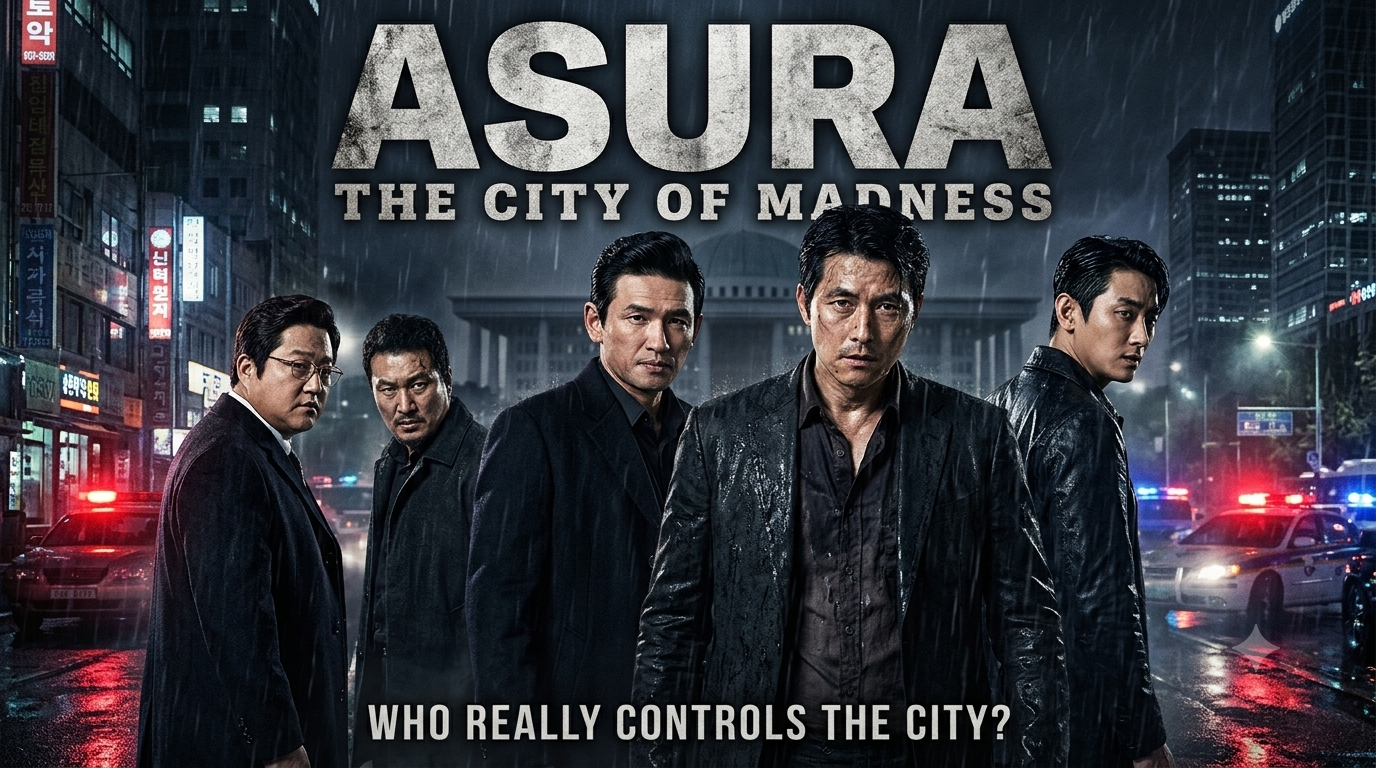
Some crime films are built around the question of who committed a crime. Asura: The City of Madness asks something far more disturbing: what happens when almost everyone involved in enforcing the law, breaking the law, or investigating it has something to hide?
Directed by Kim Sung-su and released in 2016, Asura: The City of Madness presents a fictional city where political power, police authority, business interests, and criminal violence are deeply intertwined. At the center is Han Do-kyung, a detective trapped between a ruthless mayor and prosecutors who want to bring him down.
But the film is not simply about a corrupt politician controlling a corrupt police officer. Its deeper subject is the gradual destruction of personal judgment in a world where survival depends on serving someone more powerful.
The most unsettling question is not whether the characters are good or evil. It is whether anyone can remain independent when every relationship becomes a transaction.
1. A City Where Corruption Is Not an Exception
In many crime thrillers, corruption appears as a disease inside an otherwise functioning institution. A dishonest politician, a compromised police officer, or a criminal organization threatens the system from the outside.
Asura presents a different reality.
Corruption is not an isolated problem that can be removed by arresting one individual. It has become part of the way the city operates. Political decisions, police investigations, business arrangements, and personal relationships are all influenced by competing interests.
This distinction changes how we understand the story.
If corruption were limited to Mayor Park Sung-bae, removing him might restore order. If Han Do-kyung were the only compromised officer, punishing him might demonstrate that the law still works.
But the film shows a network in which each institution has its own interests and each participant is prepared to use others.
The city is not collapsing because one person has too much power. It is collapsing because power has become disconnected from responsibility.
2. Han Do-kyung: A Man Who Mistakes Survival for Freedom
Han Do-kyung is the emotional center of the film. He is a detective who has become entangled with Mayor Park Sung-bae, carrying out tasks that go far beyond the normal responsibilities of a police officer.
His circumstances are complicated. His personal life creates pressure, and his dependence on the mayor makes it increasingly difficult for him to escape.
At first, Do-kyung can be understood as someone trying to survive inside a system that offers him very few safe choices.
But the film gradually challenges that interpretation.
He is not simply being forced to participate in wrongdoing. He also makes decisions, accepts compromises, and continues to serve the powerful man who provides him with protection.
This is where his tragedy begins.
Every time he chooses immediate survival over a more difficult alternative, his freedom becomes smaller. He may believe that he is postponing the moment when he will finally escape, but each compromise gives someone else greater control over his future.
Do-kyung’s greatest mistake is not that he fails to recognize danger. He recognizes it repeatedly. His mistake is believing that he can continue negotiating with danger without eventually becoming its property.
3. Park Sung-bae: Political Power Without Moral Limits
Mayor Park Sung-bae represents a form of political power that treats public authority as a personal instrument.
His position gives him access to administrative decisions, influence over people, and the ability to shape the environment around him. Yet the film does not portray him as someone interested in public service in any meaningful moral sense.
For Park, political authority is valuable because it allows him to protect his position and expand his influence.
He understands that power does not always require direct physical force. It can operate through appointments, favors, threats, financial interests, and the ability to make other people dependent.
His relationship with Do-kyung illustrates this method.
Rather than treating the detective as an equal partner, Park keeps him close through a mixture of rewards, pressure, and personal vulnerability. Do-kyung is useful precisely because he has become compromised.
Park’s power therefore depends on more than his official position. It depends on his ability to make other people believe that disobedience is more dangerous than obedience.
The mayor’s most effective weapon is not simply intimidation. It is dependency.
4. Moon Sun-mo: The Dangerous Education of an Ambitious Man
Moon Sun-mo is particularly important because his development reveals another dimension of the film’s corruption.
As Do-kyung’s junior colleague, Sun-mo initially occupies a different position within the power structure. He has not yet reached the same level of entanglement, and his relationship with his senior gives him a connection to the world of influence.
But he is also watching.
He sees how authority works, how powerful people treat those beneath them, and how quickly moral boundaries can become negotiable.
His transformation raises an uncomfortable question: does corruption always begin with a person who already possesses a desire for power, or can it also be learned through proximity to powerful people?
Sun-mo’s development suggests that corruption can function as an education.
He observes the rewards available to those who adapt. He sees the weakness of people who cannot protect themselves. He begins to understand that the existing rules may be less important than the relationships that determine who gets to enforce them.
The frightening part is that a new generation does not necessarily replace an old corrupt system with something better.
Sometimes it simply learns how to operate that system more effectively.
5. The Prosecutors: Can an Investigation Be Clean in a Dirty System?
The prosecutors investigating Park Sung-bae appear to offer an alternative to the mayor’s influence.
They possess legal authority, investigative resources, and the ability to challenge political power. Their presence initially creates the possibility that the system might still correct itself.
However, Asura refuses to make the investigation a simple story of justice defeating corruption.
The prosecutors also have their own institutional objectives and methods. Their interest in Do-kyung is not merely a matter of understanding his actions. He becomes a valuable source of information and a potential instrument against the mayor.
This creates an important distinction between investigating wrongdoing and using a compromised person to achieve an institutional objective.
An investigation can be directed toward the truth, but it can also become a contest over who controls the evidence, the witnesses, and the final narrative.
The film’s cynicism comes from this uncertainty.
Even when an institution challenges another institution, that conflict does not automatically mean the public interest is being protected.
The question is not simply whether the prosecutors can defeat the mayor. It is whether the pursuit of that victory is governed by principles different from the ones that created the corruption in the first place.
6. Information Is More Valuable Than Money
One of the film’s most interesting power dynamics involves information.
Do-kyung knows things about Park Sung-bae. The mayor knows things about Do-kyung. The prosecutors want information that can weaken the mayor. Each character possesses knowledge that may become useful or dangerous depending on who controls it.
In this environment, information functions almost like currency.
Money can purchase cooperation, but information can determine whether someone remains free, becomes vulnerable, or loses everything.
This explains why Do-kyung is so difficult to escape from his situation.
He cannot simply walk away because his relationships have created a collection of risks. What he knows, what he has done, and what others know about him are all connected.
The more information circulates among competing interests, the less control he has over his own future.
The film therefore presents corruption as an information network as much as a financial or political network.
The person who controls the evidence may control the next move. But the person who believes they control all the information may be making the most dangerous mistake of all.
7. Why Do-kyung Cannot Simply Choose a Side
A conventional thriller might eventually force its protagonist to make a clear decision: cooperate with the authorities, remain loyal to the criminal organization, or sacrifice himself to expose the truth.
Do-kyung’s situation is more complicated.
Every available side presents a different danger.
Remaining with Park means continuing to serve a man who has little reason to protect him once he becomes inconvenient. Cooperating with the prosecutors means trusting people who may see him primarily as a useful instrument. Trying to escape independently means confronting the consequences of everything he has already done.
This is not a situation in which one option is safe and another is dangerous.
It is a situation in which every option carries a different form of loss.
That is why his repeated attempts to manage the crisis become so destructive. He is not choosing between good and evil. He is trying to preserve himself while avoiding responsibility for the choices that have already placed him in danger.
The tragedy is that his strategy becomes increasingly impossible.
He wants the benefits of remaining inside the power structure without accepting the consequences of belonging to it.
8. The City Is a Marketplace of Fear
The title The City of Madness is more than a description of the film’s violent atmosphere.
The city operates like a marketplace in which fear, loyalty, influence, and personal weakness can all be exchanged.
A person may receive protection in return for obedience. Another may obtain information in exchange for cooperation. Someone else may use a threat to secure a favor.
These transactions do not always involve money.
Sometimes the price is silence. Sometimes it is loyalty. Sometimes it is the willingness to participate in something that cannot later be denied.
Fear is especially effective because it makes people accept arrangements they would otherwise reject.
Once someone becomes dependent on a powerful figure, the relationship can appear voluntary even when the person has very little real freedom.
That is one of the film’s most disturbing observations: people do not always need to be physically imprisoned to become trapped.
They can be trapped by what they know, what they owe, and what they are afraid will happen if they leave.
9. The Illusion of Control: Why Powerful People Still Feel Threatened
Park Sung-bae appears to possess enormous influence, but his behavior reveals that power does not necessarily create security.
He must constantly monitor the people around him. He must manage potential rivals, maintain loyalty, and prevent information from reaching those who could damage him.
His authority is therefore both powerful and fragile.
The more he relies on manipulation, the more relationships he must control. The more people he uses, the more opportunities exist for betrayal.
This creates a paradox.
A powerful person may control the decisions of others, but that control requires constant maintenance. Every new alliance creates another potential threat.
The mayor’s position is not a stable destination. It is a continuous struggle to prevent others from taking what he has accumulated.
In this sense, Park and Do-kyung are not as different as they initially appear.
One has much more power than the other, but both are trapped in a system that makes trust increasingly difficult.
10. Violence Is What Happens When Negotiation Stops Working
The film’s violence is extreme, but it is not simply decorative brutality.
Much of the violence emerges from the failure of the characters’ attempts to manage one another through pressure, manipulation, and threats.
At first, power can operate quietly. A phone call, a private meeting, a promise, or a warning may be enough to change someone’s behavior.
But these methods become less effective as trust disappears.
When everyone expects betrayal, even cooperation becomes temporary. When people no longer believe that an agreement will be honored, physical force becomes another way to settle the dispute.
Violence is therefore connected to the structure of the city.
It is not separate from politics or institutional corruption. It is one of the consequences of a world in which relationships have been reduced to contests of control.
The brutality of Asura reflects the collapse of the social mechanisms that might otherwise prevent every disagreement from becoming a fight for survival.
11. The Most Dangerous Corruption Is Self-Justification
The film’s characters do not all see themselves in the same way.
Some believe they are protecting their position. Others believe they are pursuing an important objective. Some may think they have no realistic alternative.
This is why the film’s moral world is more interesting than a simple division between heroes and villains.
People rarely need to tell themselves that they are evil before committing harmful acts.
They can explain their decisions as necessary, practical, temporary, or unavoidable.
Do-kyung can tell himself that he is trying to survive. Park can present his methods as the realities of political power. Others can justify their actions through institutional goals.
The danger is that these explanations gradually replace moral judgment.
Once a person accepts that every action is justified by necessity, there is no clear boundary left to prevent the next compromise.
This is one of the strongest ideas in Asura: corruption survives not only through greed, but through the stories people tell themselves to make their behavior acceptable.
12. The Performances Make the Moral Collapse Feel Personal
The film’s performances are essential to its impact.
Jung Woo-sung gives Han Do-kyung a restless, increasingly desperate quality. His character is not presented as a calm mastermind controlling events from behind the scenes. He looks like a man constantly reacting to pressure, trying to find a way out of situations that become worse with every decision.
Hwang Jung-min’s Park Sung-bae is a different kind of presence. His character combines political confidence with a capacity for intimidation, making his authority feel personal as well as institutional.
Joo Ji-hoon’s Moon Sun-mo adds another layer because his development allows the audience to watch a character change through his exposure to power.
These performances create a contrast between different relationships with authority.
Do-kyung is increasingly desperate to escape it. Park wants to preserve and expand it. Sun-mo learns how to approach it.
Their interactions make the film’s central conflict more than an abstract argument about corruption.
We see how power changes the way people speak, behave, trust, and calculate their next move.
13. Why There Is No Traditional Hero in This Story
A traditional crime thriller often gives the audience someone to support.
Even when the protagonist has flaws, viewers can usually identify a moral objective that separates the hero from the people he opposes.
Asura deliberately weakens that comfort.
Do-kyung is the central character, but being the protagonist does not make him morally innocent. The prosecutors may challenge the mayor, but their methods do not automatically make them heroic. Park is an obvious source of corruption, yet removing him does not guarantee that the city will become clean.
This absence of a dependable hero is important.
The film does not ask viewers to choose the least objectionable character and treat that person as the solution.
Instead, it forces the audience to examine the environment that allows all these characters to operate.
The absence of a traditional hero is not a weakness in the story. It is part of its argument.
If the entire system is compromised, replacing one individual may accomplish very little.
14. The Ending: When Everyone Wants Control, Nobody Can Escape
The final movement of Asura pushes its characters toward the consequences of their accumulated decisions.
The struggle is no longer simply about who will defeat whom. It becomes a confrontation with the destruction created by years of manipulation, dependency, and violence.
The ending is powerful because it does not offer the comforting idea that the truth will automatically produce justice.
The characters have spent the story trying to control outcomes. They have used information, institutions, personal relationships, and violence to protect themselves.
But the system they have created is too unstable to guarantee anyone’s safety.
The final catastrophe can be understood as the logical result of a world where every relationship has become conditional and every person is treated as a potential instrument or threat.
The film does not need to provide a clean moral victory.
Its conclusion leaves a much darker impression: when everyone tries to control everyone else, the struggle itself can become more powerful than any individual.
And once that happens, even the people who appeared to be in control may discover that they have lost control of everything.
15. The Real Madness of Asura: A System That Reproduces Itself
The deepest meaning of Asura: The City of Madness is not simply that politicians can be corrupt or that police officers can become criminals.
Those ideas are familiar.
The film’s more disturbing observation is that corruption can reproduce itself through ordinary human decisions.
A compromised detective accepts another favor. A politician protects his position by creating new dependencies. A junior officer observes how influence works and begins to adapt. An investigation becomes another contest over information and control.
Each decision may appear to solve an immediate problem. Together, they create a system in which the next person has even fewer reasons to behave differently.
This is why the film’s city feels so difficult to escape.
Its corruption is not sustained by one mastermind alone. It is sustained by the participation of people who believe they are protecting themselves.
That brings us back to the central question:
In a city where everyone is corrupt, who really controls the city?
Perhaps the answer is that nobody does.
The mayor may control the police officer. The prosecutors may pressure the detective. The detective may try to manipulate both sides. The junior officer may learn from the entire process.
But every attempt to gain control creates new enemies, new dependencies, and new dangers.
The real winner is not necessarily the person who occupies the highest position. It is the system that keeps reproducing itself, even when the people inside it destroy one another.
That is what makes Asura more than a violent Korean crime thriller.
It is a film about the moment when power stops serving people and people begin serving the machinery of power.
And its most frightening message is that a corrupt system does not always need people who believe in corruption.
Sometimes, all it needs is people who believe they have no other choice.