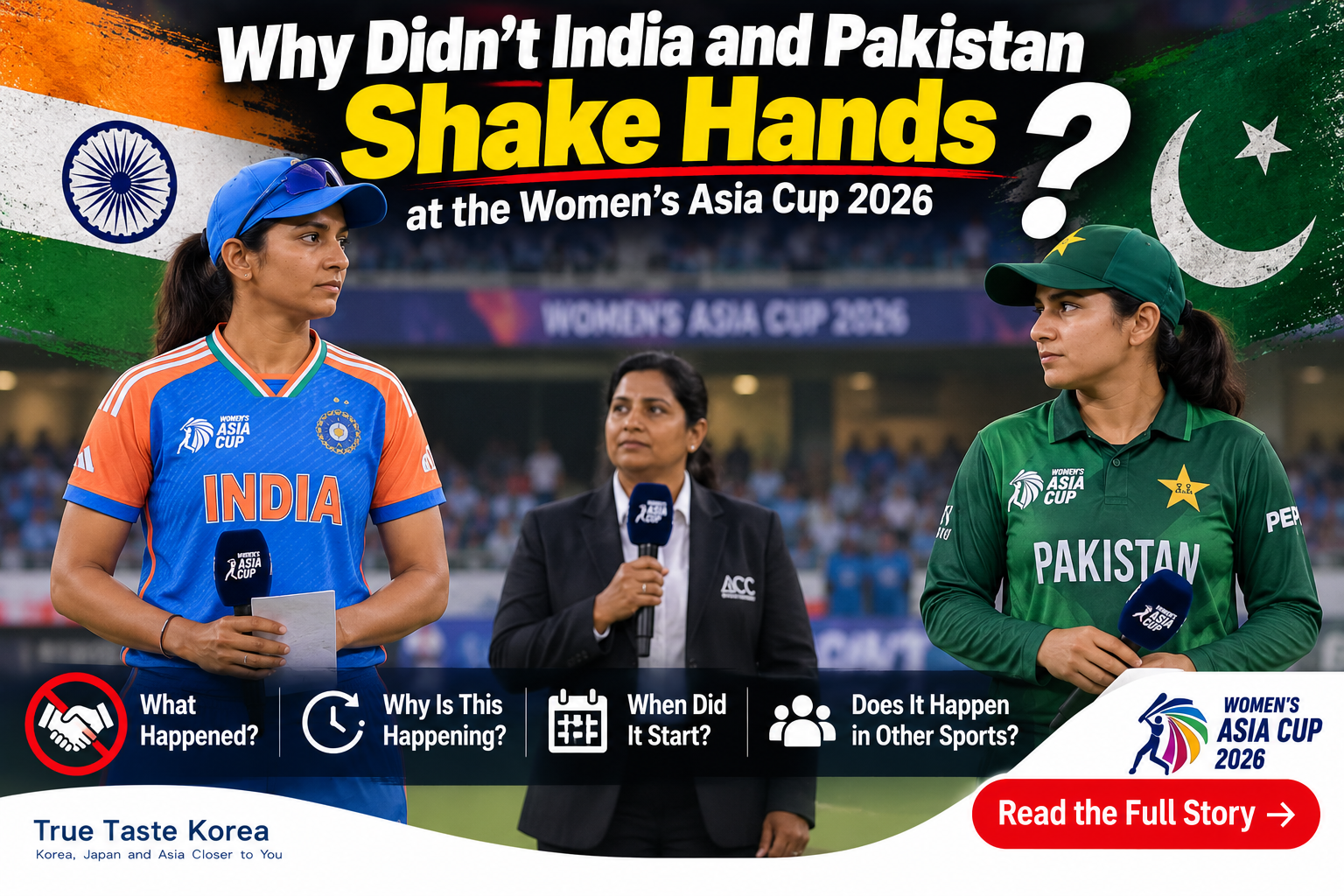
If you watched India vs Pakistan at the Women’s Asia Cup 2026 on September 5, you may have noticed something unusual before the match even began.
India captain Harmanpreet Kaur and Pakistan captain Fatima Sana came together for the toss at Dubai International Cricket Stadium.
The coin was tossed.
Fatima Sana won the toss.
The captains spoke with the presenter.
But one familiar cricket gesture was missing:
They didn’t shake hands.
It wasn’t an accidental omission.
And it wasn’t the first time.
The absence of handshakes has now become a recurring feature of India-Pakistan cricket matches, involving men’s, women’s and even youth teams.
So why aren’t India and Pakistan shaking hands in cricket?
Here’s what happened.
Did Harmanpreet Kaur and Fatima Sana Really Not Shake Hands?
Yes.
At the toss before the September 5 Women’s Asia Cup match in Dubai, Harmanpreet Kaur and Fatima Sana went through the toss without shaking hands.
The Indian Express reported that the two teams skipped the customary pre-toss greeting, continuing a pattern that has been developing in India-Pakistan cricket for nearly a year.
It wasn’t entirely unexpected either.
Even before the match, India’s head coach Amol Muzumdar had been asked whether the women’s team would follow the no-handshake approach against Pakistan.
He declined to focus on the issue, saying the team was concentrating on playing its cricket.
Then came the toss.
No handshake.
Why Didn’t India and Pakistan Shake Hands?
The short answer is:
The practice traces back to the deterioration in India-Pakistan sporting relations following the 2025 Pahalgam attack.
The current sequence began during the men’s Asia Cup on September 14, 2025, also in Dubai.
That match was played after the April 22, 2025 Pahalgam attack.
During the men’s India-Pakistan match, then-India T20I captain Suryakumar Yadav did not shake hands with Pakistan captain Salman Ali Agha.
India also did not exchange handshakes with Pakistan after the match.
The Indian Express reports that the two sides met twice more during that tournament and handshakes were skipped on those occasions as well.
What initially looked like a single controversial moment therefore developed into a recurring pattern.
Is This Only Happening in Men’s Cricket?
No.
That’s what makes the 2026 Women’s Asia Cup incident particularly significant.
The practice moved beyond the men’s senior team.
In October 2025, the Indian and Pakistani women’s teams also did not exchange the customary gesture during their Women’s World Cup meeting in Colombo.
It happened again when Harmanpreet Kaur and Fatima Sana met at the Women’s T20 World Cup in June 2026.
The Indian Express reported at the time that it was the second consecutive ICC tournament meeting between the women’s teams in which the two captains did not shake hands at the toss.
Then, on September 5:
Women’s Asia Cup 2026 → no handshake again.
So this is no longer something limited to one captain or one match.
Has It Reached India’s Younger Cricket Teams Too?
Yes.
The pattern has extended beyond the senior men’s and women’s sides.
The Indian Express reports that handshakes have also been absent from India-Pakistan meetings involving the Under-19 World Cup and Asia Cup Rising Stars.
That gives us a much clearer picture.
This isn’t simply:
“Harmanpreet Kaur didn’t shake Fatima Sana’s hand.”
The broader pattern is:
Men’s cricket
↓
Women’s cricket
↓
Youth cricket
↓
Repeated India-Pakistan matches without the customary handshake
That distinction matters.
Is Shaking Hands Mandatory in Cricket?
This is where viewers can easily misunderstand what they are seeing.
A handshake is a deeply established sporting custom, but the controversy is not the same thing as an unusual cricket dismissal or an illegal delivery that can be resolved simply by looking up a playing-law penalty.
The match itself proceeded normally.
Pakistan won the toss and chose to bat.
The teams played the game.
India eventually won by seven wickets.
So the no-handshake moment should be understood primarily in the context of the relationship between the two cricket teams rather than as something that stopped the match from being played.
Why Are India and Pakistan Still Playing Each Other Then?
This is probably the next question many international viewers have.
If relations are tense enough for handshakes to disappear, why play the match at all?
Because playing a scheduled tournament match and exchanging customary sporting gestures are separate issues.
India and Pakistan continue to meet in multinational cricket tournaments.
The September 5 game was part of the Women’s Asia Cup in Dubai.
The match went ahead as scheduled even though the customary handshake did not take place.
That produces the unusual scene viewers now see:
They compete against each other — but don’t necessarily exchange the traditional greeting.
Did the No-Handshake Situation Affect the Match?
Not in terms of the match being played.
And once the cricket began, India dominated.
Pakistan chose to bat first but were bowled out for:
55
It was Pakistan’s lowest-ever total in Women’s T20 Internationals.
India’s spinners overwhelmed the Pakistan batting lineup, with Sree Charani taking 3/6 and Prema Rawat 3/9.
India then chased the target and won by seven wickets with 11.2 overs remaining.
So ironically, the handshake wasn’t the only extraordinary thing viewers saw that day.
Pakistan’s 55 created another piece of history.
Was 55 Really Pakistan Women’s Lowest T20I Score Ever?
Yes.
According to the ICC, Pakistan’s previous lowest Women’s T20I totals included:
56 vs New Zealand — 2025
60 vs England — 2009
63 vs India — 2012
But on September 5, 2026:
55 vs India
became the new low.
Pakistan lost six wickets for just 12 runs during the collapse.
This gives the match two very different talking points:
Before the match → no handshake
During the match → Pakistan’s historic batting collapse
Did Anything Historic Happen for India Too?
Yes.
Actually, several things did.
Harmanpreet Kaur was playing her 150th T20I as captain.
And during India’s chase, Shafali Verma crossed 3,000 T20I runs.
She did it almost immediately, hitting the first ball of India’s chase for six before passing the milestone in the opening over.
India had also entered the match with Smriti Mandhana in remarkable form.
In the previous game against Hong Kong, China, Mandhana scored 124 and became the leading run-scorer in women’s international cricket, moving past Mithali Raj.
So the India-Pakistan match arrived in the middle of a tournament already producing significant records.
Is the No-Handshake Approach Used Against Pakistan in Every Sport?
Here’s one of the most interesting details.
Apparently not.
The Indian Express notes that the freeze appears to be confined to cricket, pointing out that the two countries’ hockey teams exchanged a high-five gesture during their FIH Men’s Hockey World Cup fixture.
That is important because it prevents an overly broad conclusion.
It would be inaccurate to simply say:
“Indian and Pakistani athletes never greet each other anymore.”
The evidence is more specific.
The repeated no-handshake pattern has become particularly visible in:
India-Pakistan cricket.
Was the Women’s Asia Cup Handshake Decision a Surprise?
Not really.
By September 2026, there was already a history behind it.
Before the Women’s Asia Cup match, reporters were asking India coach Amol Muzumdar about the handshake issue.
His response was essentially to keep the team’s attention on cricket rather than off-field matters.
And when the two captains finally came together at the toss:
Harmanpreet Kaur → no handshake
Fatima Sana → no handshake
The existing pattern continued.
So Why Didn’t India and Pakistan Shake Hands at the Women’s Asia Cup 2026?
If you only saw the few seconds around the toss, the moment can look confusing.
But it wasn’t an isolated personal disagreement between:
Harmanpreet Kaur and Fatima Sana.
It belongs to a much longer sequence.
The current pattern began with India-Pakistan men’s cricket during the 2025 Asia Cup, following heightened tensions after the Pahalgam attack.
It subsequently appeared in women’s cricket and youth cricket as well.
By the time India and Pakistan met at the Women’s Asia Cup in Dubai on September 5, 2026, another no-handshake moment was therefore not unprecedented.
It was the continuation of a pattern that had been developing for almost a year.
And that’s why millions of viewers could watch something that initially seems contradictory: