1. What Happens When the World No Longer Needs Warriors?
Imagine spending your entire life learning how to fight, only to discover that the world has changed and no longer has a place for people like you.
Your skills are no longer respected. Your social status has disappeared. The weapon that once represented your identity is no longer welcome in public.
What would you do to survive?
This is the central question behind Netflix’s Japanese historical action series Last Samurai Standing, also known by its Japanese title, Ikusagami.
Set in 1878, during the early Meiji period, the series follows 292 former samurai who are drawn into a deadly survival competition.
Their destination is Tokyo. Their prize is an enormous fortune. Their condition for winning is brutally simple: survive while eliminating the competition.
But beneath the sword fights and the battle royale format lies a more interesting story.
These men are not simply fighting for money.
They are fighting in a world that has already decided their way of life is over.
2. The Historical Background: The End of the Samurai Era
To understand Last Samurai Standing, viewers need to understand what happened to Japan during the Meiji Restoration.
In 1868, Japan entered a period of dramatic political and social transformation.
The old Tokugawa shogunate was replaced by a centralized imperial government. The new leadership wanted to modernize the country, strengthen its military, and compete with Western powers.
That transformation fundamentally changed the position of the samurai.
For centuries, the samurai had occupied a privileged position within Japanese society. Their identity was connected to military service, hereditary status, and a distinctive social code.
But the new government began dismantling the old class system.
Their hereditary privileges and traditional sources of income were gradually removed. The Haitorei Edict of 1876 further restricted the public carrying of swords, with limited exceptions.
For many former samurai, this was not simply a change in fashion or military policy.
It was the collapse of the world that had given meaning to their lives.
Last Samurai Standing uses this historical crisis as the foundation for its fictional survival competition.
3. The Kodoku Game: 292 Warriors, One Survivor
The story begins with a mysterious invitation.
A total of 292 warriors gather at Tenryuji Temple in Kyoto, attracted by the promise of an enormous financial reward.
The competition, known as Kodoku, offers 100 billion yen to the ultimate survivor.
Each participant receives a wooden tag. To advance toward Tokyo, competitors must collect the required tags from other participants while surviving the journey.
The rules turn the traditional samurai world upside down.
A warrior who once followed a code of honor must now decide whether to trust another fighter, form an alliance, or attack before becoming a target.
The journey becomes a brutal test of physical ability, intelligence, strategy, and human nature.
The game is particularly disturbing because its participants are not ordinary people suddenly forced into violence.
They are men who have spent their lives learning how to fight.
The organizers are not teaching them to become dangerous.
They are creating a situation in which their existing abilities become instruments of mass destruction.
4. Shujiro Saga: A Warrior Who Has Already Lost His World
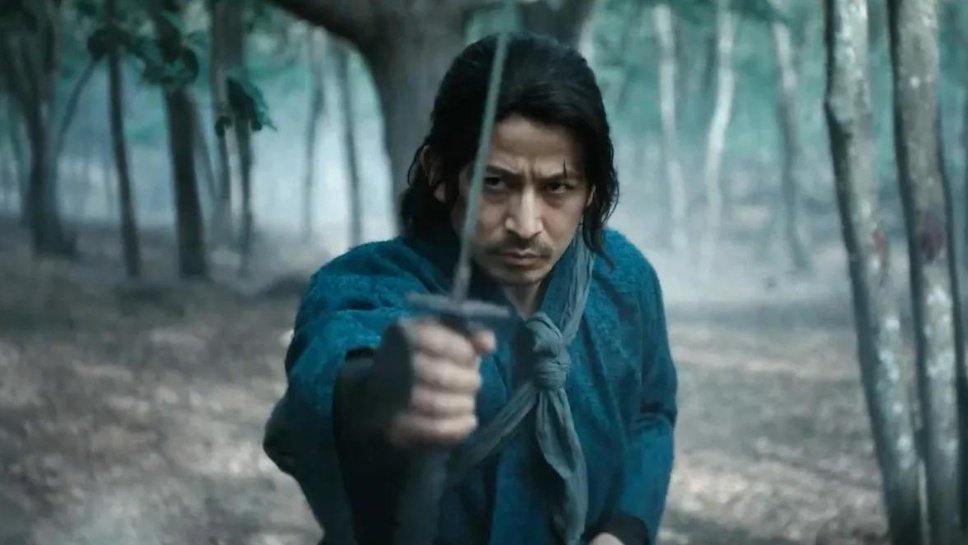
Junichi Okada plays Shujiro Saga, the central character of the series.
Shujiro is a once-undefeated samurai whose reputation is built on extraordinary fighting ability.
But his past achievements cannot protect his family from the economic and social changes of the Meiji era.
His wife and child are suffering, and he has reached a point where ordinary survival is no longer possible.
This is why he enters the Kodoku competition.
Unlike a character motivated purely by greed or a desire for glory, Shujiro has a personal reason for accepting the risk.
He needs the money to save his family.
That motivation changes how viewers interpret his violence.
Every fight is connected to something outside the competition itself.
He is not simply trying to prove that he is the strongest warrior.
He is trying to return to a life in which his family can survive.
This emotional foundation makes Shujiro more interesting than a conventional action hero.
5. Why Junichi Okada’s Performance Is So Important
One of the most distinctive aspects of the production is Junichi Okada’s involvement beyond acting.
He serves as the lead actor, producer, and action planner.
This combination gives him an unusual degree of influence over the physical identity of the series.
The action is not simply something added after the story has been written.
It is part of the way the characters and their conflicts are designed.
Okada’s martial arts experience is particularly important in the fight sequences.
His character uses different weapons and responds to different opponents in ways that reflect experience and adaptability.
Rather than relying entirely on fast editing, the series frequently emphasizes physical movement, distance, timing, and the consequences of each attack.
The result is an action style that feels closer to a carefully choreographed martial arts production than a conventional television drama.
6. The Real Star of the Series: Its Sword Fighting
The strongest element of Last Samurai Standing is undoubtedly its action choreography.
The series offers a variety of combat situations rather than repeating the same sword duel.
Different warriors have different weapons, abilities, and fighting philosophies.
Some rely on speed. Others use physical strength, deception, or long-range attacks.
The environment also changes the nature of each confrontation.
A fight in a narrow building creates different tactical problems from a battle in an open area.
One of the most memorable sequences occurs in Episode 4, where the production uses a lengthy single-take approach during a confrontation in a bar.
The scene demonstrates how camera movement, choreography, and timing can create tension without depending entirely on rapid editing.
Reddit viewers repeatedly highlighted this scene and praised the series’ sword choreography.
Some even compared its action quality to films such as The Raid and John Wick.
That comparison is understandable, although the series has its own identity through its historical setting and traditional weapons.
7. Why the Other Warriors Matter
A survival competition with 292 participants could easily become a story about one overwhelmingly powerful protagonist.
But Last Samurai Standing becomes more interesting when it introduces warriors with different backgrounds and motivations.
Some enter the competition for financial reasons.
Others have personal grudges, political connections, or a desire to test their abilities.
The supporting characters are important because they challenge Shujiro in different ways.
A powerful opponent may force him to reconsider his fighting technique.
A clever strategist may expose weaknesses that physical strength cannot overcome.
An unexpected ally may create a moral dilemma that is more difficult than any sword fight.
The variety of participants also helps create the feeling that the competition is larger than one person’s story.
Every warrior represents a different response to the collapse of the old social order.
8. The Mystery Behind the Game
The most important question is not simply who will reach Tokyo first.
It is why the Kodoku competition exists in the first place.
The organizers have access to extraordinary resources and appear to understand the political environment better than the participants.
The game is too elaborate to be treated as an ordinary criminal tournament.
Its scale raises questions about political power, social control, and the value of human lives in a changing Japan.
The competition also suggests that the former samurai may be useful to someone precisely because they have become socially disposable.
Their military skills are no longer needed by the old system, but those same skills can still be exploited by people who understand how to manipulate violence.
The mystery behind Kodoku therefore connects the action to the larger political story.
The real enemy may not be another warrior holding a sword.
It may be the people who designed the system in which all these warriors are forced to fight.
9. The Most Interesting Theme: What Is a Samurai Without His Sword?
This is the question that gives the series its strongest philosophical dimension.
For many participants, being a samurai is not merely a profession.
It is an identity.
Their upbringing, education, social position, and understanding of honor are connected to a world that no longer exists.
When that world disappears, what remains?
Some warriors attempt to preserve their old values.
Others adapt to the new environment.
Some become criminals, while others search for a different purpose.
The Kodoku competition exposes the contradictions within the traditional warrior identity.
A samurai may claim to value honor, but what happens when survival requires betrayal?
A warrior may believe that strength defines his worth, but what happens when someone weaker defeats him through intelligence?
The series does not offer one universal answer.
Instead, it places different interpretations of the samurai identity against one another.
10. Why This Is More Than a Japanese Version of Squid Game
It is easy to compare Last Samurai Standing with Squid Game because both feature large groups of desperate participants competing in deadly games.
But the similarities should not hide their different foundations.
In Squid Game, the central criticism concerns debt, economic inequality, and the desperation produced by modern capitalism.
In Last Samurai Standing, the central conflict is connected to a historical transition.
The participants are former members of a privileged warrior class whose traditional status has collapsed.
They are not all victims of the same economic system, nor do they share identical motivations.
Their crisis comes from the disappearance of the social structure that once defined them.
The competition is therefore not just a game about money.
It is also a symbolic representation of a society trying to decide what to do with the people left behind by modernization.
Calling it a samurai version of Squid Game may help explain the basic premise, but it does not adequately describe what makes the series distinctive.
11. Reddit’s Biggest Positive Reaction: The Action Is Exceptional
Reddit discussions offer a useful picture of how international viewers received the series.
In a widely discussed thread on r/television, viewers praised the choreography, intense sword fighting, and cinematic presentation.
One of the most frequently mentioned highlights was the single-take bar sequence in Episode 4.
Some viewers also appreciated the character development and the way the flashbacks helped explain the warriors’ motivations.
The discussion included viewers who started the show with relatively low expectations but ended up watching the entire season in a short period.
A separate discussion in r/JDorama described the series as one of the strongest shows of the year, with particular praise for the fights, emotional performances, and overall production quality.
The enthusiasm was not limited to the action itself.
Viewers also became attached to the characters and wanted to see their stories continue.
That emotional connection is important.
A survival series cannot depend on spectacular deaths alone. The audience needs to care about the people who are trying to survive.
12. The Biggest Criticism: The Story Does Not Always Match the Action
The series has a clear strength, but its storytelling is not equally successful in every episode.
Some Reddit viewers felt that the plot became predictable or unnecessarily complicated.
Others criticized the writing in the later episodes, arguing that certain characters behaved in ways that did not match their established personalities.
There were also complaints about occasional CGI weaknesses and moments in which the rules or logic of the competition were not sufficiently clear.
This creates an interesting contrast.
The action can feel carefully planned, but some narrative decisions appear less convincing.
For viewers who mainly want impressive sword fights, this may not be a serious problem.
For viewers expecting a tightly constructed historical thriller, it can be frustrating.
The second season has an opportunity to improve this balance.
The series has already established a visually impressive world. The next challenge is making the political mystery and character decisions equally compelling.
13. The Ending: Why Season 1 Feels Like Only the Beginning
Spoiler warning: This section discusses the final episode.
The first season does not bring the Kodoku competition to a complete conclusion.
Shujiro survives the immediate dangers and receives a mysterious summons that draws him toward Tokyo.
Futaba remains connected to his journey, while the other surviving characters face new threats and unresolved conflicts.
The final episode expands the mystery rather than closing it.
Viewers learn more about the political interests behind the game, but many of the most important questions remain unanswered.
This explains why some Reddit viewers felt that the season ended abruptly.
Some described it as though they had watched only part of a much longer story.
Others were disappointed that the first season did not provide a more satisfying conclusion.
However, the open ending was not the end of the project.
Netflix officially renewed Last Samurai Standing for Season 2 on December 19, 2025.
The announcement confirmed that the story would continue, with Shujiro’s journey toward Tokyo and the mystery behind Kodoku remaining central to the next chapter.
The renewal changes how viewers should interpret the first season.
Its ending is not simply an abandoned storyline.
It is a deliberate transition into a larger conflict.
14. The Historical Contradiction: Modernization Creates Winners and Losers
One of the most interesting ways to understand the series is through the historical tension between modernization and social displacement.
The Meiji government wanted to transform Japan into a modern state.
It pursued military reform, industrial development, administrative centralization, and the removal of older feudal institutions.
These changes helped shape modern Japan.
But modernization did not benefit everyone equally.
The former samurai experienced the loss of privileges and traditional sources of income.
Some adapted to new professions and social roles. Others struggled to find their place.
This is the historical contradiction behind Last Samurai Standing.
The country is moving toward a new future, but the people who once defended the old order are being pushed aside.
The series turns that historical tension into a violent fictional competition.
It asks what happens when people are told that their entire identity has become obsolete.
That question is not limited to nineteenth-century Japan.
Every major social transformation creates people who benefit from change and people who struggle to survive it.
15. Is Last Samurai Standing Worth Watching?
For viewers who enjoy Japanese historical action, the answer is a strong yes.
The series offers several compelling elements:
- Junichi Okada’s physical performance as Shujiro Saga
- Carefully designed sword choreography
- A large ensemble of distinctive warriors
- A survival competition with a historical foundation
- Cinematic action sequences
- A mystery that expands beyond the competition itself
It is especially appealing to viewers who enjoy samurai films, martial arts cinema, battle royale stories, and historical thrillers.
However, viewers should understand that the first season is not a completely self-contained story.
The political mystery and the competition continue beyond the first six episodes.
Those who prefer a fully resolved ending may find that frustrating.
For viewers willing to follow a longer story, however, the first season provides a strong introduction to a distinctive world.
Conclusion: When the World Changes, Does a Warrior Lose His Value?
The most powerful idea in Last Samurai Standing is not that 292 warriors are forced to fight until only one remains.
It is that these men are fighting in a world that has already rejected the identity they spent their lives building.
They were trained to serve, protect, and fight.
But the new Japan has different priorities.
Some adapt. Some resist. Others become trapped between the world they remember and the future they cannot understand.
Shujiro Saga enters the Kodoku competition because he wants to save his family.
Yet his journey gradually becomes part of a much larger question about power, identity, and the people who are left behind when history moves forward.
The series may borrow the excitement of a battle royale, but its most interesting conflict is much older.
It is the struggle between tradition and modernization, honor and survival, and the desire to remain relevant in a world that no longer needs you.
When an entire class of warriors becomes obsolete, the greatest battle may not be against other warriors. It may be against the loss of everything that once gave their lives meaning.
That is what makes Last Samurai Standing more than a spectacular samurai action series.
It is a story about the end of one world and the uncertain beginning of another.
TTK Original — Beyond the Headlines
Looking beyond the sword fights to explore the historical and human cost of a changing society.