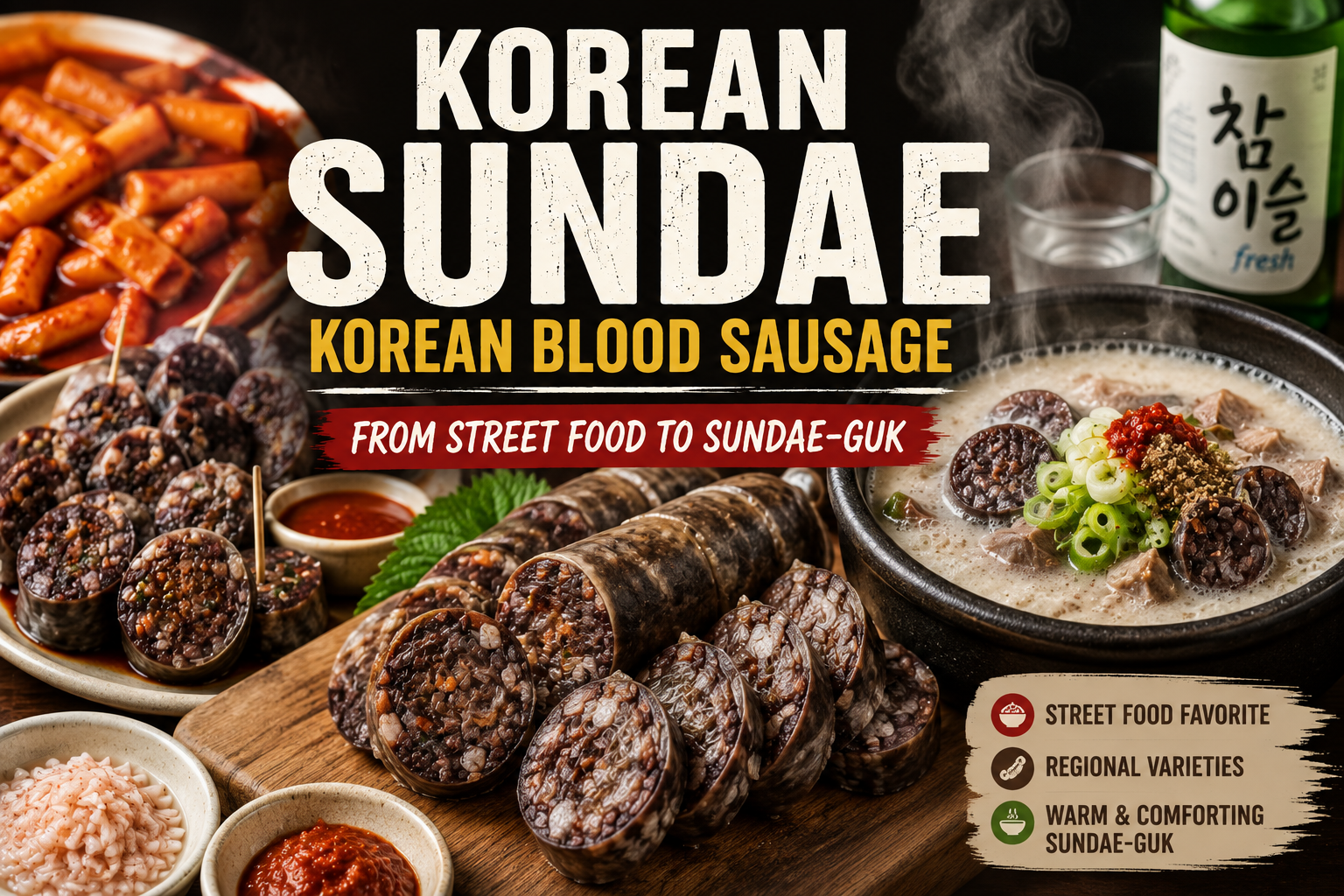
For many Koreans, Sundae grows up with them.
As a student, you might stop at a small bunsik shop after school with friends.
Someone orders tteokbokki.
Someone else orders Sundae.
A plate of warm Korean blood sausage arrives, and before long, pieces of Sundae are being dipped into the spicy red tteokbokki sauce.
Years later, the scene changes.
It’s a freezing winter evening.
You’ve finished a long day at work.
Instead of an after-school snack, there’s now a steaming stone bowl of Sundae-guk in front of you.
Add some green onions.
A little saeujeot.
Maybe perilla seed powder and spicy seasoning.
Put some rice into the soup.
And perhaps pour yourself a glass of soju.
The food didn’t really change.
The person eating it did.
That’s one reason Sundae is much more than Korea’s version of blood sausage.
It’s a food that follows Koreans through different stages of life.
What Is Korean Sundae?
First, let’s clear up one potentially confusing name.
Search for “sundae” in English and you’ll probably find ice cream.
That’s not what we’re talking about.
Sundae (순대) — also sometimes romanized as soondae — is a traditional Korean sausage.
A common modern version uses pork intestine as a casing filled with ingredients such as glass noodles, vegetables and pork blood.
But Sundae isn’t one single recipe.
Traditional and regional versions can contain rice, glutinous rice, barley, vegetables, meat and other ingredients.
The dish has changed considerably over time.
Korea.net notes that blood sausage recipes appear in historical Korean cookbooks including the 1809 Gyuhap Chongseo, while modern versions commonly use pork intestine and starch noodles.
What Does Sundae Taste Like?
If you’ve never eaten blood sausage, the name may sound intimidating.
But common Korean street-food Sundae can actually have a relatively mild flavor.
The glass noodles create a soft, slightly springy texture.
The casing adds chewiness.
Depending on the type, you may taste pork, vegetables, sesame oil and the earthy richness associated with blood sausage.
For many first-time visitors, the texture is more surprising than the flavor.
And Koreans rarely eat Sundae completely alone.
What you dip it into — or what you eat beside it — is part of the experience.
Sundae Is One of Korea’s Classic Bunsik Foods
To understand everyday Sundae, you need to understand bunsik (분식).
Bunsik refers today to affordable, casual Korean foods commonly sold at small snack shops and street-food stalls.
Korea.net identifies tteokbokki, gimbap and Sundae among its representative dishes and explains how modern bunsik culture expanded significantly during the 1960s and 1970s.
That’s why Sundae carries a different feeling from an expensive restaurant meal.
For generations of Koreans, it’s accessible food.
Food you can share.
Food you can eat standing near a market.
And especially:
food students can buy with friends after school.
The Classic Combination: Sundae and Tteokbokki
Walk into a Korean bunsik shop and Sundae rarely lives in isolation.
Nearby you’ll probably find:
Tteokbokki.
Eomuk.
Twigim.
Gimbap.
And ramyeon.
But Sundae and tteokbokki have a particularly satisfying relationship.
Take a piece of relatively mild Sundae.
Dip it into the thick, spicy-sweet red sauce left on the tteokbokki plate.
Suddenly the flavor changes completely.
The soft, savory sausage absorbs the spicy sauce.
For many Koreans, this is one of the simplest pleasures of eating at a bunsik shop.
If you’re trying Korean Sundae for the first time, Sundae + Tteokbokki is an excellent place to start.
What Do Koreans Dip Sundae In?
Here’s where Sundae gets even more interesting.
There isn’t one universal answer.
Depending on region, restaurant and personal preference, Sundae may be served with different condiments.
Salt is common in Seoul and many central areas.
Elsewhere you may encounter ssamjang or other seasoned sauces.
And at a bunsik shop?
Sometimes the best “sauce” is simply the tteokbokki sauce already sitting on the table.
This regional variation is part of the fun.
Ask Koreans what Sundae should be dipped into and you may get surprisingly strong opinions.
Don’t Forget the Liver and Offal
Order Sundae at a traditional market or old-fashioned bunsik shop and you may receive more than sliced sausage.
Pieces of steamed pork liver and other offal may be served alongside it.
For someone unfamiliar with Korean food, that can be a surprise.
You don’t have to eat everything.
But if you’re adventurous, try them.
The liver is dense and crumbly compared with the soft, chewy Sundae, creating another texture contrast on the same plate.
Sundae Bokkeum: When Sundae Gets Spicy
Now take Sundae away from the simple steamer and put it onto a hot griddle.
You get another Korean favorite:
Sundae Bokkeum (순대볶음).
Sundae is stir-fried with vegetables such as cabbage, onions and green onions.
Perilla leaves add their distinctive herbal aroma.
Then comes a spicy seasoning.
The result combines several textures and flavors at once:
Chewy Sundae.
Crunchy vegetables.
Fragrant perilla leaves.
Spicy sauce.
Nutty sesame or perilla seed powder.
And because everything is cooked together on a hot griddle, the aroma is part of the experience.
Sillim-dong Sundae Town
If you’re serious about Sundae Bokkeum, there’s a place in Seoul worth knowing:
Sillim-dong Sundae Town (신림동 순대타운).
Seoul’s official tourism guide identifies the area as one of the city’s destinations for Sundae. The area’s Sundae restaurants trace their roots to market restaurants and street vendors, with businesses gathering into the dedicated Sundae Town building in 1992.
And Sillim has its own famous style.
What Is Baek Sundae?
You might expect stir-fried Sundae to be covered in red spicy sauce.
Not always.
Sillim-dong is famous for Baek Sundae Bokkeum (백순대볶음).
Baek means white.
Instead of coating everything in a red gochujang-based seasoning, Sundae, pork intestines and vegetables are stir-fried with ingredients such as sesame oil and perilla seed powder.
Then you can dip each bite into sauce.
Seoul’s official tourism guide specifically identifies Baek Sundae as Sillim-dong’s signature style.
So if you visit Sillim with friends, there’s an obvious experiment:
Spicy Sundae Bokkeum vs. Baek Sundae.
Try both.
Then choose your side.
Korea Doesn’t Have Just One Sundae
Just as Korea has regional kimchi and noodle traditions, Sundae changes from place to place.
Ingredients, casing, texture and preparation can differ dramatically.
That means eating Sundae while traveling around Korea can become its own food journey.
Byeongcheon Sundae
One of the best-known regional varieties comes from Byeongcheon in Cheonan, Chungcheongnam-do.
Byeongcheon Sundae uses pork small intestine and a filling that can include vegetables, sticky rice and glass noodles.
VISITKOREA describes it as having plenty of vegetables and a relatively clean, light flavor.
Byeongcheon is also famous for its Sundae restaurants and Sundae-gukbap.
The area’s relationship with markets is important too: Korean tourism material describes Sundae-gukbap as an inexpensive, filling meal long associated with market-goers.
Abai Sundae
Travel to Sokcho and you’ll encounter another famous name:
Abai Sundae (아바이순대).
This style is associated with Korea’s northern food traditions and the culture carried south by people displaced during the Korean War.
Compared with the inexpensive glass-noodle Sundae many people encounter at bunsik shops, regional northern-style Sundae can feel much more substantial.
Sokcho’s Abai Village became particularly associated with food traditions brought by refugees from Hamgyeong Province.
It’s another reminder that Korean food history is often inseparable from Korean modern history.
Ojingeo Sundae
And then there’s a version that doesn’t look like ordinary Sundae at all.
Ojingeo Sundae (오징어순대).
Ojingeo means squid.
Instead of pig intestine, a squid body is stuffed with a seasoned filling, steamed and sliced into rounds.
This specialty is strongly associated with Gangwon-do and particularly Sokcho.
So even the word “Sundae” doesn’t always mean pork intestine.
The underlying idea of a stuffed casing can take very different forms.
Then There Is Sundae-guk
Street-food Sundae is only half the story.
Put Sundae into a steaming pork-based soup and you enter another part of Korean food culture:
Sundae-guk (순댓국).
The bowl may contain sliced Sundae together with pork meat and offal in a rich broth.
Rice is often eaten alongside it or mixed directly into the soup.
VISITKOREA describes Sundae-guk as a traditional Korean soup built around Sundae, and restaurants specializing in it can be found throughout Korea.
It’s inexpensive.
It’s filling.
It’s hot.
And on a freezing Korean winter evening, that’s exactly the point.
A Winter Bowl After a Long Day
Imagine walking into a small neighborhood Sundae-guk restaurant after work.
Outside, it’s bitterly cold.
Inside, steam rises from stone bowls.
Your soup arrives bubbling.
You taste the broth first.
Then add whatever you like:
Green onion.
Garlic chives.
Perilla seed powder.
Saeujeot.
Black pepper.
Maybe some spicy dadaegi.
There’s rice beside the bowl and kimchi on the table.
For many people, this is simply dinner.
But add a bottle of soju and the same bowl becomes anju — food eaten with alcohol.
A warm bowl of Sundae-guk and a glass of soju after a difficult day represents a very different side of Korean food culture from trendy cafés and luxury Korean barbecue.
It’s ordinary.
Affordable.
Comforting.
And deeply familiar.
How Koreans Customize Sundae-guk
There’s something important to know before eating Sundae-guk.
Don’t immediately throw every condiment into the bowl.
Taste the broth first.
Then customize it.
Add saeujeot if you need more saltiness and fermented depth.
Add perilla seed powder for a nuttier character.
Add chopped chili for heat.
Add dadaegi if you want the broth spicy.
Some restaurants provide garlic chives or green onions.
Everyone’s bowl can end up tasting slightly different.
That’s part of the experience.
Is Sundae-guk Always Spicy?
No.
This surprises some visitors.
The broth itself may arrive relatively mild and pale.
The red color often comes from dadaegi, a spicy seasoning that the diner adds.
So if you don’t enjoy spicy food, don’t automatically avoid Sundae-guk.
Taste it first.
You control much of what happens next.
Easy Sundae-guk Recipe at Home
Traditional restaurant Sundae-guk can involve long-cooked pork broth and several cuts of meat and offal.
But there’s a much easier way to experience the basic idea at home.
Use packaged Korean sagol-gomtang or a good bone broth.
Ingredients — 2 Servings
- 300 g Korean Sundae
- 150 g thinly sliced pork shoulder
- 500 ml packaged sagol-gomtang
- About 200 ml water
- 1/2 green onion
- A handful of garlic chives
- 1 tbsp minced garlic
- 1–2 tbsp perilla seed powder
- Saeujeot, to taste
- Black pepper
- Green chili, optional
If you can find cooked pork head meat or Korean-style pork offal, add some.
But don’t worry if you can’t.
This is an easy home version, not an attempt to reproduce a specialist Sundae-guk restaurant.
Easy Dadaegi
Mix:
- 1 tbsp gochugaru
- 1/2 tbsp minced garlic
- 1/2 tbsp saeujeot
- 2 tbsp hot broth
Adjust according to your preferred level of heat and saltiness.
Step 1: Make the Broth
Pour the packaged sagol-gomtang and water into a pot.
Bring it to a simmer.
Add the thinly sliced pork and cook it completely.
Add the minced garlic.
Step 2: Add the Sundae Last
This is important.
Most packaged Sundae is already cooked.
If you boil sliced Sundae aggressively for too long, the casing may split and the filling can fall apart.
So add the Sundae near the end.
You’re essentially heating it through in the soup.
Step 3: Finish the Soup
Add green onions and garlic chives.
Transfer everything to bowls.
Then let each person add:
Perilla seed powder.
Saeujeot.
Black pepper.
Chili.
And dadaegi.
Don’t over-season the whole pot.
Part of the Sundae-guk experience is adjusting the bowl yourself.
Step 4: Add Rice
Now eat the soup with steamed rice.
Or do what many Koreans do:
Put some rice directly into the hot broth.
At this point, your soup becomes an incredibly satisfying one-bowl meal.
What Should a First-Time Visitor Order?
If you’re visiting Korea and have never tried Sundae, I wouldn’t necessarily begin with the most intense traditional version.
Start simple.
Order a plate of regular Sundae at a bunsik shop.
Eat one piece with salt.
Then dip another into tteokbokki sauce.
If you like it, move to:
Sundae Bokkeum.
Then:
Sundae-guk.
And finally explore regional varieties such as Byeongcheon Sundae or Abai Sundae.
Think of it as a Sundae progression.
Don’t Let the Words “Blood Sausage” Scare You
There’s no reason to pretend Sundae isn’t blood sausage.
Traditionally, blood is an important ingredient.
But translating it only as “blood sausage” can make the dish sound more extreme than the actual eating experience.
For many Koreans, there’s nothing exotic about it.
It’s the plate they shared with friends after school.
It’s something their parents bought at the market.
It’s what they dip into tteokbokki sauce.
It’s what sizzles on a griddle in Sillim-dong.
And it’s what sits inside a steaming bowl of soup on a cold night.
That’s the difference between knowing what Sundae contains and understanding what Sundae means.
From After-School Snack to Late-Night Soju
Maybe that’s the best way to understand Korean Sundae.
When you’re young, it might cost only enough to share with friends after school.
You stand around a small bunsik shop eating Sundae and tteokbokki.
Years pass.
Now you’re sitting in a neighborhood restaurant after work.
There’s a hot bowl of Sundae-guk in front of you.
Maybe there’s a glass of soju beside it.
Different place.
Different age.
Different reason for eating.
But somehow, Sundae is still there.
For many Koreans, Sundae grows up with them.
FAQ
What is Korean Sundae?
Korean Sundae (순대) is a traditional sausage commonly made using pork intestine filled with ingredients such as glass noodles, vegetables and pork blood. Recipes and regional varieties differ considerably. Historical Korean cookbooks also contain older forms of blood sausage.
Is Korean Sundae the same as an ice cream sundae?
No. They simply share the same English spelling. Korean Sundae is pronounced roughly soon-deh and refers to Korean sausage.
Is Sundae always made with blood?
Blood is characteristic of many traditional and common Sundae recipes, but Sundae has numerous regional forms and ingredient combinations. Ojingeo Sundae, for example, uses squid as its casing and represents a substantially different style.
Is Korean Sundae spicy?
Regular steamed Sundae isn’t usually spicy. Sundae Bokkeum can be spicy, while Sillim-dong’s Baek Sundae is known for being stir-fried without the typical red chili-paste seasoning.
What is Sundae-guk?
Sundae-guk is a hot Korean soup containing Sundae and often pork meat or offal. It is commonly eaten with rice and seasonings such as saeujeot, perilla seed powder and spicy dadaegi.
Where can I try Sundae in Seoul?
One famous destination is Sillim-dong Sundae Town, near Sillim Station in Seoul. The area is particularly known for stir-fried Sundae and Baek Sundae.
What is the best way to try Sundae for the first time?
Try ordinary Sundae at a Korean bunsik shop alongside tteokbokki. Taste it plain or with salt first, then dip a piece into tteokbokki sauce.