Imagine spending an entire cold autumn day making a huge amount of kimchi.
Cabbages are everywhere.
Red seasoning covers the table.
Family members are working together, seasoning and packing cabbage that will be eaten throughout the winter.
And somewhere nearby, pork is slowly cooking.
When the work is finally done, someone slices the warm pork.
You pick up a piece of freshly seasoned kimchi — not fermented for weeks, but made just moments ago — place a warm slice of pork inside and wrap them together.
Sometimes you add a fresh oyster.
Then you eat everything in one bite.
For many Koreans, this is one of the great rewards of Kimjang Day.
And it also helps explain one of Korea’s most satisfying pork dishes:
Bossam (보쌈).
What Is Bossam?
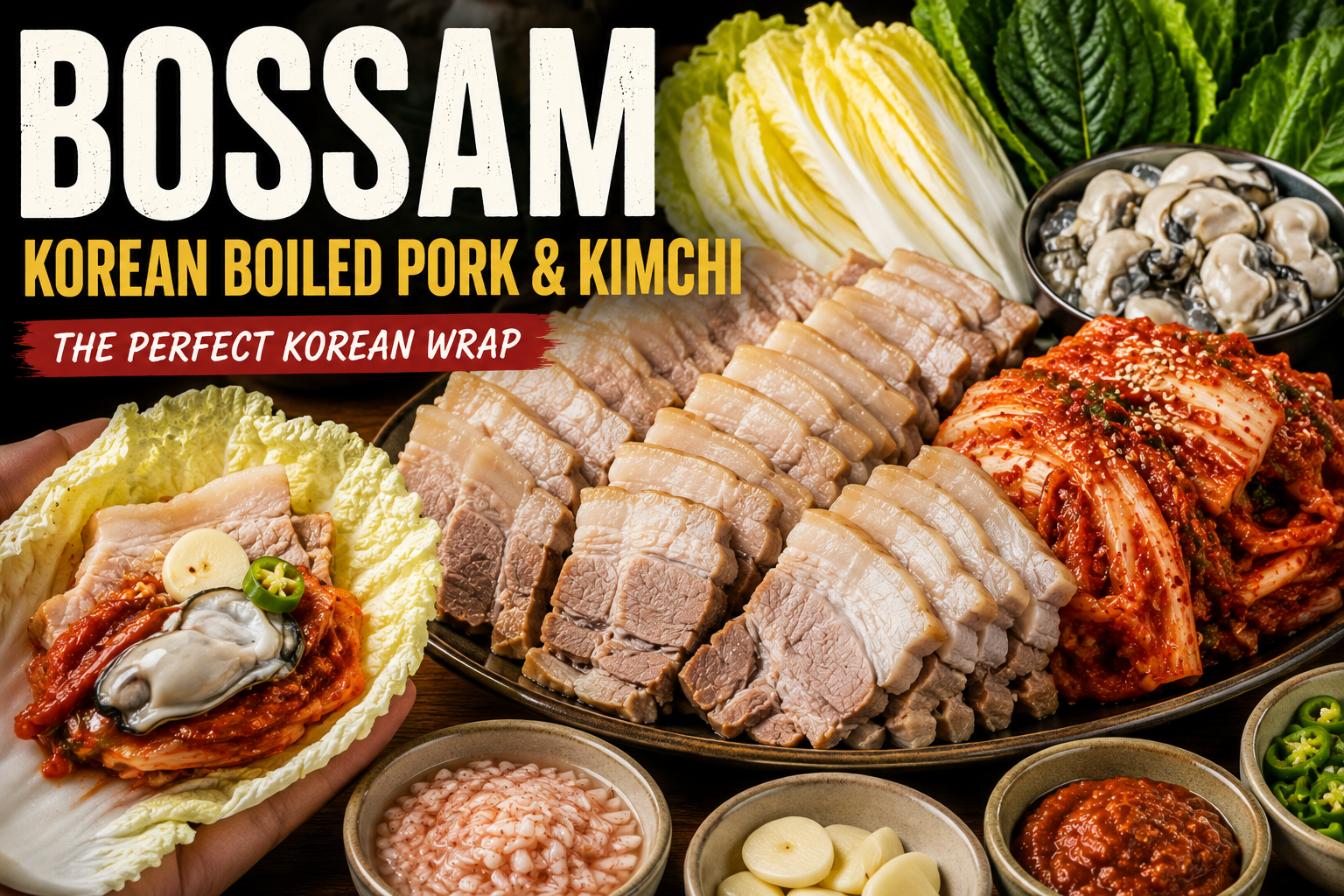
Bossam is a Korean dish of tender boiled pork served with kimchi, vegetables and various condiments.
Pork belly and pork shoulder are commonly used.
The meat is gently cooked, sliced and placed on a large platter.
But Bossam isn’t really complete when you eat the pork by itself.
The fun begins when you wrap it.
Take a cabbage leaf, lettuce or another leafy vegetable.
Add pork.
Add kimchi.
Maybe some garlic.
A little saeujeot.
Perhaps ssamjang.
Wrap everything together.
And eat it in one bite.
That’s the Bossam experience.
VISITKOREA describes Bossam as simmered, thinly sliced pork eaten with kimchi seasoning or spicy radish salad, noting that pork belly and shoulder are commonly used.
Bossam Isn’t Just Boiled Pork
If you search for Bossam in English, you’ll often see:
“Korean boiled pork.”
That’s useful.
But it doesn’t tell the whole story.
Boiled pork is only the center of the meal.
What makes Bossam special is the combination:
tender pork + fresh vegetables + kimchi + fermented condiments + garlic
Each component tastes completely different.
But when you wrap them together, they become one bite.
That’s why understanding Korean ssam (쌈) culture is essential to understanding Bossam.
Suyuk vs. Bossam: What’s the Difference?
These two Korean words are often confused.
Suyuk (수육) generally refers to boiled meat itself.
Slice the cooked pork and place it on a plate, and you’re essentially looking at suyuk.
Bossam, in common modern usage, refers to the broader dish and eating experience in which sliced pork is eaten with kimchi, vegetables and condiments, often wrapped together.
An easy way to remember it is:
Suyuk is the pork.
Bossam is the complete wrap experience.
The distinction isn’t always rigid in everyday restaurant language, but it’s useful if you’re trying to understand a Korean menu.
The Best Time to Understand Bossam? Kimjang Day
To understand why pork and fresh kimchi work so beautifully together, you need to know about Kimjang (김장).
Kimjang is Korea’s traditional practice of making and sharing large quantities of kimchi in preparation for winter.
Traditionally, families and communities worked together during late autumn to make enough kimchi to last through the cold months.
In 2013, Kimjang, making and sharing kimchi in the Republic of Korea, was inscribed on UNESCO’s Representative List of the Intangible Cultural Heritage of Humanity. UNESCO emphasizes not only the food itself but also family cooperation, sharing and the transmission of knowledge between generations.
And after all that work?
It’s time to eat.
Fresh Kimchi and Warm Pork: The Reward of Kimjang
One of the pleasures associated with Kimjang is eating the newly made kimchi with freshly cooked pork.
This isn’t something invented for tourists.
Korea.net, the official website of the Republic of Korea, describes families preparing boiled or steamed pork during Kimjang and eating it with the newly made kimchi.
And this combination makes perfect sense.
Freshly seasoned Kimjang kimchi is crisp, spicy and vibrant.
The pork is warm, soft and rich.
The kimchi cuts through the richness of the meat.
The pork softens the intensity of the fresh seasoning.
One balances the other.
For many Koreans, that first bite of warm pork with freshly made kimchi is part of what makes Kimjang Day memorable.
Fresh Kimchi Tastes Different
There’s another detail foreigners may find interesting.
The kimchi eaten on Kimjang Day hasn’t necessarily had time to ferment.
It has just been made.
That means the cabbage can still be particularly crisp and fresh, while the seasoning tastes bright and intense.
Place a warm slice of pork against that cold, freshly seasoned cabbage and you get one of the best contrasts in Korean food.
Hot and cold.
Rich and fresh.
Soft and crunchy.
That’s Bossam at its best.
And Then Koreans Add Oysters
If pork and fresh kimchi weren’t enough, there’s another ingredient closely associated with this season:
oysters.
Late autumn and winter are traditionally an important season for enjoying oysters in Korea, and some families add raw oysters to their Kimjang kimchi.
Korea.net specifically describes the combination of boiled pork, kimchi and fresh oysters as a seasonal winter delicacy.
So try this:
Fresh cabbage.
Warm pork.
Freshly seasoned kimchi.
An oyster.
Wrap everything together.
One bite.
Now you’re getting into serious Korean winter food territory.
What Is Gul Bossam?
This leads to another Korean favorite:
Gul Bossam (굴보쌈).
Gul means oyster in Korean.
Gul Bossam combines Bossam pork with oysters and the usual vegetables and kimchi.
It is particularly associated with the colder season.
VISITKOREA also lists oyster Bossam as a recognized variation of Bossam and notes that Bossam restaurants may offer oyster versions during winter.
For seafood lovers, it can be one of the most interesting versions of Bossam to try.
How to Eat Bossam Like a Korean
Your Bossam platter arrives.
What now?
Start with a cabbage or lettuce leaf.
Place one slice of pork on it.
Then add a little:
- Bossam kimchi or seasoned radish
- Saeujeot
- Garlic
- Ssamjang
- Chili pepper, if you like
If oysters are being served, add one.
Now fold the leaf around everything.
And eat the entire wrap together.
The idea isn’t to taste every ingredient separately.
The wrap is the dish.
Why Is Saeujeot Served With Pork?
You’ll often see a tiny dish of pinkish salted shrimp beside Korean boiled pork.
That’s:
Saeujeot (새우젓).
It’s a fermented salted shrimp condiment.
Because the flavor is strong and salty, you don’t need much.
Lightly dip a piece of pork into it or add a small amount to your wrap.
The salty fermented flavor works especially well against relatively mild boiled pork.
It’s also one of the classic accompaniments shared by both Bossam and Jokbal.
What Is Bossam Kimchi?
Here’s where things become a little more complicated.
The term Bossam Kimchi (보쌈김치) can refer to a distinctive Korean kimchi tradition in which ingredients are wrapped inside cabbage leaves, creating something resembling a small bundle.
But the kimchi served with restaurant Bossam today isn’t necessarily that historical wrapped form.
Korea.net specifically cautions that the kimchi commonly served with boiled pork — often sweeter and rich in radish — is different from the separate traditional dish known as Gaeseong Bossam Kimchi.
That’s an important distinction.
So when you order Bossam in Korea, don’t assume every plate will include a perfectly wrapped bundle of traditional Bossam Kimchi.
Restaurant styles vary considerably.
Why Is It Called Bossam?
The word ssam (쌈) means wrapping food in a leaf.
And that’s exactly what happens at the table.
The deeper history of the name “Bossam,” however, is more complicated than simply translating it as “wrapped pork.”
Traditional wrapped kimchi dishes also used the Bossam name, and over time the word became strongly associated with the modern pork-and-kimchi dish Koreans know today.
Rather than reducing Bossam to a literal translation, the easiest way to understand the name is to experience the food itself:
You build a bundle and eat everything together.
Easy Bossam Recipe at Home
Bossam looks impressive on the table, but the basic pork is surprisingly approachable.
Ingredients
For about 3–4 servings:
- 700–800 g pork belly or pork shoulder
- 1 onion
- 1 green onion
- 6–8 garlic cloves
- A few slices of ginger
- 1–2 tbsp doenjang (Korean fermented soybean paste)
- Black pepper
- Water
For serving:
- Kimchi
- Seasoned radish
- Napa cabbage or lettuce
- Saeujeot
- Ssamjang
- Garlic
- Chili peppers
Optional:
- Fresh oysters
Step 1: Prepare the Pork
Use a thick piece of pork belly or pork shoulder.
Pork belly will give you a richer result with visible layers of fat and meat.
Shoulder is generally leaner and meatier.
Step 2: Build the Cooking Liquid
Place the pork in a pot with onion, green onion, garlic, ginger and black pepper.
Add enough water to cover or mostly cover the pork.
Mix in a little doenjang.
Korean households and restaurants use many different aromatic combinations, so there isn’t one universal Bossam boiling liquid. Korea.net likewise notes that family and restaurant recipes vary widely.
Step 3: Cook Until Tender
Bring the liquid to a boil and then reduce to a steady simmer.
Cook until the pork is completely cooked through and tender.
For a piece around this size, roughly 45–60 minutes is a reasonable starting range, but thickness matters.
Use doneness and tenderness rather than the clock alone.
Step 4: Rest Before Slicing
Remove the pork and let it rest briefly.
Then slice it into pieces thick enough to remain juicy but thin enough to fit comfortably inside a wrap.
Step 5: Build the Bossam Table
Don’t serve only the pork.
Put everything on the table:
Pork + kimchi + cabbage + saeujeot + ssamjang + garlic + chili peppers
That’s what transforms boiled pork into a Bossam meal.
Bossam vs. Jokbal: What’s the Difference?
If you’ve visited a Korean Bossam restaurant, you may have noticed something interesting.
Jokbal is often on the same menu.
VISITKOREA listings for Bossam restaurants regularly show Jokbal alongside Bossam, reflecting how naturally the two dishes are paired in Korean dining.
Both are pork dishes.
Both are served sliced.
Both work well as large sharing platters.
Both are popular with drinks.
But their textures are completely different.
Bossam: soft, tender and meaty.
Jokbal: rich, springy and gelatinous, with its characteristic chewy skin.
This is why restaurants often sell a combination platter.
You don’t feel like you’re eating the same pork twice.
Bossam and Jokbal: The Perfect Korean Pork Combination
The accompaniments change the experience too.
Bossam shines with flavorful kimchi and seasoned radish.
Jokbal is excellent with saeujeot, garlic, ssamjang and spicy noodles.
Order both for a group and everyone can build different combinations.
One person reaches for Bossam.
Another prefers Jokbal.
Then someone makes a wrap with everything.
That’s very Korean.
Is Bossam Spicy?
The pork itself isn’t spicy.
The heat usually comes from kimchi, seasoned radish, ssamjang or chili peppers.
So Bossam can actually be an excellent Korean dish for someone who doesn’t enjoy very spicy food.
Simply adjust what goes inside your wrap.
Is Bossam the Same as Samgyeopsal?
No.
Both may use pork belly, but the cooking and eating experience are very different.
Samgyeopsal is grilled at the table, giving the pork browned edges and a grilled flavor.
Bossam is gently boiled or simmered, producing softer, moist slices of pork.
Both can be eaten as ssam.
But one celebrates grilling.
The other celebrates tenderness.
When Is the Best Time to Eat Bossam?
Bossam is eaten throughout the year in Korea.
You can order it from restaurants, have it delivered or eat it as anju with drinks.
But culturally, late autumn and winter tell the most interesting Bossam story.
That’s Kimjang season.
That’s when newly made kimchi appears.
That’s when oysters become part of the experience.
And that’s when the relationship between pork and kimchi makes the most sense.
Bossam Is More Than Korean Boiled Pork
Calling Bossam “Korean boiled pork” isn’t wrong.
It’s just incomplete.
Bossam is the warm slice of pork.
It’s the crisp cabbage leaf.
It’s freshly made kimchi.
It’s a tiny dab of salted shrimp.
It’s garlic and ssamjang.
Sometimes it’s a fresh winter oyster.
And behind that one bite is the much larger Korean tradition of Kimjang — families and communities preparing food together for winter.
So when you try Bossam, don’t eat the pork alone.
Build the wrap.
Add the kimchi.
Try the saeujeot.
And eat everything together.
Because with Bossam, the perfect bite isn’t one ingredient.
It’s everything inside the wrap.
FAQ
What is Bossam?
Bossam (보쌈) is a Korean dish consisting of tender boiled pork, usually pork belly or shoulder, served with kimchi, leafy vegetables and condiments such as saeujeot and ssamjang.
What is the difference between Bossam and Suyuk?
Suyuk generally refers to the cooked, sliced meat itself. Bossam refers more broadly to the dish in which the pork is eaten with kimchi, vegetables and condiments, often as a wrap.
How do you eat Bossam?
Place a slice of pork on cabbage, lettuce or another leafy vegetable, add kimchi or seasoned radish and a little saeujeot or ssamjang, then wrap it and eat the ingredients together.
Why do Koreans eat Bossam during Kimjang?
Eating freshly cooked pork with newly made kimchi has long been associated with Kimjang. Korea’s official government site describes families preparing pork during Kimjang and eating it with fresh kimchi.
What is Gul Bossam?
Gul Bossam is Bossam served with oysters. Oyster Bossam is particularly associated with winter, when oysters pair naturally with pork and seasonal kimchi.
What’s the difference between Bossam and Jokbal?
Bossam usually uses pork belly or shoulder and has a soft, meaty texture. Jokbal uses pig’s trotters and is known for its richer, springier, gelatin-rich skin.