When Koreans get hungry late at night, fried chicken isn’t the only answer.
For many people, another classic choice is:
Jokbal (족발).
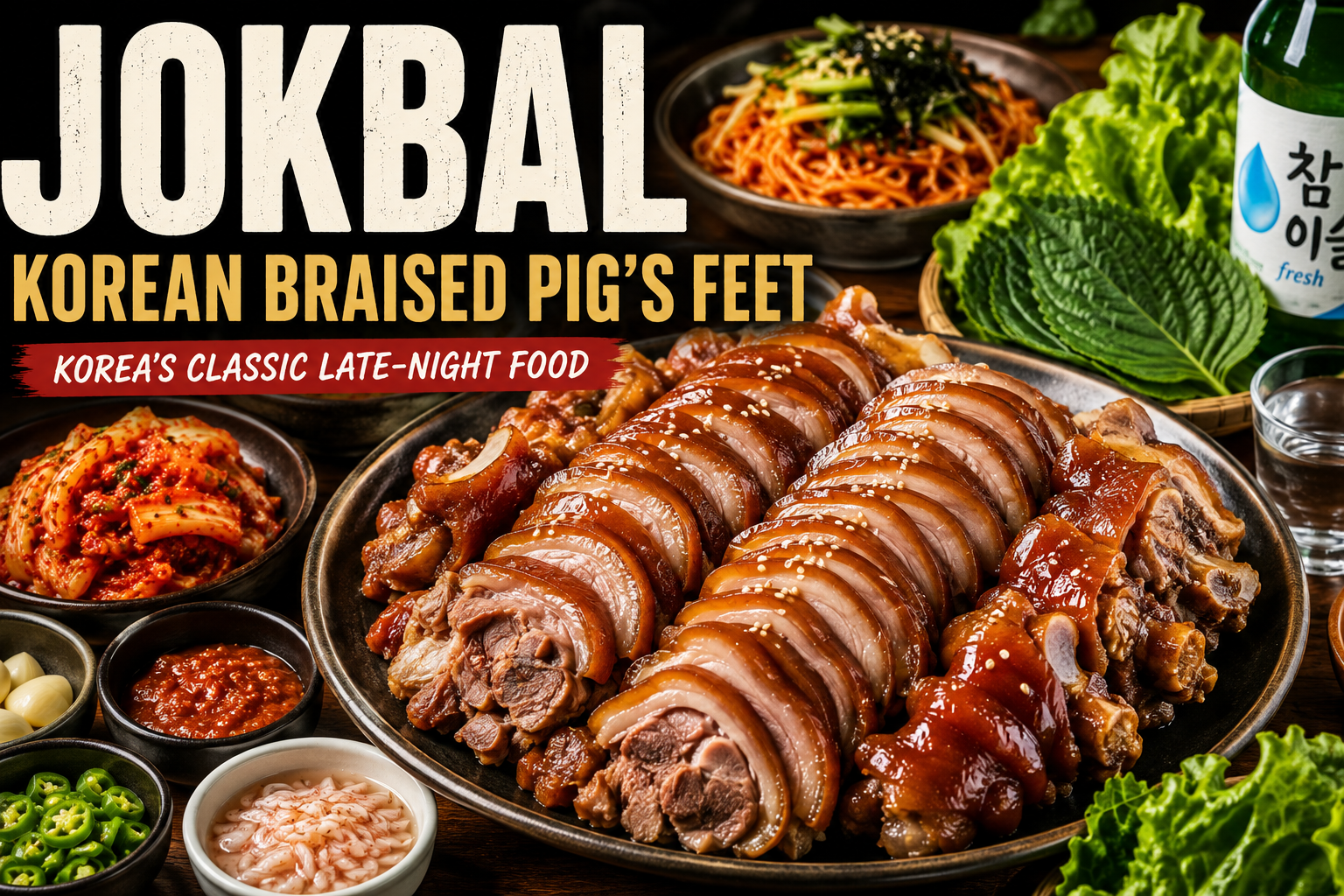
A large plate arrives piled high with glossy slices of pork, surrounded by lettuce, garlic, chili peppers, ssamjang, salted shrimp and often a plate of spicy noodles.
It’s rich.
It’s savory.
It’s tender.
But what makes Jokbal truly different from ordinary pork is something you notice with the very first bite.
The texture.
What Is Jokbal?
Jokbal is a Korean dish made by cooking pig’s trotters for an extended period until the meat becomes tender and flavorful.
The cooked meat is removed from the bone, sliced and usually served on a large platter for sharing.
But don’t imagine an ordinary plate of sliced pork.
Jokbal has its own distinctive texture.
The meat is tender, while the skin and connective tissue provide the pleasantly springy, chewy and gelatin-rich bite that Jokbal lovers look for.
That contrast between tender pork and chewy skin is one of the biggest reasons Jokbal is so different from pork belly, pork shoulder or other familiar cuts.
Korea’s official tourism site also describes Jokbal as soft yet chewy and notes that differences in cooking ingredients and preparation can give each restaurant its own flavor.
Why Is Jokbal So Chewy?
If you’ve never eaten Jokbal before, the texture may be the biggest surprise.
Pig’s trotters contain plenty of skin, connective tissue and cartilage.
Long cooking transforms those tissues and gives Jokbal its characteristic gelatinous, pleasantly chewy texture.
That’s why Koreans often describe good Jokbal as:
쫄깃쫄깃 — jjolgit-jjolgit.
There isn’t a perfect one-word English translation.
“Chewy” gets close, but good Jokbal shouldn’t simply feel tough.
Think:
tender meat + soft, springy skin + a rich, gelatinous bite.
That’s the attraction.
Jokbal Is One of Korea’s Classic Late-Night Foods
To understand Jokbal, you also have to understand Korean yasik (야식) culture.
Yasik simply means late-night food.
After dinner, people may still get hungry while watching TV, drinking with friends, working late or simply relaxing at home.
That’s when foods such as fried chicken and Jokbal become especially tempting.
Jokbal works particularly well as a shared meal.
Instead of everyone ordering an individual dish, a large platter is placed in the middle of the table.
People make lettuce wraps, eat spicy noodles between bites and share drinks.
It’s not just something to eat.
Jokbal is a social late-night meal.
Jokbal and Soju: A Classic Korean Combination
Jokbal is also popular as anju (안주) — food eaten while drinking alcohol.
Take a slice of Jokbal.
Dip it lightly in saeujeot (새우젓), Korean salted shrimp.
Place it on a lettuce or perilla leaf.
Add garlic.
Maybe a slice of chili pepper.
Add a little ssamjang.
Wrap everything together.
Then take a sip of soju.
That’s a very Korean Jokbal experience.
Korea’s official tourism material specifically identifies salted shrimp as a classic accompaniment to Jokbal.
How to Eat Jokbal Like a Korean
There’s no single mandatory way to eat Jokbal, but if it’s your first time, try building a Korean-style ssam (쌈).
Start with:
1. Lettuce or perilla leaf
Add:
2. One slice of Jokbal
Then:
3. Garlic
4. Chili pepper, if you like
5. Ssamjang or saeujeot
Fold the leaf around everything.
And — this part matters —
eat the whole wrap in one bite if you can.
The fresh vegetables, salty sauce, garlic and rich pork all meet at once.
That’s why simply eating Jokbal with a fork doesn’t quite give you the full experience.
Don’t Forget the Saeujeot
One of the smallest dishes on the Jokbal table can make a surprisingly big difference.
Saeujeot (새우젓) is fermented salted shrimp.
Rather than covering the meat in a heavy sauce, Koreans often lightly dip Jokbal into saeujeot before eating it.
Its intense salty, fermented flavor contrasts with the richness of the pork.
If you’re trying Jokbal for the first time, don’t ignore that tiny dish sitting beside the meat.
It is there for a reason.
And Then Comes the Spicy Noodles
After several rich pieces of Jokbal, you may want something sharper and more refreshing.
Enter:
Makguksu (막국수) or jaengban-guksu (쟁반국수).
Depending on the restaurant, a large plate of spicy, sweet-and-sour noodles may arrive alongside the pork.
Take a bite of chewy Jokbal.
Then eat some cold, spicy noodles.
Then return to the pork.
The contrast keeps the meal interesting.
VISITKOREA specifically recommends spicy buckwheat noodles as a companion to Jokbal, and Korean Jokbal restaurants commonly list makguksu alongside the pork.
Why Is Jangchung-dong Famous for Jokbal?
If you ask Koreans to name a place famous for Jokbal, one name will come up quickly:
Jangchung-dong (장충동), Seoul.
Today, Jangchung-dong Jokbal Street is one of Seoul’s best-known food alleys.
According to VISITKOREA, the street’s Jokbal tradition began about 50 years ago with two restaurants, followed by more Jokbal restaurants opening during the late 1970s and early 1980s.
There is also a deeper story behind it.
Official Korean tourism material traces the modern Jangchung-dong Jokbal tradition to people who came south from what is now North Korea during the Korean War.
One early restaurant owner from North Pyeongan Province reportedly drew on memories of the pork dishes she had eaten back home when she began serving Jokbal as an affordable, substantial drinking food in Seoul.
How Jangchung Arena Helped Create a Jokbal District
Location mattered too.
Nearby Jangchung Arena hosted sporting events, concerts and other major gatherings.
After events ended, large numbers of visitors needed somewhere to eat.
And Jokbal restaurants were waiting.
Seoul’s official tourism guide credits the crowds from Jangchung Arena with helping Jokbal restaurants in the neighborhood become famous and eventually creating today’s Jokbal Alley.
So Jangchung-dong Jokbal isn’t simply a famous restaurant district.
Its story connects:
migration + Seoul history + sports and entertainment + drinking culture + food.
That’s what makes Korean food history interesting.
Jokbal Isn’t Always the Same
Traditional sliced Jokbal remains the standard, but modern Korean restaurants have developed many variations.
You may encounter:
Spicy Jokbal (매운족발)
Jokbal coated or served with a fiery spicy sauce.
Buljokbal (불족발)
A particularly spicy style often associated with a smoky or fire-grilled character.
Naengchae Jokbal (냉채족발)
Chilled Jokbal served with vegetables and a sharp mustard-based sauce.
Naengchae Jokbal is particularly associated with Busan’s Jokbal Alley near Gukje Market; VISITKOREA describes it as chilled Jokbal combined with cucumber, jellyfish and mustard sauce.
So even within one dish, the experience can change dramatically.
Is Jokbal Spicy?
Traditional Jokbal itself is usually not spicy.
The flavor comes primarily from the pork and the seasoned cooking liquid.
Spiciness generally comes from the accompaniments or from specific variations such as spicy Jokbal or buljokbal.
That makes regular Jokbal a good Korean dish for people who want to explore Korean food but don’t tolerate much chili heat.
Jokbal vs. Korean Fried Chicken
Both are classic foods for sharing.
Both work well with drinks.
And both have become deeply connected with Korean evening and delivery culture.
But they’re completely different experiences.
Korean Fried Chicken is crispy, crunchy and often paired with cold beer.
Jokbal is tender, chewy and rich, often wrapped in vegetables and enjoyed with salted shrimp, spicy noodles and drinks such as soju.
If Korean Fried Chicken represents the crispy side of Korea’s late-night culture, Jokbal represents its rich, chewy and communal side.
Why Do Jokbal Restaurants Also Sell Bossam?
Look at the menu of a Korean Jokbal restaurant and you’ll often find another famous pork dish:
Bossam (보쌈).
That’s not a coincidence.
Both dishes are based on cooked pork and work extremely well as large sharing platters, but their textures are very different.
Jokbal offers its signature chewy skin and rich flavor.
Bossam, commonly made from pork belly or shoulder, is generally softer, meatier and milder.
Even official Korean tourism restaurant listings frequently show Jokbal and Bossam together on the same menu.
Jokbal and Bossam: Two Different Pork Experiences
The side dishes also help separate the experiences.
With Bossam, the star accompaniment is often flavorful Bossam kimchi or seasoned radish.
With Jokbal, salted shrimp, garlic, ssamjang, vegetables, pickles and spicy noodles create different combinations.
That’s why groups often order both.
One person may prefer tender Bossam.
Another wants chewy Jokbal.
And everyone can share.
It’s especially well suited to a night of drinking, a group dinner or a late-night gathering.
What Should You Order for Your First Jokbal?
If you’re visiting Korea and trying Jokbal for the first time, don’t overcomplicate it.
Order the original Jokbal first.
Add spicy noodles if available.
Try one slice by itself.
Then try another dipped lightly in saeujeot.
Finally, build a full ssam with lettuce, Jokbal, garlic and ssamjang.
You’ll immediately understand how much the accompaniments change the same piece of pork.
If you’re eating with several people, a Jokbal and Bossam combination platter is an even better introduction to Korean boiled pork dishes.
Is Jokbal Similar to Other Pig’s Feet Dishes?
Pig’s feet aren’t unique to Korea.
Many cultures have developed their own ways of cooking this inexpensive but flavorful part of the animal.
Germany has dishes such as Eisbein, while several Chinese cuisines have their own braised pig’s trotter traditions.
What makes Korean Jokbal distinctive isn’t simply the use of pig’s feet.
It’s the complete eating experience:
sliced Jokbal + saeujeot + ssam + garlic + ssamjang + spicy noodles + shared platter + drinks.
The culture around the plate is just as important as the pork itself.
Jokbal Is More Than Braised Pig’s Feet
“Braised pig’s feet” tells you what Jokbal is made from.
But it doesn’t really explain why Koreans love it.
Jokbal is the contrast between tender meat and chewy skin.
It’s the tiny dish of salted shrimp beside the plate.
It’s wrapping pork, garlic and sauce inside a fresh leaf.
It’s eating spicy noodles when the pork starts to feel rich.
It’s sharing one enormous platter with friends late at night.
And it’s the history of places like Jangchung-dong, where Jokbal restaurants have been serving generations of customers for decades.
So if you’re exploring Korean food beyond barbecue, kimchi and fried chicken, don’t let the words “pig’s feet” scare you away.
Take one glossy slice.
Dip it in saeujeot.
Wrap it in lettuce.
And you may understand why Jokbal became one of Korea’s classic late-night foods.
FAQ
What is Jokbal?
Jokbal (족발) is a Korean dish made by cooking pig’s trotters until tender, then slicing the meat and serving it as a shared platter with vegetables, sauces and side dishes.
What does Jokbal taste like?
Jokbal is savory and rich, with tender meat and soft, pleasantly chewy skin. The exact flavor varies depending on the restaurant’s cooking liquid and seasonings.
Why is Jokbal chewy?
Pig’s trotters contain skin, connective tissue and cartilage. Long cooking gives Jokbal its distinctive soft, springy and gelatin-rich texture.
How do Koreans eat Jokbal?
Koreans commonly eat Jokbal by itself, dip it in saeujeot, or wrap it in lettuce or perilla leaves with garlic, chili pepper and ssamjang. Spicy noodles are also a popular accompaniment.
Is Jokbal spicy?
Traditional Jokbal is generally not spicy. However, spicy variations such as maeun jokbal and buljokbal are also popular.
What is the difference between Jokbal and Bossam?
Jokbal is made from pig’s trotters and is known for its chewy, gelatin-rich skin. Bossam is generally made from pork belly or shoulder and has a softer, meatier texture. Both are commonly served as sharing dishes.
Where is Jokbal famous in Seoul?
Jangchung-dong is Seoul’s best-known Jokbal district. Its Jokbal alley developed around restaurants that became popular from the 1970s onward, helped by crowds visiting nearby Jangchung Arena.